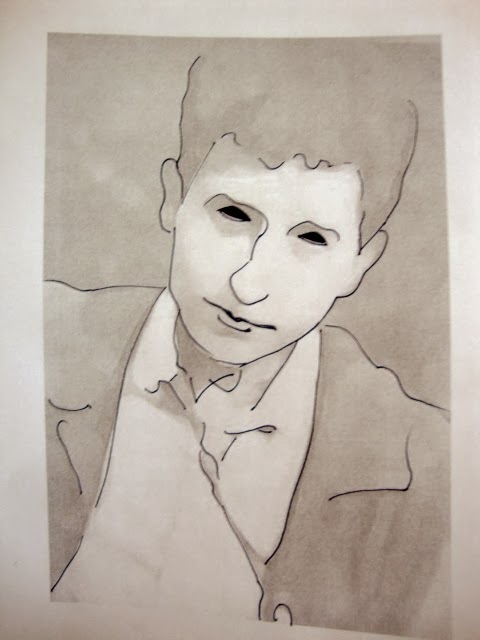
During Dylan Days last year I was asked what the greatest Dylan song of all time was, an almost impossible question as there are so many. The first thought would have to be, by what measure? I thought about how hard it would be just to pick one song from each decade of his career. Then I was asked what my
favorite Dylan song was. Naturally this is equally impossible for there are many, but if I were to narrow down the pool to five I would most assuredly include A Hard Rain’s A-Gonna Fall. It’s my personal opinion that this is one of the five greatest songs of all history, so it would have to be included in my top five Dylan picks.
The song was first performed live Sept. 20, 1962 at the home of Eve and Mac McKenzie and it’s been performed nearly 450 times since, most recently November 8 in Padova, Italy, earlier this month.
According to various sources it was written during the Cuban Missile Crisis, October 1962. He was just 21 years old at the time. Unlike many of his songs which talk explicitly about their subject matter (Oxford Town, Only A Pawn In Their Game, The Lonesome Death of Hattie Carroll) this song gives no real clue as to its impetus. The historical event may have been the driver but the song expresses a far greater overarching theme: imminent apocalypse.
Like many artists, and impressionable young people, the events weighed in on him and had to be processed. As others again have noted, every line in this densely packed song could be expanded on to be a story of its own. I’ve considered assembling a picture book of illustrations, one for each orally painted image (e.g. “I met a young child beside a dead pony“), and since I have the rest of my life I may yet consider it someday.
What’s noteworthy are the various ways in which the song has been recorded during the span of these 51 years since its inception. In the beginning it was an aching folk ballad. One of the earliest versions has only recently been released, on Bootleg Series Volume 9: Witmark Demos. Like all the versions it begins…
Oh, where have you been, my blue-eyed son?
Oh, where have you been, my darling young one?
I’ve stumbled on the side of twelve misty mountains
I’ve walked and I’ve crawled on six crooked highways
I’ve stepped in the middle of seven sad forests
I’ve been out in front of a dozen dead oceans
I’ve been ten thousand miles in the mouth of a graveyard
And it’s a hard, and it’s a hard, it’s a hard, and it’s a hard
And it’s a hard rain’s a-gonna fall
Except for the little skip in the recording of the fifth verse it carries the same pacing and intonation as the version recorded and ultimately released on The Freewheelin’ Bob Dylan. The Freewheelin’ version is a very clean recording featuring a restrained emotion-packed delivery aptly corresponding with the message of the song, sung like one who has been a long time on the road, a weary traveler like the blue-eyed son. Dylan’s acoustic accompaniment keeps the rhythm rolling while fueling the building momentum toward its climax.
Each verse of the song is in dialogue form, beginning with a mother's inquiry, according to John Hinchey in his book
Like a Complete Unknown, and a returning son's tales of the road. “Where have you been my blue-eyed son? Oh, where have you been, my darling young one?” Cat Steven’s uses a similar dialogue format in his Father and Son nearly a decade later.
Another early recording of Hard Rain is found in the Martin Scorcese Dylan bio
No Direction Home, the soundtrack forming Volume 7 in the Bootleg Series. In this live performance the young troubadour announces his song by declaring, “Hard rain’s gonna fall means somethin’s gonna happen.” It's a slower-paced acoustic piece again, sung with lengthened high notes on “It’s a hard rain’s a-gonna fall,” stretching out the “ra-a-a-a-in” on successive choruses.
Oh, what did you see, my blue-eyed son?
Oh, what did you see, my darling young one?
I saw a newborn baby with wild wolves all around it
I saw a highway of diamonds with nobody on it
I saw a black branch with blood that kept drippin’
I saw a room full of men with their hammers a-bleedin’
I saw a white ladder all covered with water
I saw ten thousand talkers whose tongues were all broken
I saw guns and sharp swords in the hands of young children
And it’s a hard, and it’s a hard, it’s a hard, it’s a hard
And it’s a hard rain’s a-gonna fall
For a total departure from this folk ballad style you’ll want to get a copy of
Bob Dylan Live 1975 (Bootleg Series Number 5). The mid-Seventies saw Dylan take to the road again with the Rolling Thunder Revue, a high energy circus of sound and celebration featuring a variety of musicians and singers, most notably Scarlet Rivera among others and even Eric Clapton for a portion. The tracks here were recorded at various stations along the way.
The third cut is an impassioned, hard-charging version of Hard Rain like you’d never have expected to hear. Yet it’s one of my favorites as the band blows the rafters off. Dylan sings with clipped, punchy phrasing, almost hollering.
And what did you hear, my blue-eyed son?
And what did you hear, my darling young one?
I heard the sound of a thunder, it roared out a warnin’
Heard the roar of a wave that could drown the whole world
Heard one hundred drummers whose hands were a-blazin’
Heard ten thousand whisperin’ and nobody listenin’
Heard one person starve, I heard many people laughin’
Heard the song of a poet who died in the gutter
Heard the sound of a clown who cried in the alley…
Backup vocalists harmonize and accentuate the chorus.
And it’s a hard, and it’s a hard, it’s a hard, it’s a hard
And it’s a hard rain’s a-gonna fall
Guitar riffing like a firefight after each verse gives this version heat.
For yet another iteration of this now-classic anthem we visit the performance in Nara, Japan 1993, Dylan and band performing with a full orchestra. It’s the fifth year or so of what has become known as the never Ending Tour. This version is a favorite of John Bushey’s, host of Highway 61 Revisited on KUMD here in the Twin Ports and worldwide via streaming audio. It starts gingerly enough, conveyed along by means of the ebb and flow of a supporting string section. The pace and the power begin to build, creating a sense in which the music itself is breathing. As you watch and listen, Dylan becomes immersed in the swell and produces a rich, wondrous version of the song, possibly unmatched and (fortunately)
preserved in this recording.
Oh, who did you meet, my blue-eyed son?
Who did you meet, my darling young one?
I met a young child beside a dead pony
I met a white man who walked a black dog
I met a young woman whose body was burning
I met a young girl, she gave me a rainbow
I met one man who was wounded in love
I met another man who was wounded with hatred
And it’s a hard, it’s a hard, it’s a hard, it’s a hard
It’s a hard rain’s a-gonna fall
One of the Dylan’s hallmarks is the manner in which he continuously redesigns his songs, sometimes completely changing the words (as he frequently does in sections of A Simple Twist of Fate or Tangled Up In Blue.) With Hard Rain he seems to almost always remain faithful to the lyrics first recorded.
Recently I acquired a copy of his Manchester England concert recorded on November 16, eight years ago. Once again he’s created a new vocal configuration, which he apparently likes as it has been maintained right up through our July 2013 concert in Bayfront Park this summer in Duluth.
In Manchest he opened the show with it… “Where have you been my blue-eyed son”
With an electric guitar, drummer, backing band, the music eased out slowly, sung melodic with vocal inflections in his inimitable modulated manner, low and high notes jumping from middle C to high C… “It’s a hard….. it’s a hard ….”
Occasionally he would stretch out a word for emphasis, “I heard one person st-ar-ve…” crooning and groaning with perfect eloquence… He placed an emphatic guitar solo between verses four and five, followed by emotional enunciations and vocal embellishments on last chorus….
Oh, what’ll you do now, my blue-eyed son?
Oh, what’ll you do now, my darling young one?
I’m a-goin’ back out ’fore the rain starts a-fallin’
I’ll walk to the depths of the deepest black forest
Where the people are many and their hands are all empty
Where the pellets of poison are flooding their waters
Where the home in the valley meets the damp dirty prison
Where the executioner’s face is always well hidden
Where hunger is ugly, where souls are forgotten
Where black is the color, where none is the number
And I’ll tell it and think it and speak it and breathe it
And reflect it from the mountain so all souls can see it
Then I’ll stand on the ocean until I start sinkin’
But I’ll know my song well before I start singin’
And it’s a hard, it’s a hard, it’s a hard, it’s a hard
It’s a hard rain’s a-gonna fall
It’s a powerful song to begin with but when delivered as Dylan does, the construction of it enables the final thrust of it to pierce the receptive heart.
“Where have you been” (with “been” the high note) Dylan declared in Duluth. Guitar strumming and instrumentation quietly carried the tune along allowing the words and Dylan to be central. He’s abandoned his guitar, but not his feeling. His piano playing is likewise simple plinking and weaving it along until the last verse where his voice begins to punch it up like hammer blows
“Well I’ll know – my -- song -- well – before -- I start – singing.”
“It’s a hard,” (gravel voiced but still
right there)
“It’s a hard… HARD…. It’s hard… It’s a hard rain gonna fall.”
All Dylan paintings and pictures here by Ennyman.