Showing posts with label George Harrison. Show all posts

Friday, March 13, 2026

Flashback Friday: 14 Blog Posts About The Beatles

Bob Boone, owner of the West Theatre, introducing
The Revolution 5. Thank you, Bob for what you have 
given the City of Duluth by renovating these two theaters.
Thursday evening I had an opportunity to see The Revolution 5, a Beatles tribute band from Minnesota, and, as expected, it was fun, nostalgic and energizing. I'd seen them in 2012 in a smaller venue, and last night the West Theatre was packed as the team of five performed all 27 of The Beatles' number one hits, plus a few additional bonus classics. 

Though outside the City of Duluth was experiencing a smothering blizzard, no one (as far as I could tell) here in the theater could care less. I intended to check to see the road conditions during intermission but forgot that, swept up in the music and memories. Hopefully you all reached home safely.

When we saw the group in 2012 I was impressed. I didn't really prepare in any way. We got tickets and went to an exhilarating show. This time I listened to most of their albums between the time we got tickets two months ago and the show last night. Besides being famously talents songwriters, they really were innovative musicians. 

Rather than write a review of last night's show I thought I'd pull together some of the blog posts I've written about the Beatles over the years. To catch a review of the show I recommend that you pick up next week's Duluth Reader and look for the story by Jill "Jillybones" Fisher who covers the local music scene here. You can also find her review of this energizing concert here at the Reader Duluth website.

In the meantime, enjoy these stories about The Beatles

Tim Hatfield's Beatles Tribute Now In Print: When We Find Ourselves in Times of Trouble 

https://www.blogger.com/blog/post/edit/9146215066182995239/7605976059959242264


The 10 Most Expensive Vinyl Records Ever Sold

https://pioneerproductions.blogspot.com/2021/04/the-10-most-expensive-vinyl-records.html


John Lennon Slits a Vein and Unburdens His Soul In "Yer Blues"

https://pioneerproductions.blogspot.com/2018/05/john-lennon-slits-vein-and-unburdens.html


Tomorrow Never Knows: The Beatles' Turning Point?

https://pioneerproductions.blogspot.com/2018/04/tomorrow-never-knows-beatles-turning.html


Dutch Beatles Authority Chantal de Paus Addresses Beatles Conspiracy Theories and How the Fab Four Became So Popular 

https://www.blogger.com/blog/post/edit/9146215066182995239/2418279277774081471


50 Years Ago Today: The Beatles' Revolver Fires Imaginations

https://pioneerproductions.blogspot.com/2016/08/50-years-ago-today-beatles-revolver.html


Back In The U.S.S.R. -- Beatles Just Having Fun Causes a Stir

https://pioneerproductions.blogspot.com/2016/07/back-in-ussr-beatles-just-having-fun.html


A Beatles Timeline, Three Beatles Trivia Quizzes and More

https://pioneerproductions.blogspot.com/2015/03/a-beatles-timeline-three-beatles-trivia.html


The Revolution 5: All Beatles, All Night Long

https://pioneerproductions.blogspot.com/2012/01/revolution-5-all-beatles-all-night-long.html


Helter Skelter, Revisited

https://pioneerproductions.blogspot.com/2009/10/helter-skelter.html


Nevada Bob MeetsThe Beatles and 14,000 Screaming Beatles Fans

https://pioneerproductions.blogspot.com/2021/12/nevada-bob-meetsthe-beatles-and-14000.html


Was Ringo a Starr? Oh Yeah.

https://pioneerproductions.blogspot.com/2016/06/was-ringo-starr-oh-yeah.html


George Harrison and the Concert for Bangladesh

https://ennyman.medium.com/george-harrison-and-the-concert-for-bangladesh-8802fd91464b?sk=21e0a740613a8d8c3475b0fcec06c067


A Leadership Lesson from John Lennon

https://audacityhr.com/a-leadership-lesson-from-john-lennon/


Personally, I think their most remarkable achievement was the moment they occupied the top five positions on the Billboard Hot 100 simultaneously. It was an extraordinary display of cultural influence and popularity, showing not just one hit song but complete dominance of the charts—a rare feat that few artists in music history have ever matched. What do you think?

Thursday, May 12, 2022

A Letter from George to Bob and Thoughts About a Lost Era

This is one of the 100,000 items archived at the new Bob Dylan Center, a note to Bob from George Harrison. After Dylan began recording in Nashville, numerous other artists were drawn to Music City to record. 

Photo by Gary Firstenberg

The thought I had as I saw this handwritten note from George to Bob was that with the advent of email we're losing something. I'm not sure exactly how to define it. Some might even say email is good because there's no waste paper to dispose of, fewer trees to cut down for paper, etc.

I don't know what to think. I read a thoughtful handwritten note of appreciation and it conveys warmth beyond the message. Maybe I'm more sentimental than some people but I keep these notes. The kindness and encouragement continues to give me a lift even when I read them years later. I have no such system for saving emails.

One of the displays at the Bob Dylan Center shows a mailbag of unopened fan mail. It's probably the downside of being a superstar. 

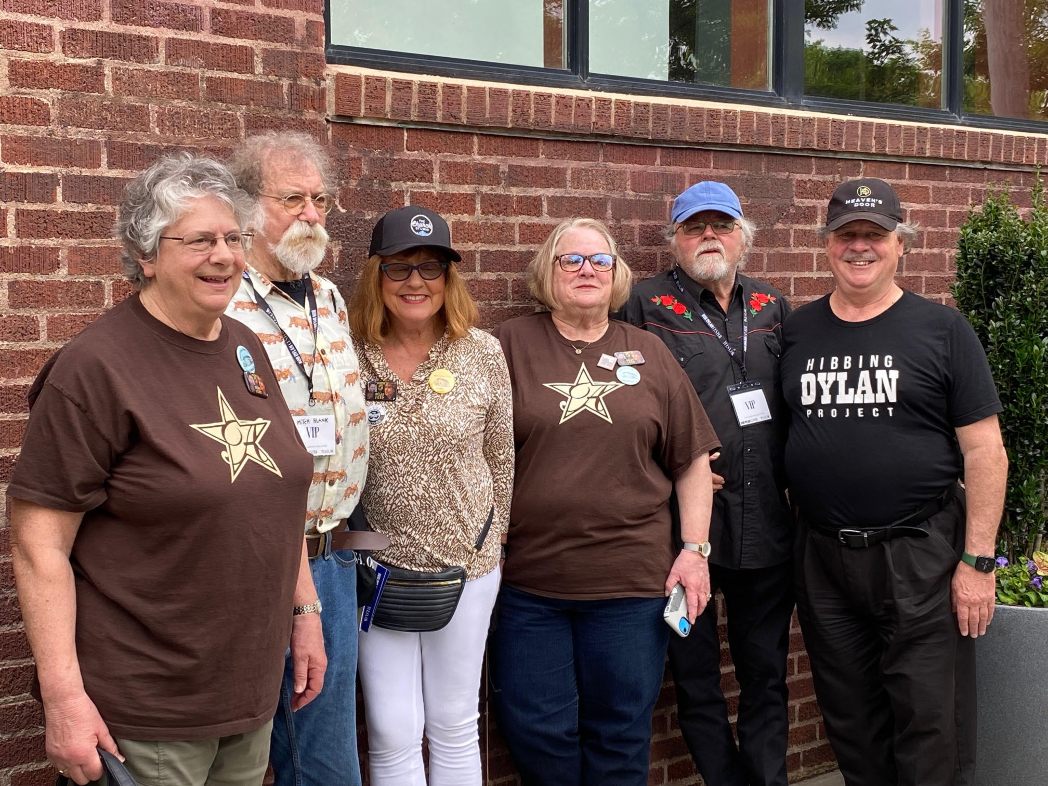
Here are some more photos sent from Tulsa, courtesy Nelson French. There were quite a few folks from the Northland in attendance this week.  

Writer/musician Jeff Slate with Gene Lafond 
Carolyn Sundquist, Mitch Blank, Susan Phillips, Mary Ostman,
Gene Lafond and 
Nelson French. (Photo courtesy Nelson French)

Dick Cohn of St. Paul speaks with Mitch Blank.

Nelson captures a front row seat. Pleased as punch to be there.

Hibbing, the heart of the Iron Range.
Patrick Eliason on the harp with Gene Lafond making melody.

Pat Eliason serves as M.C. for the Singer/Songwriter Contest at our annual Duluth Dylan Fest. The competition features musicians performing a Dylan song and a composition of their own. For many it is a highlight event for the weeklong celebration. You can find a full schedule of events here: duluthdylanfest.com

Related Links

Saturday, October 24, 2020

"Isn't It A Pity." Harrison's Words More Relevant Than Ever

On Thursday evening one of the members of our Toastmasters group gave a speech titled "We All Have Something To Say."  She began by talking about the breakdown of community discourse and the barriers that separate us. One of these is our increasing social anxiety, but there are other kinds of barriers to connectedness as well. 

The statement that especially jumped out for me--besides the shocking statistics she shared--was this one. When our inner thoughts are bottled up inside us, we live a diminished existence.

This is a recurring theme in many George Harrisons songs: love, meaning and connection. Within You Without You from Sgt. Pepper speaks of this in a sense, as does "While My Guitar Gently Weeps" on The White Album. Even "Blue Jay Way" from Magical Mystery Tour speaks with solemnity about being lost, alienated, in a fog.

Isn't It a Pity doesn't appear on a Beatles album.  Rather, we find it on Harrison's solo album All Things Must Pass after the Beatles' breakup. The surprising thing is that it was written in 1966, the year Revolver was recorded in released. 

As nearly every Beatles fan knows, the agreement John Lennon and Paul McCartney made with George was to limit the number of Harrison songs on each album. Many people, therefore, were surprised at how prolific George became after the breakup of the Fab Four. 

I'm fairly certain that I was not the only one who kept buying albums by all four of the Beatles after they split. All Things Must Pass was George's offering in November 1970. I snapped it up and found it rewarding from the first time. The album was produced by Phil Spector, who also took the thousand-plus hours of studio mish mash and crafted Let It Be for the Beatles. (Paul didn't like what Sector produced, and remastered it in 2009. Beatles fans, however, were grateful that SOMEONE stepped up to the plate and finished this project. I still remember the first time I listed to it that fall.)

One of the great features of All Things Must Pass are the jam session recordings on sides five and six. Clapton and other musician friends really rock it out, knock it out of the park. 

Isn't It a Pity is essentially two stanzas with the first one repeated again as the third. It initially sets the tone, gets amplified in verse two, then serves as an echo of itself as verse three. Here are the lyrics, carried forward by an swelling and ebbing undercurrent of lament.

Isn't it a pity
Isn't it a shame
How we break each other's hearts
And cause each other pain
How we take each other's love
Without thinking anymore
Forgetting to give back
Now isn't it a pity

Some things take so long
But how do I explain
When not too many people
Can see we're all the same
And because of all your tears
Your eyes can't hope to see
The beauty that surrounds us
Now, isn't it a pity

Isn't it a pity, 
Now, isn't is a shame
How we break each other's hearts
And cause each other pain
How we take each other's love
Without thinking anymore
Forgetting to give back
Now, isn't it a pity 

The pity here isn't just that we cause each other pain. It's that we cause our own pain, but don't see it. And as a result we also miss the beauty that surrounds us.

What is it that causes this cycle of suffering? Forgetting to give back, he sings. 

Our own self-centeredness leaves us isolated. Perhaps its our personal feeling of self-importance that causes us to have a sense of entitlement, so we don't really appreciate what others do for us. We wanted (expected) more so that instead of gratitude we feel disappointment. As a result of our sense of self-importance, we generate our own isolation.

Here are three versions of the song. The first is George Harrison's original, remastered. The second is Eric Clapton. The last is Nina Simone.
https://www.youtube.com/watch?v=eDrLTW_sesI

Eric Clapton (Live)
https://www.youtube.com/watch?v=pKu4U0YQBRo

Nina Simone
https://www.youtube.com/watch?v=LLn3FT9BsRs

* * * *

Are we building walls or building bridges? Eleanor Rigby comes to mind. "Ah, look at all the lonely people."

And this one from Bob Dylan's "Fourth Time Around": "Everyone must give something back for something they get."

* * * *

The other problem Harrison pinpoints is the notion of we/they. "Not too many people can see we're all the same," he sings. 

Our culture has become increasingly splintered along many fault lines. We see this not just in political spheres, but also gender, race, religion and more. We've lost sight of our essential and fundamental humanity, the "essence" that we share in common. A quest for meaning. A hunger for hope. A creative urge. Personality. Bone, flesh, blood. A need for affirmation.

We're really all the same. How have we lost sight of this?

Saturday, April 4, 2020

Duluth Armory History, Including the Role Played During Our Last Pandemic in 1918

The life of Dylan is one of legends. The man himself has become something of a mythological figure during the course of his lifetime. One of the signature stories in that legendary life is his trip to Duluth to hear Buddy Holly at the Duluth National Guard Armory the last evening of January 1959. Three days later Buddy Holly, Richie Valens and J.P. Richardson (The Big Bopper) were dead, killed in a plane crash in Clear Lake, Iowa.

The Armory encounter made an impression on the young Bobby Zimmerman, who referred to it later in interviews as well as in his autobiography. No doubt that tragedy that occurred in an Iowa cornfield made an equally powerful impression. (Read the story here.)

I mention all this because a friend who serves on the Armory board posted on my Facebook wall a link to Zenith City Online noting that this day in 1915 was the official opening of the historic Duluth Armory. [This blog post was originally published on November 22, 2015.]

From very early on the Duluth Armory had a storied existence. World War I was in effect, though the U.S. had not fully engaged. Nevertheless the Armory served as home for a full-scale regiment, comprised of the 34th (Red Bull) Division and the 125th Field Artillery.

It didn't take long for the Armory to get put to use and in 1918 our boys joined the Doughboys to engage in a war many people still don't understand. 317 Duluth soldiers lost their lives in Europe as a result.

But the worst was yet to come.

That autumn the Spanish Flu epidemic reached Duluth. The flu was so deadly that on October 8 the city commissioners put the entire city on lockdown. People were forbidden from shopping, going to church or congregating of any kind. It was a city-wide quarantine.

Four days after this edict, the Cloquet Fire hit. When I first visited Hermantown, just over the hill from Duluth's Western rim, in the late 1970's I couldn't help but notice that there were no really tall trees. I learned then about the Cloquet Fire. The reality is that the fire burned everything South to North around the entire outskirts of Duluth. Innumerable homes were lost, and more than 600 died. People who had gone to work that morning were unable to return home that night, many wondering whether their loved ones escaped or were consumed.

Where did all these people? Most were housed at the Armory and a few other structures where people could be attended to. Unfortunately, the Spanish influenza was in full force, and all these people in one place only contributed to its spread. Over 300 lives were taken by the flu. It was a dark year for the Zenith City.

As George Harrison once penned, all things must pass, and certainly these dark clouds of 1918 ultimately lifted after a season. No doubt our current quarantine and 2020 is challenging for our nation and the world, but it's not our first historic crisis. Let's pray that we avoid the worst, find our "best selves" as we come through to the other side.

Related Links
dulutharmory.org/about/
My 2013 Armory Update
The 1918 influenza pandemic killed thousands of Minnesotans

Historic Armory Post Card is from the informative Historic Duluth website Zenith City Online. Thank you, Tony, for your invaluable caretaking of Duluth's history.
PRE-ORDER an autographed copy of Tony Dierckins' Duluth: An Urban Biography

Information about our tragedies of 1918 came from a presentation by Dan Hartman at a Libations at the Library event here in Duluth.

Sunday, October 20, 2019

PBS Pledge Drive Inspires George Harrison Guitar Art


Anyone who has listened to public radio for any length of time is well aware of their periodic pledge drives. Over the course of many years of listening to KUMD's Highway 61 Revisited while painting in my studio on Saturday nights, there were many of these programs where the late John Bushey, the show's host, would be live on the air commenting on rare Dylan outtakes that he'd saved just for these occasions. (Miriam Hanson is our current host holding the torch for this popular Northland radio program.)

"Here Comes The Sun"
THIS PAST WEEK I learned that Susan Krochalk, a local artist who has routinely contributed her talent and art to a number of our annual Duluth Dylan Fest art shows, did this really cool George Harrison-themed guitar. She was crowdsourcing on social media, asking advice on the kind of finish to use over the surface. 

As soon as I saw it I wanted to share it here. I asked what her what motivation was for producing this beautiful creative work. She shared her story here:

My motivation for this piece was a call for art for the upcoming WDSE show celebrating 55 years of public television in the Twin Ports. So (that would be) any art inspired by PBS programming. In spring of 2018 we were watching the "Concert for George" during the PBS pledge drive. We loved it so much that we became sustaining members of the station at that time. I originally bought the guitar thinking I would create a Bob Dylan piece, however while listening to the George Harrison cd (the pledge drive gift along with concert dvd) I felt inspired to do this instead.

Glad you did, Susan. It's very, very nice.

Related Links
George Harrison & Friends: The 1971 Concert for Bangladesh
George Harrison's "Taxman" Has Lessons for Us All
My Dinner With George
And finally, one of many renditions of While My Guitar Gently Weeps that you can find on YouTube, this one featuring Eric Clapton and Paul McCartney at the Concert for George.

What's your favorite George Harrison song?

Monday, September 16, 2019

Ringo and George on Aspel & Co.,--YouTube and History

Photo by Elijah O'Donnell on Unsplash
YouTube is definitely one of the phenomenon of our time. Currently 1.3 billion people use YouTube and it hasn't even reached its 15th birthday. The infrastructure that is in place must be powerfully advanced since 300 hours of video are being uploaded every minute.  Yes, minute! And 5 billion hours of video watched every day. Yes, billion. Every day.

You might say that the Google has a vested interest in keeping it all going and now currently supports a 2000 man army of Minutemen on two artillery bases to protect the YouTube Complex.  (Please: THIS is Fake News. I made that up.)

YouTube was started in 2005 by three former PayPal employees who became quite rich when thy sold the video-sharing service to Google a year later.

According to surveys, 6 out of 10 people prefer Online Video to television, which is why we're seeing such a massive amount of content being created for online distribution. In part, this is one of the drivers behind the Catalyst Content Festival which will be held in Duluth next month. The demand for quality content is exceeding the supply.

Exceeding supply? 300 hours being uploaded a minute and the thirst is greater?

Re-read the sentence: The demand for quality content...  is insatiable.

Catalyst exists to help more content creators become more professional, to be suitably prepared for working in this expanding industry.

* * * *
This past month I read Paul McCartney: The Life and found it to be an exciting, insightful read with many lessons about many aspects of life, business and the challenges of success. One of those challenges has to do with managing money, and managing relationships.

As a Beatles fan, it was (for me) all about the music. I didn't read the mags and the rags or the books till much, much later. Through Philip Norman's book I gained a much deeper understanding of the legal crap these four boys never imagined they'd have to deal with one day. When they were starting out, rock stars last a year or two at most. Their unfathomable wealth was not part of the dream they dreamed.

So, when I came across this video of George and Ringo on the Aspel & Co. show, a British talk show featuring high profile celebrities, I tuned in. If you watch, you'll find a brief segment in which their lawsuits are brought up. They seem surprisingly good-natured about it, which just shows how classy these two guys were.


Here's the URL if the embed fails at some point down the road.
https://www.youtube.com/watch?v=JQaqcLPAI_s

It won't be long before we'll find the entire history of media on YouTube. And maybe, just maybe, at some point in the future--when time travel has been worked out--we'll get ALL of history on YouTube. Whatcha think about that?

Related Links
My Dinner With George (scene from a dream)
Have You Ever Wanted to Work in Media?
Was Ringo A Starr? Oh Yeah

Saturday, April 6, 2019

Beatles Discography: What Are Your Favorite Songs and Albums?


Earlier this week a memory was triggered about the song There's A Place, an Isley Brothers cover by the Beatles, and how special it was to me when I was young. It was the B-side of Twist and Shout, which was just one of countless top hits for this foursome who spearheaded the British Invasion. The week Twist and Shout was released in March 1963 it instantly became one of five Beatles songs that filled the Top Five slots on the chart. It's hard to be a #1 hit when you are already #1 with something else, eh?

As I thought about these things it crossed my mind that it might be an interesting exercise to determine what my favorite songs were on each of the albums produced by The Beatles during their somewhat amazing, but short, lifespan. To accomplish this I visited a Beatles Discography website to make the selections.

What I found was that in the beginning there were British releases which I didn't have, though most of the songs were similar. All that being said, here were my selections, based on these criteria: how I felt when I played them in my youth, and how they make me feel when I think back on them today.

1963
Notice anything special about this photo?
Please Please Me
There's A Place
Wonderful, simple, melodic... and heartfelt.
Harmonica intro and outro with nice harmonies. The song indeed would bring me to a place in my mind when I was a little older.
Amazing what they accomplish in less than two minutes.

1963
With The Beatles
Hold Me Tight
Released on Nov 22, 1963, the day of JFK's assassination. (C.S. Lewis and Aldous HUxley both died that day as well, fwiw)
This was their first album released in U.S.
Loved this song. A classic riff with innocent intimate lyrics. I especially love those chord transitions in the bridge.

Many of these early Beatles albums were mirrors with minor changes, released in Britain and U.S. separately.

1964
Introducing... The Beatles
Do You Want to Know a Secret
Again, only two minutes long. George has a nice voice and it's sweet.
At this time in my life I identified with George, who seemed the quiet Beatle, self-conscious or self-effacing, the one in the shadows.

1964
This was my first Beatles album.
Meet The Beatles
I Saw Her Standing There
Who doesn't like this one? Put on your dancing shoes.

1964
The Beatles Second Album
You Really Got A Hold On Me
This is a painfully beautiful song about a boy who is oh so hooked.
Smokey Robinson wrote the song and turned it into a Top 10 hit in 1962. The Beatles covered it on this album, as did many other groups afterwards.
I enjoy the way they harmonize, especially on "hold me," delivering restrained emotion throughout. It's what they did so well, sensual without being lascivious.
Was that Paul going for that high note at the end?

1964
A Hard Day's Night
If I Fell
Another simple, sweet, lyrical tune from their first film. Watching the video, looking back on these boys, it has to have been a heady experience, the sudden fame, in the center of that fierce spotlight.

1964
Something New
"Komm, Gib Mir Deine Hand"
I took German in 7th and 8th grade, so I will select this song only because it reminds me of that time in my life and a good friendship that began then.

1964
Beatles For Sale
Fourth Studio Album?
I'm A Loser .
John's got the lead vocal here and you can already hear the development in his delivery. This melancholy would become a theme that would thread through much of what he later created.

1965
Beatles '65
This is practically the same album as Beatles For Sale, so I will pick the song that precedes the above favorite, No Reply. Some heartbreak creeping in on these later albums. I love the middle section, the chord and tempo change with the vocals crushing it.

1965
Beatles VI
I Don't Want To Spoil the Party
Lennon, revealing more alienation and inner pain... and who of us has never felt this way? Come on, be honest.
Of note: Buddy Holly's "Words of Love" on Beatles VI may be the last cover the Fab Four recorded for their albums.

1965
Help!
You've Got To Hide Your Love Away
This album was the official soundtrack for the movie Help!  I went to see the movie with the girl across the street. Probably my first date. A couple days later the boy across the street asked her to go steady. She said yes. I cried on my pillow, my 13th birthday, and said to myself, "So this is what it's like to be a teenager." (Yes, a bit melodramatic.)

While Dylan was writing and recording songs that were eight, ten and twelve minutes long, and even longer, The Beatles were still writing songs for the pop charts, which meant for radio, and three minutes was max. Hence the quantity of two minute songs on these albums.

December 1965
Rubber Soul
Norwegian Wood (This Bird Has Flown)
This is an album that many say presaged the future development of the Beatles. Others point to Revolver. It's been frequently cited that Dylan's influence is distinctly present in this song. George plays a sitar part here, the first time the instrument from India had been incorporated into Western rock.
What I liked about the Norwegian Wood, though, was the storytelling. What happened and what didn't and why? Several years passed before I would learn about these kinds of things from experience.

August 1966
Revolver
Good Day Sunshine
After singing about love and relationships for a half dozen albums they had now turned the corner. The first song, George Harrison's Taxman is not about boys and girls. A majority of the songs avoid the subject of love.
Cheery harmonies, sunny uplifting mood music., Good Day Sunshine is one of my three fave wake-up songs.

May 1967
An album cover as ground-breaking as the album.
Sgt Pepper's Lonely Hearts Club Band
A Day in the Life
Nothing like it... Every song a gem. As far as I'm concerned this album is seamless perfection. From start to finish you are in a flow. I would select the whole thing here as a favorite but choose A Day in the Life as a microcosm of the whole.

November 1967
Magical Mystery Tour
Strawberry Fields Forever
The day Magical Mystery Tour came out I went to Frank Capelli's house after school. We ripped the cellophane off the album and played side one, then side two. We already had the 45 with Strawberry Fields and Penny Lane. And by the time the album came out we were quite familiar with that strange ending with what sounds like a railroad approaching and receding and what sounded like John saying, "I buried Paul."

November 22 1968
Yes, it was a white album.
The White Album
I like the sequence from Yer Blues to Helter Skelter on side three.
So many great songs... If the measure of "what is your favorite album" would be re-phrased to, "What Beatles album have you played the most since the 60s?" I would have to say The White Album. Let It Be would probably be tied with Beatles For Sale in second place, not distant but not close either. Probably has to do with associations.

While My Guitar Gently Weeps stands the test of time as a truly great song from this album, too. George Harrison purportedly wrote it as an exercise in randomness inspired by the I Ching, but it seems too premeditated to me. A poignant message.

January 1969
Yellow Submarine
All You Need Is Love
This was a single and was also the final track on Magical Mystery Tour. It begins with the French National Anthem, invests the lyrics with the history of philosophy, and by the time we reach the end, with past, present and future all converging, the song trails off, marching into the infinite. John Lennon here celebrating with a message that will evolve from the personal to the global when later he and Yoko ask us to "Give Peace A Chance."
George Harrison's It's All Too Much may be a little dated today but it was another song from the album and film that gave me goosebumps. (Maybe you had to be there.)

September 1969
Abbey Road
Side 2 Medley Sun King to The End
Like Sgt. Pepper, they reprised the seamless medley motif, and though Come Together and some of the other songs are great, this medley on side B was especially rich. They had become distinctly The Beatles, true creators, one-upping themselves yet again.

May 1970
Let It Be
Across the Universe
John Lennon yielding to a different flow here. Seems like I found comfort in this song while dealing with my own painful moments. The irony is that my world was indeed changing, even as I sang a contrary note. Perhaps this is what John was doing as well, for it was the end of the Beatles and the birth of four solo careers. By the time the album was released John and Yoko had sailed off to a new shore.

* * * *
Related Links
My Dinner with George (All in a Dream)
Interview with Dutch Beatles Authority Chantal de Paus
Was Peter Best the Best?

Saturday, October 13, 2018

George Harrison & Friends: The 1971 Concert for Bangladesh

Madison Square Garden, 1971
For Dylan fans it was one of his rare public appearances between the Woodstock motorcycle incident and the Rolling Thunder Revue. The Concert for Bangladesh, initiated by George Harrison and Ravi Shankar, served two important functions. First, it drew attention to a major catastrophe in a remote region that few Americans were even aware of, overnight turning Bangladesh into a household name. And second, by being the first concert of its kind to bring a host of famous rock musicians together for a charitable cause. The achievements and mis-steps would help future such efforts by famous musicians to bring aid to needy causes.

My aim in this blog post is to shed a little light on what was really happening in Bangladesh in the previous ten months before the concert. If you are like me, you only seem to remember the tragic cyclone, a natural disaster of epic proportions.


* * * *
There were actually two trigger events that led to the concert, the first this natural disaster, and the second a monumental man-made disaster. I've just finished reading Paul Thomas Chamberlin's The Cold War's Killing Fields, subtitled Rethinking the Long Peace. I can't recall when I've been so moved by a single book. While reading it I have mentioned to several friends that "this is the saddest book I've read in my life." The underreported human suffering that has been perpetrated in the course of our lifetimes since World War II is nothing short of shocking when you lay it all out in one book. What Chamberlin does, probably unique, is to show how a single thread actually connects all these disparate atrocities, that thread being the cold war and corresponding fears of the major superpowers.

So much of what has happened these past 70 years was delivered through the media piecemeal so that Americans not only were left in the dark much of the time, the general impression has been that Americans have always been the good guys, the white horse heroes. The tragedy of Bangladesh was two-fold. The first was a destructive cyclone of historic proportions that devastated the country and left as many as 500,000 dead in its wake. Because East Pakistan was located 1000 miles from Pakistan there was a move for liberation which led to a military incursion by the Pakistan army that resulted in the deaths of a quarter million civilians and seven million refugees fleeing to India. This latter had been building for years and did not occur overnight, but the timing of its escalation couldn't have been worse.


The Chamberlin book outlines how WW2 changed the face of the world's power game. We tend to forget that before the World Wars European powers were colonialists whom for hundreds of years had their fingers in every corner of the known world. Suddenly this all changed. The aftermath of WW2 resulted in a variety of complicated conflicts as groups within various regions struggled for freedom and autonomy. Looking back, we've forgotten, or failed to notice, the relationship between the collapse of Colonialism and the various mini-wars in all corners of the world.

The subsequent power struggles occurred against a new backdrop, the Cold War. The big players in this new game interpreted events through their own lenses. Pakistan was an ally of the U.S. so when it began committing horrors against its own people, President Nixon and his advisors chose to support Pakistan with arms and did nothing to restrain the genocidal horror under the pretext that we need an ally like Pakistan in this part of the world. China was breaking with Moscow, and we wanted to be tightly embedded in the region.

After the cyclone the United States initially wanted to help alleviate suffering, but then National Security Advisor Henry Kissinger weighed in, indicating it would make Pakistan look bad in the world's eyes if we did more than they did for their own people. After West Pakistan's bungling relief efforts, a December election showed how divided East Pakistan sentiments were from West Pakistan. In their divine wisdom the West Pakistani leaders decided in March that instead of meeting needs they would invade and slaughter, using American made M-24 tank units. Within a few days there were radio reports of three hundred thousand killed.

Reports like this were easily dismissed as Bengali exaggerations, but when Nixon's own foreign office reported how brutal the atrocities were Nixon and Kissinger applauded the success of the Pakistan army in crushing the "uprising."

I don't need to repeat all the details, only that U.S representatives in Pakistan wrote a scathing indictment of our leaders that begins with this: "Our government has failed to denounce the suppression of democracy." The London Times reported "This is genocide, conducted with amazing casualness." Millions of refugees fled to India. Cholera and smallpox began breaking out, taking even more lives.

You can be sure that all these horrors weighed heavily on Ravi Shankar, the Bengali musician who  taught George Harrison how to play the sitar which is featured on "Within You, Without You," the opening track on side two of the Beatles' Sgt. Pepper album. Ravi Shankar, who had remained a friend of Harrison since that time, had relations in East Pakistan and he (Shankar) was well aware of the trauma there.

The Concert for Bangladesh took place at the beginning of August featuring "a supergroup of performers that included Harrison, fellow ex-Beatle Ringo Starr, Bob Dylan, Eric Clapton, Billy Preston, Leon Russell and the band Badfinger. In addition, Shankar and Ali Akbar Khan – both of whom had ancestral roots in Bangladesh – performed an opening set of Indian classical music. Decades later, Shankar would say of the overwhelming success of the event: 'In one day, the whole world knew the name of Bangladesh. It was a fantastic occasion.'"*

The  account here is much abbreviated from that which is in The Cold War Killing Fields.  When I think back on that period in my life I can't recall a single word about the atrocities that took place after the initial devastation of the cyclone. The war in Viet Nam was the focus of our media and the complexities surrounding the political struggles of these various nations made it easy to not really say much. Americans were too distracted by other things to really try to figure out what was happening here or what happened in Indonesia where in 1965-66 500,000 to a million civilians were similarly slaughtered by their own government for reasons of their own while the U.S. simply stood by and watched.

All this to say that it was a beautiful thing what these performer did. But it makes me sad to reflect on how little I knew about the world we've lived in all the years. And this is but one chapter.


Related Links
Bob Dylan's 18-minute set during the Concert for Bangladesh
The Feature Film of the Concert directed by Phil Spector

"Still my guitar gently weeps..."

*Wikipedia

Popular Posts