
Showing posts with label Michael Lewis. Show all posts

Friday, October 8, 2021

The Big Short and Shorting the Grid

Photo: Hansueli Krapf. Creative Commons
This week I updated my list of favorite movies. One that I added to the list is The Big Short, based on the book by Michael Lewis. The story offers an insider view of the financial meltdown of 2008, and the people who saw it coming. Lewis, as in his many other books, strives to transform nebulous concepts and esoteric information into stories that laypeople can understand. Since so much of what happens on Wall Street or Big Business or Inside the Beltway is also shrouded from view by fog and noise, we really do need journalists like Lewis to shine a light into those caverns to show us what's going on that we fail to notice because it's too complicated for front page news. 

This week I also started reading Meredith Angwin's Shorting The Grid, a book about the hidden fragility of our electric grid. Like Lewis, she's clearly done her homework. As I go along on this journey into nuclear power and the energy grid I will share some of what I learn.

And guess what? The first chapter of Angwin's book is titled The Big Short. 

At the center of The Big Short we see how the banks and Wall Street played games with complex credit instruments. Most people played along with these games taking place in the overheated housing market. 

It's understandable how overconfidence created this unrealistic disparity between perceived and real valuations. People with lots of money want to invest in things that offer the most potential gain with the least potential risk. Because real estate values always seemed to go up, everyone assumed this would always be the case. 

For decades housing prices were perpetually going up. For example, the house my parents bought for $24K in 1964 was sold for over $100K fifteen years later. Not many years after that the Browne's house next door, which was also purchased for $24K, went for $200K. 

Somewhere around 2006 or so I looked on Zillow and saw that our four-bedroom split-level house with partial basement was now valued at $450K. To me, it was just another "used house" but there seemed to be nothing stopping prices from climbing. That is, until all the easy credit started to dry up and people began defaulting on those overblown mortgages.

Because the housing market propped up the wider economy, everything took a hit when the bubble burst. The credit system crashed, and everything else went with it down the toilet. 
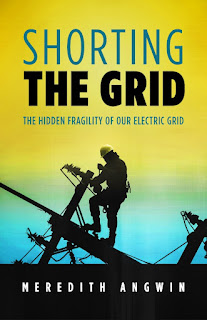
This story lays the foundation for Ms. Angwin's book because, as she sees it, there are many parallels between 2007 and our current situation with regards to energy. 

Most Americans, having grown up enjoying the benefits of electricity, probably take it for granted. We turn on the light with the flick of a switch. We recharge our devices by plugging them into an outlet. But few of us have really bothered to understand how it works or how the utility companies keep our lights on 24/7.

(For what it's worth, I lived in Puerto Rico for a year and experienced what it is like to have weekly brownouts and occasional blackouts. That was long before the more recent hurricane that so devastated our island neighbor.)

In this first chapter Ms. Angwin gives readers a brief overview of how things have been changing with regards to power. We don't notice because for 80 years or more it has almost always been fine. The exception being Texas this past winter.) Nevertheless, things have changed, even if we haven't noticed anything different at the user end. She writes:

In the old days regulatory bodies wanted to see a grid with reliable power plants and, hopefully, plants that use different types of fuels. A varied grid meant that, if one fuel had shortages or rose in price, the grid would still be stable, and costs would remain relatively stable.

In current grid governance, none of these things matter. In many areas power plants that make steady reliable power can’t make a profit. Several large utilities are trying to sell or shut down their nuclear, gas, and coal plants in these areas. These utilities plan to operate plants only in other parts of the country.

She then discusses the Regional Transmission Organization (RTO) which is a thread that will run through the length of this book.

In many areas of the country, especially in RTO areas, power installations that can operate only intermittently, such as solar and wind installations, are the sure bet for becoming wealthy. In the mortgage situation the intrinsic value in the mortgage didn’t matter. In the RTO area, the value of the power produced doesn’t matter. As a matter of fact, less-valuable power is more profitable. 

Trouble is sure to come and it’s on its way. In these areas we are on our way to an expensive and fragile grid.

* * * 

Unlike Christian Bale or Steve Carrell in the movie version of The Big ShortMeredith Angwin is not a lone voice in the wilderness. In the very short time I've been learning about nuclear power, I encountered quite a tribe of people who "get it." These are people fully committed to clean air, clean water and a safe future for our grandchildren. 

The interview I posted yesterday, provides a number of useful insights worth taking into consideration as we discuss the benefits of nuclear energy.  Check it out here: Putting Nuclear Power In Perspective: An Interview with David Watson.

Photo at top of page: Leibstadt Nuclear Power Plant, Switzerland

Saturday, February 13, 2021

Michael Lewis' Tribute to Coach Fitz

There was a turning point in Michael Lewis's life, in a baseball game when he was fourteen years old. The irascible and often terrifying Coach Fitz put the ball in his hand with the game on the line and managed to convey such confident trust in Lewis's ability that the boy had no choice but to live up to it. "I didn't have words for it then, but I do now: I am about to show the world, and myself, what I can do."

The coach's message was not simply about winning, but about self-respect, sacrifice, courage, and endurance. In some ways, and even now, years later, Lewis still finds himself trying to measure up to what Coach Fitz expected of him.


--Teaser copy from the Amazon page


Having just finished Moneyball for the second or third time I decided to take out a couple more books by Michael Lewis. I'd enjoyed Flash Boys, The Big Short and Liars Poker, so I was going to keep following the the stream and see where it led. The Undoing Project and Coach were both in our library and I requested them.


I found myself surprised at my disappointment in The Undoing Project. When I picked up Coach: Lessons on the Game of Life, I was immediately drawn in. 


First off, the book design is elegant. It's a small--5"x 7"--and only 90 or so pages, one-third of which are black and white photos of junior high kids playing baseball, or swimming or just being kids. It didn't take long for me to realize where Mr. Lewis' Moneyball came from. He himself had once dreamed of being a big league ballplayer, as did I when I was his age. 


The story itself is a tribute to a coach who made an impact on his life, Coach Fitz. It is also something of a morality tale, revealing how times have changed over the past three or four decades. 


Lewis, born in 1960, play ball in the 70's under a coach who had had experience in both basketball and baseball, including a two-hit fight during a basketball game with Pistol Pete Maravich. (He hit Maravich and Maravich hit the floor.) He'd played in the Oakland A's minor league farm system, a 6'4" 220 lb. catcher.  He'd caught Catfish Hunter and Rollie Fingers, among others.


I so relate to this book because I, too, played ball in high school and had a JV coach who made an impact on my life. Mr Dennison. who was also my Physics teacher junior year, had spent seven years in the Boston Red Sox farm system as a pitcher. He, too, was probably 6'3 or 4 inches and at the end of that last year he was brought up for the last couple games of the season to be in the bullpen for the Red Sox. This is the famous stadium with the Green Monster in left field, which is featured in Field of Dreams.


Mr Dennison sometimes used to take me and Skip Hoy out of last period study hall and pitch to us Sophomore year. Junior year it was Joe Sweeney and I. That first year Skip Hoy batter .500 and I was the second best hitter on the team at .387. The following year Joe Sweeney batter .500 so I was second best again.  


Becoming a better player was not the point of Michael Lewis' story of Coach Fitz, nor was it the big takeaway for my story of Mr. Dennison. Since this is a review of Coach, I only share this above to say that I related to this book on many levels.


Mr. Lewis does an interesting thing is this book, though. He returns to his high school at a time when the kids who had him in the past came back to honor him. There is simultaneously a new generation of students whose parents want to censure him. His intensity unwelcome, his honesty unwelcome, his passion perceived as destructive. 


Example. One kid doesn't show up for practices, has even appeared to have lost interest in trying to win, and Fitz benches him. The parents rake him over the coals, try to get him fired, because if he doesn't play it may hinder his ability to get a scholarship. 


There are more examples and I witnessed this myself in our local high school on parent/teach conference night. While we met with our daughter's teach, across the hall a parent was hollering at a teacher there, not interested in advice on help the student but insisting that her daughter get a better grade. 


When the police came to our house when my brother was caught shoplifting football cards (he was 9 or 10) not parents did not defend him. My parents didn't insist that there must have been a misunderstanding.


Coach tries to modify his behavior, but in an era of increased coddling of egos, there's a real problem here.


* * * 


I once pitched a book idea about someone whom I thought worthy of a tribute. I went to the library and looked at a hundred biographies to get an image of what I was thinking would be the right concept. It turns out that what I envisioned was something not too different from Coach. Short, with photos and substance, inspirational but real. 


Did you have a teacher or coach that took in interest in your development, who believed in you or inspired you? Feel free to share in the comments.


* * * 


Related Links


Moneyball: Worth More than the Price of Admission


Major League Baseball: Some Things Have Changed and Some Haven’t in the Umpire Business


Play Ball!


Coach: Lessons on the Game of Life


Friday, January 29, 2021

The Undoing Project by Michael Lewis Didn't Do It For Me

I've been a longtime fan of Michael Lewis, having read a half dozen of his books over the years. I recently started reading The Undoing Project and for some reason wasn't getting into it. I then decided to re-read Moneyball, the bestseller that later became a motion picture starring Brad Pitt and Philip Seymour Hoffman. As with the first time, I again thoroughly enjoyed it.

This prompted me to go back and continue with The Undoing Project. It's not the first time I started a book, failed to connect and had better luck the next time. It was until my third effort with Malcolm Lowry's Under the Volcano that I not only engaged with but devoured it. Unfortunately, my second effort here yielded little fruit. If words were food, The Undoing Project was sawdust. Why was this?

I decided to go to Amazon and see what other readers were saying. Many liked the book very much, but there were others who expressed my sentiments as well.

--> This is my 10th or 11th Michael Lewis book and this is the only one I couldn't finish and did not enjoy. 

--> When this book was chosen for my book group, I looked forward to reading it. I have read other Michael Lewis books and totally enjoyed them, even when the topics were not a subject I was particularly interested it. Baseball! Derivatives! Why not psychology? Lewis' books always had energy and told an interesting tale. Not so with The Undoing Project. Nearly halfway through I stopped to read some reviews of the book because I had no idea what it was about or where it was going.

The book opens with Lewis talking about the challenges basketball teams have in determining who will succeed and who will not in pro basketball. Just as Moneyball focused on the Oakland A's, this book details challenges the Houston Rockets faced. 

Somewhere along the way it seemed I missed what this had with Undoing, but I hung in there, wondering where this would all be going. I'd read enough Lewis books to know that he is a storyteller, enjoys gathering details and sharing them in story form. Unfortunately, as these stories unfolded I was unable to see where they were all going.

There is a certain amount of trust that readers put in writers. If they trust the writer they continue reading, believing there will be a payoff for their efforts. The Fables of Aesop always had a payoff, but they did not require endless pages of story to get there.

The central story here is that of the friendship between Daniel Kahneman and Amos Tversky, two Israeli psychologists and economists who did research on heuristics (among other things) in Eugene Oregon. Their work ultimately garnered them a Nobel Prize.

After the lengthy lead-in we arrive at the main event, which is presented in a meandering story that winds over the river and through the woods, but never arrives anywhere. Or at least, after passing the midway point, did not give me confidence that there was a destination. It felt like the story was supposed to be the destination. And I was not alone in this sentiment. Here's another Amazon reviewer:

--> I'm a huge Michael Lewis fan but this book was awful. It was tedious and trying to understand where he was going with the book was hopeless.

I can't say the book was awful. It just wasn't engaging, and I would suggest part of the reason had to do with the writing. Tedious is probably an accurate word. As a result, I lost faith that the story was taking me somewhere.

Be sure to read the positive Amazon reviews before you make up your mind on this one. This review is just my two cents from the peanut gallery.

Related Links

My review of Malcolm Lowry's Under the Volcano

Moneyball Worth More Than the Price of Admission (A Review)

Thursday, January 21, 2021

Does Moneyball Give a Gliimpse of How to One Up Wall Street?

I realize that not everyone is a reader. When I interviewed the famed British illustrator Ralph Steadman (think of Hunter Thompson's Fear and Loathing in Las Vegas for example), I mentioned that I had started as an artist and became a writer. He replied that he started as a writer and became an artist, "because no one reads anymore."

Near two decades have passed, and the readers of this world still love their books. Many of us have not only read 50 or a hundred books a year most of our lives, but we've read many of those books more than once and as many as four or five times possibly.

I bring this up because I am currently reading, for the second time, Michael Lewis' Moneyball. After my first reading it was made into a movie starring Brad Pitt and Philip Seymour Hoffman. Now, near 20 years later, I am seeing it with new eyes, not as a baseball fan but from the point of view of an investor. 

The book is about how baseball historically came to place value on certain factors that statistics actually proved were backwards. Billy Bean, who had been drafted as a most-likely-to-succeed superstar, is at the center of this story about the Oakland Athletics. Bean is GM, the decision maker regarding the makeup of the team. His experience as a failed potential superstar gave him an insight into the game that most front office folks could never recognize. 

How this applies to investing is obvious. The conventional wisdom is that the prices of stocks (which represent partial ownership of companies) are fairly valued by the market. That is, if the price of one share of a company is seventeen dollars, the company's true value will generally correspond with that in the aggregate of all its shares. Or more correctly, the price of a share will correspond to the future earnings based on risks and potential rewards.

If this is so, how then does a bridge player  from Omaha do so phenomenally better than a majority of others when purchasing portions of company's shares? How does he succeed where others fail? 

It may be like the story in Moneyball. Conventional wisdom is safe but backwards. Warren Buffet made a name for himself by (a) doing more homework than the herd, and (b) by using a different set of measurement tools.

I like the illustration of the herd because it corresponds to life as a zebra on the Serengeti. There is safety in the herd. The reason is that to leave the herd is to become vulnerable to the lions. 

The problem for the zebra in the herd, though, is that the grass gets shorter and shorter. Outside the cluster of zebras in the herd there is ample food, but how retrieve it and enjoy it without risk of become food oneself? 

Somehow Warren Buffet is getting outside the herd and avoiding the lions as well. How he does this is not my point. The point is that there are opportunities available by shucking off conventional wisdom. This is what Billy Bean did because he saw with great clarity how wrong the "experts" were about him.

I once published an article titled "Who Are Your Experts?" in which I challenge people to think for themselves, or at least recognize that when choosing experts you are ultimately responsible for the choices you make. 

Desert Storm was another example of how the conventional wisdom was wrong. Experts were saying that we were about to enter a protracted war with Saddam Hussein that would end up as another Vietnam. Instead, Iraq capitulated in 100 hours. (This was Desert Storm under George Herbert Walker Bush.) There were many lessons for both businesses and investors from that brief war.

* * * *

The subtitle of Moneyball is, The Art of Winning an Unfair Game. Wall Street, which Michael Lewis has also written about in the past, is also considered by many to be an unfair game. Can the lessons Billy Bean learned about player valuations be transferred to the Street? 

To some extent it may be possible. When everyone loves a stock because of the personality of its leader or for any other reason trotted out by the media, it valuation goes up, and likely exceeds its real value. The diamonds in the rough, like some of the players with apparent flaws -- a pitcher with a quirky delivery, for example -- may be neglected and undervalued, until someone notices that they have been consistently making a boatload of money for years, and with no end in sight.

All decisions involve weighing risks and rewards, and learning how to identify what has real value and what only has the illusion of value. Be wise.

Popular Posts