Showing posts with label Modern Song. Show all posts

Monday, September 18, 2023

Weighing In on Bob Dylan's Philosophy of Modern Song

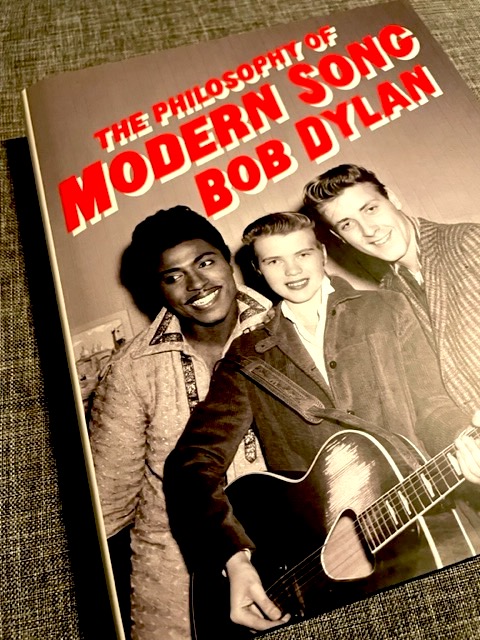
Despite waiting years for Dylan's sequel to Chronicles: Volume One, I did not order my copy of his Philosophy of Modern Song in advance last year, as I might normally have done. Rather, I requested it as a Christmas present and thus received it after weeks of reviews had already appeared. The "controversy" regarding his "autograph scandal" didn't phase me. Nor did the misogyny brickbats.

So here it is, sitting before me on the coffee table/wooden chest, beckoning me to express my initial first reactions.  

* * * 


The Philosophy of Modern Song is not anything like what most of us expected as the sequel to Chronicles Vol. 1. The writing, however, feels like a Dylan volume. Most Dylan fans who have listened to his Theme Time Radio show will very likely hear Dylan's voice reading it aloud as they read the text.

The book itself is a collection of essays on 66 songs by other artists, spanning from Stephen Foster to Elvis Costello. It has the look of a scrapbook in some ways. To some extent that makes sense in a pop culture sort of way. (When I was in Italy, I was talking about Dylan with a fellow who owned a craft brewery. He had a couple Dylan posters on the wall so I commented on my surprise at how much Dylan had been imported into Italy. He said, "America gave us two things: Bob Dylan and Pop Culture.")

According to the text on the inside cover flap Dylan began working on it in 2010. The sales-copy describes it as "a master class on the art and craft of songwriting," though quite a few critics demur on this proclamation. 

John Carvill at PopMatters.com, for example, wrote, "There’s very little of what we could sensibly consider ‘modern song’ in The Philosophy of Modern Song, and any ‘philosophy’ is strictly of the cracker barrel variety. That’s ok, though, because we’ve learned never to take Dylan at face value, and the title was just too pretentious to have been meant seriously." The subhead to that article calls it "an awful book, awash with misogyny and crusty old man rants."
I found that last barb to me a little harsh, but having become an older man myself I do understand why folk become "crusty" in their later years.

Sasha Frere-Jones called it "a fractured memoir and punch list of nightmares." And follows up with "what begins as a set of interpretations ends up as a sour little diary."
(4columns)

On the other hand, if you're seeking reviews with a little more enthusiasm for the subject matter (Bob's sequel to Chronicles: Volume One) then here's the place to be: 130+ Published Reviews of Dylan's Book.

I believe I did see at least one reviewer agree it that was "master class on the art and craft of songwriting." I saw it as something different. 

I enjoyed seeing the variety of songwriters selected. No surprise to find spotlights on Elvis, Little Richard, Johnny Cash and Hank Williams, as long-time fans know his respect for the music of these giants. Happy surprises include Stephen Foster, Nina Simone and many others. As for Dylan's impressions on pop hits from my own Boomer-era lifetime, there were many, such as "Ball of Confusion" by the Temptations, "Black Magic Woman" by Santana, "By the Time I Get to Phoenix" by Jimmy Webb, etc.  And then there are all the slices and slivers from other assorted musical genres that you probably would not have expected. 

The writing style is, as I noted, more of a rhythmic impressionism, a Dylan style you find in songs like "Subterranean Homesick Blues," punchy phrases falling all around like shrapnel from a hand grenade. 

Here's an excerpt from his chapter on Cher's "Gypsies, Tramps and Thieves" which is accompanied by old photos of a Peep Show carnival barker and a Side Show Zoo sign. 

You've evolved over thousands of years and you're still traveling through, setting up the tent and making ends meet. Hoaxes, tournaments and spectacles, that's your line of business. Drugstore cowboys, girl watchers, night owls--everybody and their uncle, you lighten them up and bleed them with ease. You give nightmares to people while they're fully awake. People whisper behind your back--lampoon you, satirize, mock and ridicule you, make bitchy comments but your place in the sun is secure.

Some of the book is almost as strange as his Tarantula.

A novel with a plot this is not. It's entertainment. Dean Martin's "Blue Moon" is accompanied by a cover photo of Robert Heinlein's The Moon is a Harsh Mistress. Carl Perkins' "Blue Suede Shoes" ends with a shoe ad.

Here's a digression from another chapter.

You're in an exclusive club, and you're advertising yourself. You're blabbing about your age group, of which you're a high-ranking member. You can't conceal your conceit, and you're snobbish and snooty about it. You're not trying to drop any big bombshell or cause a scandal, you're just waving a flag, and you don't want anyone to comprehend what you're saying or embrace it, or even try to take it all in. You're looking down your nose at society and you have no use for it. You're hoping to croak before senility sets in. You don't want to be ancient and decrepit, no thank you. I'll kick the bucket before that happens. You're looking at the world mortified by the hopelessness of it all.

In reality, you're an eighty-year-old man, being wheeled around in a home for the elderly, and the nurses are getting on your nerves. You say why don't you all just fade away. You're in your second childhood, can't get a word out without stumbling and dribbling. You haven't any aspirations to live in a fool's paradise, you're not looking forward to that, and you've got your finger....

In the first paragraph you are you, in a hopeless world. But suddenly, you are an eighty-year old man in a home for the elderly. Is that a pivot? Is Dylan saying what he means or is it the opposite? Is this his take on the sunset years? 

MY TAKE
Philosophy of Modern Song is fun, but is best enjoyed if you treat it like a book of poetry 
next to your easy chair which you can dip into and savor any time of day or night. Don't take it too seriously. Just enjoy it.

Related Links
Bob Dylan In Italy
What Does Charles Trenet's "La Mer" Have to Do with Dylan's Philosophy of Song?

Postscript
"an enthralling farrago of fabrications and tangents that occasionally, when it circles back to his early life on the Greenwich Village folk scene, offers rare bits of vivid personal disclosure, including meditations on artists and songs that helped shape him."
--Bob Dylan, Philosophy of Modern Song

Illustration Credit: Collaboration with Dream by Wumbo. 
Photo credits: the author, the latter at the train station in Florence, Italy.

Sunday, January 8, 2023

What Does Charles Trenet's "La Mer" Have to Do with Dylan's Philosophy of Song?

"In this song your happiness lies beyond the wide sea, and to get there you have to cross the great unknown."--Bob Dylan, The Philosophy of Modern Song

Dylan fans spent years wondering if and when a Chronicles: Volume 2 would be published. Those who were patient enough have been rewarded. I doubt, however, that a single one of us anticipated the form it would take. I myself, like many, expected more of a memoir. Instead, we were treated to The Philosophy of Modern Song, a book about songs more than about philosophy. In either case, it is pure Dylan. 

There's been plenty written about this book already. This website alone has links to more than 130 reviews of the book. Most Dylan fans know that it's essentially Dylan weighing in on 66 songs from Stephen Foster to Elvis Costello, Nina Simone to Little Walter; "Your Cheatin' Heart" to "Viva Las Vegas."

The first track, I mean chapter, in the book is Bobby Bare's "Detroit City." Now if you are one of the countless fans who listened to Bob Dylan's Theme Time Radio Hour, you can't help but hear Bob's ominous gravelly voice and delivery as you read some of the passages. The opening line for chapter one is "IN THIS SONG YOU'RE THE PRODIGAL SON."

Chapter 19 is "Beyond the Sea," the 1958 version sung by Bobby Darin. Dylan opens this chapter with "IN THIS SONG YOUR HAPPINESS LIES beyond the wide sea, and to get there you have to cross the great unknown." Listen as you read:

You're going out of bounds and you're into the briny deep-navigating by the stars, measuring longitudes and latitudes. You're the captain and you're sailing towards your nerve center, who is waiting in the coastlands upon the rich and rosy beach. She's waiting for you there, biding her time, sitting tight--she's on the lookout for you, checking out every ship. The clipper ships, the schooners and sloops. Onwards and onwards you go sailing over the bounding main, and off into the wild blue yonder. Sailing towards your life--your final destination. You're checking your compass, your almanac and your horoscope. The entire hemisphere is right there at your command, right there in your field of vision.

In writing about the songs he covers, Dylan's approach is imaginative, gliding across cresting waves of the unexpected. The essays and stories alternate between second person and third person. The segment in blue above, introducing Bobby Darin's "Beyond the Sea" for example, is second person.

I really knew very little about Bobby Darin while growing up. For some reason I failed to appreciate his music, perhaps seeing the showmanship as old fashioned. Years later, via karaoke, I came to associate Bobby Darin with "Mack the Knife." But it's Darin's "Beyond the Sea" that Dylan lifts up to shine a light on here. 

Of the six pages Dylan devotes to Bobby Darin's song (half of which of which are illustrations or photos), only one sentence is dedicated to the origin of the song. It's an amusing sentence. "THIS IS A FRENCH SONG originally written Charles Trenet, pretty much untranslatabe." Does Dylan mean the French words can't make sense in English? Or that the idea behind the song gets lost in translation?

You can read two translations of "La Mer" here -- one converted into verse and one more literal -- and decide for yourself what Dylan meant:  
https://www.rougemusic.com/la-mer 

What's certain is that the Charles Trenet version has been a favorite of mine since I first heard it sung during the credits for the film The Diving Bell and the Butterfly. The film had already moved my heart. The song welded this story to an emotional connection. Music does that.  

The Diving Bell & the Butterfly is an autobiographical memoir by Jean-Dominique Bauby, a French journalist and editor of the fashion magazine Elle. His life consisted of fame and style, wealth and women… a lifestyle others only dream of. Then one day, at age 43, Bauby suffered a massive stroke that left him in a condition called “Locked In Syndrome.” His mental faculties were totally intact but his body paralyzed. Though speechless and immobile, he learned to communicate by blinking a single eyelid. By means of blinking, communicating one letter at a time, Bauby produced a book remarkable for its candor and beauty. It's a powerful book, and Julian Schnabel proved he was up to the task of translating this story to the screen. 

You can read my review of The Diving Bell and the Butterfly here(EdNote: This review was written about the film before I'd read the book, which I later purchased and have since read twice.)

Until I read this chapter in Dylan's book I never felt all that inclined to learn more about Bobby Darin. I knew he died young, but for some reason I thought he died in a plane crash. The reality is that he had always been sickly since his youth and lived longer than his doctors expected. He was 37 when he died of sepsis.

The song itself brings to mind a quote I'd read two or three decades ago regarding seas and life. If while in England you are unwilling to leave sight of the land for a while, you will never see New York. (This was before air travel, of course.) In other words, to reach other lands you must risk the open sea, a recurring theme in literature related to risk and reward. The failure to accept risks can frequently lead to regrets.

Here's Bobby Darin showing his chops on the 1960 Beech-Nut Show... back when TV performers lip-synced their way through their numbers. You'll notice that the Beatles weren't the first performers to ignite screams from teenaged girls.


Here is Charles Trenet's version of the song for comparison purposes:


The sea that we see dance along the clear bay has reflections of silver.

The sea, changing reflections under the rain.

The sea to the summer sky confounds those white sheep with the angels so pure. 

The sea, shepherd of infinite azure.

Look! Near the ponds, those tall reeds! 
See those white birds and those rusty homes!

The sea, rocks (like in a cradle) them along the clear bay
And in a love song, the sea cradled my heart for life.

* * *  

TRIVIA
The French edition of The Diving Bell and the Butterfly  was published on March 7, 1997. It sold the first 25,000 copies on the day of publication, reaching 150,000 in a week. It went on to become a number one bestseller across Europe. Its total sales are now in the millions.

 On 9 March 1997, three days after the book was published, Bauby died of pneumonia. 

Popular Posts