Showing posts with label Native artist. Show all posts

Wednesday, February 12, 2020

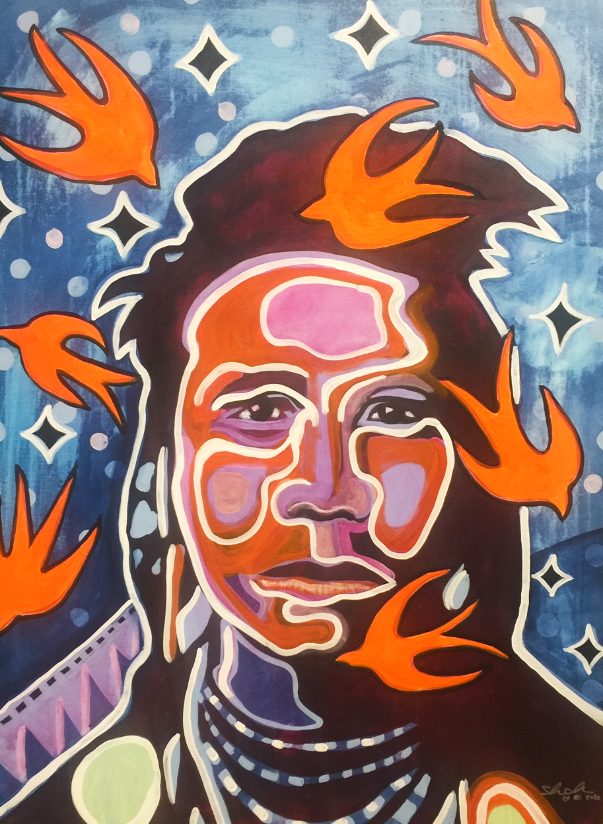
Local Art Seen: Shaun Chosa's War Paint in the John Steffl Gallery

Shaun Chosa travelled throughout the country in his youth, visiting and living among various Native American tribes alongside his mother who was herself an artist. He does detailed pen and ink work that's been described as evocative, and sometimes whimsical. The current exhibition is titled War Paint and features larges canvases in an array of colors. His design work can be found locally on posters, CD covers and apparel. This show will be on display in the Steffl Gallery at the Duluth Art Institute through the end of March.

Rise

Water Protector
War Paint
Rain Dancer
Ride or Die II
Be sure to see all the exhibitions on display at the Depot. 
This show will be on display through the end of March, but 
the DAI Member Show only through the end of February.

For other art happenings in the Twin Ports be sure to visit

SPECIAL SHOUT OUT: DOCUMENT SPRING, a special event on February 20
which is part of a larger ongoing project, documenting change in our environment
through photography and the arts. An Oldenburg House program.  Details Here.

Monday, September 9, 2019

Local Art Seen: Karen Savage-Blue @ The Pine Knot

"Deer Woman" -- Karen Savage Blue
This past Thursday three venues in Cloquet and Carlton had their doors open for an art crawl. The Encore Theater, Magnolia Salon and the Pine Knot held receptions and it was nice to see the turnout. This blog post is about new work by Karen Savage Blue.

Ann Markusen, who came to UMD in 2000, introduced the artist. Markusen, who has been writing about art and placemaking, was at that time doing a study of Native artists, whose thriving arts scene was pretty much under the media radar. She was doing analysis of why Native artists are not getting the support other artists receive.

She shared a book she co-authored called Native Artists, which you can download here from issuelab.org. (Free) (You can find more of Ms. Markusen's work at annmarkusen.com)

After briefly addressing the challenges of being an artist, she introduced Karen Savage Blue, a Native artist from the Fond du Lac Reservation. She worked as a teacher for year (K-12 students) and now teaches art full time at Fond du Lac Tribal and Community College.

She began her talk by sharing her process. "As an artist I have to determine what I'm going to spend my time on." She described how she enjoy's being alone in front of her paintings for hours in her studio on Big Lake.

She likes working in series. In 2014 she produced a series of 365 landscape paintings, one each day for an entire year. She was inspired by the film Julie & Julia about a blogger who is challenged to cook all the recipes in Julia Childs' first book.

For her project she would take a walk each day and shoot photos, making one selection each day to paint. On day 90 she was tempted to believe she'd done enough, but pressed on to the finish.

A lesson she's learned from this discipline is that an artist can do art daily no matter what is going on around them. "If you've got it in you, you can pull it out of you."

For each series, Savage-Blue sets rules. For this set, to create paintings depicting people in nature. And, though this presented new challenges for her, "No looking at other people's work to see how they solve this problem." For the seven paintings now on exhibit at the Pine Knot, she invented novel imagery with delightful solutions to the problems posed in each. The exhibit also includes a series of landscape paintings and some earlier, playful figuratives.

The creative solutions were truly original, each one having its own narrative. For this series of seven paintings she invented new kinds of imagery with innovative solutions to the problems set within each.

"Journey to the Other Side"
One of the paintings, titled Journey to the Other Side, was a response to the Parkland shootings. It shows four parents who come together and realize their children are gone. In the painting are 17 "energy spheres," one for each of the children whose lives were taken. The painting shows the parents coming to terms with these departing souls, some of which are ascending toward a sphere of light t the top of the painting.

Each of the paintings has a story. The artist elaborated briefly on her painting titled Deer Woman, which was done as a companion piece to one of Jonathan Thunder's paintings in a similar vein. As a fan of Thunder's work, I may have been the only one in the room who immediately recognized the echo.

Another painting features rabbits walking on their hind legs, titled Zorro Meets Dirty Bird. We all know who Zorro is, or so we think, but who is Dirty Bird? Dirty Bird is the nickname people in the Central Hillside Native community have given to one of the men there who has lived like something of a derelict. What's interesting is that this character, aware of his demeaning nickname, has re-named himself, calling himself Dusty Eagle. Of course, what is a dusty eagle? It's a dirty bird.
"Zorro Meets Dirty Bird"
* * * *

* * * *

* * * *
Ms. Savage Blue shared stories about her work and her approach to making art.
* * * *
Photo shows scale of her new work.
* * * *
"My Sister's Garden"
* * * *
* * * *

The paintings of Karen Savage Blue will be on display here at the Pine Knot offices in Cloquet through the end of September. These and other paintings by the artist are available for purchase.

* * * *

TWO EVENTS OF NOTE

TONIGHT 
Join Phil Fitzpatrick, Penny Perry and Friends at the Zeitgeist Atrium for their book launch reception, poetry reading and the music of Woodblind.
The book is Hawks on High: Every Day Miracles in a Hawk Ridge Season

Zeitgeist Atrium
5 p.m. until 9 p.m.
Ryan Frane will be playing during the reception and art show (5-6), and Woodblind will play from 7-9 after the poetry reading. Books can be purchased at Hawk Ridge, at Zenith Bookstore, as well as directly from the author and the artist.
Related: Interviews with Phil Fitzpatrick and Penny Perry.

TOMORROW NIGHT
Pints & Pottery--A fundraiser at Ursa Minor for the DAI Ceramic Studio.
Tuesday, 5:30-8:30 p.m.   DETAILS & TICKET INFORMATION HERE

Tuesday, May 1, 2018

Local Art Seen: Native Artist Leah Yellowbird's Stunning New Work at the AICHO

The work Leah Yellowbird has been producing now defies easy categorization other than to say it is remarkable. The sad part of language is that in our super-hype culture words like "awesome" and other superlatives have been watered down from overuse. Yes, I am guilty of using similar language at times, in an effort to convey how distinctive something is. In Leah Yellowbird's case, the words aren't big enough, expressive enough to convey the power one sees and feels here.

This past Friday evening was the opening reception for her new show DIMENSIONS. Her technical explorations have led her into more 3-D constructions and continued decorative marvels. Her American flag is one of the most striking new pieces. I share three photos here from various angles so as to help convey the whole of it properly. I can't recall ever having seen anything like it.

Here are a dozen images from the Dimensions show, some of them showing a close-up detail to help you appreciate the work involved. At the end of this page is a link to my interview with Leah from a couple years ago. She is an artist whom I will continue to watch, a true innovator. 

Flag, from the left.
From the front. 
From the right. As you can see, one photo would fail to convey what you see here.
This is a decorated table.
Much of her imagery has its origin in nature.
This close-up shows the detail that might initially be missed in the piece above.
Her snakes writhe.
Her horses leap from the imagination.
Like a blossoming flower, her creative spirit emerges and unfolds
in endless new forms.

Ms. Yellowbird's work is currently on display in the Dr. Robert Powless Cultural Center at the AICHO Building on Second Street in Duluth.

Meantime, art goes on all around you. Get into it.

Thursday, December 8, 2016

Six Minutes with Native Artist Leah Yellowbird

I'm uncertain as to when I first saw Leah Yellowbird's work but it was most likely at an exhibition at the American Indian Community Housing Organization (AICHO). The AICHO has been strongly supportive of the arts in various ways, and I've attended as many events as possible in the past beginning with Al Hunter's poetry reading, Beautiful Razor in 2013.

Ms. Yellowbird's beadwork was not only striking in its beauty, the rich meaning behind the work was even more profound. Most recently she has begun working in acrylic paint, but with a near-stipple technique that emulates the beadwork. It breaks new territory, as I have never seen anything like it. Her painting titled Otters earned an honorable mention in this year's Duluth Art Institute Biennial.

EN: Your painting of otters in the DAI Biennial is astonishing for its detail. Even more remarkable is how it initially appears to be actual beads. What prompted you to work in acrylics these past several years after decades of bead-work?

Leah Yellowbird: We went away for the winter and I didn't want to drag all my beads with me and when we arrived in Arizona I was lost without the beads... beads are so expensive.. so paint was the alternative.. and once I started I couldn't stop. I took over the living room in our rental and I haven't stopped.

EN: You clearly honor your native roots. What are some of the things that you have drawn from your First Nations heritage?

LY: I can't say it's one thing more then another... it's an inner feeling that is not explainable for me ...and I'm ok with that. The ancestors have really blessed me and keep blessing me.

EN: I can't help but think that doing bead-work for a few decades would teach you patience and attention to detail. What other qualities come from that discipline and experience that you apply to your current work?


LY: To trust my instincts with color combinations... If I like looking at it then I go with it.. I don't really look at the painting as a whole.. each component stands alone. Each being in the painting has the same value: a plant, a flower, a frog. It's harmony from my eyes

EN: Do peoples' reactions to your work surprise you?

LY: Yes.. very much. I'm never sure if I should call myself an artist. What does that really mean? I do enjoy watching the reactions of people when being told that they can touch the paintings.. it's part of the interaction of understanding of each painting. Without that touch I think you lose an integral part of what the ancestors are saying.

EN: I understand that some of your pieces are available as giclee reproductions. How did that come about?


LY: AICHO and Michelle Lebeau. Without the support from the organization and Michelle, I would be a beader who painted one winter, not a beader and a painter etc...

With Michelle's help and encouragement and the AICHO community I felt brave enough to try painting number two, then three.... etc.

EN: How long does it take to produce a painting like Otters? What do you call this technique, which appears to be a form of pointillism? How do you make each point so perfect?

LY: The Otters is a smaller painting. It took about a month of working on it everyday. Some days I paint for 12 hours ..I get in a zone n it's like it just flows out of me. Bead painting pointillism... maybe it's called history... I have an incredible sense of urgency to get it out. I feel like I need to keep working as hard as I can to honor what the ancestors are giving me.. I feel like if I let up even a little they may stop. I'm a conduit, nothing else. The real magic lives all around us.

EN: Where can people see more of your work, or purchase prints?

LY: AICHO is my home.. and that's the place where all the prints or originals can be bought and seen.

* * * *
If you are out and about Friday evening for the Friday Night Art Crawl here in the Twin Ports, be sure to visit the AICHO-hosted Standing Strong for Our Precious Water, an art opening and benefit concert. Ask someone on staff to show you Leah Yellowbird's paintings there. Engage deeply.

To purchase prints of Leah Yellowbird's work, visit leahyellowbird.com.

* * * *
REMINDER: Tonight is the Brian Barber opening reception for his new "Wild Kingdom" on display at Beaner's Central this month. Woodblind is on the docket for a fab backdrop.  And the opening reception for Chris Monroe's 'north of Superior" will be on Monday at the Zeitgeist. Details here.

Meantime, art goes on all around you. Get into it.


Thursday, August 11, 2016

Artist Monica Ares Talks About Her Upcoming Show at the Washington Studios Gallery

Monica Ares arrived in Duluth in 2010, and moved in to Washington Studios in the Central Hillside in 2011. Today she is co-chair of the co-op along with Jonathan Thunder. Next week her first one-woman show will open at Washington Galleries. What follows here was assembled from notes taken during a visit this weekend at the gallery.

* * * *
Monica Ares was born in Huron, South Dakota. While growing up she never knew that her parents were Native American.

Like many artists she grew up making art in childhood, but when it came time to graduate high school she and her mother had an important conversation. "My mother asked, 'What do you want to do?' I said I wanted to go to art school. But she said I needed to get a real job." As a result Ares went to school for nursing, eventually completing her degree while living in California. But she never forgot her interest in art.

It was a high school art teacher who really ignited her art interests. "We had an art teacher who let you try things and allowed you to experiment. On one occasion I had to have an art project and an English project, so I wrote a paper and sculpted." Years later that introduction to sculpting re-emerged while she was working in a hospital emergency room. "I saw so many faces that it became a good resource for sculpting. I started sculpting again. Doctors and other personnel who saw my work encouraged me and it took off from there." Some of her work was plaster of Paris. Some clay. Some wood carving. There was a fence company that had leftover redwood that was for free and this also became material for Ares to create with, teaching herself how to work in each of these various mediums.

Many years later she married her husband and they moved to Tennessee. "I went to a lot of art fairs where I got interested in stone sculpture there," she said.

When her husband retired from the military they decided to move to the Southwest. She moved to New Mexico six months prior to her husband. There she met a realtor while looking for a house and he introduced Monica to his wife who was student teaching at "The Art School" in Albuquerque.

Here she was finally able to get the schooling she desired when she was young, investing three years in an apprenticeship program. "I learned welding, metal sculpture, stone sculpture, painting, drawing... It was great. I knew I was in the right place when I opened up the door and could smell the linseed oil and the thinner," says Ares. "I cried."

"We lived in Albuquerque ten years. I did art the whole time. Got into a guild. Became involved with a group of women artists and we showed in group shows."

Then her husband succumbed to a bout with cancer. Ares next moved to Nevada where she spent five years in Pahrump outside of Las Vegas. "It was a time for regrouping. I wasn't doing art but was working, until the company I worked for eventually closed." She had to decide if she wanted to stay there or not.

At this point Monica's dear friend from California suggested that she consider Duluth because of what was happening in the arts here. "My native people are from the Midwest so it gave me a chance to learn more about what's here." Ares learned she was Lakota. "Now, they are the focus of my work. I didn't know until my parents were already passed away that they were both Native."

"When I moved to Albuquerque it was very interesting. I asked my realtor what the ethnicity was there. The whites have the money, the Indians have the land and the Hispanics have the power. It works because everyone has a bargaining chip."

 * * * *
Now that she is co-chair at the Washington Studios, her desire is for there to be good quality shows here. "My focus is to make sure that what we have here in the Gallery is interesting, insightful, exciting. It may not be everyone's taste, but that's OK.

"I want the artwork to be memorable in a good way. I realize that living in a co-op not everyone went to art school, not everyone is professional level... One of my all-time heroes, Bob Ross, took the snootiness out of art. I want the arts to be enjoyable for everyone, not just the elite."

"I worked at the Tweed for a couple years and had the opportunity to look at the Native artists and read their packages. If I remember there was a comment by George Morrison that he was proud to be an Ojibway, but he was an artist and an Indian, and one doesn't cancel out the other."

* * * *
Next week Monica Ares' one-woman exhibition will open at Washington Studios Gallery at 315 N. Lake Avenue in Duluth. The show, titled In Their Midst, takes a look at the history of the Southwest Indians, what they contributed. The work pulls together information from historical societies, museums and parks. States Ares, "There's millions of acres in the Southwest. We know the Indians were here because they built these structures. There's animal bones, but no people bones." And to some extent it is a great mystery. "How can they make such an awesome mark but there is nothing left behind of them. One author said that because of the size of the area there is probably an underground cache somewhere..." The reception card is a painting of a kiva ladder that goes into a dug out area where they would put caches of food, sometimes sleep and also do ceremonies.

(detail)
Another painting shows two adobe structures on a rock ledge... When the Spaniards came the Natives had the advantage of being up high. The image points to lessons about life strategies.

Other paintings show half-ruins... Underground huts enabled people hide their cache, their things, and they could follow where the harvest was or the food....

Ares currently works in oil and acrylic, sculpting mud, canvas and masonite box... plus some three-dimensional gourd pieces, gourds and antlers. The exhibit will be on display through the end of September.

Opening Reception: August 19, 5:30 - 8:00 p.m.

* * * *
LOCAL REMINDERS for August 11
Tonight from 5 to 7 p.m. is the opening reception at Lizzard's Gallery for a joint show called Collusion. Lizzard's is located at 11 West Superior Street, a half block west of the Tech Village, across from the HQ for Minnesota Power.

This afternoon beginning @3:00 p.m.: Duluth Quantum Computing Project at 3 West Superior Street.

This evening, 6:00 - 7:30 p.m.: Artist Talk at the Tweed, Iron Range photographer Vance Gellert.

Friday, AJ Atwater's 400 Paintings opens and Saturday eve Lydia Walker's colorful show will open at Studio 15.

* * * *

Meantime, life goes on.. Let's see what happens next!
Sunday, April 10, 2016

Local Art Seen: Gordon Coons, Ojibwa/Ottawa Artist

Friday evening I had the privilege of attending the opening reception at the AICHO for artist Gordon Coons of the Ojibwa heritage from the Lake Superior Chippewa Band of Wisconsin and Ottawa of Michigan. Now living in Minneapolis, Coons is a self-taught artist who works in a variety of mediums including painting, printing and mixed media. The work was an interesting blend of traditional native storytelling and various forms of contemporary expression.

There were numerous familiar faces present, including painter Jonathan Thunder who confided that Coons had been a mentor when Thunder first began to taking his art seriously, and Ivy Vainio whose photography proved to be an emotive addition to last Monday's One River, Many Stories exhibition at the Depot.

"Muskrat returning the Earth"
The exhibit itself seemed to be something of a retrospective from various stages of Coons' career. There were also a range of creative explorations that involved various types of printing, embossing and even works in duct tape.

In the hallway outside the gallery there were a series of paintings using the American flag, in a manner not unlike Jasper Johns, yet altogether different. Here we find Coons incorporating statements from Ojibwa history into the flag, most vividly the grievous Mankato hangings of 1862 in which 38 Dakota natives were executed by hanging. One flag painting lists Native tribes and the years of their treaties. Another lists the 38 Dakota men who were hung in Mankato the day after Chritmas, 1862. Here's one account from the New York Times. And here's an alternative or supplementary account of this tragic moment in time that was overshadowed by the American Civil War. You may also read the Wikipedia record here.

Ivy Vainio, Gordon Coons, Jonathan Thunder, Francine Corcoran
Jake Vainio produced a soothing ambience with his electric guitar during the reception except for a portion in which Mr. Coons was invited to address the audience from the AICHO stage. To see more from this event, visit this page of photos by Ivy Vainio.

Gordon Coons speaking after introduction by Jonathan Thunder.
"Mooz / Moose"
"Owaazisli / Bullhead"
"Lac Courte Oreilles Elder" -- Layered duct tape cutout. 
American Flag with tribes and treaties.
Detail from above. 

Gordon Coons has won numerous awards and commissions for his graphics, prints, paintings and sculptures. His work has become part of numerous permanent collections. 

If you have never taken in an exhibit at Trepanier Hall, the former YWCA, then you really need to put American Indian Community Housing Association on your watch list for upcoming events. There is a vibrant arts community here and a lot happening.  

Meantime, art goes on all around you. Engage it.

Popular Posts