Showing posts with label disasters. Show all posts

Monday, January 3, 2022

Niall Ferguson On Disasters and What We Can Learn from History

This past year I discovered the writings of Niall Ferguson, a Scottish historian and author of numerous insightful books about the growth and decay of civilizations and the challenges we have lived through and will face again tomorrow. Here are some notes from a YouTube video I listened to titled "Humanity must learn from its mistakes."

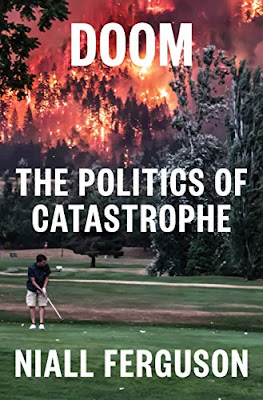
He had been invited to Budapest to discuss his most recent book, Doom: The Politics of CatastropheThe discussion took place in September 2021, which helps give context to the introductory portion about Covid-19. I will leave a link at the end of this page in the hopes that you will watch it in its entirety. 

* * *
Ferguson began by reminding us that from the start of this pandemic we have seen two narratives in operation. On the one hand there were those who said it was not a big deal, or maybe even a hoax. On the other hand we had those saying that the pandemic is as bad as the Spanish Flu and we must lock people in their homes or millions and millions will die. Some experts estimated that it would kill 2.2 million people in the U.S. alone.

By September last fall it was apparent that the Covid-19 impact lies somewhere between the extremes. How bad has it been? 

Clearly is has been as bad as the H2N2 SARS outbreak of 1957-58. But it has not been nearly as deadly at the Spanish Flu. According to Ferguson, the Spanish Flu of 1918-19 killed two percent of the population of the whole world. By way of contrast, the death toll for Covid-19 has been only 0.06 percent, less than one-tenth that of the Flu of a century ago.

* * * 
Ferguson states that even if we don't accept the lab leak theory for Covid-19, China is culpable because of its attempt to cover-up the disaster in its early stages.  The cover-up helped enable the spread.

The point he drives home, however, is that there will always be disasters and we can't predict when they will happen. We don't know when the next war or major earthquake will occur, but we do know they will come. It then becomes our responsibility to improve the ways we cope. 

The U.S. Health Department had a 36-page preparedness plan on hand in the event of a pandemic like this. It became useless in real life. Things don't unfold as anticipated. It only provided officials with a false sense of security. Why do these big government agencies fail?

The host of the program asked Niall Ferguson why he didn't wait till the pandemic was past before publishing this book. Then he could have had more information about how it was resolved.

Ferguson replied that he is 57 years old and Covid will be here for another century. There is plenty to be learned from the past with regards to disasters, and to be gleaned from the past 18 months that can be applied here and now. "Applied history really matters," he said. "We must learn from these disasters."

Niall Ferguson is a Senior Fellow at Stanford and Harvard. The 48 minute talk has many insights that are worth pondering.

* * * 
Related Links

Tuesday, July 20, 2010

Top Ten Environmental Disasters

My son, with aspirations in the restaurant industry, has talked for more than a year about leaving California to be a chef in New Orleans. He's a fabulous cook and loves things spicy and rich. New Orleans seemed like a dream destination for someone to add to one's experience.

Then, the oil spill came.

As you can imagine, as the days became weeks with no end in sight, concerns were raised about the viability of this new direction. One Saturday morning I was talking with my mom and she brought up an even greater disaster, the island of debris in the middle of the ocean. She said that there was a circle of plastic and garbage and waste the size of New Jersey out there. I had never heard of this so I did some checking. Turns out she was wrong. The island of debris is the size of Texas.

This week they succeeded in stemming the flow coming out of the gulf leak, to some extent, but how the mess ultimately gets addressed is another story, and something of a commentary on man's achievements on planet earth. Technologically we have accomplished so much, but we've also been leaving our mark in other ways.

Yesterday, CNBC published an editorial by Terry Tamminen titled "10 Environmental Disasters Worse Than BP Oil Spill." The title alone draws you in. We love lists, as I have noted recently, especially Top Ten lists. Tamminen is former secretary of the California EPA. The giant offshore garbage patch that my mother mentioned is number eight on his list.

Tamminen's article is more than a bland serving of food for thought. But be sure to read the comments at the end as well, a little seasoning that makes the dish even more zesty.

Here's a snapshot of what he calls the 10 worst (man-generated) environmental disasters.

10. Chevron oil refinery, El Segundo California

9. Our impact on Pacific Salmon

8. The Texas-sized garbage patch in the Pacific

7. The oil pipes of Esmeraldas, Ecuador

6. Destruction of the Mississippi and Colorado Rivers

5. Decimation of the American Bison

4. The Great Dust Bowl

3. Ocean acidification

2. Emptying of the groundwater in California

1. Air pollution

The BP spill has created a terrible mess, but it's not the only mess humans have created in history. Tamminen blames greed for a lot of it, but some of it is ignorance and probably a measure of it is overconfidence and pride. Mix in a little stupidity and the kind of attitude that assumes no responsibility, and you get into some dicey consequences. I think here of Michael Crichton's cautionary tale Jurassic Park. Everything seemed so safe, until factors out of their control came into the picture... Just like real life.

Popular Posts