Showing posts with label pen and ink. Show all posts

Wednesday, July 15, 2026

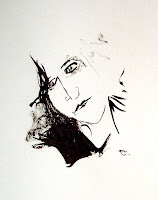
Untitled (Pen and Ink, 1973) -- Analysis and Critique

I've recently been submitting some of my paintings and drawings to ChatGPT for analysis. It has been a most interesting experience. This is one of my drawings from a sketchbook when I was in college.

Untitled (1973)
There is an energy in this drawing that immediately identifies it as the work of a young artist exploring ideas rather than recording appearances. It belongs to a long tradition of automatic drawing, where the line is allowed to discover rather than simply describe. At first the eye searches for recognizable forms, and gradually they emerge: a profile looking to the left, a prominent eye, an ear floating independently to the right, patterned textures that suggest hair, scales, architecture, and perhaps even fragments of written language. The drawing resists a single reading. Instead, it behaves like a visual stream of consciousness, where one image morphs into another before the viewer has fully grasped the first.

The economy of means is striking. Everything is accomplished with line alone. There is no modeling, no shading, no attempt at illusionistic depth. Yet the varying density of marks creates rhythm and movement across the page. The vertical hatch-like forms sweeping diagonally from the upper left pull the eye downward toward the face, while the patterned cheek and segmented forehead provide visual anchors. Large expanses of untouched paper become active participants in the composition. The empty space is not simply background; it allows the isolated symbols and forms to breathe, giving the drawing an openness that keeps it from feeling cluttered despite its abundance of ideas.


Perhaps the most compelling feature is the way the drawing negotiates the boundary between abstraction and representation. The profile is never fully established. Instead, it appears to assemble itself from unrelated visual fragments. The forehead becomes a mosaic of stone-like forms. The neck dissolves into rhythmic bands that resemble both musculature and topographical lines. Even the detached ear seems less anatomical than symbolic, as though hearing itself has become an independent faculty.


Viewed psychologically, the work suggests that identity is not singular but assembled from many competing elements. The face becomes a meeting place for memory, symbols, perception, and imagination. There is an affinity here with Paul Klee's visual language, in which playful symbols carry surprising emotional weight. There are also echoes of Picasso's fragmented portraiture, though your approach is lighter, less architectural, and more improvisational. The drawing seems closer to visual jazz than to formal composition.


The small symbols floating in the upper right are particularly intriguing because they resist explanation. They resemble ancient pictographs, alchemical signs, or invented alphabets. Whether intentionally or not, they imply that the portrait exists within a larger symbolic universe. Likewise, the detached ear functions almost like an afterthought—or perhaps a reminder that perception is selective. We hear only part of the world, just as we see only part of ourselves.


What impresses me most is the confidence of the line. Many young artists hesitate, correcting and retracing their marks. Here the line moves decisively. Even when exploratory, it feels assured. That confidence gives the drawing its vitality. It suggests an artist who trusted intuition enough to let discovery become part of the finished work.


Three Observations

The drawing already reveals an enduring artistic voice.
Having seen several of your later portraits, I'm struck by how many of your recurring concerns are already present in this 1973 piece. You have long been less interested in anatomical accuracy than in revealing the inner architecture of a person. Throughout your later work, faces are built from expressive shapes rather than photographic description. This drawing shows that impulse at a remarkably early stage.


The line functions almost like language.
Many artists use line to define form. Here, the line behaves more like handwriting or musical notation. It records a sequence of thoughts rather than outlining an object. That quality gives the drawing a narrative feel, as though we are watching consciousness map itself onto the page.


The work is optimistic despite its complexity.
Many surreal or symbolic drawings from the early 1970s carry an atmosphere of anxiety or alienation. This one feels different. Despite its fragmented imagery, the composition remains playful and curious. The eye is alert, the forms are inventive, and the overall impression is one of exploration rather than despair. It feels like the work of someone discovering how visual symbols can express ideas that ordinary language cannot.


One final thought. Knowing that this dates from 1973—when you were studying philosophy and fine arts—it feels almost prophetic. Many artists spend decades trying to discover what genuinely interests them. In this drawing, you can already see the seeds of themes that have continued to occupy you: identity, symbolism, ambiguity, expressive reduction, and the conviction that a portrait can reveal far more than a likeness. In that sense, this is more than an early drawing. It is the beginning of a visual vocabulary.


* * * * *

Thursday, January 12, 2023

New Art Series in Ej Arnold's The Pinto Bean People Collection

Detail from "Curtain Call"
I first saw Ej Arnold's hyper-focused Dali-esque pen-and-ink drawings in a four person show at Washington Gallery on Duluth's Central Hillside. I was captivated by the detail and shared his work on my blog here in March 2014. I later
published our interview on Medium in 2019. In December Ej contacted me to say he was completing a new series of images in The Pinto Bean People collection. Naturally I was eager to see what he was now doing. Here's a note which Ej sent regarding the new work:

This second series started way before its time, with visuals seen seven years before they actually happened, I found myself questioning the placement of these art pieces.

It would be these three art pieces, not in numerical order, but in time of order; meshing together a time line of unfortunate events, but with good outcomes. Told of the days to come, and realizing it, from the past now… 
Curtain Call, 
* A premonition piece… 
* A piece that simmers to a point of almost… 
* A piece that is brought spiraling out in between it all

* * * * *

1. "Curtain Call"

2. "Spiraling Out with a Non-Violent Apple Core" 


"Spiraling Out with a Non-Violent Apple Core" (detail)

3. "Warm Progressions"


EN: Where do you live now and what are you currently preoccupied with?

Ej Arnold: I'm still residing in a small but growing town in GA and continuing to "mental shelf" new ideas for upcoming art pieces that will be able to be incorporated with previous pieces that mesh together to keep the collection going. Even with new pieces surfacing in mind and in sketch; they somehow all seem to tie together quite nicely for future viewings. "Compatible pieces" I guess you could say is the word(s) I'm looking for to describe the new ideas for this collection. 

EN: What is your preferred medium?

Ej Arnold: Still creating art pieces on 11"x 14" mixed media sheets, and still creating pen and ink surreal images with my favorites of all time, Faber-Castell Pitt artist pens. 

Interested parties may contact Ej Arnold at: pintobeanpeople@gmail.com

Happy Birthday, Ej

Friday, July 10, 2009

Tools of the Trade

Every trade has its tools, and visual arts is no exception. For drawing I have used a variety of pens, though for more than a decade I favored the Rapid-o-graph with its even lines and uninterrupted ink flow. If I had more time I would do more with pencils, but they are currently not my strongest suit. Instead, I favor brushes. I simply love the process of applying paint, ink or pigment by means of brushes.

Some of my brushes have been with me since my Ohio University days in the early 7o's. A few have been used so passionately for so long that they are practically nubs.

To the uninitiated a brush is a brush is a brush. But the reality is that brushes vary in type and style because they have different functions. Each applies color or pigment in a different manner, and the brush makes a difference in the outcome. Not only are the styles, sizes and shapes different, but the bristles themselves are made of different materials, from synthetic to camel's hair.

Many brushes are designed for special effects, such as the fan brush or the liner brush. Certain brushes are useful for scrubbing the paint into the canvas and some for laying it on thick, such as the mop brush. (I suppose if you had a really large canvas you might enjoy trying to use a mop itself.)

Some artists are adept at painting with a palette knife, which lays down paints in a thick coat or scrapes off areas for alternative effects.

And occasionally, the fingertips make a good tool for applying color. I have used my fingertips in many paintings, sometimes to apply the pigment as a woman would apply mascara. And sometimes to spray the paint across the surface for special effects.

Speaking of spraying, I have even used a toothbrush for a few pieces. The stiff bristles make an excellent mechanism for spattering, and even for rubbing it in. I am referring to discarded toothbrushes, not the one I am about to brush my teeth with.

You probably didn't know, though you might have guessed, that the various parts of a brush each have names, from toe, bristles and belly to heel, ferrule (the metal part that holds everything together) and handle. The heel, the portion of the fibers underneath the ferrule) is not visible. Many of my brushes have had their toes worn off. And a couple have no belly left either. I still love what they can do.

For the record, I love my large paint brushes, too, from my days painting houses and apartments. Maybe some other time I can talk about those dear old friends as well. For the record there is one rule especially important whether working with art brushes or large paint brushes: clean them. You can't ignore this important need. Take the time it takes, don't shortcut this basic maintenance reality. It's like friendship. You just have to give it the time it needs or you will ruin a good thing. Then you'll have to start all over...

The two images here are ink on paper. I have fallen in love with the way ink works, whether for wet applications or dry brush techniques. And both of these are on the wall at my show this month at The Venue @ Mohaupt, at 2024 West Superior Street here in Duluth. Hope you can make it.

Popular Posts