Showing posts with label Albert Woolson. Show all posts

Thursday, November 11, 2021

Gods and Generals: The Good, the Bad and the Boring

Today is Veterans Day. Originally this was Armistice Day, celebrating the end of World War I, which was terminated on the 11th hour of the 11th day of the 11th month of 1918. Armistice Day was renamed Veteran's Day in 1954.
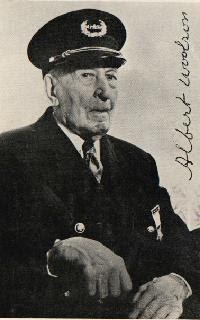
Interestingly enough, Albert Woolson, the oldest living veteran of the U.S. Civil War was still alive that year here in Duluth, Minnesota. Born in 1850, he served briefly as a teen in the last year of that war national conflict.

Woolson was not originally from the Northland but settled here later in life. His home on Duluth's Central Hillside was just a few houses from the first home of Bobby Zimmerman, who became known world wide as Bob Dylan. It's been said that on the Fourth of July the neighborhood boys would march up the alley behind Woolson's house and salute him as they went by. The young Dylan walked past that house every day during his first year of school, attending the Nettleton Elementary School two blocks away.

It is possible that Dylan's later interest in the Civil War was, in part, stimulated by these early memories. His song 'Cross the Green Mountain was written and recorded for the 2003 film Gods and Generals. It was included on the soundtrack for that movie and also included on his own album Tell Tale Signs in 2008, one of my favorite Dylan albums.

* * *
Gods and Generals was a Civil War drama written and directed by Ronald F. Maxwell based on a book by the same name by Jeffrey Shaara. Despite the praise heaped on this film and its sister project Gettysburg, I expected a story that would stir me. I could not have been more wrong. 

What follows are my impressions of the film. 

The Good.
The cinematography... Some beautiful camera work at times.
Dylan's elegant "Cross the Green Mountain. playing over the closing credits.
The film succeeded at depicting how clumsy it was to re-load a musket when you're in the heat of battle.

The Bad.
Hours of endless hokey music overlaying every speech and all the action.
Weak acting in the battle scenes.
Hokey speeches. Some being given in such a way that they were nothing more than soliloquies dribbling into the breeze.
Fake beards and mustaches. 
Maudliin sentimentality.
And then there were the inaccuracies.
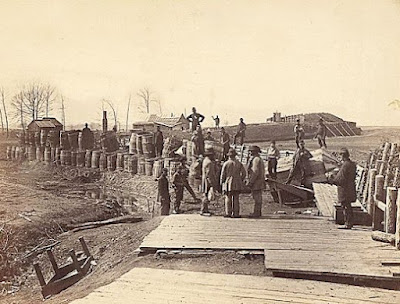
Manassas Fortifications (National Archives)
I will point to just one of the inaccuracies that stood out for me. There is a scene in which the army requests permission to use an estate as a hospital. They set up an operating table. There is an exchange of dialogue. But there are no moans, no groans, no screaming. Everything is peaceful and quiet.

By way of contrast, U.S. Grant in his autobiography (which I've devoured twice) describes an instance in which it was raining and cold and the wounded men were being worked on in the officers tent. He says the screaming and groaning was so loud that he went out and slept under a tree in the rain so he could get some needed rest.  

*

"Ours is not to reason why. Ours is but to do or die."
--Alfred Lord Tennyson, Charge of the Light Brigade

This film is purportedly about General Stonewall Jackson. Of the 20 greatest battles in world history as regards military strategy, 12 were conceived by Napoleon. Only two were conceived and executed by generals of the Civil War. One of these was the Battle of Vicksburg, carried out by General U.S. Grant. The other was General Stonewall Jackson's Shenandoah campaign.
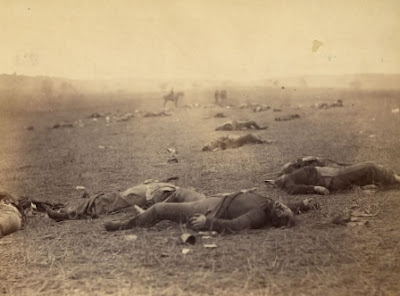
Dead on battlefield at Gettysburg. (National Archives)
Gettysburg was the first in this series of three films. (The third, I believe, was abandoned after the second was an epic fail.) Gods and Generals, the second in the series, which was actually a prequel, much like the superhero films Batman and Superman. With Stonewall Jackson as centerpiece and a cast of thousands (of extras performing their authentic re-enactment efforts) led by generals and officers whose idea of strategy seems to be having men march forward into withering gunfire, the film had potential as an idea. Rotten Tomatoes notes that only 8% of the critics reviewing it gave it a positive rating. 

I wanted to watch the film for two reasons. First, because Bob Dylan wrote a song for it, and second, because I wanted to see how they portrayed the Shenandoah campaign. To my surprise, there were no signs of Jackson's brilliance as a leader. And the director seems to have had no clue as to why the Shenandoah campaign had any importance at all.

The following statements, extracted from reviews I found at imdb.com, express some of my own impressions of the film.

A ridiculously long and staggering film that trips over itself in a drunken stupor so much that it becomes one of the biggest duds the cinema has ever seen.

and

Gods and Generals is targeted directly at the CWBs out there, a.k.a. the Civil War Buffs. It is so painstakingly boring and dull that only the fanatics could care about it. It is as if any interest in the film is tossed aside, just so the small amount of true CWBs out there can enjoy it, and nudge each other when their favorite historical figure comes on screen.

Someone else titled their review...

Great visuals, but where's the drama?

Another comment extract:

I found this dull, boring, and some of the worst war scenes ever in a movie. The battle scenes were not realistic and should have been saved for a TV movie.

* * * 

Sorry to belabor my point. Just trying to paint the picture.
If you like Civil War history, these links will interest you.

Related Links

Those Topps Civil War Cards Were Graphic But We Loved Them

Four Books About U.S. Grant

More Quotes Showing Why U.S. Grant Was Such an Inspirational Leader

Tuesday, August 7, 2018

New Insights About the Albert Woolson Statue by Dr. Avard Tennyson Fairbanks

In 2015 I wrote a blog post about the Bob Dylan-Albert Woolson connection. Young Bob was a Zimmerman then, but he lived just around the corner from the man who became the last surviving Civil War veteran before his passing. In that particular post I shared an anecdote by Don Dass (Bob Dylan Way committee) regarding how the neighborhood kids would parade past his house on Veterans Day (or it may have been his birthday or some other special occasion). Young Bob was undoubtedly one of these zealous marchers.

I learned all that because I'd become inquisitive about the statue of Albert Woolson that sits in front of the Duluth Depot where the Historical Society offices are as well as the Train Museum and the Duluth Art Institute.

That's not the new insight that prompted this post. What initially prompted this post was the discovery that there is a second statue honoring this Civil War veteran. It's located inside Duluth City Hall, a bust of Albert Woolson. To see it, walk through the first floor entrance and turn to your right. There is a dark underlit alcove there with the Woolson bust on a pedestal.

I discovered the bust while heading to a meeting of the Duluth Public Arts Commission last month. It was out of curiosity that I sauntered over to the alcove, thinking, "I wonder who this is." The plaque identifies it as the bust of Albert Woolson.

Though I failed to catch the name of the artist, I did proceed to learn the name of the artist who produced the life-sized sculpture of a seated Woolson in all his dignity. The artist was Dr. Avard Tennyson Fairbanks, a prolific 20th-century American sculptor with notable work in the U.S. Capitol, including one of Lincoln, as well as the capitols of Utah and Wyoming. This statue is a patinated bronze. (I did later learn that Dr. Fairbanks also did the bust in City Hall.)

The nearly ubiquitous Ram
is a Fairbanks design.
According to the Britannica, "Fairbank's numerous works include a bronze medal of courage presented to British Prime Minister Winston Churchill by Canadian Prime Minister William Mackenzie King, the monument to Lycurgus, the Lawgiver. in Sparta, and Rain, selected as one of the greatest U.S. sculptures for Brookgreen Gardens in South Carolina." 

According to Wikipedia "Fairbanks studied at the Art Students League of New York beginning at age 13 and the École nationale supérieure des Beaux-Arts in the atelier of Jean Antoine Injalbert beginning at age 17. Fairbanks received his bachelor’s degree from Yale University and his master’s degree from the University of Washington. For three years Fairbanks studied on a Guggenheim Fellowship in Florence, Italy. He received his Ph.D. in anatomy from the University of Michigan. He was also a professor of sculpture at the University of Michigan. His father was John B. Fairbanks, who was an artist and art professor. His mother, Lilly Annetta Huish, died about a year after he was born. she was a cousin of Orson Pratt Huish. Avard’s brother J. Leo Fairbanks was also an artist, and helped Fairbanks start sculpting as a teenager. Among Fairbanks’ children is Jonathan Leo Fairbanks, who was curator of the Boston Museum of Fine Arts in the early 1990s."

Possibly his most well-known artistic contribution was designing the Ram emblem for Dodge. I'll bet you didn't know that!

* * * *
Meantime art goes on all around you. Get into it.

Tuesday, November 24, 2015

The Dylan-Woolson Connection

The Albert Woolson statue in front of the Depot.
For years I've been going to events at the Duluth Depot that houses the Duluth Art Institute, Historical Society, Train Museum and Playhouse. It's strange to think that all this time I've walked past this statue that sits out front without ever wondering who it was or why it was there. This summer I decided to check it out and learned that it's a Duluthian named Albert Woolson, who at the time of his passing was the last living veteran of the Civil War.

He was young when he entered the service, only 15, as a drummer boy in Company C, 1st Minnesota Heavy Artillery Regiment. When he died in 1956 Life magazine ran a seven-page story about our last connection to that war between the states. (You can read more at Wikipedia.)

This summer I took photos of the Woolson statue intending to write a blog post about this man when Saturday, at the 100th anniversary of the Duluth Armory, Don Dass of the Dylan Way Committee told me the most fascinating anecdote about how the kids in the Central Hillside would parade past the elderly Woolson's home each year. What makes it intriguing is that young Robert Zimmerman lived just a couple houses down the alley from Woolson and had almost certainly been part of that children's parade. Here's Don's account along with a map showing the Zimmerman home and its relation to the Woolsons:

Hand-drawn map shows relationship of the two homes.
"A few years ago during Dylan Days I heard a story from a woman who owned an art gallery in Canal Park. She had gone to kindergarten with Robert Zimmerman at Nettleton and she said it was the tradition for students to parade past Albert Woolson's house on either Veterans Day or on his birthday. (She couldn't remember which it was.) I thought that was a remarkable coincidence even before I read the November 11, 2015, article about Woolson in the DNT and noticed a picture of him standing outside his home with a lot of small children gathered before him. I thought of that story I'd been told and realized that here was photographic evidence of those occasions. In reading the piece I came across the address where Woolson had spent his later years -- 215 5th Ave. E. Close to Nettleton and even closer to the Zimmerman home at 519 N. 3rd Avenue E. I had to make a little sketch so I could verify what was just coming together in my mind. Dylan and Woolson lived on the same block, shared the same alley, scarcely a stone's throw apart. I find it almost beyond ironic that the last officially documented survivor of the Civil War and Bob Dylan lived not only in the same smallish city, but apparently actually lived almost next door to one another."

Young Robert Zimmerman lived upstairs here till age 6
Now here's something cool. If you use Google Maps here's what you will see when you do the "Street View".  (Mr. Woolson lived on the East, or right, side of the brick duplex.) Now, if you turn to the right and go to the end of the block, then make a left, go up the hill to the alley and look left, there's the house where young Dylan lived the first six years of his life. The alley referred to above is on the left side of this house.

Next May if you're in town for Dylan Fest, and the celebration of Bob Dylan's 75th birthday, you might enjoy taking a side trip up the hill to this house and that alley alongside it.... remembering that the oldest survivor of the Civil War lived his last years "a stone's throw away."

Is it possible these early memories of the old Civil War veteran played a role in Dylan's writing Cross the Green Mountain for the Civil War trilogy Gods and Generals?


Popular Posts