Showing posts with label Veteran's Day. Show all posts

Thursday, November 11, 2021

Gods and Generals: The Good, the Bad and the Boring

Today is Veterans Day. Originally this was Armistice Day, celebrating the end of World War I, which was terminated on the 11th hour of the 11th day of the 11th month of 1918. Armistice Day was renamed Veteran's Day in 1954.
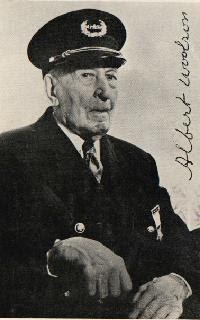
Interestingly enough, Albert Woolson, the oldest living veteran of the U.S. Civil War was still alive that year here in Duluth, Minnesota. Born in 1850, he served briefly as a teen in the last year of that war national conflict.

Woolson was not originally from the Northland but settled here later in life. His home on Duluth's Central Hillside was just a few houses from the first home of Bobby Zimmerman, who became known world wide as Bob Dylan. It's been said that on the Fourth of July the neighborhood boys would march up the alley behind Woolson's house and salute him as they went by. The young Dylan walked past that house every day during his first year of school, attending the Nettleton Elementary School two blocks away.

It is possible that Dylan's later interest in the Civil War was, in part, stimulated by these early memories. His song 'Cross the Green Mountain was written and recorded for the 2003 film Gods and Generals. It was included on the soundtrack for that movie and also included on his own album Tell Tale Signs in 2008, one of my favorite Dylan albums.

* * *
Gods and Generals was a Civil War drama written and directed by Ronald F. Maxwell based on a book by the same name by Jeffrey Shaara. Despite the praise heaped on this film and its sister project Gettysburg, I expected a story that would stir me. I could not have been more wrong. 

What follows are my impressions of the film. 

The Good.
The cinematography... Some beautiful camera work at times.
Dylan's elegant "Cross the Green Mountain. playing over the closing credits.
The film succeeded at depicting how clumsy it was to re-load a musket when you're in the heat of battle.

The Bad.
Hours of endless hokey music overlaying every speech and all the action.
Weak acting in the battle scenes.
Hokey speeches. Some being given in such a way that they were nothing more than soliloquies dribbling into the breeze.
Fake beards and mustaches. 
Maudliin sentimentality.
And then there were the inaccuracies.
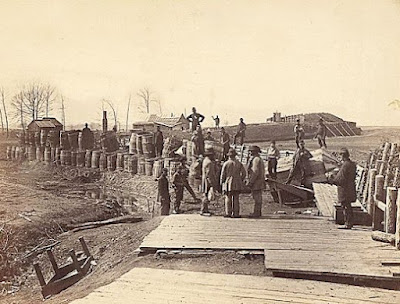
Manassas Fortifications (National Archives)
I will point to just one of the inaccuracies that stood out for me. There is a scene in which the army requests permission to use an estate as a hospital. They set up an operating table. There is an exchange of dialogue. But there are no moans, no groans, no screaming. Everything is peaceful and quiet.

By way of contrast, U.S. Grant in his autobiography (which I've devoured twice) describes an instance in which it was raining and cold and the wounded men were being worked on in the officers tent. He says the screaming and groaning was so loud that he went out and slept under a tree in the rain so he could get some needed rest.  

*

"Ours is not to reason why. Ours is but to do or die."
--Alfred Lord Tennyson, Charge of the Light Brigade

This film is purportedly about General Stonewall Jackson. Of the 20 greatest battles in world history as regards military strategy, 12 were conceived by Napoleon. Only two were conceived and executed by generals of the Civil War. One of these was the Battle of Vicksburg, carried out by General U.S. Grant. The other was General Stonewall Jackson's Shenandoah campaign.
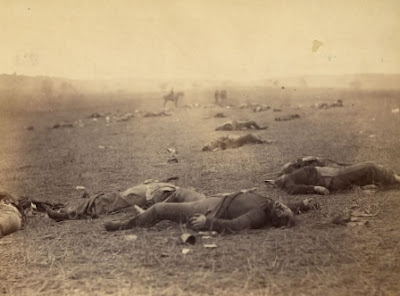
Dead on battlefield at Gettysburg. (National Archives)
Gettysburg was the first in this series of three films. (The third, I believe, was abandoned after the second was an epic fail.) Gods and Generals, the second in the series, which was actually a prequel, much like the superhero films Batman and Superman. With Stonewall Jackson as centerpiece and a cast of thousands (of extras performing their authentic re-enactment efforts) led by generals and officers whose idea of strategy seems to be having men march forward into withering gunfire, the film had potential as an idea. Rotten Tomatoes notes that only 8% of the critics reviewing it gave it a positive rating. 

I wanted to watch the film for two reasons. First, because Bob Dylan wrote a song for it, and second, because I wanted to see how they portrayed the Shenandoah campaign. To my surprise, there were no signs of Jackson's brilliance as a leader. And the director seems to have had no clue as to why the Shenandoah campaign had any importance at all.

The following statements, extracted from reviews I found at imdb.com, express some of my own impressions of the film.

A ridiculously long and staggering film that trips over itself in a drunken stupor so much that it becomes one of the biggest duds the cinema has ever seen.

and

Gods and Generals is targeted directly at the CWBs out there, a.k.a. the Civil War Buffs. It is so painstakingly boring and dull that only the fanatics could care about it. It is as if any interest in the film is tossed aside, just so the small amount of true CWBs out there can enjoy it, and nudge each other when their favorite historical figure comes on screen.

Someone else titled their review...

Great visuals, but where's the drama?

Another comment extract:

I found this dull, boring, and some of the worst war scenes ever in a movie. The battle scenes were not realistic and should have been saved for a TV movie.

* * * 

Sorry to belabor my point. Just trying to paint the picture.
If you like Civil War history, these links will interest you.

Related Links

Those Topps Civil War Cards Were Graphic But We Loved Them

Four Books About U.S. Grant

More Quotes Showing Why U.S. Grant Was Such an Inspirational Leader

Monday, November 12, 2012

Anna Ladd: An Artist Who Helped Veterans

A recurring theme in my blogs has been showing the variety of ways creativity is being expressed. I've written about people who paint outdoors, indoors, and on doors; who paint dogs, who paint realistic, who paint abstract; who make pictures in oils, acrylics, mixed media and Conte crayons. There are also writers, poets, musicians and photographers. And there are sculptors.

While sifting through some old periodicals yesterday I came across a fascinating article in The History Channel Magazine about a sculptor named Anna Ladd.

But first…

One of the great films of the 1980s was the powerfully memorable Chariots of Fire. It’s a story of two British track and field athletes striving for gold in the 1924 Olympics. Early in the film there is a scene in a bus station that sets the post-WWI context for this film. As the athletes climb aboard we see men with a variety of contraptions on their faces and bodies, revealing the physical handicaps they came away with after their service in “the Great War.”

This is where Anna Ladd’s story comes in, and the History Channel article begins:

In the final months of 1917, groups of wounded soldiers began arriving at an artist’s studio on Rue Notre-Dame-des-Champs in the Latin Quarter of Paris. Moving haltingly and sometimes guided by helpers, they entered a courtyard filled with statues, climbed five flights, and found themselves in a large room illuminated by tall windows and banks of skylights. Their host was an imposing American with high cheekbones and pinned-back hair, a 39-year-old Bostonian named Anna Coleman Ladd. She gave them dominoes and checkers to occupy them, refreshed them with chocolates and white wine, and offered them newspapers.

As the men laughed and smoked, Ladd examined them. She studied their shot-off jaws, missing noses, and scarred and empty eye sockets. Doctors could not restore these soldiers to handsomeness, or even to ordinariness. But as a sculptor, Ladd could apply talents that the doctors lacked. She could make new faces—masks—for the men, beautifully crafting them of copper, metallic foil, and paint. And wearing their prosthetic masks, the soldiers could return to the families, fiancĂ©es, and friends they had been afraid to allow in their unsightly presence.


Physical pain is very challenging to the psyche, but disfigurement goes deeper. The film Vanilla Sky deals with the challenges David Aames, a handsome but spoiled, ultra-wealthy son of a publishing magnate must deal with when he is mutilated in a dramatic car wreck. The experience cuts to the core of who he is.

Yes, Vanilla Sky is a surreal story, but there’s nothing surreal about war. That’s why Anna Ladd, when she saw what World War I had done to many of the men who put their lives on the line, she decided to do something about it.

Ladd was an American sculptor in Massachusetts. She’s studied in Paris and Rome, but married a doctor in the States, moving to Boston in 1905. She was also a writer, producing two books and two unproduced plays. It was 1917, while they were living in Paris in her late 30’s, that she saw the cruel impact of the great conflict.

As a sculptor who had studied under Auguste Rodin, among others, Ladd used her talent to “fix faces” broken by the war. On this Veteran’s Day as we honor those who sacrificed so much, let us also remember the doctors, nurses, volunteers and even artists who have used their gifts to help bring them back.

Read here the full story of Anna Ladd’s Masks.

EdNote: Anna Ladd's Masks, written by Jack El-Hai, first appeared in the July-August issue of The History Channel Magazine and was later posted on their website in 2009.

Popular Posts