Showing posts with label George Orwell. Show all posts

Thursday, November 18, 2021

Orwell On Media Mischief

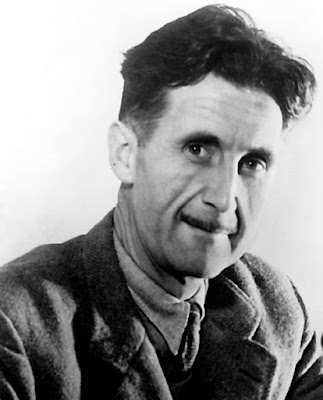
Eric Blair, a.k.a. George Orwell
This year I have been on something of an Orwell jag. After reading 1984 and Animal Farm last year I dove into Thomas E. Ricks' Churchill and Orwell this spring, which ignited a renewed interest in reading more Orwell. According to Ricks, both Churchill and Orwell produced their best work at the end of their writing careers.

In the case of Orwell, the books 1984 and Animal Farm were his best, but Ricks cited Homage to Catalonia as a turning point. I thus purchased Homage to Catalonia, in part because of the Ricks endorsement and in part because of a recurring interest in the Spanish Civil War. 

But Ricks also noted that Orwell, whose birth name was Eric Blair, wrote innumerable essays in the twilight of his career. (He only lived to be 47.) Currently I have been dipping in to a collection of narrative essays assembled under the title Facing Unpleasant Facts.

The essay currently in my hands during my bedtime reading is titled Looking Back On The Spanish War. In the fourth section of the essay he discusses the manner in which the media cover events, not just the specificities of the Spanish conflict but media in general. It is no wonder that people are so misinformed, as all the events we read about are mediated to us. We are not there and so we rely on others to convey what is happening.

Here's what Orwell has to say about this.

The struggle for power between the Spanish Republican parties is an unhappy far off thing which I have no wish to revive at this date. I only mention it in order to say: believe nothing, or next to nothing, of what you read about internal affairs on the Government side. It is all, from whatever source, party propaganda--that is to say, lies.

A little further down the page he writes:

Early in life I had noticed that no event is ever correctly reported in a newspaper, but in Spain, for the first time, I saw newspaper reports that did not bear any relation to the facts, not even the relationship which is implied in an ordinary lie.

I saw great battles reported where there had been no fighting, and complete silence where hundreds of men had been killed. I saw troops who had fought bravely denounced as cowards and traders, and others who had never seen a shot fired hailed as the heroes of imaginary victories; and I saw newspapers in London retailing those lies and eager intellectuals building emotional superstructures over events that had never happened. I saw, in fact, history being written not in terms of what happened but of what ought to have happened according to various "party lines.”

These observations seemed to jump off the page in light of current events and a few experiences from my own lifetime. 

Something to think about.

* * *

Related Links


Orwell's Homage to Catalonia Is Instructive on Many Levels, Plus a Good Read


Staying Human Is What Is Important

Bertrand Russell's Free Thought and Official Propaganda Has Much to Say about the Current State of Cancel Culture


He Who Controls the Narrative Controls the People

Wednesday, November 3, 2021

Yes, the Soviet Union Was an Evil Empire, Though We Have Our Issues As Well

I'd like to share two articles from the December 2021 Reason magazine. I would have shared this last night except I was distracted by the Tuesday election results along with the climax of the World Series. (Congratulations, Braves fans.)

Reason routinely produces excellent journalism that fails to get the recognition it deserves. The first article is from their December issue marking the 30th anniversary of the collapse of the Soviet Union. Like Nobel Laureate Aleksandr Solzhenitsyn, she brings an insider's view to this in depth story that has contemporary applications.

The second article ought to keep us from gloating. To fight for freedom means we have to be humble, vigilant and aware. 

Yes, It Was An "Evil Empire"

It was the summer of 1983, and I, a Soviet émigré and an American in the making, was chatting with the pleasant middle-aged woman sitting next to me on a bus from Asbury Park, New Jersey, to Cherry Hill. Eventually our conversation got to the fact that I was from the Soviet Union, having arrived in the U.S. with my family three years earlier at age 17. "Oh, really?" said my seatmate. "You must have been pretty offended when our president called the Soviet Union an 'evil empire'! Wasn't that ridiculous?" But her merriment at the supposed absurdity of President Ronald Reagan's recent speech was cut short when I somewhat sheepishly informed her that I thought he was entirely on point.

* * *

The woman on the bus in 1983 did not surprise me. By then, I had already met many Americans for whom "anti-Soviet" was almost as much of a pejorative as it had been in the pages of Pravda, the official newspaper of the Soviet Communist Party. My favorite was a man in the café at the Rutgers Student Center who shrugged off the victims of the gulag camps by pointing out that capitalism kills people too—with cigarettes, for example. When I recovered from shock, I told him that smoking was far more ubiquitous in the Soviet Union, and anti-smoking campaigns far less developed. That momentarily stumped him.

You can read the full story here. Cathy Young's account is loaded with insights.

* * * * 

The second story is a reprint from 2013. It's a must read because it shows the extent to which the U.S. is involved in illegal domestic surveillance. 

Thank You, Edward Snowden

"The NSA has turned the internet into a giant surveillance platform."

Last week the Cato Institute put on a terrific conference about unconstitutional domestic spying. The Cato conference took place after a summer of alarming revelations of just how deep and extensive the feds' secret surveillance of our everyday communications had become. The conference, held at the institute's downtown D.C. headquarters, brought some of the most knowledgeable Internet luminaries together with some of the fiercest fighters for Americans' Fourth Amendment rights.

Watchdog organizations such as the Electronic Frontier Foundation (EFF) and the American Civil Liberties Union (ACLU) had sought for years to expose the extent and depth of federal surveillance, but their efforts were largely stymied by the very walls of secrecy they were trying to breach...

The walls of surveillance secrecy were finally cracked by the June revelations of whistleblower Edward Snowden. Snowden's files conclusively show that the federal government has been operating a vast spying program that violates the Fourth Amendment rights of tens of millions of ordinary Americans.

This one, written by Ronald Bailey, is another good read:
Thank You, Edward Snowden

* * * 

Related Links

Solzhenitsyn on World Communism

George Orwell: Insight from a Man Who Saw It All

Friday, October 1, 2021

The Bells of Rhymney, A Lamentation

West Virginia Coal Miner (Public Domain)
Both of my grandfathers worked in the West Virginia coal mines for a short period of their lives. As anyone who has read about life in those underground coal mines one hundred years ago, it was "dark as a dungeon" down in those mines, and the work was dangerous.

My mother's father would leave for the mines on Sunday night and return home on Saturday morning. My grandmother boldly did the unthinkable by heading to the mine on Friday night so she could be with her man two nights a weekend and not just the one. 

On one occasion a section of mine collapsed and my grandfather and others barely escaped with their lives. He told the other miners not to say a word to anyone, because his wife would not approve of him working in the mines if it was going to cost him his life.

Nevertheless, my grandmother was an exceedingly intuitive woman and the evening of the near-disaster (no one was killed) she sat up in bed and sensed that something had happened at the mine. When she later confronted my grandfather he initially denied it, but when she presented the exact day and time of her sense that something had occurred, he admitted that yes, there had been a mining accident.

The Bells of Rhymney is about mining disasters, mining accidents that cost men their lives. Pete Seeger recorded the song, but its words were penned by a Welsh poet, Idris Davies. I first heard the song when the Byrds recorded it and later included it on their Greatest Hits album.

It's a sorrowful song about a sorrowful reality, many laborers lost their lives while providing for their families (and making rich people richer.)

In listening to the song last night, George Orwell's Road to Wigan Pier was fresh in my mind. The book goes into great detail regarding the hardships of the working class in pre-WW2 England. While living with the miners of Manchester, Orwell saw up close the grittiness of a life where nearly every dignity has been stripped away. His description of what was involved in simply going to work (walking nearly a mile underground while hunched over) is vividly made tangible.

The church bells of Rhymney are sad bells because men have lost their lives. It's not a Sunday morning call to worship. They are funeral bells. The poem then cites other mining towns where bells have tolled for those who were lost--Merthyr, Rhondda, Blaina, Newport, Caerphilly, Swansea, Neath and Wye.

The Byrds version of the song was recorded in April 1965. Roger McGuinn's trademark 12-string Rickenbacker and the group's harmonious melancholy vocals popularized the song. But it's especially poignant when you hear Pete Seeger's rendition. You can listen to The Byrds' version of the song here and a Pete Seeger performance of the song here

* * * 

The Bells of Rhymney
Oh, what will you give me?
Say the sad bells of Rhymney
"Is there hope for the future?"
Say the brown bells of Merthyr
"Who made the mine owner?"
Say the black bells of Rhondda
"And who killed the miner?"
Say the grim bells of Blaina
They will plunder will-nilly
Cry the bells of Caerphilly
They have fangs, they have teeth
Shout the loud bells of Neath
Even God is uneasy
Say the moist bells of Swansea
And what will you give me?
Say the sad bells of Rhymney
"Throw the vandals in court"
Say the bells of Newport
"All will be well if, if, if, if, if-"
Say the green bells of Cardiff
"Why so worried, sisters, why?"
Say the silver bells of Wye
"And what will you give me?"
Say the sad bells of Rhymney
"Oh, what will you give me?"
Say the sad bells of Rhymney
"Is there hope for the future?"
Say the brown bells of Merthyr
"Who made the mine owner?"
Say the black bells of Rhondda
"And who killed the miner?"
Say the grim bells of Blaina
Songwriters: Pete Seeger / Idris Davies

Friday, August 6, 2021

Orwell's Homage to Catalonia Is Instructive on Many Levels, Plus a Good Read

After reading Thomas E. Ricks' Churchill and Orwell: The Fight for Freedom, I knew I had to read Orwell's Homage to Catalonia, the book Orwell wrote preceding Animal Farm and 1984. To paraphrase one Amazon reviewer, a
lmost no war is both more pivotal to 20th century history and less understood by young and old alike today.

I've long been fascinated by the Spanish Civil War without fully comprehending what really happened there. Picasso's Guernica was inspired by an event in that conflict. Hemingway's For Whom the Bell Tolls provides images of horrors that took place at that time, placing a microscope on the characters interacting in a specific event.

When I was in high school I took an interest in Leon Trotsky (because my first name is Leon) with very little understanding of Communism, socialism or any other ism. I knew that he was assassinated in Mexico but I didn't know why he was living there.

When we went to Mexico in 1980 to work at an orphanage in Monterrey, I was only partially surprised to see the hammer and sickle insignia painted on walls there. By then I'd already known that 40,000 communists fled Spain after Franco took power. I did not understand that the communists and socialists were splintered into additional factions, one of them being the Trotskyites. These were the ones who fled to Mexico because of Stalin's efforts to eradicate adversaries and consolidate power.

In short, this book helps illuminate a somewhat confusing period of history.

On a larger scale, the Spanish Civil War was a place where modern technology was used to subdue opponents in a new destructive way as never before. Hitler and Mussolini helped arm Franco and the Fascists. In return they gained many insights that would be applied in the coming global conflict

* * * 
The big surprise for me as I began this book was learning that Orwell went to Catalonia not as a journalist but to fight. Most of the book is about his experiences in the trenches or in training. It is a detailed account of the war's degradation and insanity. He does not gloss over anything with regards to the smells, the lice, the confusion. Late in the book he is shot through the neck and his descriptions here are remarkably detailed. Had he not survived we'd never have had the opportunity to be enriched by Animal Farm and 1984.

Orwell's book, among other things, clearly aims to dispel the notion that war is glamorous.

* * * 
An Amazon reviewer from the UK wrote this about Homage:

I had to buy this again. I was 21 when I read this. Now, I'm 45. I'm a life long socialist and this book sums up perfectly how the left always fights itself more than the opposition. This is the book I always quote whenever the left turns in on itself (which is always!.) "My cause is more important than your cause etc." is pretty much the left. 70 odd years later, it's still the same lol


Charlie Calvert, another Amazon reviewer, wrote:

This classic book is a cure for idealism. It raised my political awareness about the Spanish Civil War and human nature. The tale Orwell has to tell is relentlessly depressing and frequently shocking. Soldiers are rushed into battle with little training and fewer weapons. Idealists take charge and murder innocents on the slightest of pretexts. The weather is terrible, the food worse and despite the optimism of the troops, one feels they know there is little chance of beating Franco.


For those unfamiliar, Catalonia is a section of Spain located in the far Northeast, a triangle of four counties adjacent to France and the Mediterranean.

* * * 
One reason this war was so complicated is that historians wrote little about it, or oversimplified it because that is always the easy way out. If taught at all, this was a Civil War between the Nationalists and the Republicans. Orwell dissects these two groups into multiple factions that include fascists, anarchists, socialists, Stalinists, Trotskyists, POUM, UGT, CNT, revolutionaries and foreign mercenaries. All together it was a mishmash of groups with differentiating agendas.

Orwell shows the uses to which propaganda was being used to manipulate public opinion. When Stalin began to purge the Trotskyists from the program, the word had a fluid meaning so that anyone the Stalinist regime didn't like could be called a Trotskyist with no opportunity for a trial. In order to win public opinion against Trotskyists the papers printed stories that said Trotskyists were actually Fascists posing as revolutionaries.

* * * 
Orwell saw first-hand the ways in which propaganda helped lay the groundwork for mass manipulation. Propaganda was a key feature in both Animal Farm and 1984. During this period of upheaval in Spain, Stalin was actively consolidating his power. 

For writers, there are some really nice sentences. I liked this one, for example:
"We were near the front line now, near enough to smell the characteristic smell of war--in my experience the smell of excrement and decaying food."

Here's another:
"The hills opposite us were grey and wrinkled like the skins of elephants."

* * * 
Whereas the book is helpful in giving us a richer understanding of the Spanish Civil War, I believe you will also see many lessons for the times we live in today. I believe astute readers will see many takeaways from this account.
Friday, November 15, 2019

Flashback Friday: Did you Know George Orwell Took a Stand Against Paperbacks?

Illustration by Tara Stone
Not sure if you have been following the conflict between Hachette and Amazon regarding publishing and especially eBook pricing. As an eBook author using the Kindle Direct Publishing system, I was on the receiving end of an interesting email this morning. I found it interesting to learn that book publishers were seriously frustrated when the paperback book industry emerged with low cost alternatives to expensive hardcover books that the majors stocked shelves with. Especially surprising was George Orwell's response to this upstart industry.

Here's the first portion of the letter I received. I've included a link at the end so you read the whole of it, including the call to action. 


Dear KDP Author,
Just ahead of World War II, there was a radical invention that shook the foundations of book publishing. It was the paperback book. This was a time when movie tickets cost 10 or 20 cents, and books cost $2.50. The new paperback cost 25 cents – it was ten times cheaper. Readers loved the paperback and millions of copies were sold in just the first year. With it being so inexpensive and with so many more people able to afford to buy and read books, you would think the literary establishment of the day would have celebrated the invention of the paperback, yes? Nope. Instead, they dug in and circled the wagons. They believed low cost paperbacks would destroy literary culture and harm the industry (not to mention their own bank accounts). Many bookstores refused to stock them, and the early paperback publishers had to use unconventional methods of distribution – places like newsstands and drugstores. The famous author George Orwell came out publicly and said about the new paperback format, if “publishers had any sense, they would combine against them and suppress them.” Yes, George Orwell was suggesting collusion. Well… history doesn’t repeat itself, but it does rhyme.

Fast forward to today, and it’s the e-book’s turn to be opposed by the literary establishment. Amazon and Hachette – a big US publisher and part of a $10 billion media conglomerate – are in the middle of a business dispute about e-books. We want lower e-book prices. Hachette does not. Many e-books are being released at $14.99 and even $19.99. That is unjustifiably high for an e-book. With an e-book, there’s no printing, no over-printing, no need to forecast, no returns, no lost sales due to out of stock, no warehousing costs, no transportation costs, and there is no secondary market – e-books cannot be resold as used books. E-books can and should be less expensive.

Perhaps channeling Orwell’s decades old suggestion, Hachette has already been caught illegally colluding with its competitors to raise e-book prices. So far those parties have paid $166 million in penalties and restitution. Colluding with its competitors to raise prices wasn’t only illegal, it was also highly disrespectful to Hachette’s readers.

The fact is many established incumbents in the industry have taken the position that lower e-book prices will “devalue books” and hurt “Arts and Letters.” They’re wrong. Just as paperbacks did not destroy book culture despite being ten times cheaper, neither will e-books. On the contrary, paperbacks ended up rejuvenating the book industry and making it stronger. The same will happen with e-books.

Many inside the echo-chamber of the industry often draw the box too small. They think books only compete against books. But in reality, books compete against mobile games, television, movies, Facebook, blogs, free news sites and more. If we want a healthy reading culture, we have to work hard to be sure books actually are competitive against these other media types, and a big part of that is working hard to make books less expensive.

Illustration by the author.
Moreover, e-books are highly price elastic. This means that when the price goes down, customers buy much more. We've quantified the price elasticity of e-books from repeated measurements across many titles. For every copy an e-book would sell at $14.99, it would sell 1.74 copies if priced at $9.99. So, for example, if customers would buy 100,000 copies of a particular e-book at $14.99, then customers would buy 174,000 copies of that same e-book at $9.99. Total revenue at $14.99 would be $1,499,000. Total revenue at $9.99 is $1,738,000. The important thing to note here is that the lower price is good for all parties involved: the customer is paying 33% less and the author is getting a royalty check 16% larger and being read by an audience that’s 74% larger. The pie is simply bigger.

But when a thing has been done a certain way for a long time, resisting change can be a reflexive instinct, and the powerful interests of the status quo are hard to move. It was never in George Orwell’s interest to suppress paperback books – he was wrong about that.

You can read the rest of this letter at www.readersunited.com I'd be interested in hearing what you think.

Do you read eBooks? Do you have a Kindle or eReading device? Do you read books on your iPhone? Leave a comment. Inquiring minds want to know.

# # # #

Featured eBook of the Day: The Red Scorpion
To purchase any of my other books, click on the covers at the right... No shipping. You may purchase and download these stories from nearly anywhere in the world. 

Monday, August 19, 2019

Notes from an Old Card Catalog

As I continue my assault on getting organized, I keep finding things I'd forgotten I had. The other day I decided to examine several small boxes containing 3'x 5" note cards, the kind we used to use in high school and college when doing research for a paper.

One such box from four decades ago had a lot of notes about cults, with one of these quoting a writer as saying cults are the biggest threat to America today. It's been a long time since cults were front page news.

Here are some quotes that I found intriguing from this another batch of note cards.

* * * *

"People judge us by what they see--our actions, our means--not our intentions."--Jacques Ellul

"A people which no longer remembers has lost its history and its soul."--Aleksandr Sozhenitsyn

"There is a powerful tendency to move from the conviction that one knows the public good to the use of (force) power to impose that good."--Jeanne Kirkpatriick

"Within the last decade there have been many references from varied sources to the fact that the Western world stands on the verge of a spiritual rebirth, that is, a fundamental change of attitude toward the value of life."--Cary F. Baynes, translator's preface to Jung's Modern Man in Search of a Soul (1933)

Solipsism: the view that there is no reality outside of the self; all things relate solely to the experiences of the observer.

"A rising mass movement attracts and holds a following not by its doctrine and promises, but by the refuge it offers from the anxieties, barrenness and meaninglessness of an individual existence."--Eric Hoffer, The True Believer

"Three things are to be looked to in a building: that it stand on the right spot; that it be securely founded; that it be successfully executed."--Johann Wolfgang von Goethe

"There is always inequity in life. Some men are killed in a war and some are wounded, and some men never leave the country."--John F. Kennedy, March 21, 1962 press conference

"All animals are equal, but some animals are more equal than others."--George Orwell, Animal Farm


* * * * 


Monday, August 15, 2016

Public Introspection: George Orwell's Why I Write

"From a very early age, perhaps the age of five or six, I knew that when I grew up I should be a writer. Between the ages of about seventeen and twenty-four I tried to abandon this idea, but I did so with the consciousness that I was outraging my true nature and that sooner or later I should have to settle down and write books." ~George Orwell

This past week I came across a George Orwell quote that went something like this: "I learned from an early age not to believe anything I read in the newspapers." But when I tried to find it, to confirm that my recollection was accurate, I instead stumbled upon an Orwell essay titled "Why I Write" which begins with a similar sequence of words. "From a very early age..."

The essay starts off by explaining the young George Orwell's upbringing, exposure to and interest in poetry, and other factors that led to his taking up an interest in writing. After setting the stage he begins a transition paragraph with this sentence.

I give all this background information because I do not think one can assess a writer's motives without knowing something of his early development.

If there are any writers reading this post, I propose that you take some time to reflect on that sentence and mull over the role your own early development played in your becoming a writer. In a broader sense we could all benefit from reflection on that point, how our early development contributed to who we are and what we're doing today.

Orwell then elaborates on the four primary motivations for writing.

Putting aside the need to earn a living, I think there are four great motives for writing, at any rate for writing prose. They exist in different degrees in every writer, and in any one writer the proportions will vary from time to time, according to the atmosphere in which he is living. They are:

(i) Sheer egoism. Desire to seem clever, to be talked about, to be remembered after death, to get your own back on the grown-ups who snubbed you in childhood, etc., etc. It is humbug to pretend this is not a motive, and a strong one. Writers share this characteristic with scientists, artists, politicians, lawyers, soldiers, successful businessmen — in short, with the whole top crust of humanity. The great mass of human beings are not acutely selfish. After the age of about thirty they almost abandon the sense of being individuals at all — and live chiefly for others, or are simply smothered under drudgery. But there is also the minority of gifted, willful people who are determined to live their own lives to the end, and writers belong in this class. Serious writers, I should say, are on the whole more vain and self-centered than journalists, though less interested in money.

(ii) Aesthetic enthusiasm. Perception of beauty in the external world, or, on the other hand, in words and their right arrangement. Pleasure in the impact of one sound on another, in the firmness of good prose or the rhythm of a good story. Desire to share an experience which one feels is valuable and ought not to be missed. The aesthetic motive is very feeble in a lot of writers, but even a pamphleteer or writer of textbooks will have pet words and phrases which appeal to him for non-utilitarian reasons; or he may feel strongly about typography, width of margins, etc. Above the level of a railway guide, no book is quite free from aesthetic considerations.

(iii) Historical impulse. Desire to see things as they are, to find out true facts and store them up for the use of posterity.

(iv) Political purpose. — Using the word ‘political’ in the widest possible sense. Desire to push the world in a certain direction, to alter other peoples’ idea of the kind of society that they should strive after. Once again, no book is genuinely free from political bias. The opinion that art should have nothing to do with politics is itself a political attitude.

The essay continues with a poem that speaks to writers and readers of every age, and then proceeds to dive in to the formative historical events that resulted in his producing the work that established his legacy, Animal Farm and 1984.

The full essay, a relatively short read with long aftereffects, can be found here at Why I Write.

Meantime, life goes on all around you. Think about it.

Painting by Brent Kusterman can be found at Lizzard's Gallery in Duluth.

Saturday, August 9, 2014

Did you know that George Orwell at one time took a stand against paperbacks?

Not sure if you have been following the conflict between Hachette and Amazon regarding publishing and especially eBook pricing. As an eBook author using the Kindle Direct Publishing system, I was on the receiving end of an interesting email this morning. I found it interesting to learn that book publishers were seriously frustrated when the paperback book industry emerged with low cost alternatives to expensive hardcover books that the majors stocked shelves with. Especially surprising was George Orwell's response to this upstart industry.

Here's the first portion of the letter I received. I've included a link at the end so you read the whole of it, including the call to action. 


Dear KDP Author,
Just ahead of World War II, there was a radical invention that shook the foundations of book publishing. It was the paperback book. This was a time when movie tickets cost 10 or 20 cents, and books cost $2.50. The new paperback cost 25 cents – it was ten times cheaper. Readers loved the paperback and millions of copies were sold in just the first year. With it being so inexpensive and with so many more people able to afford to buy and read books, you would think the literary establishment of the day would have celebrated the invention of the paperback, yes? Nope. Instead, they dug in and circled the wagons. They believed low cost paperbacks would destroy literary culture and harm the industry (not to mention their own bank accounts). Many bookstores refused to stock them, and the early paperback publishers had to use unconventional methods of distribution – places like newsstands and drugstores. The famous author George Orwell came out publicly and said about the new paperback format, if “publishers had any sense, they would combine against them and suppress them.” Yes, George Orwell was suggesting collusion. Well… history doesn’t repeat itself, but it does rhyme.

Fast forward to today, and it’s the e-book’s turn to be opposed by the literary establishment. Amazon and Hachette – a big US publisher and part of a $10 billion media conglomerate – are in the middle of a business dispute about e-books. We want lower e-book prices. Hachette does not. Many e-books are being released at $14.99 and even $19.99. That is unjustifiably high for an e-book. With an e-book, there’s no printing, no over-printing, no need to forecast, no returns, no lost sales due to out of stock, no warehousing costs, no transportation costs, and there is no secondary market – e-books cannot be resold as used books. E-books can and should be less expensive.

Perhaps channeling Orwell’s decades old suggestion, Hachette has already been caught illegally colluding with its competitors to raise e-book prices. So far those parties have paid $166 million in penalties and restitution. Colluding with its competitors to raise prices wasn’t only illegal, it was also highly disrespectful to Hachette’s readers.

The fact is many established incumbents in the industry have taken the position that lower e-book prices will “devalue books” and hurt “Arts and Letters.” They’re wrong. Just as paperbacks did not destroy book culture despite being ten times cheaper, neither will e-books. On the contrary, paperbacks ended up rejuvenating the book industry and making it stronger. The same will happen with e-books.

Many inside the echo-chamber of the industry often draw the box too small. They think books only compete against books. But in reality, books compete against mobile games, television, movies, Facebook, blogs, free news sites and more. If we want a healthy reading culture, we have to work hard to be sure books actually are competitive against these other media types, and a big part of that is working hard to make books less expensive.

Moreover, e-books are highly price elastic. This means that when the price goes down, customers buy much more. We've quantified the price elasticity of e-books from repeated measurements across many titles. For every copy an e-book would sell at $14.99, it would sell 1.74 copies if priced at $9.99. So, for example, if customers would buy 100,000 copies of a particular e-book at $14.99, then customers would buy 174,000 copies of that same e-book at $9.99. Total revenue at $14.99 would be $1,499,000. Total revenue at $9.99 is $1,738,000. The important thing to note here is that the lower price is good for all parties involved: the customer is paying 33% less and the author is getting a royalty check 16% larger and being read by an audience that’s 74% larger. The pie is simply bigger.

But when a thing has been done a certain way for a long time, resisting change can be a reflexive instinct, and the powerful interests of the status quo are hard to move. It was never in George Orwell’s interest to suppress paperback books – he was wrong about that.

You can read the rest of this letter at www.readersunited.com I'd be interested in hearing what you think.

# # # #

Featured eBook of the Day: The Red Scorpion
To purchase any of my other books, click on the covers at the right... No shipping. You may purchase and download these stories from nearly anywhere in the world. 

Popular Posts