Showing posts with label food shortages. Show all posts

Thursday, August 6, 2026

John Stossel Says The Climate Apocalypse Is Bunk. I Agree.

As I have noted on numerous occasions, the public would be better served if they listened to more contrarians. One of my favorites is John Stossel. This week I watched his latest video You Don’t Understand the Environment: Lies about Greenhouse Gases, Polar Bears, Recycling, and More and wish everyone would watch or listen to it. You have my permission to quibble with a few details, but check out the facts first. Stop listening to the nonsense designed to keep you in a state of fear.

Stossel's guest in this half hour program is Research Fellow Linnea Lueken of The Heartland Institute. She is a Senior Fellow with the Arthur B. Robinson Center on Climate and Environmental Policy.

Global Warming and Climate Change Myths

Stossel opens by challenging popular alarmist claims, moving from "global warming" to "global boiling." He asserts that many scientists do not agree with the apocalyptic predictions made by activists and the media.


1. Melting Ice Caps

The arctic will be ice-free, oh no! Stossel disputes claims that Arctic ice is melting at a catastrophic rate and that the Arctic could be ice-free in summers by 2030 and sea levels will rise more than 20 feet. 


Stossel points out that while some melting has occurred, the trend has stabilized over the past 20 years and that predictions made in past decades have not come to fruition. Sea level rise is acknowledged but is described as occurring too slowly to prevent adaptation, debunking predictions that it will imminently flood cities. For over thirty years the Greens have been warning that coast cities will be underwater in ten years. Millions will be displaced. Malaria will kill even more. 


I'm reminded here of Michael Crichton's State of Fear, which argues that the threat of global warming is heavily exaggerated, driven by alarmist media, political agendas, and vested financial interests. The novel’s central message is a warning against "politicized science"—the dangerous intermixing of scientific data with politics, propaganda, and fear-mongering.


In 2009 Al Gore stated, "There is a 75% chance that the entire north polar ice cap during some of the summer months could be completely ice-free within the next five to seven years." How do these people still have any credibility?


2. Polar Bears and Mass Extinction:

The next myth Stossel challenges is the polar bear crisis. Contrary to claims of polar bear extinction, Lueken points out the reality is that polar bear numbers have increased by more than 50%. I know it's old-fashioned and unfair to use facts in such a controversial issue, but what the hey. When environmental groups use misleading information to solicit donations, someone has to point out the truth.


3. Massive Global Food Shortage

He next refutes the idea that climate change has led to a global food shortage. Lueken smiles and says, "There is o claim less true." In point of fact, there has been an increase in agricultural outputs, attributed in part to higher CO2 levels aiding plant growth and technological advances.


4. Droughts 

We have had a lot of wildfires this year, but claims that droughts and wildfires are increasing are easily disputed by pointing to historical data showing that drought conditions were worse in the 1930s, and that current wildfire incidences are more linked to land management and urban sprawl rather than climate change.  The EPA has itself acknowledged that the last 50 years has been wetter than average.


5. Wildfires

Yes there has been a modest uptick in wildfires since the early 1980s, but that was the lowest period of wildfires in U.S. history Lueken points out. The data from 50 years earlier shows that more than twice as much land area burned. And we should know. Here in the Northland we should know. The 1918 fires wiped out 35 towns and communities. Was that the same year as the Hinckley fire? 


6. Rising Seas

Oh please. Climate alarmists predicted in the 1990s that major European cities would be underwater by 202o. I'm rolling my eyes.


6. Coral Reefs

How many times have you heard that the Great Barrier Reef is dying and will become extinct? I have heard this assertion numerous times over the years. It's convenient that none of us live there. Repetition of this lament is endless. Stossel challengesn this nonsense with data indicating recent expansions of the Great Barrier Reef, countering the image of them as dying ecosystems.


7. Plastic and Recycling

This one may cause pushback by some. Stossel criticizes the recycling industry, particularly the inefficiency in recycling plastics. He points out that very little plastic is actually recycled and much ends up in landfills or is shipped to developing countries. 


8. Honeybees

We've heard plenty about the ominous decline in the honeybee population. Lueken and Stossel say it just isn't so. There is no Bee Apocalypse.


9. GMOs

Hmmm. All we've ever heard is how bad GMOs are. There's another side of that story, too. Why do we never hear it?


10. Environmental Activism and Financial Motives
Environmental groups are scrutinized for their fundraising strategies, which allegedly rely on perpetuating myths and fears about the planet's future. Stossel suggests these groups, despite their activist image, hold significant financial power and often obstruct development that could lead to greater prosperity.

This is my own personal beef with the environmentalists. There is a "no compromise" stance toward everything to a degree that it almost appears that their intentions are to deliberately damage the economy (which creates wealth that creates jobs and enriches all of us).  Instead, Greenpeace and other groups spend bazillions on lawyers to thwart projects that are in the best interests of all of us. 


11. The Role of Media

Stossel has special contempt for those in the media for amplifying alarmist climate narratives without adequately considering contrary scientific evidence, driven largely by the pursuit of sensational stories that attract attention and funding. When I used to have a radio in my car I regularly listened to NPR and thought it almost hilarious how many ways they could tie any event into a climate change reference. If one did a study, I'm willing to bet that there has never been a day in 20 years that did not mention climate change in a story. I'm not making this up. (Does anyone have access to the last 20 years of NPR transcripts? Maybe an AI could quickly answer that question for us?) "When was the last time NPR did not mention climate change?" As we know, NPR is not alone in tooting this horn.


12. Summing Up

Stossel concludes with these observations:

"I'm ashamed that I once fell for their scams. Years ago, my TV station ran ads promoting my alarmist environmental reporting. Now I realize that what today's big environmental groups mostly do is stop progress and make lawyers richer. We invited the groups to come here and explain to me why I'm wrong, defend your work. Not one would agree. I still want to ask them how they justify making it so hard for people to build anything. It's a shame because really, when I think about what America could be, what we could be building, we could be so prosperous, so much more prosperous than we are." 


I find it lamentable how any and every issue gets twisted once it has become political. Perhaps the real underlying issue is the fact that so much money is at stake. It seems like the doomsayers missed the point on the story of Chicken Little. Always screeching that "the sky is falling" should have consequences. The moral the story is that eventually no one takes you seriously. Children "got it." Why don't more adults get it?

Related Links
Climate Change Myths https://www.youtube.com/watch?v=m3vsyB84TcI
He Who Controls the Narrative Controls the People


Sunday, June 5, 2022

Robert Bryce Discusses Current Events with Doomberg

Nope, we're not in Kansas anymore.
This weekend Meredith Angwin (Shorting the Grid) sent me a Robert Bryce podcast addressing many of the energy concerns that I worry about. Bryce is an American author and journalist who writes about energy, politics and other related topics. In this particular episode he interviewed a green chicken named Doomberg.

Doomberg is the nom de plume of one of the most successful new publications on Substack. In this episode, Doomberg’s famed green chicken icon explains the power of anonymity in a time of cancel culture, why politicians prefer platitudes over physics on energy, China, supply chains, the many problems with cryptocurrency, the “profound wave of onshoring” about to occur, and why “there’s going to be a lot of suffering” around the world in the coming months.

Doomberg self-identifies as a small team of consultants that come from industry. "We collectively have decades of experience in the heavy industry, commodity energy sectors. Doomberg is the anonymous publishing arm of that bespoke consulting firm."

The podcast was so insightful I wanted to share some excerpts in the hope that it might stimulate some thinking. Near the beginning Robert Bryce asks what it is about how being Anonymous that helps Doomberg get their message out.

Doomberg: When you write about provocative things, one of our objectives is to be provocative without being polarizing. That’s becoming harder and harder to do in our culture. It’s just a fact of life. And to the extent that being anonymous allows people to or forces people to attack your ideas, as opposed to attacking the person, right? That’s another huge benefit of being anonymous."

Bryce: Let me jump into this piece you wrote February 25. It’s time to get serious about energy. And this is the day after Russia’s invasion of Ukraine, trying to get serious about U.S. energy policy and preserve our place in the geopolitical order or be forced to stop play acting as a superpower. 

The laws of physics make our cards transparent to our political enemies. And it’s all too easy for them to call our bluff when they know in advance what we’re holding. So my question here is, why is it so easy or so facile for Pelosi or Joe Biden or John Kerry, who just about two weeks ago said, "Oh, we’re going to decarbonize our entire electric grid, and we’re going to do it in 13 years." Why is it so easy for them to demagogue about energy? Or why do they have such a predilection about it?

Doomberg: Honestly, I chalk it up to shocking ignorance on the part of the people who end up in positions of power. And we have a phrase that we’ve coined, which has kind of gotten popular, which is in the battle between platitudes and physics, physics is undefeated. And this actually dovetails on something that you said about your career and that I think makes Doomberg unique. You have reporting background, we have decades of experience in heavy industry. But we are freed from heavy industry and freed from the confines of corporate public affairs teams that far too often shackle the the executives who who know enough and articulate enough to make the case for energy policy. 

So if you’re working at an Exxon Mobil or you’re working downstream in chemicals at a Dupont or pick your favorite major and you’re an executive, the last thing you’re going to do is go on social media and engage in the tug of war. They’re more interested in stock options, you know, RSU units, not getting cancelled, toeing the company line, letting the professional PR people within their company handle that aspect of the dirty part of the business. Because we’re freed of all of that, we occupy a pretty unique, you know, overlap in the Venn diagram between detailed industry experience, deep background and finance, and an ability to jump into the arena of content creation and effectively compete. And very few teams have all three of those. 

There’s a lot of content creators who come from academia or who come just from finance. We have all three, we have finance, we have industry expertise... I’m a PhD scientist, and I lead many hundreds of PhDs on research programs in renewable energy, on traditional energy, pick your favorite material science development. Very few people who are creating content today for the world of consumers have that kind of background and are willing to share it. And so our political class unfortunately lacks that background. 

What does John Kerry know about the physics of life? Nothing. John Kerry is the product of elite school systems, who, you know, I’m sure he’s a frequent attender of very well fed cocktail parties, and gets all kinds of applause for spouting platitudes. Why wouldn’t he keep spouting platitudes, it’s worked for him for the first, you know, six or seven decades of his life. Eventually, if you speed headlong into the wall of physics at 60 miles an hour, are you going to crash? And we’re going to do that. It’s unfortunate. We are optimistic about what happens after that. But the path function needn't be this terrible. It just seems like we are on an irreversible course to make all the wrong decisions and let physics teaches what’s what the true constraints are.

* * * 

:57 Food crisis

After explaining why the impact of food shortages in the U.S. will not be devastating here in the U.S., Doomberg expresses extreme concern about other parts of the world:

Doomberg: The farmers who are on the brink are the people in South America, and Sri Lanka. India is having crop failures... there’s going to be a lot of suffering in Africa. So the price spike in fertilizer for the subset of farmers who are sort of cash based accounting, and that’s, you know, the majority of them, they’re gonna use less fertilizer. They’re gonna use more manure, they’re gonna have lower yields. They’re gonna have more crop failures. There’s gonna be less food. We believe the behavior in the US that will avert a food crisis here will only make it worse over there.

...And here’s the scary part, Robert, We have outsourced a lot of the heavy industry, mining and things like that to countries that are going to be on the brink. And we’re seeing it already in the copper mines in Peru and Chile. They’re critical inputs into the electric revolution, that are dependent upon these societies being fed and we’re seeing food riots early on. What are we going to see in the fall?

...Their currencies are hyper inflating. Yeah, that’s what happens. Because they can’t afford to pay for the imports needed to run their societies. And it’s tragic. People are going to starve in vast numbers. And we wish this wasn’t true, as we as you quoted in that piece. Never have we been more convinced we're right and more disappointed that we’re right. It’s not a happy prediction. 

* * * 

From here Doomberg explains how much fertilizer we use to grow corn for ethanol or soybean oil for renewable diesel. But once again, there are limitations. The more fertilizer we use for running our cars, the less that is available for the rest of the world. Bottom line: "These are all just trade offs. We could pay a little bit more at the pump and feed the world. Or we could pay a little bit less at the pump and starve the world." 

THERE IS A LOT MORE. If you want to listen to the podcast or skim the transcript, Check it out HERE.

Friday, January 14, 2022

A Few Comments on the Food Shortages

In June 1992 a Burlington Northern railroad derailed while crossing the Nemadji River. 14 cars jumped the track. One of these, a chemical car, fell into the water and began spilling benzene. A toxic cloud of benzene began to form, slowly growing only to be carried by winds in what appeared to be the direction of Duluth and the North Shore. Local authorities quickly went into action and began urging people to evacuate the city.

Our family was living on the Central Hillside at the time. Susie called me at work to make a plan. It so happened that we had booked a cabin up near Gooseberry Falls for the weekend but cancelled. Because we could not get our deposit back I had planned to turn it into a one day writing retreat. 

Everyone had their radios on, following the breaking story. I was working at Chromaline in West Duluth at the time and it was decided that we would all leave by noon. The slow moving toxic cloud would not reach the city for a couple hours. The radio station I was listening to had callers calling in to ask which roads were best to take in order to get out of town. Purportedly all traffic heading toward Duluth from the north was stopped in Two Harbors, as were other roads coming from the west and south.

When I left the office and headed to my house at the top of First Avenue East, there was an eerie sensation that I was living in a horror film. There were no cars moving, and with the exception of one man who was standing in the middle of his front yard with his arms folded I saw no people at all anywhere. I went into my house, changed clothes, grabbed a few items for the evening and left. 

While I was in my car, people were calling the radio station asking what roads were open to get out of town, and one of them said that traffic heading toward Two Harbors was backed up all the way to London Road. Well, that was the direction I needed to go. Looking out over the lake I could see the benzene cloud but it was moving slow and going more north than west, so I decided to take my chances.


SO HERE'S THE SHOCKER. When I drove down London Road, which was supposedly bumper to bumper traffic going north, there was nary a car. I mean, I did not see a single vehicle. I figured that if I keep going I'll reach the tail end of the traffic at some point further on, but as I drove along -- I took the scenic route so I could watch the white cloud on the lake -- I went totally unimpeded. Even while driving on this empty road one of the radio announcers repeated that this was not a good way to leave town because of the traffic which was stopped dead for 20 miles. 

My car was the only vehicle on the road, the entire way to Two Harbors.

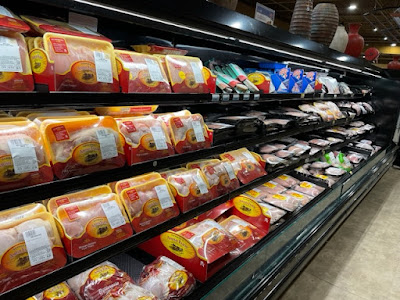
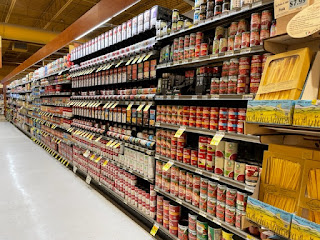
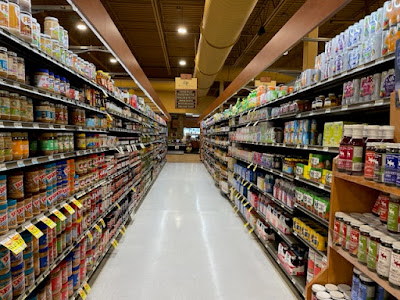
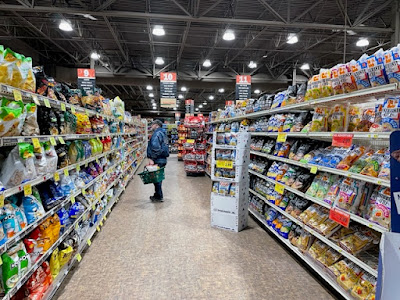
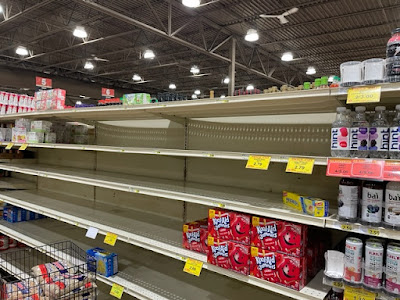
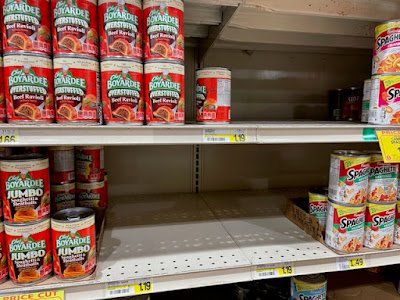
OK, here's the point of my story. Wednesday on one of the radio stations I heard someone say how the grocery store shelves are all empty, that  it was like living in 1981 Soviet Union. 

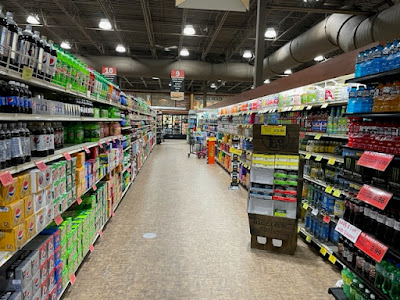
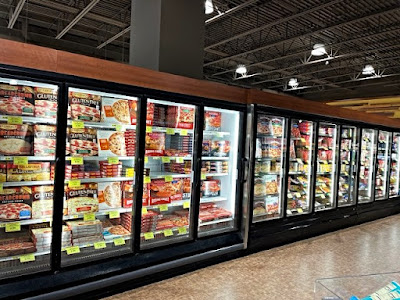
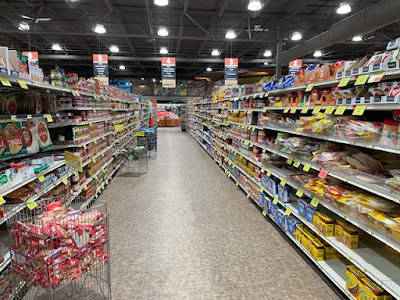
The photos above were taken at the Mount Royal grocery store here in Duluth. The photos below were taken at a Super One in Hermantown or Pike Lake. 


OK, so we had a couple places where they were missing items. Last year we went three to four weeks without "Tostitos with a Hint of Lime."

But it's hardly the Soviet Union 1981. At least not here.

If your experience is different, feel free to leave a comment and say where you're from. I'd like a clearer picture of what is really happening.

Popular Posts