Showing posts with label physics. Show all posts

Thursday, August 3, 2023

Light Waves, Sound Waves, Wi-Fi and the Universe

"Beyond Imagination"
At the beginning of the film Oppenheimer there’s a scene or sequence that conveys this sense of the young physicist’s mind being blown by his awareness of the incredible universe we live in. As I watched that scene it triggered thoughts and imaginings of my own regarding the nature of reality. It’s almost strange how we lose our curiosity about the galaxies and matter and how do our minds and bodies work and where life comes from. 

I remember learning about the structure of atoms in high school chemistry. There's a sense in which atoms are like our solar system. There is more nothingness than substance. That is, we have this huge space but a handful of planets circulating within it. So, too, an atom has a tiny nucleus made up of protons and neutrons which has even tinier electrons floating around it. In other words, there is more space than substance. And this is what our bodies, tools, furniture and everything else is made of. 

One of the questions that crossed my mind back then was this. What if you could line up all the molecules in your body in such a way so as to be able to walk through a wall? Those kinds of questions are where sci-fi comes from.

In 2014 I wrote a blog post about another physics conundrum. I was thinking about all the things that surround us that we can't see. In fact, it's somewhat staggering. 

I started the strange thought that the room I'm in is filled with sound waves but I couldn't hear them. Wherever you went, if you had a the right kind of radio you could pick up a radio station.

When we were kids, my dad had purchased a multi-band radio that could pick up short wave signals from all over the world. Even though he mostly listened to WOR on the AM dial I remember occasionally tuning in to strange languages on some of the other dials and trying to guess where they were coming from. "Is that Russian? Is that Finnish?" I imagined that I was listening to a submarine captain in the Baltic Sea.


All these sounds were accessible, surrounding us, but we couldn't hear them. Nor could we see those sound waves even though they were streaming all around us.  It was interesting to contemplate.


Fast forward to the present. Think of the bombardment nowadays. Satellite radio is spraying signals continuously, and satellite television. Your GPS device signals are ever instructing, and the old fashioned network TV towers keep singing. We're surrounded by a cloud of noises we can't hear at all.


Now consider this. Science has shown us that we're also awash in light waves. We don't see light waves, of course, but only see the objects that they reflect off of. Our light bulbs emanate photons likewise invisible to perception or comprehension. The sun, too, is perpetually spraying light in all directions. Scientists point out that light is a wave but also has particle-like properties. So we're surrounded by all these sound waves and light waves we can't see.


And then there is air. Oxygen and nitrogen not only fill the rooms we sit in and the atmosphere outside, but also go into our bodies as we breathe. We can't see these gases either. It's simply amazing how much stuff is wrapped around us that we are blind to.


So here is the question I asked in 2014: What if we could see all this unseen "stuff"? 


It might be interesting for a moment, but somehow I have to think if we could see all those sound waves and light waves, and all that air swirling around, it would be a little challenging. I can envision my room here stuffed with a giant mass of shredded cottonball-like material, and myself absorbed in it. Maybe I wouldn't even be able to see this computer monitor because all that "stuff" was in the way.

Bottom Line: I think I like it just as it is, the room an empty space with an easy chair where I can curl up and read a good book.


What do you think? 

Friday, May 5, 2023

The Galileo Museum in Florence Is Worthwhile Destination

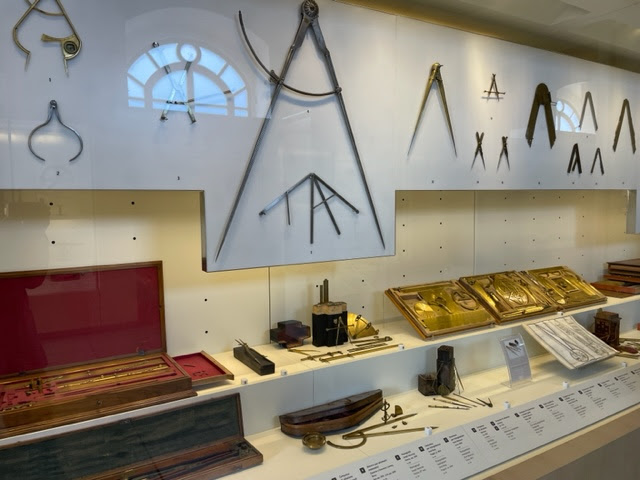
Operations of the Compass: Geometric and Military
Dedication to D Cosimo Medici
The Galileo Museum in Florence offers keen insights into the incredible advances in science, astronomy and geometry more than 400 years ago. The museum showcases microscopes, telescopes, lenses, barometers, globes, models of planetary movements and even medical devices. 

Galileo Galilei (15 February 1564 – 8 January 1642) was an Italian physicist, astronomer and engineer. Born in Pisa, an hour to the west, his family moved to Florence when he was eight. He joined them when he was ten.

If you go to Florence, you might consider a day-trip by train to Pisa. The leaning tower is a letdown to some people, but there is plenty more to see than that. Here in Florence, though, you can get a focused picture of the period in which Gallileo made his way. 

I was surprised to discover that Galileo did not start out in astronomy or geometry, but had gone to school for a medical degree. Doctors, even then, made more money than the average tradesman. Nevertheless, his other interests propelled him into a wide range of explorations into the natural world.

Galileo wasn't the first person to use a telescope to look at the moon, but he was the first to map what he saw. He was also the first to observe moons orbiting Jupiter.


His ceaseless curiosity about the stars and earth's place in the universe got him embroiled in religious wrangling at a time when such conflicts were unhealthy for one's career. The Roman Inquisition was active at this time. His writings countered the then-current narrative that the sun
travelled around the earth, an Aristotle proposition that had not yet been discarded due to the works of Copernicus. (EdNote: And idea can be erroneous even when it is believed by the majority.)

After a trial Galileo was placed under house arrest for the rest of his life. His book was banned and he was forbidden to publish anything else for the rest of his life. He disregarded this, continuing research in new directions. His book The Two Sciences was published in Holland, a book about kinematics and the strength of materials. Three centuries later Albert Einstein would praise this early work in the field of physics.

The Galileo Museum is just around the corner from the Uffizi Gallery, and a stone's throw from the Arno. 


And much, much more.

Sunday, June 5, 2022

Robert Bryce Discusses Current Events with Doomberg

Nope, we're not in Kansas anymore.
This weekend Meredith Angwin (Shorting the Grid) sent me a Robert Bryce podcast addressing many of the energy concerns that I worry about. Bryce is an American author and journalist who writes about energy, politics and other related topics. In this particular episode he interviewed a green chicken named Doomberg.

Doomberg is the nom de plume of one of the most successful new publications on Substack. In this episode, Doomberg’s famed green chicken icon explains the power of anonymity in a time of cancel culture, why politicians prefer platitudes over physics on energy, China, supply chains, the many problems with cryptocurrency, the “profound wave of onshoring” about to occur, and why “there’s going to be a lot of suffering” around the world in the coming months.

Doomberg self-identifies as a small team of consultants that come from industry. "We collectively have decades of experience in the heavy industry, commodity energy sectors. Doomberg is the anonymous publishing arm of that bespoke consulting firm."

The podcast was so insightful I wanted to share some excerpts in the hope that it might stimulate some thinking. Near the beginning Robert Bryce asks what it is about how being Anonymous that helps Doomberg get their message out.

Doomberg: When you write about provocative things, one of our objectives is to be provocative without being polarizing. That’s becoming harder and harder to do in our culture. It’s just a fact of life. And to the extent that being anonymous allows people to or forces people to attack your ideas, as opposed to attacking the person, right? That’s another huge benefit of being anonymous."

Bryce: Let me jump into this piece you wrote February 25. It’s time to get serious about energy. And this is the day after Russia’s invasion of Ukraine, trying to get serious about U.S. energy policy and preserve our place in the geopolitical order or be forced to stop play acting as a superpower. 

The laws of physics make our cards transparent to our political enemies. And it’s all too easy for them to call our bluff when they know in advance what we’re holding. So my question here is, why is it so easy or so facile for Pelosi or Joe Biden or John Kerry, who just about two weeks ago said, "Oh, we’re going to decarbonize our entire electric grid, and we’re going to do it in 13 years." Why is it so easy for them to demagogue about energy? Or why do they have such a predilection about it?

Doomberg: Honestly, I chalk it up to shocking ignorance on the part of the people who end up in positions of power. And we have a phrase that we’ve coined, which has kind of gotten popular, which is in the battle between platitudes and physics, physics is undefeated. And this actually dovetails on something that you said about your career and that I think makes Doomberg unique. You have reporting background, we have decades of experience in heavy industry. But we are freed from heavy industry and freed from the confines of corporate public affairs teams that far too often shackle the the executives who who know enough and articulate enough to make the case for energy policy. 

So if you’re working at an Exxon Mobil or you’re working downstream in chemicals at a Dupont or pick your favorite major and you’re an executive, the last thing you’re going to do is go on social media and engage in the tug of war. They’re more interested in stock options, you know, RSU units, not getting cancelled, toeing the company line, letting the professional PR people within their company handle that aspect of the dirty part of the business. Because we’re freed of all of that, we occupy a pretty unique, you know, overlap in the Venn diagram between detailed industry experience, deep background and finance, and an ability to jump into the arena of content creation and effectively compete. And very few teams have all three of those. 

There’s a lot of content creators who come from academia or who come just from finance. We have all three, we have finance, we have industry expertise... I’m a PhD scientist, and I lead many hundreds of PhDs on research programs in renewable energy, on traditional energy, pick your favorite material science development. Very few people who are creating content today for the world of consumers have that kind of background and are willing to share it. And so our political class unfortunately lacks that background. 

What does John Kerry know about the physics of life? Nothing. John Kerry is the product of elite school systems, who, you know, I’m sure he’s a frequent attender of very well fed cocktail parties, and gets all kinds of applause for spouting platitudes. Why wouldn’t he keep spouting platitudes, it’s worked for him for the first, you know, six or seven decades of his life. Eventually, if you speed headlong into the wall of physics at 60 miles an hour, are you going to crash? And we’re going to do that. It’s unfortunate. We are optimistic about what happens after that. But the path function needn't be this terrible. It just seems like we are on an irreversible course to make all the wrong decisions and let physics teaches what’s what the true constraints are.

* * * 

:57 Food crisis

After explaining why the impact of food shortages in the U.S. will not be devastating here in the U.S., Doomberg expresses extreme concern about other parts of the world:

Doomberg: The farmers who are on the brink are the people in South America, and Sri Lanka. India is having crop failures... there’s going to be a lot of suffering in Africa. So the price spike in fertilizer for the subset of farmers who are sort of cash based accounting, and that’s, you know, the majority of them, they’re gonna use less fertilizer. They’re gonna use more manure, they’re gonna have lower yields. They’re gonna have more crop failures. There’s gonna be less food. We believe the behavior in the US that will avert a food crisis here will only make it worse over there.

...And here’s the scary part, Robert, We have outsourced a lot of the heavy industry, mining and things like that to countries that are going to be on the brink. And we’re seeing it already in the copper mines in Peru and Chile. They’re critical inputs into the electric revolution, that are dependent upon these societies being fed and we’re seeing food riots early on. What are we going to see in the fall?

...Their currencies are hyper inflating. Yeah, that’s what happens. Because they can’t afford to pay for the imports needed to run their societies. And it’s tragic. People are going to starve in vast numbers. And we wish this wasn’t true, as we as you quoted in that piece. Never have we been more convinced we're right and more disappointed that we’re right. It’s not a happy prediction. 

* * * 

From here Doomberg explains how much fertilizer we use to grow corn for ethanol or soybean oil for renewable diesel. But once again, there are limitations. The more fertilizer we use for running our cars, the less that is available for the rest of the world. Bottom line: "These are all just trade offs. We could pay a little bit more at the pump and feed the world. Or we could pay a little bit less at the pump and starve the world." 

THERE IS A LOT MORE. If you want to listen to the podcast or skim the transcript, Check it out HERE.

Thursday, January 10, 2019

Throwback Thursday: Reflections on Water and Ice

34 below zero F. Coldest reading yet on our thermometer. The sun is a muted white, beaming from the southeast. Back down below, a prism of color rises from Rocky Run, a pulsing pillar that at times is quite pronounced and at other times so indistinct as to be invisible. It springs from the earth near two pines across the way which I have never noticed before, just this side of the gravel pit. It extends quite high at times, the endpiece of a rainbow. How strange this phenomenon on a cloudless morn.

How can it be so cold out there? Where does cold come from? Absence of heat... but the sun is no further, nor nearer, than another day 50 degrees warmer.

~ Journal note, 15 January 1994

While looking through one of my journals I came across the above observations. I was attempting to describe a phenomenon that I'd never seen before coming to Minnesota, the way fog and crystal-laden moisture refracts light in the context of intense cold. Here in the Northland you can sometimes tell how cold it is by the way it squeaks when walking on the frozen snow as you go out to fetch the paper in the morning.

Water is the strangest thing. The manner in which it changes based on temperature, and not just random temps but a specific temperature, at 0 degrees Celsius. And how it vanishes (becomes vapor) when it boils. Yet it is still H20 so that when it condenses it become moisture again.

The density of water is another mystery. You would think that when water freezes, becomes a solid, it would sink, wouldn't you? Yet when icebergs break off from Greenland they float. This seems very strange. Yet we just take it all for granted.

I was reading how water expands when it freezes. This, too, seems strange because the molecules are still H20, yet they re-form themselves somehow when they become crystals. My initial sense would be that frozen water would take less room, as if the fluid's molecules were arrange themselves tighter together when they became solid. But this is not the case. In point of fact, water expands by 9% when it freezes, hence the burst water pipes some of people have experienced in very cold weather in the Northland.

* * * *

Physics is the study of nature and natural phenomena in our world. I have fond memories of Mr. Dennison's physics class my junior year in high school. A former minor league pitcher who after 7 years finally came up for a pair of games with the Red Sox at the end of a season, he was also our Junior Varsity baseball coach. I learned a lot from Mr. Dennison about many things, but never quite got the answer to why it's so hard to hit a knuckleball.

* * * *

By the way, did you see the size of the moon last night? (Unfortunately, a sheet of clouds slid across the sky to hide the eclipse that occurred shortly after dark.) I find it intriguing that when the moon circles 'round the earth its influence causes the tides to advance and recede. Because of gravity the earth's bodies of water pull inward, or downward depending on your point of view. But when the moon passes overhead the gravitational pull of our lunar companion produces swelling seas. What's especially interesting is how the waters on the opposite side of the earth also bulge to produce a high tide there as well. (You can read how all this works here.)

* * * *

It's also interesting that water covers about two-thirds of the earth, and that when we mature our own bodies are about two-thirds water. (The ratio changes from infancy to maturity.)

* * * *

Here's another observation. Whereas water is essential for our nourishment to survive, water is also a destructive force, causing buildings to rot, dead trees to decay, and so on.

* * * *

For those who are interested in other mysteries and observations about water check out these links:

The Many Mysteries of Water

5 Weird Things About Water

Middle School Chemistry Lessons on Water and Ice

Observations on Melting and Freezing

In closing, a quote to float your boat: “Human nature is like water. It takes the shape of its container.” ― Wallace Stevens

EdNote: The journal entry that started this post was our second winter living just outside Duluth. Since that time I have since seen 42 below on our thermometer. Welcome to the Northland. The original blog post was published in 2015.

Popular Posts