Showing posts with label healing. Show all posts

Thursday, December 15, 2022

Hardship, Grief and Healing: Carol Dunbar's Novel The Net Beneath Us

"Grief" -- Painting modified with Photoleap
Tschaikovski's Sixth Symphony, famously known as the Pathétique, was not well received when first performed in 1893. The actual name he gave to it was The Passionate Symphony, though the word could acceptably be translated The Emotional or Emotive Symphony. Decades would pass before Igor Stravinski brought it forward and praised it as "ahead of its time." 

What's distinctive about the composition is the sinking feeling one gets throughout, but especially in the the fourth movement, a grinding drawn out decline that is in sharp contrast to most 19th century symphonies that customarily end with a big finish, a buoyant crescendo. When the composer died 9 days later, the suspicion was that Tschaikovski had deliberately permitted himself to become ill-unto-death by drinking unboiled water that carried cholera.

While reading The Net Beneath UsCarol Dunbar's first novel, the preceding thoughts about Tschaikovski's Sixth came to mind. 

The Net Beneath Us opens in gut-wrenching fashion. Elsa Arnasson grew up in the city but now finds herself living deep in the woods of Northwest Wisconsin. When her husband Silas, a logger, gets felled by a tree he was attempting to fell, Elsa becomes emotionally disoriented as the weight of what lies ahead suddenly falls on her shoulders. 

What's challenging for Elsa (the heroine) is that Silas is not killed outright, but left in a coma, hooked to machines in a persistent vegetative state. His death alone, however, is not what leaves her undone. Rather, the ongoing grind of "what now?" and "what next?" drones on and drains her, leading to impossible decisions. She also has two young children and a wagonload of anxieties.

The book is laid out in a manner that coincides with the seasons, opening with Fall. Fall is always a busy time of year because winter is just a stone's throw away. There always seems to be too much to do and serious regret at projects that have yet to be completed, like the second floor of the house Silas was building for the family.

The challenges of living "in the woods" are presented in detail. Winter is usually half the year in these parts. One of the consequences of the accident, for example, is having to deal with keeping heat in the house. No one ever taught Elsa how to chop wood. There are also other characters in the story who add complications. 

Although this is not the type of story I normally pick up, I was captured from the first pages by Dunbar's writing. Her vivid descriptions are amplified by wonderful metaphors and similes. She's what I would call "a writer's writer." What I mean is that the average reader will enjoy the story but may not notice the author's craftsmanship and her magical ability to turn a phrase. Other writers will. She practices what the writing manuals preach: avoid cliches.

Other stories came to mind while reading this book. The film Phenomenon, with John Travolta, made an impact on me when I saw it. One of the sub-themes in the movie had to do with the interconnectedness of trees and their root systems and the fleeting span of our own lives.

 The second is a non-fiction book, A Grief Observed by C.S. Lewis, based on a real story about grieving and healing. Lewis penned some frank and troubling passages regarding the inner turbulence we experience when we lose a loved one and all our internal props are upended. For Lewis, it was the death of his wife, Joy Davidman. 

Hence we follow Elsa as she passes through the seasons, wrestling with her fears and struggling to get a handle on her life. This is another area where Dunbar shines. Elsa and all the characters behave in ways that feel authentic. At various points we're taken inside Elsa's introspective thought-procession; it rattles with reality as she peels scabs away to face the open wounds within.

My only difficulty with the book was keeping track of characters. It seemed like every time I encountered someone I kept having to go back and review earlier sections of the book to see what their connection was to the story. (Full disclosure: It's possible that I may have been at fault because I was reading three books at the same time.)

You can find The Net Beneath Us at all our local book stores. If you're from elsewhere, it's readily available here at Amazon.

* * * *   

Related Link
Interview with Carol Dunbar: A Ghostwriter Who Lives in the Woods

Monday, January 31, 2022

The Music of Our Lives: A Visit with Podcast Host Mindy Peterson on the Power of Music

Mindy Peterson has been hosting the Enhance Life Through Music podcast about music since 2019 and a piano teacher since 1991 to students ages kindergarten to

adult. She began taking piano lessons at the age of 6. Like many who had an early intro to playing an instrument, music has been an integral part of her life ever since. She not only enjoys listening to live music and expressing herself through music, her podcast shows how interested she is in learning more about the benefits of music, and passing on that love of music to her students and others.  

This past fall Mindy visited Duluth to learn more about the influence our city and the Northland had on Minnesota's latest Nobel Prize recipient. This visit became the foundation for a December podcast on the impact of Bob Dylan and his music


EN: Can you briefly share your background with regards to music? What you have created here— your podcast‐‐clearly didn’t spring out of thin air.

Mindy Peterson: I started taking piano lessons in first grade, and have taught piano lessons since 1991. I’ve always been intrigued by the many ways music benefits our lives, and was fascinated with news articles, books, and studies showing music’s power in protecting the brain from dementia; transforming our experience of a movie scene; increasing athletic endurance; increasing literacy skills in children with dyslexia; and more. I believe passionately in the power of music to enhance our lives, and wanted to shout it from the rooftops in order to help others make life better through music, and also to advocate for musicians and music education. Music advocacy and education are two sides of the same coin; and when people understand the value that music brings to our shared human journey, I believe they will want to invest in musical experiences and training. 


EN: Music is probably something important to most of our lives. What was it that triggered you to start a podcast about music?

MP: You’re so right – music affects ALL of our lives, whether we consider ourselves musicians, or not! While there are exponential benefits for those who actively make music, I was struck by how music can make life better in so many ways for all. I observed how frequently my non‐ musician friends made casual comments referencing music, such as: 


   “I heard this song in a store the other day, and it instantly took me back to senior prom!” (Music is the sound of emotions, and one of the last memories to fade from our brains.) 


   “After waiting on hold, I could NOT get that hold music out of my head the rest of the day!” (Earworm!) 


   “Thank goodness ‘Don’t Stop Believin’ was playing – that’s the only way I made it through the last set of that workout.” (Music has been called “legal doping” because it can enhance athletic performance and endurance up to 15%.) 


When I first discovered podcasts, I was hooked! As I explored shows and found new favorites, it occurred to me that podcasting was the perfect medium for showcasing the myriad applications of the power of music. Surely such a podcast must exist! I went on the hunt for a podcast fitting this description, but couldn’t find it. Enhance Life with Music was my creation of the podcast I wanted and couldn’t find. 


EN: You cover such a wide variety of topics showing ways that music is such an important component of our lives. What have been some of the biggest insights for you personally? 


MP: It is such a treat to meet and speak with people from around the country and globe about music’s application in fields as seemingly disparate as sports, social justice, science, business, medicine, mental health, entertainment, education, and history. I’m continually amazed by two things: 


Music’s ability to bring people together. It is one of very few things (food possibly being another?) that can lower walls and bond people who otherwise may have nothing in common – and in fact may have reason to see one another as enemies (such as the Israeli and Palestinian youth featured in Ep. 123).


The endless applications of the power of music. One of my hesitations in starting this 
podcast in August 2019 was the apprehension that I might run out of topics. I didn’t want to launch a podcast, only to have the well of ideas run dry within a few months. Well... over two years and 120 episodes later, the list of potential topics continues to grow. Music is the salt of life – it just makes every aspect of life better! 


EN: I think the way Hollywood directors use music to add dimensions to films is intriguing. Stanley Kubrick’s films are a superb example. So many classic films give us songs or tunes as a takeaway. “Ding dong, the witch is dead!” What an anthem. I read that “Somewhere Over the Rainbow” was the number one song of the 20th century. Care to comment on this? 


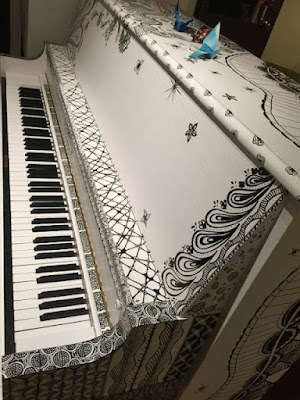
Zentangled Piano by Esther Piszczek
MP: I’m endlessly fascinated by music’s ability to affect our TV‐ and movie‐viewing experience! The phrase that comes to my mind is the courtroom phrase, “leading the witness.” Music can lead us as viewers to pretty specific emotions and biases. I used to drive my kids crazy when they were young with my commentary while watching movies together. I was constantly pointing out things like, “Ooh, the creepy music just started when this person entered; they must be the ‘bad guy!’” 

Another factor of film music that is intriguing is the fact that sometimes the most skillfully composed scores are the ones that we don’t even notice. The score plays into the storyline and overall experience so skillfully and seamlessly that we’re not consciously aware of the music as it’s playing. And you can have equally skillful and outstanding scores that are epic and totally do capture your attention (such as John Williams’ Star Wars scores). 


I suppose this fascination is one reason that several episodes explore facets of music in movies/TV! 


By the way, your reference to “Somewhere Over the Rainbow” reminds me of one of my all‐ time favorite music quotes, which is by that song’s composer, Yip Harburg: 

"Words make you think a thought. Music makes you feel a feeling. A song makes you feel a thought." 


EN: I like how you discuss practical things like how to find a piano teacher, but also get into neuroscience and the ways music shape us, inspire us, lift and even heal us. Do you have a set of guiding rules regarding what you cover and don’t cover on your Enhance Life With Music blog? Can you share them?


MP: In addition to making life better through music, I look for subjects that:

--Educate me.  

--Expand my world.

--Inspire me.

--Help me.

--Entertain me.

The more boxes I can check with an episode, the better!

EN: Thanks for everything you're doing. I have no ideas where we'd be if it weren't for music, especially this past two years.

Check out Mindy Peterson's podcast here: Enhance Life with Music 
www.mpetersonmusic.com  

Related Links
Music of Our Lives: Songs That Make Me Think of Various People I've Known
My Early Introduction to Classical Music... And My Father's
Oli Braithwaite of Stars & Catz on the Power of Music 
Episode 118: Bob Dylan Case Study on the Power of Music to Change the World 
Quiet Heart Comfort: Music CDs and Videos

Tuesday, November 9, 2021

How to Buy a Used Piano and What is a Good Age to Start Piano Lessons?

"Practice makes perfect." 

Nowhere is this adage drummed into little heads with such metronomic regularity as with piano playing. And it's true: If you have dreams of little Kim soloing with the Boston Symphony when she grows up, or even playing a few simple tunes for Grandpa the next time he visits, she's going to need more than a weekly piano less. She's going to need a piano at home so she can practice every day.

So begins the article I co-authored with piano tuner and friend Ed Beaver that appeared in the January issue of Parenting Magazine in 1992. The title of the piece was Pianos: A Sound Investment. Our aim was to share insights regarding how to buy a used piano so you don't get stuck with a 900-pound lemon. Here'a a little backstory on how that article came to be.

Esther Piszczek's Zentangled Piano
And here are some tips I learned from my friend Ed and shared with readers. 

1. Stand back and look at the keyboard. Are the keys level and all the same height? Do they wobble from side to side? Are the ivories cracked and broken?

2. Try out the piano. Do the keys feel loose a floppy? Do you hear any clicks, rattles or buzzes? Do you like the tune? Is the touch too heavy for a child? Play each keey four times rapidly to make sure none of the keys stick.

3. Do the pedals work? Press down the "sustain" (right) pedal and run your fingers up and down the keyboard. Now let the pedal up. The sound should stop promptly.

4. Check the hammers for wear. Deep string cuts in the felt cause poor tone; loose hammers tend to rattle annoyingly.

Pianos are too big to be used as a door stop if you make a problem purchase. So choose wisely.

* * * 

A love of music is one of the greatest gifts we can give to our children. And there's no better way to make the introduction than the having music in the home. 

* * * 

A few months back I became aware of a podcast by Mindy Peterson, a Nationally Syndicated Music Teacher. I listened to a couple of her podcasts this week and thought this one should be paired with the article I wrote above. It's titled, "What is a Good Age to Start Piano Lessons?Check it out.

Related Links

Oli Braithwaite of Stars and Catz on the Power of Music

Henry Wiens Talks About the Power of Music to Comfort and Heal

Quiet Heart Music: CDs and Grief Videos

Sunday, April 11, 2021

When Forgiveness Heals the Forgiver

This is a guest blog post by John Prin, who nearly 40 years ago helped me launch my career as a professional writer.

John Prin, during a visit to our home several years back.
If you are like many people, someone in your life has hurt you deeply in the past and you have struggled with feelings of anger, resentment and perhaps rage. Possibly you have buried or denied such fierce emotions over time and still hold a grudge that, when triggered, arouses fury. Harboring stormy emotions like these has become a burden, an aggravation that weighs on you and adds to your grief and sense of injustice. 

One day a good friend suggests an action available to you, to forgive. “No way! Not a chance!” 
you howl. But . . . But what if . . . What if you actually forgave that person? Fully. Whole-heartedly. No strings. Today’s blogpost offers such a story.

It starts when I was a boy of eleven facing a disturbing change: my parents relocated from our cherished home in Minneapolis to the outskirts of exurbia where they built a new oversized house on the wooded shore of a small lake. I came to discover that the move was largely because of my mother’s oversized ego and her need to show off the family’s rising career status and her own artistic decorating and gardening prowess. In short order, I said goodbye to classmates and playmates, then started sixth grade at a new “country” school seven distant miles away.


Until now my Mom had enjoyed hosting parties and celebrating annual festivities like Christmas, Halloween, and Easter as well as birthday parties and summer picnics. She was a typical loving mom in my brothers’ lives and my own. As for Dad, we all noticed his health was failing, just at the time when his career and reputation was rising in the eyes of his employer and clients.


Then “it” happened.


At the two-acre lot where construction of the new house was underway, Mom ordered me and my brothers Dave and Tom to move a grove of birch trees 150 yards to the lakeshore. Why? So she would enjoy viewing them someday through the then-imaginary picture window. We boys looked at Dad, who shrugged meekly, and our visit turned into a workday. Amid the natural wild beauty of the lake, the sunny day turned hot and we boys sweated in our T-shirts as we uprooted nineteen young trees, hauled them in a wheelbarrow, dug deep holes 150 yards away, and replanted them… all day until dark. I recall Dave saying, “She’s so bossy!” I nodded. “She must think we’re her slaves!”


Any project for Mom entailed working long hours, like the time Dave and I were told to tile the entire ground floor of the house. This meant covering 1800 square feet—a large rec room, a utility room, a furnace room, and a long hallway connecting them—with square one-foot vinyl tiles. We stared at the boxes of floor tiles on the bare concrete floor and a five-gallon bucket of black, sticky glue. Mom departed, leaving us to fend for ourselves with no clue about how or where to start. It was now a year later and Dad couldn’t even supervise because he was hospitalized on and off with complications from diabetes and neuropathy (and eventually an amputated leg). In all, the tiling took ten days, after school each day and on weekends.


More endless projects kindled hatred within me, deep hatred. Life in that fancy house became warped by Mom’s ambitions, all while her boys’ needs were neglected to meet her demands. Eventually, the family’s finances tanked and Dad took months off from work on medical leave.


During my college years, and later when I landed work in California’s TV industry, I put as much distance as possible (thousands of miles, months of silence) between myself and the mother I could not—could never—forgive. Dad’s death sparked the forced sale of “Mom’s palace on the pond.” When 25, I married a sweet, kind-hearted woman.


Twelve years passed.


Often my rage simmered in my soul and, when triggered, boiled over. One day a good friend responded to my intense agitation when I complained about how futile and wretched human life was. His name was Joe Steward, a Midwesterner like me with stars in his eyes for Hollywood fame; acting was his dream, screenwriting was mine. Too many rejections of my dramatic scripts over six years had soured my hopes for a movie career, and now I felt stymied.


“You’re mad at Hollywood like I am, John,” Joe said. “But it’s really because you’re not part of God's plan.”

     Shocked, I stammered, “God? Huh? What the . . . ?”

     “God wants to help you and has a plan for your life. But maybe it’s not screenwriting.”

     “A plan? Since when?”

     “Since his son Jesus walked the earth.”

     “Oh boy, are you serious?”

     After more back-and-forth, he uttered, “Jesus loves you, John. Know Jesus. Know God.”


This out-of-nowhere news flabbergasted me. I doubted, I debated, I fretted. During my growing-up years, my parents had never attended church, and God’s name, when spoken at home, ended in profanity. Joe’s suggestion that my feelings of powerlessness were spiritual confounded me, yet emotionally—like those powerless years as a teenager in Mom’s orbit—I sensed in my heart he was right. In a leap of faith, I dedicated my life to Jesus Christ.


Life flip-flopped from despair to euphoria. My wife and I located a welcoming church community where the believers’ love of Christ revitalized us. As I learned to pray, to worship, to read Scripture and be baptized, a light-hearted spirit lifted my woeful moods. My wife’s own journey of faith accompanied mine day by day.


“While walking under the sign I heard the voice...."
A year went by during which the memories of Mom’s abuse still lingered. Every so often I went for walks on a footpath along the base of the towering H-O-L-L-Y-W-O-O-D sign—until the day I was walking alone and heard a voice in my head say, Forgive your mother. Startled, I stopped. Again the voice said, Forgive your mother. “No way! Impossible! It’s not fair!”

I drove home and told my wife, “Twice the voice said, Forgive your mother.” 


She replied, 
“Sounds like a good idea!” 


I growled, “No, I could never do that.” 


For the next few days, I brought up every objection possible with the Lord: Mom did not deserve forgiveness, she hadn’t apologized or admitted her faults, her behavior had made Dad miserable, my own hurt was too deep.


During a sermon, I heard a Bible verse that stirred me to the core: “Get rid of all bitterness and wrath and anger . . . forgive one another as God in Christ has forgiven you.” (Ephesians 4: 31) Oh boy, now what? So simple, so difficult. Yet, when I reflected on God’s freely offered forgiveness for my sins and misdeeds, something rigid inside me softened.


That day I knelt on the ground, and spoke aloud: “Mom, I … I … forgive … you.” Sobs welled up within me and tears exploded from my eyes. Huge waves of sorrow and grief dislodged from my soul like tons of lead. Years of ugly, murderous grudges dissolved right there in the Lord’s presence. Over time, memories of my younger Mom the first ten years of my life replaced the long history of my painful anger.


A bonus occurred that Christmas. With my wife and 5-year old daughter, I flew home to visit Mom. Although I had insisted on minimal contact for years, it was my idea to return and reconcile with her. As a widow for 14 years who’d never remarried, it was clear she had reflected on her past behavior and gained emotional insights into the feelings of others.


We knocked on the same door I had slammed behind me the day I swore to never return. When the door opened, Mom’s face lit up in a smile as she greeted us. Seeing my beaming face, she blurted out, “Johnny, you’ve changed! You look happy!”


“Yes, Mom, I’ve changed. I love you.”


Abruptly, her hands covered her face and she gasped, “That’s the first nice thing I’ve heard you boys say in twenty years!” Teary-eyed, she reached for my hands. “You really love me?”


“Yes, Mom. I’ve forgiven you.”


“Forgiven me . . .?”


I hugged her tenderly, then put my arm around her as we walked to the living room where we sat together. I confided how God had helped me let go of the decades of pain and anger, and she curled up in my arms as she welcomed the rekindled love I felt for her.


* * * 

During his career John Howard Prin has specialized in helping people who are recovering from addictions to experience the joys and rewards of lifelong recovery. John's talents as an addictions counselor and educator have motivated individuals in recovery groups and treatment centers to stay sober nationwide. You can visit his Amazon author page here.

Saturday, February 27, 2021

Oli Braithwaite of Stars & Catz on the Power of Music

Oli Braithwaite, founder Stars & Catz
If you ever need scientific ammunition to lend support to your conviction that music has power to improve peoples' lives, look no further. Oli Braithwaite, founder of Stars & Catz, has assembled more than 200 research papers on the power of music to bring hope and healing. Listening to music and learning to play an instrument have many other benefits. Music improves our mood, improves our memory, reduces anxiety, distracts us from pain, lowers blood pressure, and much, much more. 

Earlier this month Oli Braithwaite, after stumbling upon my interview with Henry Wiens about the power of music to heal and give hope, reached out to ask if I might put a link from that page to his web page featuring the aforementioned research papers. When I saw the page I wanted to do more than a link. An interview with Braithwaite seemed in order. 

Stars & Catz is much more than a repository for music research. In fact, that's just a side alley. Connecting students and teachers is a bigger part of his vision. When all has been boiled down to its essence, the message is clear. Music ought to be part of all our lives, for the sake of our mental, physical and spiritual health.

EN: You are something of an evangelist for the power of music. How did this come about for you?


Oli Braithwaite: As a musician, music teacher and then the author of the articles on Stars & Catz, I have always found music to be a powerful and essential part of life and an end in itself. But what came to my attention as I researched and wrote on ever widening music topics is that the scientific community is publishing a steady stream of studies supporting various benefits of music beyond the experience of the art itself, and that these benefits are significant.

Since I’m also interested in the mind and the human condition in general, I was naturally curious about these additional benefits. When I tried to find a single, central place that summarized and categorized all (or at least many) of the most important music related studies, it became clear that no such page existed on the internet. I knew the value that such a page would have for the wider music education community, teachers and students, so I undertook to put it together and publish it on Stars & Catz. That’s how our page on the benefits of music and music education, with over 200 studies, came into being.


EN: When did you begin Stars & Catz, and what is the story behind the name?


OB: The name is a bit weird, right? We wanted something a bit different because there are so many generic names around. How it came about was that we originally started in 2010 with only two instruments, guitar and piano. So students had the opportunity to become a ‘guitar star’ or a jazzy ‘piano cat’, hence Stars & Catz. When we expanded beyond those two instruments, we decided that being a star or a jazzy cat still applied, so we kept it.


EN: How does Stars & Catz fulfill its mission to help people realize their music dreams?


OB: We achieve this with three core pillars:

1. A free suite of music tools including, for example, this online metronome

2. Our learning hub articles, mostly catering for beginners in various instruments and singing

3. A teacher matching service to find either a local or online music teacher


EN: What prompted you to begin assembling all these research reports on the impact of music?


OB: As mentioned above, I realized that a comprehensive collection was missing from the web and knew how valuable it would be for music teachers, students and just anyone writing about the benefits of music. I also knew we’d be able to do justice to it, so we rolled up our sleeves and set aside the time (many weeks) needed to do the job properly. We also intend to update the page annually, if there’s enough interest in it.


EN: The list of benefits from music is impressive. What are the most surprising to people?


OB: Great question. The general reaction to the page as a whole is ‘wow’ and then people tend to

comment on the sheer weight of evidence and the wide range of benefits derived from listening or playing music. Most people, aside from music teachers, simply aren’t aware of the power of music on the human mind and body. I don’t tend to get specific feedback on which benefit was most surprising though. For me, it was definitely music’s ability to boost the immune system that was most surprising.


EN: Anything else you would like to add?


OB: If anything is clear from the body of scientific work on the benefits of music, it’s that it really doesn’t matter what age you are, learning a musical instrument or singing is a wonderful and potentially very beneficial thing to undertake on many levels.


* * *

Key Links

About Stars & Catz

The Benefits of Music & Music Education (200+ Studies)
242 Music Quotes to Share & Inspire

Quiet Heart Comfort  

Armory Arts & Music Center


Copyright 2021 Stars & Catz PTY LTD 

Saturday, January 16, 2021

A Man Convinced Against His Will...

Photo by Sean Thomas on Unsplash
Very early in life I remember my mother saying, "A man convinced against his will is of the same opinion still." I remember it because Mom this was one of quite a few sayings that she repeated from time to time.*

I don't recall the context, but she was full of pithy sayings that she'd pulled from the Elbert Hubbard Scrap Book, which was essentially a collection of sayings, quotes and anecdotes that he'd collected over the course of a lifetime. We had the hardcover edition  from 1923 that looked like this.

This quote came to mind many times in recent months as I observed the clash of conflicting views on nearly every topic being debated now on the national stage. 

What's disappointing to me is that there does not seem to be a real effort to reach out and build bridges in order to gain an understanding of opposing views. This is especially the case in the Cancel Culture of mob discipline in which many people -- generally those not accustomed to fighting -- have been battered into silence. 

I'm curious to know if in Washington there might be legislators on both sides of the aisle who want to quietly address real issues, but fear being "cancelled" by the extremists in their parties? 

Is it my imagination or does the media thrive on generating this adversarial atmosphere? If yes, then what we have is a situation in which they are incentivized to create agitation rather than incentivized to help us better get along. This is not a healthy situation. 

My heart is heavy about what's going on. One can only hope that there are people in positions of influence behind the scenes who are quietly working toward solutions for taming this seemingly out of control dragon.

* * * 

HERE ARE SOME MORE QUOTES FROM ELBERT HUBBARD

--Every man should have a college education in order to show him how little the thing is really worth. The intellectual kings of the earth have seldom been college-bred.

--Never explain — your friends do not need it and your enemies will not believe you anyhow.

--If men could only know each other, they would never either idolize or hate.

* * *

According to Cliffnotes, the saying was popularized by Dale Carnegie in his book How to Win Friends and Influence People, though its origins are much earlier.

* * *

Meantime, life goes on...

* Here is another of my mom's favorites: "Oh what a tangled web we weave when first we practice to decieve."

Tuesday, November 10, 2020

The Evocative Power of "Jerusalem" by Vangelis

Exquisite.

I truly enjoy listening to movie soundtrack CDs from time to time. When a director spends five, fifty or two hundred million to make a great film, it pays dividends to have a soundtrack that is equally memorable and evocative. Music has ways of connecting with us in inexplicably deep ways.

Favorites, over the years, include soundtracks for Barry Lyndon,  The Truman Show, O Brother Where Art Thou. The Lion King, A Clockwork Orange and so many others. A lot of movies incorporated tracks that were already popular, and others turned to reliable composers like David Grusin, Ennio Morricone and Randy Newman to embellish the key plot points. 

Morricone is astonishing for the longevity of his career, but he contributed to making many movies memorable. Yes, Clint Eastwood was the star, but Morricone's embellishment (soundtrack/theme) for The Good, Bad and the Ugly made it eternally memorable. (His soundtrack for The Mission is another I've listened to many times over the years.) 

* * * 

Here's another great Hollywood score, the soundtrack for Academy Award winning Chariots of Fire. Released in 1981, the film is a re-telling of the 1924 Olympics in which runners Eric Liddell, a devout Scot Christian and Harold Abrahams, an English Jew, were competing for gold. Liddell, who afterwards became a missionary to China, was running for the glory of God. Abrahamson ran to overcome prejudice. Both were motivated by high ideals. 

A fair summary of the plot can be found here.

The soundtrack by Vangelis is more than simply catchy. It lifts the spirit, elevates the soul and is at times even haunting. The opening scene, in which the Chariots of Fire theme is introduced while British Olympians run along a beach, was parodied for years afterwards and often used in slow-mo scenes in television. The beauty of the full score reaches deep places of our heart where only music can penetrate.

Great artists see themselves as part of a greater stream of history, swept as it were on the wings of the greats who preceded them. The selection of the song Jerusalem at the culmination of the film pays tribute to classical chorale themes and the transcendent Jerusalem by William Blake:

And did those feet in ancient time
Walk upon England's mountains green?
And was the holy lamb of god
On England's pleasant pastures seen?
And did the countenance divine
Shine forth upon our clouded hills?
And was Jerusalem builded here
Among those dark satanic mills?
Bring me my bow of burning gold
Bring me my arrows of desire
Bring me my spear, o clouds unfold
Bring me my chariots of fire
I will not cease from mental fight
Nor shall my sword sleep in my hand
Till we have built Jerusalem
In England's green and pleasant land

Part of what set the Chariots of Fire soundtrack apart from many other films considered "period pieces" set in the past is that this soundtrack utilized modern synthesizer-based music combined with raw piano and orchestral elements. 

It was Kubrick's inimitable A Clockwork Orange ten or so years earlier that cracked open the possibilities of electronic and digital soundtracks. When I was a freshman at Ohio U in Athens I had a friend from Washington Dorm who was set to become the first grad in their music program with a Moog synthesizer as his instrument. From time to time I've wondered where his path took him.

Here is the music for the Jerusalem track that I find so moving. Perhaps you'll agree that it is truly sublime.


Related Links

Definiteness of Purpose

Anna Ladd: An Artist Who Helped Veterans

Music as an Agent of Healing and Hope

Thursday, August 20, 2020

Let's Face It. A Lot of People Are Suffering. Here Are Some Links to Useful Grief Resources

Losses can be devastating. It can be like a wound that initially feels numb, but then the pain hits you with an unexpected intensity. For some, the wound can become infected and require a more complicated healing process. Over time, the wound may heal, but the scar remains as a reminder of the pain and loss you endured. For some, the wound never fully heals.
--Dr. Ron Newman

Loss has always been a part of life, and alongside loss is that inner anguish we've come to label "Grief." The above is a quote from my brother's article Seeking Balance When Experiencing Grief.

I've already noted in several blog posts that 2020 is a year very few could have imagined. The economic challenges are pervasive and news stories somewhat striking, but when families lose loved ones, it's very personal. We're not just statistics. Their absence, especially when sudden and unexpected, leaves a massive hole in our hearts.

For this reason it's good to be aware of resources that are available to soften the wound and aid in healing. That is the purpose of this blog post. The trigger for this post was discovering that Quiet Heart Music has a new website: https://quietheartcomfort.com/

* * * *

So far COVID deaths are currently more than three-quarters of a million globally, more than 170,000 in the U.S. There may be a few, but most people have friends and family members who have had hearts broken this year, and more to come. Are you among those who have lost a loved one?

Pianist Henry Wiens has spent a lifetime producing and sharing music designed to comfort those who are hurting. Through Quiet Heart Music Henry sought to provide a meaningful, inexpensive alternative to sending flowers to friends, co-workers and employees who have lost loved ones. Flowers are a temporary token, but you can tell that many people today are requesting that "in lieu of flowers" you should consider giving to a charity that the loved one cared about.

Giving music that truly heals those who are left behind is another alternative. (EdNote: My intention here is not to put florists out of business. It is to add options to friends and family, especially an option that contributes to the well-being of someone you care about, the ones left behind.)

I found this note about the gift of music in one of my old journals:

Music is one of the more fantastic gifts of God. It lifts the soul on wings to ethereal inner spaces. Nothing more effectively breaks life’s monotonous hold on us, transporting us to the portals of paradise. How do musicians and composers do it? From nothing & emptiness they bring forth combinations of sounds, melodies, themes, so pregnant with feeling it seems an inexplicable mystery. Rainbows of sound, trembling with life, causing our hearts to break open with rapture, or sweet sorrow.--Journal Notes, June 30, 1993

* * * *

The new Quiet Heart website allows you to listen to Henry's music free, something I heartily recommend. Then purchase the CDs that you most relate to. (I have all, but also have favorites.) In addition to being a potent form of healing, Henry's music is perfectly suited as a background track for writers and artists. It doesn't intrude. Like a light breeze on a summer's eve it carries you along on its wings.

* * * *

Another truly valuable feature of the site is a section titled Grief Resources. One page in this section has links to an overabundance of articles on grief by Dr. Alan D. Wolfelt. In one of these he writes, "Grief is not a train track toward acceptance. Instead, it is more of a 'getting lost in the woods' and almost always gives rise to a mixture of many thoughts and feelings at once.

There are links to more than 50 articles dealing with all aspects of grief. Some deal with grief in general, some with helping you in your grief, or with helping others through their grieving. Others deal with grief with regards to specific situations like suicide, or grieving children or teens. Life is hard, and I know first hand how isolating it is to suddenly lose someone close when you are a teen. There are even sections to help hospice workers and funeral directors.

Visit this page for the grief resources noted above:
https://quietheartcomfort.com/grief-resources/

For what it's worth, Henry Wiens is a beautiful man with a beautiful spirit. You can feel it in his music.

Related Links
Henry Wiens Talks About the Power of Music as an Agent of Healing and Hope
Healing the Hurting Through Music
Quiet Heart Testimonials
A Grief Observed, by C.S. Lewis

Popular Posts