Showing posts with label comfort. Show all posts

Tuesday, November 9, 2021

How to Buy a Used Piano and What is a Good Age to Start Piano Lessons?

"Practice makes perfect." 

Nowhere is this adage drummed into little heads with such metronomic regularity as with piano playing. And it's true: If you have dreams of little Kim soloing with the Boston Symphony when she grows up, or even playing a few simple tunes for Grandpa the next time he visits, she's going to need more than a weekly piano less. She's going to need a piano at home so she can practice every day.

So begins the article I co-authored with piano tuner and friend Ed Beaver that appeared in the January issue of Parenting Magazine in 1992. The title of the piece was Pianos: A Sound Investment. Our aim was to share insights regarding how to buy a used piano so you don't get stuck with a 900-pound lemon. Here'a a little backstory on how that article came to be.

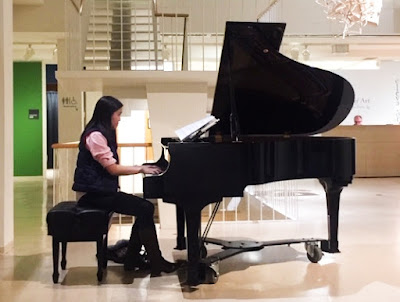
Esther Piszczek's Zentangled Piano
And here are some tips I learned from my friend Ed and shared with readers. 

1. Stand back and look at the keyboard. Are the keys level and all the same height? Do they wobble from side to side? Are the ivories cracked and broken?

2. Try out the piano. Do the keys feel loose a floppy? Do you hear any clicks, rattles or buzzes? Do you like the tune? Is the touch too heavy for a child? Play each keey four times rapidly to make sure none of the keys stick.

3. Do the pedals work? Press down the "sustain" (right) pedal and run your fingers up and down the keyboard. Now let the pedal up. The sound should stop promptly.

4. Check the hammers for wear. Deep string cuts in the felt cause poor tone; loose hammers tend to rattle annoyingly.

Pianos are too big to be used as a door stop if you make a problem purchase. So choose wisely.

* * * 

A love of music is one of the greatest gifts we can give to our children. And there's no better way to make the introduction than the having music in the home. 

* * * 

A few months back I became aware of a podcast by Mindy Peterson, a Nationally Syndicated Music Teacher. I listened to a couple of her podcasts this week and thought this one should be paired with the article I wrote above. It's titled, "What is a Good Age to Start Piano Lessons?Check it out.

Related Links

Oli Braithwaite of Stars and Catz on the Power of Music

Henry Wiens Talks About the Power of Music to Comfort and Heal

Quiet Heart Music: CDs and Grief Videos

Tuesday, September 17, 2013

Quiet Heart Music Celebrates Ten Years In Business

Yesterday on the radio I heard an interview with someone who made music for people with Alzheimers or in their declining years. The interviewee made some interesting statements about the healing power of music, but his approach was different from what I usually read in one particular way. He said that he was in the business of creating music that had no attachments to memories of earlier years. That is, it was all original with no connection to memories, though still designed to comfort.

Because of my longtime friendship with Yamaha Recording Artist Henry Wiens, I wasn’t sure how to take this. In  my 2007 interview with Henry I asked why music has such power to reach so deeply into peoples’ hearts. He replied:

Music is like beauty for the ears and mind. The answer to why people are moved by beauty is rooted in what it means to be human. For me, creating and listening to music is linked to expressing love for everything that is beautiful about life. As a listener, I respond to what I "read between the lines"; as a composer-performer, I try to express that love & beauty to others. Any power that music may have to touch others is rooted in the authenticity and depth of the artist's expression.

As people experience music throughout their lives, they build up associations with that music which reinforce each other. Hearing a familiar melody will bring past experiences to life. For example, hearing a song that you danced to when you were 18 and in love will probably elicit some of those good feelings even decades later. Hearing a song that was sung in church while you were held on your mother's lap may bring comfort the rest of your life.

Joan Baez
It may be that the person I heard on the radio is right in some instances, but I’m going to imagine that when we Baby Boomers are in nursing homes or hospice care we’re more likely to be transported to fond memories and beautiful landscapes when we hear "Bridge Over Troubled Water" or "Jesu, Joy of Man's Desiring" than when we hear something unfamiliar. Maybe I’m wrong but I’m guessing that three decades from now our souls will continue to resonate with Bach, the Beatles and "Wind Beneath My Wings."

Ten years ago Henry started a business called Quiet Heart Music based on the widespread response to his CDs as a source of comfort. His primary customers were nursing homes, hospice and funeral homes that purchased personalized CDs, but he’s not averse to individuals purchasing his music. This week he gave his website a facelift and if you’re in need of comfort or a quiet background as you write or draw, I can attest that Henry’s music offers a soothing accompaniment to nearly any activity.

There 's another feature of this kind of "comfort music" that's worth noting. According to many sources the music is not only like a soul-balm for the dying or grieving, but for the caregiver as well. Sherri Snelling's post in this Alheimer's Association blog is titled Music as Therapy: A Five-Note Plan For Caregiver Calm. Snelling explains, "Music as therapy is not just for your loved one. We know caregivers encounter increased stress over caring for a loved one — in fact caregivers who reported their health was impacted by caring for a loved one cite stress as their No. 1 challenge." She goes on to note that our reaction to music is actually physiological in that listening to music releases the hormone melatonin which reduces aggression and depression and can help us sleep.

No wonder we feel so good when we're listening to the music. Let's dance!

Centerville All Stars

Sunday, March 8, 2009

Rebecca’s Remembrance Bears

One of the harder things in life is the loss of a loved one. Sooner or later it happens to all of us, because none of us lives forever.

One of the hardest parts of dealing with a lost loved one is the sense that we never want to say goodbye. Yet we are parted and because we have no say in the matter, it hurts. Memories are one source of comfort, which is why our photos and videos help keep the connection alive while we go through the grieving process.

Last month I learned about Rebecca Bruley’s home business which also addresses this very real issue of grief and loss that we all deal with. Rebecca’s Remembrance Bears are a way to find comfort in the memory of a lost loved one while going through bereavement.

Because I thought some of you might be interested in learning more so I asked Rebecca a few questions about what she is doing and the difference it makes.

Ennyman: Your bears are very nicely tailored. How did you develop your sewing skills?
RB: I learned from my mom and sister-in-law at the age of eight. I was involved in my local 4-H program in sewing and submitted several entries in the local county fair. At Central High School I took classes in Home-Economics. Most recently I have been the director of costumes at several church play productions.

Ennyman: What do you enjoy most about making Rebecca’s Remembrance Bears?
RB: Using the material that a person actually wore makes each bear special. I lost my brother at an early age and wish that I could have a piece of clothing from him. I know the pain of losing some -one close and know what comfort it can bring by having something that was theirs to hold and touch.

Ennyman: Where did the idea of your Remembrance Bears come from? What makes yours unique as opposed to similar products?
RB: My mother-in-law passed away and I received several blouses she used to wear to add to my material inventory. For a few years I thought about what to make out of them. This past Christmas I remembered a bear my mom received when her brother died. I thought about making a pillow but the bear seemed more comforting. I made them for my husband’s brother and sisters and they were very excited to receive such a precious gift. Seeing their reaction made me believe that others would really love this too.

I take careful consideration in the design of the material and incorporate it into the pattern to make the bear extra special. The card attached to each bear has a Scripture verse and a unique poem written by my daughter that expresses perfectly what the bear was created for.

“I thank my God upon every remembrance of you” ~ Phil 1:3

"This is a very special bear made lovingly for you
Just give it a hug whenever you’re feeling blue
This was a shirt that I used to wear
And now it’s worn by your special Teddy bear.”
Love,___________ In memory of:___________
*

Ennyman: Starting a home business in midlife is a big step. What lessons have you learned from past experiences that prepared you for this?
RB: Since sewing is my passion and gift, it is a perfect match. Having owned our coffee business for over seven years we learned to be careful not to over invest at the start. Quality is very important and your best advertising is the testimonials of customers.

Ennyman: Are your customers primarily people who buy one as a gift? Or do people ask you to make one for them because they wish to remember a parent, spouse or sibling?
RB: Initially a person would want one for a friend or family member. Then once they receive it others will want one for themselves. These remembrance bears are not just for remembering someone who passed away. Best friends can each submit a shirt and combine both to create a bear for each of them. Also, a dad leaving for military service can have a bear made out of a shirt for his wife and/or children. College roommates, best friends, missionaries, newlyweds… the possibilities are endless.

Ennyman: It seems this kind of project would create some connections between you and hurting people. Do you ever get emotional while sewing because you know the story behind the bear?
RB: Yes! I get very attached to each bear. Each one is unique. That is why I take great care in handling each garment with respect. Sometimes it takes a little longer because I can relate to them so well so l want to do the very best that I can.


If you or someone you know is interested in your own Remembrance Bear, contact:
Rebecca’s Remembrance Bears
6717 West Cook Lake Road
Duluth, MN 55803
Phone: (218) 721-3006

*The poem that accompanies each bear is Copyright 2008, Rebecca Bruley, Rebecca's Remembrance Bears

Tuesday, July 15, 2008

Healing the Hurting Through Music

Music has long been understood to have power to comfort distress, to deliver us from the solitude of our sufferings. In the Old Testament, David the shepherd boy was brought before King Saul to play the harp, thereby relieving the king from his depression. Three thousand years later, we have CD players and radios. In whatever form it is delivered, the simple beauty of music is a therapeutic wonder.

To the hurting soul every bitter moment is an eternity. As the music unfolds, we are comforted.

Who can understand it, this miracle that music brings? For many at life’s end, whether ill or simply bed-ridden, time slows to a crawl. In fact, with little to look forward to, there really is nothing but time. The hours stand still, especially when magnified by pain. Time is impossibly slow for those who hurt or grieve.

One musician who understands music’s power is Henry Wiens, a Midwest pianist, Yamaha recording artist and founder of Quiet Heart Music. After years of receiving letters and calls from grateful listeners coping with grief, chronic pain, and stress, Wiens recognized that his music had significant healing potential and began to distribute his CDs to nursing homes, hospices and hospitals across the nation.

My wife and I first met Henry and his wife Lisa when we all lived in the Twin Cities back in the early eighties. Both are sensitive, thoughtful people with good hearts.

Earlier this year I asked Henry why music has such power. He replied as follows:

Music is like beauty for the ears and mind. The answer to why people are moved by beauty is rooted in what it means to be human. For me, creating and listening to music is linked to expressing love for everything that is beautiful about life. As a listener, I respond to what I "read between the lines"; as a composer-performer, I try to express that love & beauty to others. Any power that music may have to touch others is rooted in the authenticity and depth of the artist's expression.

As people experience music throughout their lives, they build up associations with that music which reinforce each other. Hearing a familiar melody will bring past experiences to life. For example, hearing a song that you danced to when you were 18 and in love will probably elicit some of those good feelings even decades later. Hearing a song that was sung in church while you were held on your mother's lap may bring comfort the rest of your life.

This summer, Quiet Heart Music was featured The Director magazine, a publication for NADONA, the National Association Directors Of Nursing Administration. You can read The Power of Music to Comfort and Heal here.

Saturday, March 1, 2008

Postmodernism

I had a boss once who told me “Stop and smell the roses.” Evidently I was working too hard. I had always thought working hard was a virtue. Guess in our postmodern world it’s better to be hardly working.

Has anyone noticed this new word that crept into our vocabulary in recent years? Post-modernism.

Based on my research and reading, here are the basic tenets of Postmodernism as a philosophy: Certainty is bad. Confidence is wrong. Progress is a myth. History is NOT going anywhere. (Kind of like my comedy career.)

According to academics, it is dishonest to be certain. Reason does not add up. How do we know 2 + 2 isn’t five? How can you be so sure?

How do I know my fly is down? I don’t know. Is it really down? What is down? Maybe down is up? What if the top of the world is really the bottom?

Doubt is the central pillar of our contemporary belief system. Did we really land on the moon or was that a massive media manipulation?

Did Lee Harvey Oswald act alone or was there a massive conspiracy involving 194 million Americans, excluding Jackie, Caroline and John-John?

Did the Twin Towers in New York collapse or was this a brilliant plan designed to draw attention to President Bush’s involvement in the Florida public education system?

I have friends in New York who tell me the Towers are still there. The whole thing was done with mirrors to create the illusion of a disaster.

Yes there are still some things we can be sure of…. but I can’t think of any off the top of my head. Am I really standing here at the Fillmore? It just doesn’t seem real.

Wednesday, December 19, 2007

Beauty for the Ears and Mind

Henry Wiens, a Midwest pianist, recording artist and founder of Quiet Heart Music, is not “just another piano player.” After years of receiving letters and calls from grateful listeners coping with grief, chronic pain, and stress, Henry recognized that his music had significant healing potential and began to distribute his CDs to nursing homes, hospices and hospitals across the nation. For more information about Quiet Heart Music, visit http://www.quietheartmusic.com/

An interview with Yamaha recording artist Henry Wiens.

Ennyman: Why does music have such power to reach so deeply into peoples' hearts?
Henry: Music is like beauty for the ears and mind. The answer to why people are moved by beauty is rooted in what it means to be human. For me, creating and listening to music is linked to expressing love for everything that is beautiful about life. As a listener, I respond to what I "read between the lines"; as a composer-performer, I try to express that love & beauty to others. Any power that music may have to touch others is rooted in the authenticity and depth of the artist's expression.

As people experience music throughout their lives, they build up associations with that music which reinforce each other. Hearing a familiar melody will bring past experiences to life. For example, hearing a song that you danced to when you were 18 and in love will probably elicit some of those good feelings even decades later. Hearing a song that was sung in church while you were held on your mother's lap may bring comfort the rest of your life.

Ennyman: When did you first realize that your music had power to alleviate suffering and/or bring healing to hurting people?
Henry: My parents took me to sing at the local nursing home with others from our little country church, from the time I was about 9 years old. I saw elderly people who couldn't even speak trying to sing along with songs from their childhood. I saw that their souls were stirred, their faith strengthened and their joys rekindled. Starting around the age of 12, I began playing a pump organ at the "home" with this group led by my preacher father.

In the middle & late 90's, I got an amazing number of letters from people around the U.S. who had purchased my 1st CD, "The Quiet Heart", which was then distributed by a now-defunct record label called ColorSong, based in St. Paul. Some of them told how their loved one's passing was eased by my music. Some hospices called me for additional copies for their patient rooms. Most often, though, the letters told about listening to this CD over a period of months or even years after a bereavement. They wanted to thank me for the gift of music that had helped them through their darkest days, weeks, and months. The # of these letters reached critical mass around 1998, and led me to focus on music that heals. These letters also resonated with my own grief, having lost my father in 1994 and my closest friend in 1997.

Ennyman: Are there things you do consciously to make your music more effective in bringing comfort?
Henry: I try to choose songs that are already meaningful to people. I could compose original solo piano music in a soothing style, and I may do that someday. But because this music is wordless, I want to harness the meaning and significance these songs already have in the listener's life.

As I have written elsewhere, I consciously try to create a space to experience the feelings of loss. I do this by playing in a way that is deliberately unhurried. I believe this slower paced music helps to facilitate a deeper, reflective state of mind where memories of a loved can be savored. Some may think that the grieving should listen to music that is happy and distracting. There may be a time and a place for that, but I think there is generally too much hurry and distraction, and not enough opportunity to experience the memories that eventually bring healing.

Ennyman: How did you first become interested in music? What inspired you to take up a career in music?
Henry: I grew up in a home where my mother and older sister played the piano at home and in church. Our family would sing hymns around the piano. When I was 11, my mother said I should take piano lessons. I was reluctant to start, but enjoyed it almost immediately. I had a flair for improvisation, so much that my piano teacher told me -- after about a year of lessons -- that I would be a jazz pianist someday. Since my dad was the preacher and my mother was the choir director, I became the official pianist of our little church in 7th grade -- the 1st of many unpaid positions!! The simple hymns and gospel songs we sang week after week became fertile soil for improvisation. I had countless opportunities to play the same songs different ways, which was a lot of fun, compared with playing those boring notes on the page.

When I was 12, I heard a southern gospel group from Tampa, Florida, called the Rebels Quartet. Their pianist, "Little Jimmy Taylor" really fired my imagination with his playing. I made a point of meeting him after the concert -- a very rare event in our isolated Upper Michigan community. I told him I wanted to play just like him when I grew up.

When I was 15, I won 2nd prize in a local talent contest and got to shake hands with Miss Teen America and a couple of Green Bay Packers. Guess which impressed me more? Anyway, that kind of positive reinforcement motivated me to practice that much more.

While in my early 20s, I was very involved as an accompanist at a church in my college town. One night after choir practice the pastor's wife asked me "Have you ever thought of playing piano with performing groups that travel full-time"? Something clicked inside when I heard that and I soon decided to pursue such an opportunity. This led to living on a bus with a gospel quartet for 3 years, performing across the country in churches, nursing homes, schools, jails, etc. This led me back to college to study music theory and composition which equipped me to work for many years as a producer and arranger of many recordings for a wide-variety of artists. I also arranged hundreds of songs for publishing, mainly church related. And all of this goes back to that pastor's wife's comment after choir practice!

Ennyman: Who are your sources of inspiration?
Henry: On a personal level, I would have to say my loving father, who died in 1994, my 97 yr. old mother who still sends me daily e-mail, my wife of 36 years, Dr. Lisa Wiens, and our 4 daughters. Our pastor, Ken Johnson. Many dear friends. The late Tom Fitch, music minister at Park Ave. church, was very inspiring, right up till the end of his battle with cancer at the age of 45.

Andrae Crouch has been a huge influence musically and spiritually. I have always loved a lot of black gospel music. This "gospel" flavor is discernible on certain songs from my new CD, "Wind Beneath My Wings"; particularly, check out “Bridge Over Troubled Waters.”

Fernando Ortega's music is very beautiful, sensitive, creative, reflective. I love his Hymns & Meditations project. This is closer to what I'm doing today with music that heals.

Ennyman: You seem to enjoy being improvisational. How would you compare improv to coloring outside of the lines?
Henry: Improvising is the heart and soul of what I do. A painter works to communicate his unique way of seeing -- "Here's how I see it". When I make something new out of a familiar song, I'm saying: "This is how I hear it". Great painters go far beyond the literal re-creation of what is seen. After all, anyone can take a picture -- though a gifted photographer can take us beyond literal images, too.

Just playing the notes on the page is comparable to coloring inside the lines or paint by number. If I'm looking at notes, the written music merely reminds me of the literal melody; it serves as a point of reference for improvisation.

Ennyman: Everyone has certain motivations . (such as teaching, selling, helping.) What are your personal motivations that make you feel most fulfilled when you are doing them?
Henry: In the first place, creating the music is its own reward. Listening to a CD that represents months of improvising and pruning musical ideas is mostly a joy. (perfection is elusive!) The feeling is, "Wow, that really is beautiful!" But the greatest reward comes later when you learn that other people are also moved & inspired by the music; then I know they have felt and heard something like I hoped they would hear. I have a strong desire to encourage and help other people, especially those with grief and pain. I hope this music embodies love & mercy.

Ennyman: If you had not gone this direction with your life, what would you be dong now?
Henry: I would most likely be teaching math in a high school or college. I was certified to do that in 1973 in the state of Michigan.
Popular Posts