Wednesday, September 20, 2023

Rocky Mountain High: Nevada Bob in a Colorado Hospital

Over the past few years octogenarian Robert "Nevada Bob" Gordon has made 7 trips to Nashville to record covers and original songs in that inimitable Country style. During one of his trips his path crossed with "America's Photographer" Gary Firstenberg, whose images grace the sleeves Nevada Bob's music is housed in, plus the cover photos for his memoir 50 Years with the Wrong Woman.

During these past two years the two have also shared a couple of extended road trips, visiting points of interest while passing through 47 of the 48 continental United States together. 

While homeward bound last week, Nevada Bob checked in to a hospital in Denver. His heart had an irregular heartbeat and the early diagnosis was congestive heart failure. It seemed he would be back on the road after a weekend of observation, but is still there "on hold" till his oxygen levels stabilize.

Here are a few Colorado snapshots, courtesy Gary Firstenberg.


What I remember from numerous business trips to Denver is that there is a lot of wonderful public art, especially sculptures. From first to last, my visits to Colorado were all good. 

Here's Nevada Bob getting ready to order Beef Wellington, 
au gratin potatoes, lima beans and Baked Alaska. 

His smiles are quite subtle, but he sounded cheerful on the phone. 
Leave a comment for Bob and I will pass it along for you. Or
contact me some other way. He's looking forward to getting home
but would enjoy hearing from you.

Related Links

Come Along and Ride Nevada Bob Gordon's Long Train to Nowhere

Monday, September 18, 2023

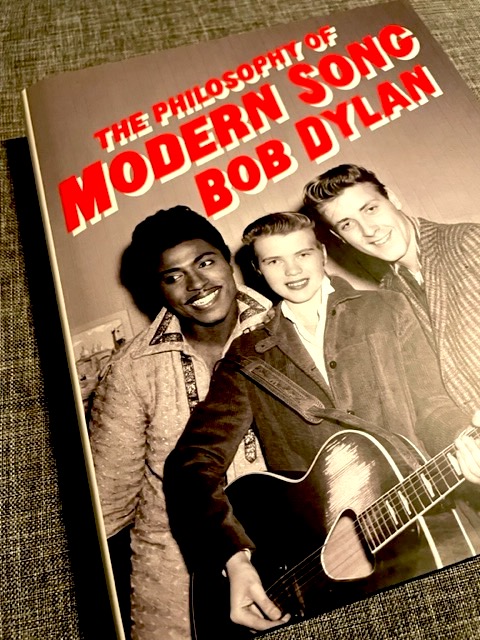
Weighing In on Bob Dylan's Philosophy of Modern Song

Despite waiting years for Dylan's sequel to Chronicles: Volume One, I did not order my copy of his Philosophy of Modern Song in advance last year, as I might normally have done. Rather, I requested it as a Christmas present and thus received it after weeks of reviews had already appeared. The "controversy" regarding his "autograph scandal" didn't phase me. Nor did the misogyny brickbats.

So here it is, sitting before me on the coffee table/wooden chest, beckoning me to express my initial first reactions.  

* * * 


The Philosophy of Modern Song is not anything like what most of us expected as the sequel to Chronicles Vol. 1. The writing, however, feels like a Dylan volume. Most Dylan fans who have listened to his Theme Time Radio show will very likely hear Dylan's voice reading it aloud as they read the text.

The book itself is a collection of essays on 66 songs by other artists, spanning from Stephen Foster to Elvis Costello. It has the look of a scrapbook in some ways. To some extent that makes sense in a pop culture sort of way. (When I was in Italy, I was talking about Dylan with a fellow who owned a craft brewery. He had a couple Dylan posters on the wall so I commented on my surprise at how much Dylan had been imported into Italy. He said, "America gave us two things: Bob Dylan and Pop Culture.")

According to the text on the inside cover flap Dylan began working on it in 2010. The sales-copy describes it as "a master class on the art and craft of songwriting," though quite a few critics demur on this proclamation. 

John Carvill at PopMatters.com, for example, wrote, "There’s very little of what we could sensibly consider ‘modern song’ in The Philosophy of Modern Song, and any ‘philosophy’ is strictly of the cracker barrel variety. That’s ok, though, because we’ve learned never to take Dylan at face value, and the title was just too pretentious to have been meant seriously." The subhead to that article calls it "an awful book, awash with misogyny and crusty old man rants."
I found that last barb to me a little harsh, but having become an older man myself I do understand why folk become "crusty" in their later years.

Sasha Frere-Jones called it "a fractured memoir and punch list of nightmares." And follows up with "what begins as a set of interpretations ends up as a sour little diary."
(4columns)

On the other hand, if you're seeking reviews with a little more enthusiasm for the subject matter (Bob's sequel to Chronicles: Volume One) then here's the place to be: 130+ Published Reviews of Dylan's Book.

I believe I did see at least one reviewer agree it that was "master class on the art and craft of songwriting." I saw it as something different. 

I enjoyed seeing the variety of songwriters selected. No surprise to find spotlights on Elvis, Little Richard, Johnny Cash and Hank Williams, as long-time fans know his respect for the music of these giants. Happy surprises include Stephen Foster, Nina Simone and many others. As for Dylan's impressions on pop hits from my own Boomer-era lifetime, there were many, such as "Ball of Confusion" by the Temptations, "Black Magic Woman" by Santana, "By the Time I Get to Phoenix" by Jimmy Webb, etc.  And then there are all the slices and slivers from other assorted musical genres that you probably would not have expected. 

The writing style is, as I noted, more of a rhythmic impressionism, a Dylan style you find in songs like "Subterranean Homesick Blues," punchy phrases falling all around like shrapnel from a hand grenade. 

Here's an excerpt from his chapter on Cher's "Gypsies, Tramps and Thieves" which is accompanied by old photos of a Peep Show carnival barker and a Side Show Zoo sign. 

You've evolved over thousands of years and you're still traveling through, setting up the tent and making ends meet. Hoaxes, tournaments and spectacles, that's your line of business. Drugstore cowboys, girl watchers, night owls--everybody and their uncle, you lighten them up and bleed them with ease. You give nightmares to people while they're fully awake. People whisper behind your back--lampoon you, satirize, mock and ridicule you, make bitchy comments but your place in the sun is secure.

Some of the book is almost as strange as his Tarantula.

A novel with a plot this is not. It's entertainment. Dean Martin's "Blue Moon" is accompanied by a cover photo of Robert Heinlein's The Moon is a Harsh Mistress. Carl Perkins' "Blue Suede Shoes" ends with a shoe ad.

Here's a digression from another chapter.

You're in an exclusive club, and you're advertising yourself. You're blabbing about your age group, of which you're a high-ranking member. You can't conceal your conceit, and you're snobbish and snooty about it. You're not trying to drop any big bombshell or cause a scandal, you're just waving a flag, and you don't want anyone to comprehend what you're saying or embrace it, or even try to take it all in. You're looking down your nose at society and you have no use for it. You're hoping to croak before senility sets in. You don't want to be ancient and decrepit, no thank you. I'll kick the bucket before that happens. You're looking at the world mortified by the hopelessness of it all.

In reality, you're an eighty-year-old man, being wheeled around in a home for the elderly, and the nurses are getting on your nerves. You say why don't you all just fade away. You're in your second childhood, can't get a word out without stumbling and dribbling. You haven't any aspirations to live in a fool's paradise, you're not looking forward to that, and you've got your finger....

In the first paragraph you are you, in a hopeless world. But suddenly, you are an eighty-year old man in a home for the elderly. Is that a pivot? Is Dylan saying what he means or is it the opposite? Is this his take on the sunset years? 

MY TAKE
Philosophy of Modern Song is fun, but is best enjoyed if you treat it like a book of poetry 
next to your easy chair which you can dip into and savor any time of day or night. Don't take it too seriously. Just enjoy it.

Related Links
Bob Dylan In Italy
What Does Charles Trenet's "La Mer" Have to Do with Dylan's Philosophy of Song?

Postscript
"an enthralling farrago of fabrications and tangents that occasionally, when it circles back to his early life on the Greenwich Village folk scene, offers rare bits of vivid personal disclosure, including meditations on artists and songs that helped shape him."
--Bob Dylan, Philosophy of Modern Song

Illustration Credit: Collaboration with Dream by Wumbo. 
Photo credits: the author, the latter at the train station in Florence, Italy.

Sunday, September 17, 2023

Bob Dylan In Minnesota Now Available at Zenith Bookstore: A Handy Tool for Music-Based Tourists

Music-based tourism is well developed and growing, especially in countries featuring both mature tourism and music industries, such as the USA and the UK. 

So begins an abstract about a paper by David Leaver and Ruth A. Schmidt titled Before they were famous: music-based tourism and a musician's hometown roots.

They go on to say "Mintel estimated destination driven trips as 75 per cent of all music tourism at approximately 55 million annual visits worldwide, including domestic and international travel. It relies on evidence of cultural activities, incidents from the past, and tangible artifacts that can be photographed (Connell and Gibson, 2003). Memphis, with its strapline “Home of the Blues, birthplace of Rock n Roll” has built, post the mid-1980s, a thriving music based tourism industry attracting some million visitors and a spend of $3 billion (Memphis Convention and Visitors Bureau, 2007). The popularity of heritage attractions is highest among middle aged and older consumers, [“baby boomers” born between 1944 and 1964] with a bias towards the more affluent ABC1 socio-economic groups, with the third-age group, which makes up 25 per cent of the UK population, classed as very heritage-active (Mintel, 2008b). 

"The search for a contextual understanding is a key driver for these heritage tourists. Sites of music production and of births and deaths which emerged in the latter part of twentieth century are central."

This link will bring you to sources for this document: Before they were famous: music-based tourism and a musician’s hometown roots.

If you do decide you want to see points of interest from the early life of octogenarian Bob Dylan, I can recommend a couple of books to help you catch a few scenes you may not have been aware of before. The first, which is now near impossible to find, is Dave Engel's Just Like Bob Zimmerman' Blues.  You can read my interview with Mr. Engel here. The second might me K.G. Miles' Bob Dylan in Minnesota, of which I was one of several contributors. If you are planning a trip to the Northland, I recommend buying it when you visit us here Up North or in the Twin Cities.

* * * 

Thursday night I attended a book-signing by Rick Shefchik and Paul Metsa at Zenith City Books where their newly released Dylan-themed Blood In The Tracks is now available. I noticed that Zenith is also carrying K.G. Miles' fourth book in the Troubador Tales series, Bob Dylan in Minnesota. (Caveat: I saw the last copy pulled from the shelf so hopefully it will be back in stock soon.) Paul Metsa was also a contributor to that book as well, along with three other Minnesotans including myself.

If you're looking for a good read, their knowledgeable staff will help guide you to something worthy of your time. What's more, other than the library, I think Zenith has the most complete selection of works by local authors. There are a lot of excellent writers here, so make time to explore.

Here are a few fotos from Thursday eve.

An attentive crowd for the book signing.

Paul Metsa signs a book for Duluth Dylan Fest chair Zane Bail.

Rick Shefchik adds his signature for Nelson French


Meantime, life goes on all around you. Get into it.

Friday, September 15, 2023

From Dylan's Heart to Your Ears: The Untold Stories of of the Minnesota Musicians Who Helped Shape "Blood on the Tracks"

It’s a classic conundrum. If a tree falls in the woods but there’s no one to hear, does it make a sound? Technically yes, in the sense that there were sound waves generated. Subjectively, if no one hears, then it’s as if it never happened at all.  


This is what the Minnesota musicians who recorded half the songs on Bob Dylan’s Blood on the Tracks were up against.  


It was his 15th studio album, recorded in New York in the fall of 1974 under the guidance of engineer Phil Ramone, backed by a handful of Big Apple session pros. The feedback from peers was purportedly stellar, though Dylan himself was privately niggled by doubts.


By late December he took the decisive step of re-recording five tracks while back home in Minnesota, his brother David Zimmerman assembling a team of top notch Twin Cities musicians for a pair of sessions.   Because the album’s cover sleeve had been pre-printed, the six Minnesotans went uncredited. It was as if their contributions to one of Dylan’s most highly acclaimed albums never happened.  


Blood in the Tracks, by Paul Metsa and Rick Shefchik, tells the story of these Minneapolis instrumentalists and the making of Blood on the Tracks. What prompted Dylan to re-visit an album that was already in the can? The New York studio hands had delivered what Bob was looking for. Or so they believed.    


My full review appeared in The Reader here: New book offers intimate insights on the making of Bob Dylan’s Blood on the Tracks


Related Link

While visiting Italy this spring I browsed a several bookstores in Florence and Parma. I was surprised at how every one of these stores had a Dylan book or two prominently displayed so they would catch an eye. Read: Bob Dylan in Italy.

Wednesday, September 13, 2023

Excerpts from Orwell's The Road to Wigan Pier

For many, if not most, of us George Orwell's last two books were required reading when I was growing up. If you brought up the books Animal Farm or 1984 in a conversation, it could pretty much be assumed that everyone present knew what you were talking about.

This is not the case with regards to Orwell's previous works, at least in the U.S. 

Briefly, The Road to Wigan Pier is a nonfiction work, otiginally published in 1937. The book is divided into two parts. The first part, which I found truly fascinating, is an account of Orwell's experiences living among the working class in Lancashire and Yorkshire in the north of England during the Great Depression. The second part is a more theoretical discussion of poverty, class, and socialism.

In the first part of the book, Orwell describes the harsh living conditions of the working class in detail. Both of my own grandfathers worked in the West Virginia coal mines for a brief period of their lives. Orwell makes vivid the poverty, hunger, and unemployment that they face. He also writes about the lack of opportunities for education and advancement. Orwell's descriptions are often graphic and disturbing, but they are also honest and compassionate.

HERE are some excerpts from the book, the first of these being quite amusing.

In addition to this there is the horrible — the really disquieting — prevalence of cranks wherever Socialists are gathered together. One sometimes gets the impression that the mere words "Socialism" and "Communism" draw towards them with magnetic force every fruit-juice drinker, nudist, sandal-wearer, sex-maniac, Quaker, 'Nature Cure' quack, pacifist, and feminist in England.

* * * 

Watching coal-miners at work, you realize momentarily what different universes people inhabit. Down there where coal is dug is a sort of world apart which one can quite easily go through life without ever hearing about. Probably majority of people would even prefer not to hear about it. Yet it is the absolutely necessary counterpart of our world above. Practically everything we do, from eating an ice to crossing the Atlantic, and from baking a loaf to writing a novel, involves the use of coal, directly or indirectly. For all the arts of peace coal is needed; if war breaks out it is needed all the more. In time of revolution the miner must go on working or the revolution must stop, for revolution as much as reaction needs coal. Whatever may be happening on the surface, the hacking and shovelling have got to continue without a pause, or at any rate without pausing for more than a few weeks at the most. In order that Hitler may march the goose-step, that the Pope may denounce Bolshevism, that the cricket crowds may assemble at Lords, that the poets may scratch one another's backs, coal has got to be forthcoming.

* * * 

But on the whole we are not aware of it; we all know that we 'must have coal', but we seldom or never remember what coal-getting involves. Here am I sitting writing in front of my comfortable coal fire. It is April but I still need a fire. Once a fortnight the coal cart drives up to the door and men in leather jerkins carry the coal indoors in stout sacks smelling of tar and shoot it clanking into the coal-hole under the stairs. It is only very rarely, when I make a definite mental-effort, that I connect this coal with that far-off labour in the mines.

* * * 

You could quite easily drive a car right across the north of England and never once remember that hundreds of feet below the road you are on the miners are hacking at the coal. Yet in a sense it is the miners who are driving your car forward. Their lamp-lit world down there is as necessary to the daylight world above as the root is to the
flower.
5
Twenty million people are underfed but literally everyone in England has access to a radio. What we have lost in food we have gained in electricity. Whole sections of the working class who have been plundered of all they really need are being compensated, in part, by cheap luxuries which mitigate the surface of life.
6
When I was a small boy at school a lecturer used to come once a term and deliver excellent lectures on famous battles of the past, such as Blenheim, Austerlitz, etc. He was fond of quoting Napoleon's maxim 'An army marches on its stomach', and at the end of his lecture he would suddenly turn to us and demand, 'What's the most important thing in the world?' We were expected to shout 'Food!' and if we did not do so he was disappointed.

Obviously he was right in a way. A human being is primarily a bag for putting food into; the other functions and faculties may be more godlike, but in point of time they come afterwards.

* * * 

So perhaps the really important thing about the unemployed, the really basic thing if you look to the future, is the diet they are living on.
Related
What I have shared here are excerpts, not a real review of Orwell's book. You can find an interesting review here: George Orwell's The Road to Wigan Pier

George Orwell’s Homage to Catalonia


Orwell on Media Mischief

Tuesday, September 12, 2023

Back Pocket Influences: Variations on a Theme

 VARIATIONS ON A THEME
Explanation at the end.


Here's the original photo. I tore the pocket off my used jeans
and fastened it to the wall in my studio. I inserted this paint brush
into the pocket, which serves a holder for the brush I use to sweep
debris off surfaces and for other purposes.

 AI Collaborator for these images: Dream by Wombo

Monday, September 11, 2023

Six Timeless Lessons from Sun Tzu on the Art of War

25 years ago I created a marketing plan for a new product rollout in which I borrowed practical wisdom from Sun Tzu's The Art of War. It was fun, creative and (best of all) successful. 

This week I've been revisiting the book for the first time in a while. This time around I've been noticing something. So much of the advice Sun Tzu gives has been utterly ignored in so many of the conflicts that have taken place during my lifetime.

Here are a handful of statements from Sun Tzu's masterwork, with examples of how they were carried out or disregarded. My comments are in blue.

"Victory is the main object in war. If this is long delayed, weapons are blunted and morale depressed."
The Vietnam War illustrates this vividly. Not only was morale depressed amongst the troops, the entire country seemed to become weary with these years of conflict. The Soviet Union's invasion of 
Afghanistan suffered a similar fate, a lesson the U.S. evidently failed to pay attention to as we proceeded to later make the same mistake there.

"Generally in war the best policy is to take a state intact; to ruin it is inferior to this."
Apparently Vladimir Putin missed this passage in Sun Tzu's manual. Our carpet bombing of North Vietnam likewise reveals our own generals' ignorance in these matters. 

"To win one hundred battles is not the acme of skill. To subdue the enemy without fighting is the acme of skill."
If you were to study the career of Napoleon Bonaparte, you'd see how much of Sun Tzu's wisdom Napoleon took to heart. 
He once said, "Read and meditate upon the wars of the great captains. This is the only means of learning the art of war." This passage can be illustrated in several of Napoleon's remarkable victories, battles that were won without ever firing a shot.

"Treat your captives well and care for them."
Our shameful behavior at Abu Grahib illustrates once more how far we've veered from being moral leaders of the free world, though this hardly compares to many past regimes in history. Genghis Khan's brutality in the 13th century was legendary. The Spanish Conquistadors route of the Aztec and Inca empires was likewise cruel and brutal.

"He whose generals are able and not interfered with by the sovereign will be  victorious."
The Granada invasion is a perfect example of this principle, or rather, what happens when this principle is violated. Norman Schwarzkopf, in his memoir, describes the rapid success their surprise invasion achieved with no loss of a single American life. Unfortunately, there was a phone call from the White House requesting that the troops check on the students at a university in another part of the island. The unplanned additional mission led to a helicopter collision that took the lives of 24 GIs. When Schwarzkopf was asked to take the lead in Desert Storm, he replied, "Yes, under one condition." That condition was that he would be in charge and there would be no phone calls from the White House asking for favors or telling him what to do. Lesson learned.

"There are occasions when the commands of the sovereign need not be obeyed."

It was General Grant who masterminded the Vicksburg Campaign that broke the back of the Confederacy during the Civil War. After crossing the Mississippi below Vicksburg, he broke his army off from Union supply lines and led a zigzag encirclement of the city from behind. His commanding officer, General Halleck, had sent orders to Grant to turn back, but it took 30 days to find Grant because his army was forraging while fighting a number of other battles to get in position for a siege. When Grant saw Halleck's orders, he sent back a reply: "If you knew where we were and what was happening here, you would not have sent these orders." Halleck's orders were not obeyed, which made Halleck furious. If I remember correctly, Halleck tried to court-martial Grant, but President Lincoln would have none of it. Rather, Lincoln was thrilled to find a general who was bold and would do whatever it took to get the job done, selecting Grant to head the Union armies and press the war to its conclusion.

* * *  

Popular Posts