|
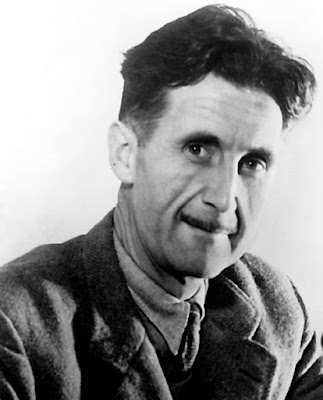
| Eric Arthur Blair, aka George Orwell |
Something I'd read this past week prompted me to see how many George Orwell books there were in our local library. I was surprised at the number of books written by or about this man. Thursday I put in requests for about eight. Friday I lay them out on a table and riffled through the contents of each, finally withdrawing four for further review, foolish because I already have a short stack of books I'm gripped by, clambering through.
Orwell is a writer whom nearly everyone is familiar with through his dystopian 1984 or the dark tale Animal Farm. These were certainly jewels, but his essays show him to be an exceptionally perceptive observer of his times.
One of the books I brought home is titled Dickens, Dali and Others. It's a compilation of essays on various people, one of them being a barbed 1941 critique of H.G. Wells.
The essay begins with a long quote from Wells' pen nearly mocking those who are afraid that Hitler is about to overrun England. As proof he states "The German air power has been largely spent. It is behind the times and its first-rate men are mostly dead or disheartened or worn out."
The quote goes on for two more paragraphs in which Wells derides the experts who talk as if Hitler is someone to be feared and concerned about. Wells sees Hitler as nothing more than a silly defective, nothing more than a phantom threat.
Orwell extracted the quotes from newspaper columns that had been assembled and published as a book titled Guide to the New World. The rest of the essay is Orwell's response.
He sets up his rebuttal by drawing attention to how quickly the German army had overrun the Balkans and invaded Russia and could march through Turkey and Spain at will. In other words, Wells appeared pretty naive about Germany's incapacity to be a real threat to anyone and Wells' predictions were wrong almost as soon as the ink dried on the printing press.
The real problem with Wells, Orwell points out, was that his world view and belief system blinded him to the realities that were right in front of his face.
Wells at this time was an old man who for decades had been a proponent of a World State in which all people lived in harmony. To this Orwell observes, "What is the point of pointing out that a World State is desirable? What matters is that not one of the five great military powers would think of submitting to such a thing." Even if sensible people believe in such a dream, the reality is that the sensible people have no power, he writes.
It may be that Hitler is a criminal lunatic, Orwell notes, he still has an army of millions, thousands of airplanes, tens of thousands of tanks and a nation that has been working six years of overtime for this man and fighting for two years more, "whereas for the common-sense, essentially hedonistic world-view which Mr. Wells puts forward, hardly a human creature is willing to shed a pint of blood."
That sentence alone had me sit upright and take note. He continues:
"But before you can even talk of world reconstruction, or even of peace, you have to eliminate Hitler."
 |
| I love the feel of well-worn old books. |
Here's the thing he underscores. While the liberal elite scoff at patriotism, Orwell asks, "What has kept England on its feet during the past year? In part, no doubt, some vague idea about a better future, but chiefly the atavistic emotion of patriotism, the ingrained feeling of the English-speaking people that they are superior to foreigners. For the last twenty years the main object of English left-wing intellectuals has been to break this feeling down, and if they had succeeded, we might be watching the S.S. men patrolling the London streets at this moment."
"Similarly, why are the Russians fighting like tigers against German invasion? In part, perhaps, for some half-remembered ideal of Utopian Socialism, but chiefly in defense of Holy Russia..."
The people who identified Hitler with the Antichrist or, on the other hand, the Holy Ghost, were nearer to an understanding of the truth about him, Orwell says, than the intellectuals who saw him as a character from a comic opera not to be taken seriously.
One reason English authors were unreliable interpreters of the times is that they lived life too leisurely. The best writers, Orwell says, are those "who have seen totalitarianism up close quarters and known the meaning of exile and persecution."
As I read that last sentence writers like Solzhenitsyn and Koestler came to mind.
What stood out for me in this essay was how these world-views continue to be in conflict amongst us today. Take for example this constant repetition in our time of the phrase, "trust the science." When people say this, what I hear is, "Trust our narrative of the science."
Here's Orwell on Wells again:
"If one looks through nearly any book that he (Wells) has written in the last forty years one finds the same idea constantly recurring: the supposed antithesis between the man of science who is working towards a planned World State and the reactionary who is trying to restore a disorderly past."
Our attitude toward the past determines much regarding how we go forward. Years ago I remember hearing a speaker contrast the two perspectives in this manner. The conservative view is that the past is a foundation upon which we build. For the modernist the past is an anchor that holds us back. Their solution is to cut the cord and leave the past behind.
If you look around, read and listen, you'll see that the ideas in this essay are still at war with one another. Here's the full essay, a relatively short one and a worthy read:
Related Links