Showing posts with label Clear Lake. Show all posts

Saturday, September 3, 2022

The Coroner's Investigation of the Crash That Killed Buddy Holly, Ritchie Valens and the Big Bopper, J.P. Richardson

Actual photo of the crash site, Feb 3, 1959
This week I was discussing details about the tragic crash that prematurely ended the lives of three significant performing stars and one young pilot. The discussion led me to review once more some of the details of that terrible event. In my research I came across death certificates and individual coroner's reports on the four men who died. I share this report for those interested in learning more. The details are graphic and not recommended for the faint of heart. The individual reports are even moreso, which is why I have left them unshared out of respect to any loved ones still living. I chose a Courier font to correspond with the typewritten report on file in Iowa. As I read this today I thought of the men who had to deal with the post-crash details, and especially the man who had to type up his notes for this report.

* * *

Coroner's investigation
Air crash, Feb. 3, 1959
SW Section 18, Lincoln Twp.
Cerro Gordo County, Iowa


Jiles P. Richardson, Charles Holley, Richard Valenzuela and Roger A. Peterson, pilot of the plane, were killed in the crash of a chartered airplane when it fell within minutes of takeoff from the Mason City Airport. The three passengers were members of a troupe of entertainers who appeared at the Surf Ballroom at Clear Lake, Iowa, the evening of Feb. 3, 1959, bound for Fargo, N. D. and was headed northwest from the airport at the time of the crash in a stubble field, 5 miles north of Clear Lake, Iowa. The plane was discovered about 9:00 A.M., February 3, 1959, when Mr. H. J. Dwyer, owner of the crashed plane, made aerial search because he had received no word from Peterson since his takeoff.

The wreckage had been approached only by Deputy Sheriff Bill McGill in his sheriff's car before I arrived about 11:15 A.M. At this time two sheriffs' cars, two highway patrol cars and cars carrying members of the press, both reporters and photographers, and representa tives of TV and radio stations and a few spectators were allowed to pass through the gate into the field where the crash occurred. Approach was made in a circuitous route to avoid disturb ing wreckage and debris from the crash.

Memorial at crash site by well-wishers.
The wreckage lay about 1/2 mile west from the nearest north-south gravel road and the farmhomes of the Albert Juhl's and Delbert Juhl's. The main part of the plane lay against the barbed wire fence at the north end of the stubble field in which it came to earth. It had skidded and/or rolled approximately 570 feet from point of impact directed northwesterly. The shape of the mass of wreckage approximated a ball with one wing sticking up diagonally from one side. The body of Roger Peterson was enclosed by wreckage with only the legs visible sticking upward. Richard Valenzuela's body was south, lying prone, head directed south 17 feet from the wreckage; Charles Holley's body, also in the prone position, was lying southwest, head directed southwest, 17 feet from the wreckage; and J. P. Richardson's body, lying partly prone and partly on the right side, was northwest of the wreckage, head directed south 40 feet from the wreckage, across the fence in a picked cornfield. Fine snow which fell lightly after the crash had drifted slightly about the bodies and wreckage. Some parts of each body had been frozen by the ten hours' exposure in temperature reported to have been near 18 degrees during that time. The three bodies on the ground were removed before I left. Peterson's body was removed after permission was granted by the inspector for the Civil Aeronautics Board and Federal Aviation Agency. This was done by Deputy Sheriffs Wm. McGill and Lowell Sandquist using metal cutting tools to open a space in the wreckage.

Wings for pilot Roger Peterson.
At the scene of the crash Mr. Carroll Anderson was helpful in tentatively identifying the bodies from the clothing.

A large brown leather suitcase with one catch open lay near one leg of Charles Holley, and about 8 ft. north of the same body lay a travel case with brown leather ends and sides of a light plaid color. This measured approximately 15 in. x 12 in. x 6 in.

A billfold containing the name of Tommy Douglas Allsup and a leather pocket case marked with the name, "Ritchie Valens", were brought to me at the scene by Deputy Sheriffs inspecting the ground over which the wreckage had skidded and rolled.

Glen Kellogg of Clear Lake took photos of the scene at the request of Sheriff Jerry Allen and me. News and TV photographers also took still pictures and movies of the scene.

The plane was a Beach-Craft Bonanza, No. N3794N, painted red, with white and black trim. Deputy Sheriff Lowell Sandquist, an experienced pilot, who has flown in and out of the Mason City airport, was present when the radio and navigational equipment from the plane was examined. He reports the radio to have been set for listening and talking to the Mason City Airport Station MCW, and the navigational equipment to have been correctly set for a course from Mason City to Fargo, N. D.

Arrangements for the flight were made by Mr. Carroll Anderson, Manager of the Surf Ballroom at Clear Lake, Iowa, with Mr. H. J. Dwyer, fixed base operator for the Mason City Airport. The reasons given to Mr. Anderson for the flight were that all three passengers wished to reach their next destination in their itinerary ahead of the chartered bus which carried the rest of the troupe in order to have some laundry done. Mr. Anderson drove the three passengers to the airport in his family automobile. Accompanying him were his wife and 8-year-old son. They saw the plane take off and make its circle to take up its course.

The Air Traffic Communication Center of the Federal Aviation Agency at the Mason City Municipal Airport reported to me that at 0058 on February 3rd, the wind was south, gusty to 20 M.P.H., temperature 18 degrees F., dew point 11. In takeoff, the plane followed a normal procedure using the runway toward the south and turning in a counterclockwise direction. The amount of now falling from midnight to 6:30 A.M. on February 3rd was listed as a trace.

Further information from them was that as the pilot taxied down the runway he communicated by radio with the tower and secured additional information about the weather en route. He told the officer in charge in the tower he would file a flight plan after getting in the air. When this information did not come in, the officer tried to reach the pilot without getting a reply.

An official investigation was carried on by a crew of field representatives headed by Mr. C. E. Stillwagon of the Civil Aeronautics Board, Bureau of Safety Investigation, 4825 Troost Avenue, Kansas City, Missouri, and Mr. A. J. Prokop, Federal Aviation Agency, Des Moines office. This group spent three days on the investigation arriving here the evening of February 3rd. They visited the scene of the crash for preliminary survey before dark that day.


I, Ralph E. Smiley, M. D., Acting Coroner of Cerro Gordo County, Iowa, on the 4th day of February, 1959, hereby certify that the above facts are made of record after diligent investigation and I believe them to be correct. 

Tuesday, April 19, 2022

The Surf Ballroom In Clear Lake: A Hall of Memories

On January 27, 2009, the Rock and Roll Hall of Fame dedicated the Surf Ballroom as a historic rock and roll landmark as part of their ongoing Landmark Series, identifying locations significant to the origins of rock and roll. The Original Surf Ballroom opened on April 17, 1933. When the Surf burned to the ground in 1946 a new Surf Ballroom was quickly rebuilt across the street to replace it by the following year. Yesterday, 18 April 2022, I finally had an opportunity to go inside and see the place where Buddy Holly performed his last concert.

Selfie with my Buddy Holly tour guide, Mike Tefft
In some ways, the venue reminded me of the Historic Duluth Armory, where Bob Dylan and other Northlanders say the Winter Dance Party a few days earlier. No, the two venues bear little visual resemblance to one another. Rather, their connection is more historical. Each became a showcase for countless familiar names, singers and performers. 

The Surf has plenty of memorabilia for fans of music history. In the thirties and forties, it was a major "go to" for big bands. Count Basie, Benny Goodman, Duke Ellington and a ton of others performed here. With the birth of rock and roll, a whole new generation of performers made this part of their stomping grounds.

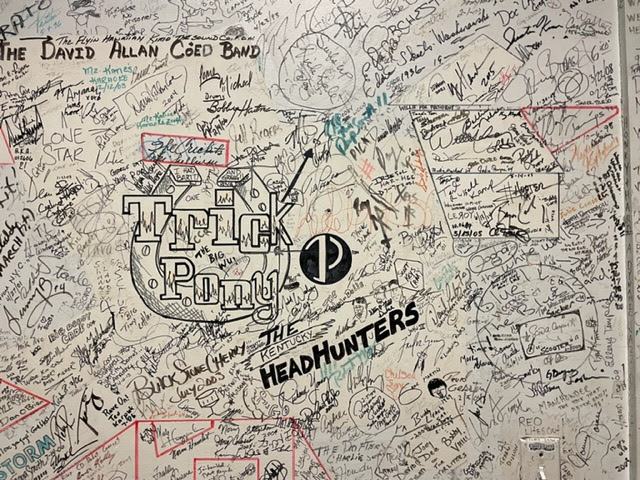
Inside the Green Room. Many a famous personality prepped
in this place. They not only left an indelible mark on their fans,
they also left initials, doodles and other memorials.

Monday, May 6, 2019

A Visit to the Buddy Holly Crash Site in Clear Lake, Iowa

Clear Lake resident Mike Tefft with your faithful scribe.
Last Monday, near the tail end of a 17-day road trip, I visited a friend in Clear Lake, Iowa. Mike grew up in Clear Lake, which 60 years ago February proved to be the last stop for Buddy Holly, Ritchie Valens and The Big Bopper (J.P. Richardson) on their Winter Dance Party Tour.

We drove out to the horn-rimmed glasses that mark the spot where you leave your car to trek the quarter-mile to the crash site. (Crash documents state it to be a half mile walk, but it didn't feel quite that.) As you can see from the photo (right) our mood was upbeat as we disembarked.

Once there, however, the crash site makes an impression on you, especially when you let your imagination run with it. Mike pointed to a spot 50 feet from the crash where Richardson's body was found in the cornfield beyond the fence. Many have wondered whether he was thrown from the wreck or managed to stagger to that place where he lost his powers to go on. Upon reading the coroner's report, walking away from the crash seems impossible. Buddy Holly and Ritchie Valens were also thrown from the plane, each found approximately 17 feet from the wreck. The 1947 Beechcraft Bonanza slammed into the ground nose first and cartwheeled more than 500 feet to the fence-line where it tumbled to a stop.


According to a report made after the crash, the stated motivation for taking the plane was to arrive early ahead of the bus so the stars would have time to do laundry. It may have in part been motivated by the breakdown that occurred in the middle of the night after their Winter Dance Party performance at the Duluth Armory.

The photos on this page show how the location of the tragedy has been memorialized. It was a very sad day in music history, and especially for the friends and loved ones who knew these four young men who died.

The four blue dots represent the four lives that had been taken that night.

A sobering Civil Aeronautics Board photo. (Public domain.)

Related Links
Chronological Presentation of Final Hours
Photos of the crash site and subsequent investigation along with official crash documents  
The Day the Music Died

Popular Posts