Showing posts with label Mississippi. Show all posts

Wednesday, December 22, 2021

AICHO to Host Papercut Artist Ellen Sandbeck's "As Long As the Rivers Shall Run"

Mississippi River Headwaters

How do you spell "Impressive"? 
I spell it E-L-L-E-N S-A-N-D-B-E-C-K 
That's also how I spell the word Prolific.

Upper Mississippi River
After nearly two years of virtual visual arts, the AICHO Galleries is opening its doors for its first in-person exhibition since the start of Covid. The artist kicking off this new chapter is Ellen Sandbeck, a well-known local artist and publishing author who has been doing papercut art for 35 years. 

This show, which will be on display from January 8 through February 25, is titled "As Long as the Rivers Shall Run." It will include a papercut workshop on February 3 at 7:00 pm in the Dr. Robert Powless Cultural Center, 212 W. 2nd Street here in Duluth.

Middle Mississippi River
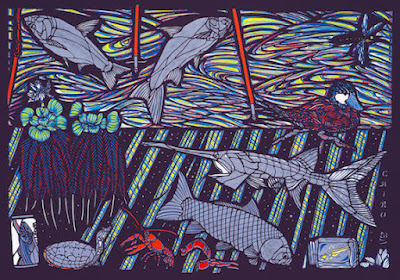
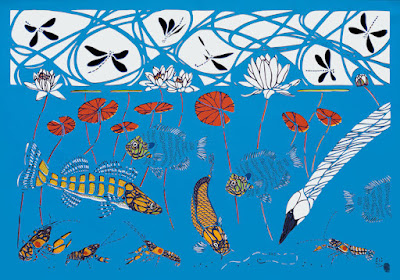
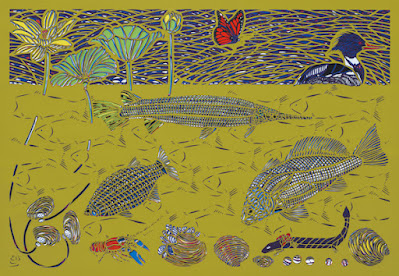
The artwork in this show depicts species endemic to the Mississippi River, including endangered and recently extinct as well as invasive ones. This is the first of a series of sets that will later explore the species found in other rivers around the world including the Yangtze, the Mekong, the Nile, the Ganges and the Amazon. There will accompanying text that includes scientific names, conservation status and snippets of natural history about each species, as well as the challenges faced by each river. 

Lower Mississippi River

The artwork consists of multicolored, multi-layered papercut images.
 The Mississippi River has been represented by five large-scale papercuts (39” x 27”): “Mississippi River Headwaters,” “Upper Mississippi River,” “Middle Mississippi River,” “Lower Mississippi River,” “Mississippi River Delta."  

OPENING RECEPTION: January 8, 5:00-7:00 p.m. 
Pre-registration required. Bookmark this page for more information:
http://www.aicho.org/ellen-sandbeck-2022.html

* * * * *

Ellen Sandbeck's illustrations have been published by several publishing companies. Her artwork has been shown all over Minnesota, and in Wisconsin, Illinois, Virginia, and New Jersey. In 2020, she was awarded a Minnesota State Arts Board Artist Initiative Grant and she is on the artist roster for the Minneapolis Airport Foundation.

Related Links

Books by Ellen Sandbeck
https://www.thriftbooks.com/a/ellen-sandbeck/219554/ 

A Buddha A Day, the Ellen Sandbeck Way  (2010)


Local Art Seen: Sandbeck and Villiard Explore Issues Surrounding Endangered Species and Endangered Lifestyles Portrayed (2018)


COVID-19 Safety Protocol Precautions: The gallery open hours are yet to be determined. Visitors to the gallery will be required to wear face masks regardless of vaccination status and that there will be limited gallery viewing hours and social distancing guidelines. 

Wednesday, January 1, 2020

Is This Something That Was On Dylan's Mind When He Wrote High Water (For Charley Patton)?

Photo by Chris Gallagher on Unsplash
As I've said many times, you never know when a Dylan reference will appear. Sometimes it's a song in a movie, a photo in a magazine, a commercial inserted into the Super Bowl and frequently, as in this case, a reference in a book.

A couple weeks ago I was reading Anna Merlan's book Republic of Lies, which takes a deep dive into the variety of ways conspiracy notions get generated. Chapter two explores how the notion came about that the flooding in New Orleans during Hurricane Katrina was a result of the government blowing up the levees.

Merlan writes, "The idea (that the government would dynamite the levee) is rooted in two things: an infamous 1927 decision in New Orleans to dynamite the levees; and a long-standing, multi-pronged suspicion that the federal government has engaged in depopulation schemes aimed at black citizens." Even Spike Lee doesn't find the idea all that far-fetched that the government would try to push blacks out of New Orleans.

This feature of the Great Mississippi Flood of 1927 is something I've been unfamiliar with. On that occasion, the leaders of New Orleans, in an attempt to save the city took dynamite and blew up the levees upstream at Caernarvron, Louisiana. The result: more than half a million were left homeless. Many died.

Photo by the author.
Charley Patton wrote his song "High Water" as a protest. Blacks living on the Delta were restricted as to where they could live or move to. Relief efforts treated whites and blacks differently. The event, which has been cited in numerous blues songs, including "When the Levee Breaks" by Kansas Joe McCoy and Memphis Minnie (which Dylan re-invents on Modern Times), triggered one of the largest mass migrations in U.S. history.

According to a letter to President Calvin Coolidge, a complaint written by a black businessman, blacks were forced to keep working on the levee at gunpoint while whites and mules were given time to escape to safety.

What is not mentioned in this account of mass migration is how crowded the black parts of the Northern cities already were. This was pre-Civil Rights Act of 1964. Those who left the devastation in the Delta found themselves cramped into overcrowded Rust Belt ghettoes.

So the story of the flood is to some extent a story about racism. This is a factoid that I was unaware of, one that according to Merlan is fairly well-known among a segment of our society. I've not yet elsewhere read about this notion of that flood and racism, nor have I seen this connection made by any of the lyrics interpreters in Dylan circles. (Correct me, please, if I am wrong.)

Has Dylan, who famously does not interpret his lyrics for us, been attempting to subtly make this connection apparent by continuously favoring the song in his setlists? He's performed it over 700 times now since recorded in 2001 for Love and Theft.

Though most of us have little knowledge or recollection of these events, the 1927 flood "lives vividly in the collective memory of the region," write Merlan. When Hurricane Betsy struck in 1965, the levees were breached and some New Orleans residents were certain that city leaders had blown the levees to save the wealthier parts of town. There were people who claimed to hear explosions that sounded like dynamite, just as in the Katrina disaster.

* * * *
Photo by the author.
While listening to Disc Two of Travelin' Through this past week, one of two discs featuring Dylan and Johnny Cash recording songs together on Bootleg #15, the familiar Five Feet High & Rising played again, leading me to see if Johnny's song was about the same incident. It was not.

Cash, who himself was born into poverty in the Arkansas lowlands, was writing about the Mississippi River flood of 1937 that occurred when he was just shy of five. His first person account appeared on his third album as a Columbia recording artist, in 1959.

* * * *
Randy Newman, whose distinctive voice we're all familiar with from the numerous film scores he's produced, also wrote and recorded a song about the 1927 flood, simply titled, "Louisiana 1927." His is a straightforward account of the disaster after the river "rose all day and rose all night." 700,000 people were left homeless.

* * * *
Kees de Graaf, another lyric dissector, makes additional connections of note from this song, one being it's parallel to Hard Rain and the theme of "apocalyptic menace." "The flood," he writes, "overwhelms doomed people, and there is no help as the structure of society breaks down like in the days of Noah’s great flood."

Of course Apocalypse is nothing new in Dylan's oeuvre. (cf. "All Along the Watchtower.") At the same time that the Fifth Dimension was singing about the Age of Aquarius there were more books about the end of the world being produced than ever before. Against this backdrop an entire generation has been raised, now sinking into the twilight.

The song itself is a series of image fragments but when all is said and done, the conclusion is simple to understand:

It's bad out there
High water everywhere.

* * * *
Related Links
Tony Attwood breaks down High Water (For Charley Patton)
Lyrics to High Water 
Song Analysis by Kees de Graaf
When the Levee Breaks and Modern Times

New Year's Day Trivia: On this day in history, Abraham Lincoln issued the Emancipation Proclamation.
Thursday, June 20, 2013

Water Themes Featured In DAI Shows Opening Tonight

“Eventually, all things merge into one, and a river runs through it.” ~ Norman Maclean

The overarching theme is water, a common touchstone for many local artists who draw inspiration from living at the edge of the world's largest freshwater body in the world. At least two of Mike Savage's novels have Lake Superior water-related issues as a central plot element. Tonya Borgeson's series of "Something About the Water" shows, with other participating artists, keep cropping up. Visual artist/critic Ann Klefstad's water themed works likewise reflect her passion for the theme. (Both Klefstad and Borgeson can be found frequently out sailing on the waters as well, the one passion that overrides their desire to be in the studio.)

So it comes as no surprise that the Duluth Art Institute (DAI) would have a summer art opening titled Water Works. What did surprise me, though, was seeing the full page, front page story about the opening in Tuesday's Duluth News Tribune. Whether it was paid advertising, or a generous plug by the DNT, the net effect was that Water Works is an event not to miss. (Opening from 5-7 p.m. tonight.)

Here are a few notes about the three overlapping exhibitions that will be on display this summer. Lee Englund's A Strong Experience of Nature is aptly titled. The now-retired art teacher is a leading painter in the "plein air" school. "En plein air" is French for painting in the opening air. Englund describes it as the visual equivalent of jazz improvisation as the artist responds to the stimulation of the scenery which is ever changing.

One day back when I lived in the Central Hillside I came home from work to find a painter from Hungary on the sidewalk in front of our house, painting the hillside scene with the sunlight pouring through the trees and houses down toward the Great Lake. I asked why he was here and he said Duluth is one of the three most beautiful cities in the world to paint because of the steep hills and the lake, and the way the late day sun pours through everything. (The other two cities were San Francisco and one of Switzerland's beauties.)

Anways, it's been a pleasure watching Englund work and the title of his show is a thrill in and of itself. The show will run through August 18 if you can't make it tonight.

Then there's Jerry Allen Gilmore's Boats Will Float and Bumble Bees Will Sting which will have a shorter run in the Steffl Gallery, from June 6-24. Another fun title.  Gilmore states that his work "has always contained an element of water in its narrative." The images here are autobiographical in nature, and what he calls "markings" from his life.

Finally, from July 1 thru September 8, there will be Chris Faust's photography exhibit titled Revisiting Twain's Mississippi, a suitable companion for the other exhibits. Many people unfamiliar with North American Geography are not aware that we not only have the world's largest lake, but also the headwaters of one of the great rivers in the world, and our longest in North America. The headwaters of the mighty Mississippi begin here in out North Country.

St. Paul native Chris Faust chose to revisit the river that had been documented in such detail in Mark Twain's time by photographer Henry Peter Bosse.

Our ongoing fascination with rivers is nothing new. Rivers have been part of human history for ages, serving as transportation routes, power generators, geographic barriers, political boundaries, and more. Rivers have also served as a source of inspiration for poets, writers, artists and philosophers.

The flowing river is a theme upon which many minds have meditated. Twain, Hesse, Annie Dillard, Norman Maclean have all recorded reflections on rivers. Hesse’s Siddhartha concludes with a contemplation on the meaning of his life while watching, and listening to, the river.

Tonight's art opening(s) will give us a chance to explore our waters, and our selves, in new ways.

Popular Posts