Showing posts with label artist talk. Show all posts

Monday, July 18, 2022

Sirpa Särkijärvi Returns to the Joseph Nease Gallery in Duluth

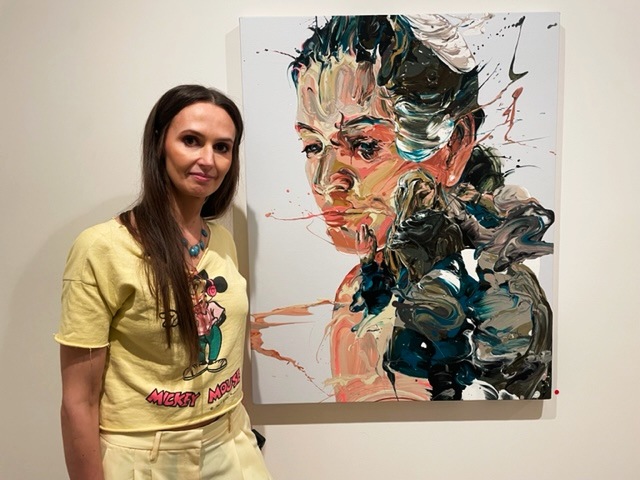
Finnish painter Sirpa Särkijärvi was in Duluth this weekend to give an artist talk to a strong turnout at the Joseph Nease Gallery (JNG) here. This is Särkijärvi's second visit to the JNG here in Duluth, the first being with a powerful exhibition titled Transcriptions in 2019.

I was able to sit with her for a few minutes before her artist talk Saturday to discuss her current work and career. Sirpa, who is tall and slender, was wearing a pastel yellow dress with a Mickey Mouse image on the front. Her gentle appearance seems almost at odds with the volcanic force of her work, which she said emerges from within.

She talked about the psychological aspects of how the mind works, and about relationships, and how we learn about who we are through interactions with others. "Every person is different," which brings out different aspects of our selves.

detail from painting below

It was interesting to learn how Finland supports its artists and covers their expenses when they have exhibits abroad. It is as if the nation is proud to showcase its talents. 

Her current show has six pieces that are similar in power yet more complex than her 2019 show. Within the figures there are many other things happening as you can see here. I asked how this came about.

She replied that in 2005 she was doing something similar in that she had other things happening within the images beyond the images themselves. These new works, all created in 2022, draw from and incorporate some of that exploration. "I don't plan too much," she said, adding that she relies a lot on instinct.

The artist is originally from Northern Finland, in the vicinity of Lapland near the arctic. She now lives in the south, about 200 km from Helsinki.

When I asked about the influence of having come from such a cold, remote region, she said something that made me think of a conversation I had with Native American photographer Vern Northrup. Both Sirpa and Vern said the same thing: you have to prepare for winter. You don't take it for granted.

In Sirpa's case, she compared her painting approach to that very notion of preparation. She described what is involved with getting her acrylic paints to have a precise consistency. Her style is fluid so the paint must be very liquid. 

I said that it seemed her paintings had a bit of Francis Bacon influence, and she confirmed that there was some of that. And though quite different from Willem de Kooning, there's a sense of the same energy being released in the process. "I have to work quick," she said with regard to her own process. 

detail from painting above

"Because I'm a reasonable human being, when I paint I have to lose myself," she said. There a conscious side to her painting (preparation) and an unconscious side. "That's why I relax and connect to myself. There are no rules."

* * * 

Notes from Her Artist Statement

Sirpa at the JNG with Tara Austin
works in background
Särkijärvi (b. 1974 in Muonio) is currently based in Turku, Finland. She's interested in approaching her subjects from the perspective of literary deconstruction or critical reading, revealing hidden conflicts of meaning. She seems very in tune with the ideas that we are not isolated individuals. We cannot escape each other's' influence.

Her paintings are inspired by our motivations, needs and the inconsistency of our actions, which together form the complex entity that the artist attempts to reflect in her work. What is between the lines is also important.

Intertextuality, everything that has been experienced, seen and learned influences the artists's interpretation. Finally, viewers also receive and interpret everything in the painting through their own backgrounds and experiences.

Beginning of presentation at the JNG
Särkijärvi creates her paintings in several long and methodical painting sessions. Her method is technically demanding as 
she uses dozens of pre-mixed colors and it requires a lot of preparation, and development of the idea. Särkijärvi says that her goal is to immerse herself in the work so that painting becomes a tool for thought and contemplation. She paints with fluid acrylics onto a horizontal canvas where the paint flows and mixes to form planes of color, movements and strokes, and the fragmented structure creates illusions that change depending on the distance they are viewed from.

The vibrant and explosive material turns into considered and controlled images of humanity. The paintings seem at the same time out of control and closely controlled, just like the human mind often is.

Sirpa Särkijärvi lives and works in Turku but she was born in Muonio in Lapland. Her family's long history and deep roots in northernmost Finland have left their mark on her identity and influenced her visual approach.

* * *

Related Link
Sneak Preview: Sirpa Särkijärvi
Joseph Nease Gallery  home page

Friday, August 18, 2017

Tuesday Artist Talk: Jonathan Thunder @ Duluth Art Institute


Tuesday evening the Duluth Art Institute hosted an artist talk featuring Jonathan Thunder, whose work is currently on display in the Morrison Gallery, Kathy McTavish serving as moderator. Thunder, who hails from the Red Lake Reservation, grew up in an urban Twin Cities setting. His interest in art as a vocation led him to study painting in Santa Fe for three years. After this period of study he proceeded to isolate himself in order to paint without the influence of others and find his voice. What emerged was something of a blend of American cartoons, Southwest art, and a "magical realist" sense of the everyday... though it's evident that there's much more than meets the eye.

Thunder acknowledges that his first paintings were filtered through a Santa Fe lens. When the paintings sold it served as an encouragement to continue in that style, but for an artist it was more important to produce work that was honest. He took an inward journey to find this authentic self.


The artist, who grew up in an urban setting, noted that many stories are tragedies. He cited Shakespeare, who also wrote tragedies, and how the Bard would find light in the darkness. He described the process of chiaroscuro in which one begins with a dark foundation and layers the light over the dark surface, pulling everything forward.

Most of the paintings feature a single character which is often cartoonish, but which has layers of meaning. "I've met with a lot of different responses to my work," he said. Because it doesn't fit the mold of a traditional Southwest style, he added, "It would be hard to get into a Santa Fe gallery. They don't know how to sell it."

"I like to paint truthful pictures," he stated. As a result, his work doesn't perfectly align with a Native or Non-native gallery.

Thunder moved to the Twin Ports four years ago and has appreciated the warmth he's found in this community. He's also begun some collaborative work that has taught him new things about the "beauty of collaboration.


Most of the paintings show strong, defined characters, but two of the pieces in the alcove feature softer imagery. He assented that it was a change of direction, that the softer imagery has become more painterly and is "a reverse of what I normally do," beginning with defined images that he washed over and repainted and washed again. Like many other painters in the room it was evident that he likes paint.

The artist also discussed his interest in animation, which was triggered by his seeing a remarkable black and white film of a shadow boxer at the Walker Museum. Quoting Charles Bukowski he said, "If you're going to try, go all the way."

Nearly all the seats were filled when Kathy McTavish introduced the speaker at the beginning, but as more people arrived, more chairs were brought in. One could tell that everyone was engaged for when the Q&A began. A dialogue commenced between audience and artist for near forty minutes, discussions about every aspect of the work it seemed. One recurring theme was in regards to how far a painting should be explained by the artist. I think a case could be made for taking opposing sides on this, but I did appreciate one observer's remark: "It's like explaining a joke. If they don't get it..."

The impression I was left with afterwards was of an artist whose skills have been honed, as well as his vision. His "voice" has an unrestrained quality, like the singers who accompany the dancers at a powwow: bold, evocative and seriously moving.  It's been good having this voice in Duluth. It will be a worthwhile endeavor to follow him as his career unfolds.

* * * *
EdNote: There will be a September 8 opening for Wendy Rouse, and a September 9 workshop.
Also, Jonathan Thunder will be featured in an exhibition at the All My Relations Gallery on Franklin Avene in Minneapolis.

Meantime, art goes on all around you. Engage it!

Friday, December 23, 2016

Elizabeth Kuth Artist Talk Provides Deeper Understanding of Abstract Expressionism

Wednesday evening Elizabeth Kuth gave an "artist talk" about her abstract paintings currently on display at Studio 3 West, one of the newest gallery spaces in Downtown Duluth. The paintings discussed were from her 2014-2016 series titled "Ritual Forms."

Drew Digby welcomed everyone and made a few introductory remarks about the space. In addition to showcasing artists' work, Studio 3 West will be used for helping artists to develop in their careers. He then introduced Elizabeth Kuth, whose work I have found inspiring since I first discovered it.

Ms. Kuth began by sharing that after her parents died she committed to devoting her next ten years to her work as an artist. She also listened to women artists and focused on mentoring women. At one time her life was about doing, but at this time in her life she needed to listen and pay attention more.

* * * *

EK described her approach to painting. It is something akin to automatic painting in which things emerge as she paints. Some of the themes include women being victimized and encounters with nature.*

For EK painting is about paint. Identifying with it. Another key concept, she said, is overcoming the fear of destroying something good.

In her work EK gives a lot of attention to form. Some of her earlier paintings were displayed on the west wall of the gallery space and showed a lot of color interplay. In her more current work she downplays color and uses values instead so that form could dominate. Having become overwhelmed with form and color she moved toward a reductionism, cutting out the expressive use of color.

A little further in her talk she addressed issues like how a viewer enters a picture and interacts with it. She also addressed the various kinds and features of forms – circular, tubular, curvular, edges – as well as the manner in which thickness and texture of the surface produces different effects. Ultimately, she noted that destruction is as much a part of the process as creation. For artists who get paralyzed by the fear of messing something up if they make one more mark, this is a liberating secret.

Her early work incorporated a greater infusion of color.

After discussing her process she invited us to contribute to the conversation about the various pieces.

Touched by the Medium

Ms. Kuth says she paints from the gut. The process of painting, for her, is a very primal activity. "I learn about myself as I paint," she said. It's a very determined process for finding out more about yourself.

The respondents discussed various features of the work, including the sense of movement in a painting, and the feeling of being immersed in a piece.

A highlight of the chat came at this point when EK shared that a special feature of abstract expression is that by not finishing a piece off -- by this I mean completing all the details so as to give perfect definition of the objects in a paint, such as "This is a horse" and "This is a dog with her pups" -- the viewer is able to engage it and finish it by making their own interpretations. New contemporary work frequently keeps imagery obscure. Mystery is part of the engagement. Viewing the work is a form of surrender.

* * * *
Many of the exhibitions in local galleries include artist talks. It can be a rewarding way to learn more about our local artists as well as how and why they do what they do. In addition to art openings, which are celebratory in nature and draw crowds, you may want to add artist talks to your art appreciation regimen. They are usually more intimate affairs and highly informative. Life is for learning.

Meantime, art goes on all around you. Immerse yourself. 

Popular Posts