Showing posts with label ceramics. Show all posts

Thursday, July 3, 2025

A Random Walk Through Last Weekend's Park Point Art Fair

This was the 53rd Annual Park Point Art Fair. Wow! What a great track record. The weather forecast was mixed, but we'd decided to go and it turned out to be a beautiful day Saturday mid-morning to early afternoon when we did our walk-through. As usual, there were artists of all types and stripes creating in all manner of media. Ceramics, fiber arts, Jewelry, photography, sculpture, wood, glass and combinations of the above, from whimsical to practical as well as serious.  

Here are just a few of the varieties of creativity we saw:

Support Your Local Artists

There were also food trucks and musicians, includng Russ Sackett, Hannah Rey, 
Water Cat, The Has Ben's Paul Metsa and Mississippi Mike Wolf.

MY ONLY RECOMMENDATION
to the folks who assemble this event 
would be to include websites or contact information on the program 
for the participating artists so attendees can find them later.

Otherwise, THANK YOU to the Park Point Community Club 
and all the local companies who help 
make these events possible through sponsorships.

Tuesday, June 26, 2018

The Ceramicists: More Cool Shots from the Park Point Art Fair

The dictionary defines ceramics as "pots and other articles made from clay hardened by heat." Making things out of clay is something so simple a child can do it, yet even after a lifetime the master ceramicists are learning new things about firing techniques, glazes and the possibilities of the medium. Like writing, playing an instrument, or drawing, it's something everyone can enjoy. But mastery is something wholly other.

Making pottery goes back to ancient times. It must have been interesting when the first clay bowls were actually placed in a fire and hardened. Shards of broken bowls and pots are among the items most often found in archaeological digs. More than 2500 years ago the prophet Isaiah wrote "Yet you, Lord, are our Father. We are the clay, you are the potter; we are all the work of your hand." And Jeremiah expressed similar sentiments after being instructed by the Lord to go down to the potter's house.

I like the look of Gail Rosenquist's pieces.
In 1981, when Susie and I were living in Mexico, we worked at an orphanage that was walking distance from a small pottery business, two or three people working on wheels making bowls, among other things. There was also a brick making business, of a much larger scale, in the direction of town. Both processes involve taking raw material out of the ground, shaping it and baking it.

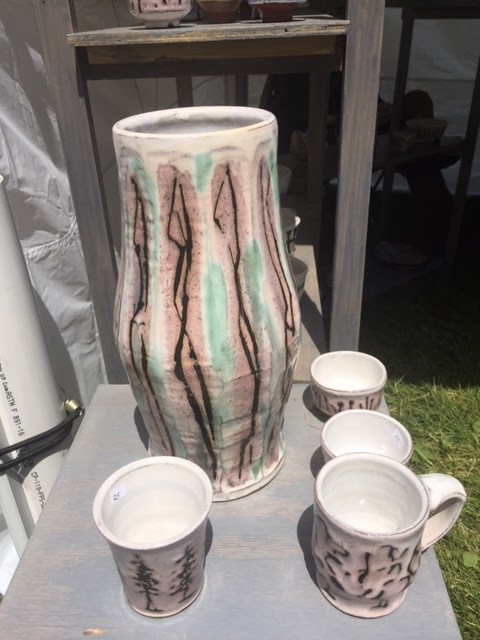
All this to say that we saw some wonderful ceramics at the Park Point Art Fair this past weekend. Here are a few pieces I especially liked.

The familiar designs of Husby Pottery.
Richard & Rosetti Gruchalla (here, top right and below)
were awards Best of Show this year.
The ubquitous Karin Kraemer

Related Links
Tate Rich Talks About Ceramics and Community Art
Making Bowls at the North Pole

Upcoming Art Events This Week
Adam Swanson's Science Art will be showing at Karin Kraemer's Duluth Pottery, 5-9 p.m. Tomorrow
Friday evening from 4 till late is the Duluth Art Walk.
And let's not forget the Free Range Film Festival in Wrenshall

Meantime art goes on all around you. Do it in Duluth.

Saturday, October 11, 2014

Broc Allen: East Meets West (October Tweevenings at the Tweed)

Tuesday evening I attended the October Tweevenings lecture at the Tweed Museum of Art. With the current Resurfaced and Reformed: Evolution in Studio Ceramics exhibition currently on display, it was only natural to have Broc Allen return to talk about some of the pieces here in this show in a lecture titled East Meets West.

Allen's talk was more challenging than most of the lectures I've attended, in part because of the lack of familiarity I have with the names and characters he talked about. Inasmuch as I try to take notes, I found myself sometimes scribbling Japanese names with phonetically imprecise markings. My guess is that this challenged some of the other listeners as well.

Nevertheless, I found it exceedingly interesting how some of the themes here echoed previous speakers' talks, most specifically Ann Klefstad's "Double Vision" lecture about masterfully artistic things that also had utility.

Broc Allen's talk began with how Japanese ceramic artist Soetsu Yanagi met Shoji Hamada. Yanagi's ideas resulted in a book called The Unknown Craftsman, a book that "challenges the conventional ideas of art and beauty. What is the value of things made by an anonymous craftsman working in a set tradition for a lifetime? What is the value of handwork?"

According to the book's description, "Mr. Yanagi sees folk art as a manifestation of the essential world from which art, philosophy, and religion arise and in which the barriers between them disappear. The implications of the author's ideas are both far-reaching and practical."

According to Allen, Soetsu Yanagi is often mentioned in books on Japanese art, but this is the first translation in any Western language of a selection of his major writings. The late Bernard Leach, renowned British potter and friend of Mr. Yanagi for fifty years, has clearly transmitted the insights of one of Japan's most important thinkers. The seventy-six plates illustrate objects that underscore the universality of his concepts. The author's profound view of the creative process and his plea for a new artistic freedom within tradition are especially timely now when the importance of craft and the handmade object is being rediscovered.

Allen talked about the artists who made objects for everyday use. Minji (or Minggi??) artists do not sign their work. Their aim is perfection, without trying to be famous. High level of art. It made me think about the superficiality of our American quest for celebrity and fame.

Yanagi created Tokyo Folk Art Museum. And at a certain point in time met Bernard Leach, the father of British studio pottery. Leach was a detail-oriented person who took great pains to document glaze recipes. (Glaze is the final coating on a piece of pottery that is fused to the piece through firing. Glazes are the decorative skin of the cup or bowl or vase, but also serve to waterproof the piece.)

Allen talked briefly about Shoji Hamada's path and then noted how Yanagi was into William Blake and Walt Whitman. In fact the Japanese master was so into Blake that he wrote a 700 page book on Blake.

Some of the details in the talk were probably a bit esoteric for the average person, and because of my own lack of familiarity with a lot of the lingo I was lost for parts of the talk. But there were some takeaways.

1. Everyone has a history. These men were individually influenced by people and places. They went on to other places and influenced many people.

2. Leach, Hamada and Yanagi went on a world tour that included a pass across the U.S. Their ideas were disseminated like apple seeds by means of lectures and demonstrations.

3. One story Broc Allen told was very interesting regarding one master's high standards when training new students of the high art of fine bowl making. The first day the student would try to make fifty perfect bowls. The master would keep one and scrap the rest. The second day he kept three. The third day he kept five. After that he never had to check again.

Warren McKenzie was the 1st Americans to appreciate what Bernard Leach was doing, another point in which the migration of ideas from East to West took place.

The next Tweevenings talk will be November 4.

Friday, September 19, 2014

The Ceramic Art of Carolina Niebres

Art fairs are a great way to see a wide range of art in a short amount of time and to meet new artists. I met Carolina Niebres at the Bayfront Art Fair in mid-August. Because I liked her work I asked if I could share it here and she consented to this interview.

EN: How did you get started in ceramics?
CN: I actually started in 7th grade making sculptures. I always wanted to do more but did not get back to it until 1999 after I had a health incident that made me realize that life is too short not to do the things that I want to do.

EN: Where were you trained?
CN: I started and continue to take classes at the Edina Art Center. I had my first Friday night beginner class in January 1999. I still take classes there and also help with firing, glaze mixing and other things. It is a great facility to learn as much as you are ready for. I have also gone to classes and workshops by other potters like Bob Briscoe, Ellen Shankin, Ian Currie, Robin Hopper, Robbie Lobell, Simon Levin, etc.

EN: Where have you been showing your work?
CN: I mainly do art fairs but have a few galleries. Iowa Artisans Gallery - Iowa City, IA; Gallery 319 and Octagon Gallery - Ames, IA; Edina Art Center - Edina, MN; Minnetonka Center for the Arts - Minnetonka, MN. Hopefully more to come.

EN: Where does your inspiration come from?
CN: Some of my designs come from the plants in my yard. I also love tribal tattoos from the Pacific Islands with all their intricate lines following and accentuating the lines of the body. My shapes come from observing natural curves; however, some of my new forms have been more geometric.

EN: Any up-coming shows?
CN: Yes, you can find them at my site: http://healingvessels.com

EN: Do you have a website or somewhere we can see your work online?
CN: My site is listed above. My more current work can be found on my facebook photos and here.

EN: Is there anything especially unique in how you create?
CN: Besides my designs, I do fire my pottery by adding a mixture of baking soda, sawdust, and water for the last few hours of firing. The baking soda circulates in the atmosphere of the kiln and falls on the pots very randomly. This adds additional variation and movement to each piece by possibly changing the glaze color and also flashing and creating a thin glaze which can build up to have an orange peel texture. This required extra work in the preparation, firing and clean up but the effects for me are worth all the extra work!

EN: When did you realize you were going to be serious about art?
CN: About 2 years after my first class, I found that I was making more and more and want to learn more! I knew then that I need to not just give away my work but actually sell it so that I could do more. A group of us decided to have annual holiday sales. I found that I really liked doing shows and interacting with clients and started doing juried shows. It just progressed from there.

EN: What are you working on now that has you jazzed?
CN: I am continuing to explore shapes out of round in all different forms: pitcher, bowls, mugs, tumblers, bottles, etc. I am working on "twisted" square or triangular forms that just have flashing on the exterior. I don't have many yet. I still also love working on new patterns as well as old favorites that are very meditative to create like my spirals and spiral trees.


* * * *

Quick note here: If you are in any way able, be sure to check our Remigio Bello's art opening, Northland-Southland at Trepanier Hall, tonight at 5:30. Trepanier Hall is the former YWCA located at 202 West 2nd Street in downtown Duluth.

Meantime... enjoy your weekend. If able, go out of your way to see or do something creative. 

Monday, September 2, 2013

Tweed and DAI Bring Special Events Here This Fall

Untitled, by Norval Morrisseau
From September 10 through March of next year the Tweed Museum of Art is hosting a major exhibition titled Blood Memoirs: Exploring Individuality, Memory, and Culture through Portraiture. Amber-Dawn Bear Robe is the guest curator of this show which features a compelling exhibition of painting, sculpture, photography, works on paper and video, all of which explore identity through the eyes of native and non-native artists. According to the Tweed's announcement regarding this show, "The exhibition looks at the contemporary vision of the "North American Self" by spotlighting how the artists choose to represent themselves, revealing a complexity of identity, a shared human constituent, and a mutual platform for dialogue."

The opening reception for this exhibition will be held the evening of Tuesday, October 22, 2013 with a presentation by Amber-Dawn Bear Robe followed by one of the artists in this exhibit Adrian Stimson, present as his alter ego "Buffalo Boy", who, through performance, provides visual commentary on the Buffalo Bill shows of the past as well as other identity issues.

The following evening internationally known filmmaker Chris Eyre will be introducing and showing his film "Skins" from 6:00-8:00 pm in Montague Hall 70. Eyre has been described as "the preeminent Native American filmmaker of his time" by People magazine. Mark you calendar.

National Juried Show "Possession" to Unveil This Week at the Duluth Art Institute

By Lenore Lampi
The Minnesota Women’s Ceramics Association (MNWCA) has assembled a show called Possession, a celebration of all things clay at the Duluth Art Institute. This was the MNWCA’s first national call for ceramic artists and the response was robust. 64 artists from 27 states submitted work for consideration in this grand event. And in the Steffl Gallery New Work by Robin Murphy will be on display. The opening reception for both exhibitions will be Thursday, September 19, 5-7 p.m.

I spoke with Tonya Borgeson of the Snoodle Studio regarding another feature of this show. Because of her involvement in clay and firing workshops around the country, she know the excitement that can come from the workshop portion of events like this, especially since our region is so alive with ceramics artists.

Borgeson has been with the MNWCA for seven years having attended numerous workshops including the Redwing Cearamic Workshop. She approached the Duluth Art Institute three years ago to host this major event which included and exhibit and workshops, developing the concept in conjunction with curator Annie Dugan. Workshops will be conducted Saturday at the DAI's Lincoln Center September 21.

By Holly Lacour
The title for the art show came from a discussion by the MNWCA in January. They talked about various potential themes and brainstormed about rhythm and life force and endurance. The idea of waters had already been a theme this summer. Ultimately they came upon the intrinsic possession of one’s skill and the personal possession of objects.

This is a juried show by two widely respected, internationally acclaimed artists, Eva Kwong and Mary Bohls. From the numerous submissions the judges selected 32 pieces that evoke a play with the understanding of ownership and control, passion and property.

When the MNWCA began it grew by word of mouth, attracting increasing numbers over time. They support both men and women artisans.

For more information on this show, visit mnwca.org/   Be sure to pre-register for the workshops if you want to participate.

Friday, October 5, 2012

Tate Rich Talks About Ceramics and Community Art

Next week is another big week for the Northland arts scene. On October 8-10 there will be the three day CREATIVE FLOW ~ CREATIVE ONENESS Fine Arts Festival at Minnesota Community College Ruttgers Bay Lake Lodge in Deerwood, MN (between Aitkin and Brainerd.) The event will feature art making, labyrinth exercises, lectures on building community around creativity, and workshops  with Tate Rich, artist and instructor at Cochise College in Douglas, AZ and Doug Padilla, a self-taught visionary artist of Norwegian/Mexican/cowboy roots living in the wilds of Minneapolis, Minnesota.

Then on Thursday and Friday here in the Twin Ports, there will be the two-night Gallery Progressive featuring as many as twenty galleries and dozens of artists. Much more will be said, but you can start by visiting the Twin Ports Gallery Progressive Facebook Page.

Doug Padilla and Tate Rich will be at LSC this coming week.
Overlapping both events, on October 10 and 11, Tate Rich will also be here in Duluth at Lake Superior College conducting demonstrations and having an Open Pit Firing Wednesday evening from 5 - 9. Pit Firing is a ceramic finishing technique. Thursday Oct. 11 11:30-1:50 Rich will conduct ceramic demonstrations at the school's ceramics room in LSC's Art Building.

Earlier this week I made contact with Tate to learn more about his work in ceramics.

EN: Briefly, where did you grow up and what life lessons have you carried with you from that experience?

TR: I grew up in Saint Cloud, MN. Often we had fires every night to stay warm. From that ancient tradition of sitting around a fire [I experienced] the basics of humanism, to gather, eat, sing, tell stories, and give thanks. I still really enjoy fire, and work in clay so I can be close to it. The one event that I spend most of my time organizing is the Pit-fire event. This event is celebration of the arts around a monstrous fire. Over 1000 clay objects are vitrified under the bonfire.

EN: Currently you are an instructor at Cochise College. How did this life direction come about?

TR: Cochise College is in Southern AZ outside of a artistic mountain border town called Bisbee. Do some research about the funk and magic of this place. Fate brought me to this little college in the desert. I firmly believe this is where I am supposed to be. I was teaching as an adjunct faculty member at 4 colleges and universities in SoCal for for 7 years before I accepted this job at Cochise College. Working adjunct is hard work because one has to teach double or triple loads to make the same money as a full-timer, but without any benefits. I was teaching at Goldenwest college in Huntington beach, Saddleback college in Mission Viejo, Citrus College is Glendora, and Cal State University in Fullerton. I was literally running a majority of all 4 programs and was burnt out. I decided to apply for a full time position and by law, any full time position has to be advetised. That semester there were 3 colleges hiring around the U.S. I applied here and was offered a position, I accepteed, then was offered a follow up intereview at another college but declined as I already accepted this position at Cochise.

EN: What is it about doing community art that gets you jazzed?

TR: Its advocacy for creativity. Recently I just finished a large-scale sculpture with the welding department and the Friends of the Warren Ballpark. It's a huge 24 foot sculpture of 3 bats leaning on each other. It was in the local paper last week. We need more art in the community. I am the chair of the Bisbee Arts Commission, through the city of Bisbee. We do many community activities and our mission is to support the arts and artists in our town.

EN: How did you become interested in and involved with making things in clay?

TR: Clay is an amazing material and was turned on to it at a young age. In high school and college I had some great instructors that help guide me in this material. Perhaps, this is why I teach also… Anyhow, clay is complex and takes much patience. I often find my self working/meditating with clay for many of hours in the studio without realizing time. I can easily pass 8 hours with working with the process. I am also very interested in fire and this is an important part of working with clay.

EN: How did you come to be giving demonstrations and speaking at Lake Superior College?

Tanya saw a presentation of mine at this last year's NCECA conference in Seattle. I presented a documentary of the Pit-fire festival that I put on in SoAZ. She then asked if I would be willing to present and demonstrate at Creative Flow. I am honored and excited to be a part of this upcoming conference. It will be a great opportunity to connect with my home state of Minnesota and to collaborate with some wonderful people. I hope to bring some positive energy to the event.


You can learn more about pit firing by watching these videos:
2009 Cochise College Pit-Fire Documentary
2010 Cochise College Pit-Fire Documentary

Monday, July 9, 2012

Eight Minutes with Artist/ Water Advocate Tonya Borgeson

Tonya Borgeson, an instructor at Lake Superior College, has been making ceramics for nearly two decades. Based on her numerous shows, workshops and activities she appears to have an indefatiguable energy. Her artist statement begins, “I have been creating with ceramics for 18 years. The focus of my art work currently is about water, how humans use water and how humans react and are responding to the water crisis on Earth.” She is especially passionate about Lake Superior.  

EN: How did you first become interested in the arts?
Tonya Borgeson: I was always artistic. It was basically the one outlet I felt comfortable doing. And being supported by my family was good. My parents never told me “Why would you go to school to be an artist?” They were supportive and I have been doing it since very young.

EN: What prompted you to take an interest in ceramics as a means of expression? 
TB: My mom grew up in Wrenshall, and there was a lot of natural clay there. We used to play with that clay. When I took art in school, Mr. Pullan the art teacher was a ceramicist and he encouraged us to try the wheel. I know of several other ceramic artists from my high school.

So I applied for colleges and decided to go into graphic design or interior design. But since I started doing ceramics in seventh grade and by the time I was a junior and senior I was helping teach in Mr. Pullan’s art classes. I was literally taken out of classes – math, science, English – to make posters for teachers. I was highlighted for my creativity in my high school.

I fell into choosing ceramics in college because I felt so comfortable in the pottery room. So I took the pottery class and the teacher Roy Strassburg pulled me aside and asked how I developed my skill. He suggested I become a ceramics artist, which I never had heard of before, that a person could be just a ceramics artist.

After that I switched my major to a bachelor of fine arts with a specialty in ceramics and painting.

EN: You got your MFA at Indiana State U. … What were some of the things you learned through that experience? 
TB: First I did a student-at-large position at Carbondale, IL which was an experience builder and resume builder. You also continue to expand your web of people whom you become colleagues with. I was there for two terms and then moved to Indiana State University.

I learned independent thinking, and strong evaluation critiquing of your projects and concepts. During that time I had multiple art history classes and was interested in artists who were untrained and was interested in those artists, like Jean Dubuffet and folk artists, tribal and ceremonial art. At the time I felt like I was aligning myself with artists who documented our human time.

It was while working on my Masters I became involved in community-based art, or art that was placed in the community, with natural materials. I did a twenty acre land drawing outside Chicago, using the earth as a medium, and which no one could see except in a plane.

Through that research I developed the concept of this Snoodle, a community clay center. I had a whole section on how to start a community art center, not knowing that I would come up to Duluth and end up doing that. I visited other centers and researched and wrote about it in my Master’s thesis.

EN: So what is the Snoodle? 
TB: The Snoodle is my working studio space as well as a community clay center. Anybody from age 2 to 102 can come in and within one hour can make something. I offer hands on events and teach techniques. There is also a gallery space where we show art by various artists in different mediums. People can come and rent space here, rent the kilns, use the tools.

EN: You make a living by both teaching ceramic sculpture and pottery. What are some of the things you teach about pottery? 
TB: I teach the creative process. I use different methods and teach people about the different mediums and materials.


EN: In June you assembled a group show at the Whole Foods Co-op addressing water issues and now followed up with a solo exhibition called Waters, What about the Waters IV which will be showing thru August 7. How did you become such an advocate for water?
TB: It just developed out my own growth as an artist. As an undergrad I concentrated on our humanity and spirituality in our place. And then in graduate school I felt like my work represented animal, human and earth elements. So then I just kept working through that, continually building upon them and becoming more and more aware of what you are seeing in the work. All of a sudden, at a certain point it switched to water. Along with these other art forms I also sketch daily. The drawings began to show a cloud theme and the influence of water… and reading about it in the media that people are dying because they don’t have access to water and hearing people in our region saying there is not a water issue, which was so shocking to me because we are in a huge water issue worldwide. Like any valuable resource there is a potential end to that resource.

Eventually I became more open and public with work on this theme.

Tonya's website can be found at www.tonyaborgeson.com

Popular Posts