Showing posts with label California. Show all posts

Saturday, April 6, 2024

California Keeps Lawyers Occupied as Common Sense Falls by the Wayside

Here are two California stories that caught my eye this weekend. This first appeared in Reason magazine.

San Francisco Bill Would Let People Sue Grocery Stores for Closing Too Quickly

A proposed ordinance would empower people to sue supermarkets that close without giving the city six months' advance notice.

* * *  

Now, here is my question: Will a bill like this incentivize ANY businessperson to start a grocery store in San Francisco? The intentions may be good (to take care of the community's food necessities during the six months they prepare for alternative grocery supplies) but the long term effect will be to create the opposite effect. No new grocery store will move into that neighborhood because it's too high risk. 

There are already too many regulators and regulations in California. I remember reading a story a number of year back in which someone wanted to start an albacore business. They had to get approvals from nearly 50 agencies before they even opened. After opening they were fined $25,000 because they had not obtained approval from yet another agency that they had never even heard of. 

The story in Reason noted that grocery store executives had been warning that layers of process (red tape) would make it less likely that grocery stores would even do business there in the first place.

As I've noted repeatedly, incentives matter. Make it easy to do business and you get more businesses (and jobs). The harder you make it to do business, the fewer entrepreneurs and risk takers you'll have in your town, city or state. 

Read the full account here at Reason.

ON THE ENERGY FRONT

In January, Joe Biden and the Department of Energy coughed up $1.1 billion to keep Diablo Canyon running. This move came after Governor Gavin Newsom of California put his foot down, saying the plant, originally slated to shut down in 2025, had to stay open to prevent blackouts.

In response, California environmentalists are now throwing a fit and suing to shut down the very same Diablo Canyon reactor, the state’s final nuclear power plant. This plant produces about 9% of California's juice. 


Meanwhile, lawmakers are running feasibility studies to see if they can get buy-in for next-gen nuclear reactors. They know Californians won't be thrilled if they don't keep the lights on. It's not a given.      


You can read a more complete account at The Center Square: California enviros sue to close last nuclear plant providing 9% of state's power 


Wednesday, March 30, 2022

Lewis Lapham's Money and Class in America

Lewis Henry Lapham is an American writer. He was the editor of the American monthly Harper's Magazine from 1976 until 1981, and from 1983 until 2006. He is the founder of Lapham's Quarterly, a quarterly publication about history and literature, and has written numerous books on politics and current affairs. --Wikipedia
* * * 

For years I was a subscriber to Harper's Magazine during the second period Lewis Lapham served as editor of the publication. Many, if not most, magazines have an opening letter from the editor, and Lapham's lengthy editorial was always something I looked forward to reading. George Plimpton called him a cross between Mark Twain and H.L. MenckenEven when not in alignment, his prose was pointed and insights worth chewing on, even when sad and cynical. 

For this reason I went on to acquire his book Money and Class in America. Its subtitle: Notes and Observations on the Civil Religion

While reading yet another story about California, wealth and poverty recently, Lapham's California pedigree came to mind. I pulled it off the shelf in search of a couple comments he made about his family. Now I'm re-reading it and appreciating it even more than the first time I'd held it in my hands.

The factoid I was looking for I haven't found yet, but it went something like this: his family once owned about one-fourth of the real estate of California. What I did find was that his great-grandfather was a co-founder of Texaco and his grandfather was once mayor of San Francisco. Lapham came from money -- as in Big Money -- and understand the paradoxes associated with wealth.

Here's an overview of the book's contents. 

Money and Class in America

Creative Commons license. Author uncited.
Never in the history of the world have so many people been so rich; never in the history of the world have so many of those same people felt themselves so poor.

Chapter One: The Gilded Cage
Seeking the invisible through the imagery of the visible, the Americans never can get quite all the way to the end of the American dream.

    Chapter Two: Protocols of Wealth
    The history of the United States is synonymous with the dream of riches.

    Chapter Three: The Golden Horde
    At this late stage in the history of American capitalism I'm not sure I know how much testimony still needs to be presented to establish the relation between profit and theft.

    Chapter Four: The Romance of Crime
    The pose of innocence is as mandatory as the ability to eat banquet food and endure the scourging of the press.

      Chapter Five: Social Hygiene
      Once having proclaimed our loyalty to the abstract idea that all men are created equal, we do everything in our power to prove ourselves unequal. Among the world's peoples, none other belongs to so many clubs, associations, committees and secret societies.

      Chapter Six: The Precarious Eden
      The rich, like well brought up children, are meant to be seen, not heard.

      Chapter Seven: Descent into the Mirror
      Since the eighteenth century the immense expansion of the world's wealth has come about as a result of a correspondingly immense expansion of credit, which in turn has demanded increasingly stupendous suspensions of disbelief.

      Chapter Eight: Holy Dread
      Wars might come and go, but the seven o'clock news lives forever.

      Chapter Nine: Coined Souls
      That the obsession with money dulls the capacity for feeling and thought I think can be an axiom requiring no further argument.

      Chapter Ten: Envoi
      Surely they knew that the very idea of the future came in an American box - complete with instructions for assembling a Constitution, a MacDonald's hamburger franchise, a row of Marriot hotels and a First Amendment.

      * * *

      The book is a pretty scathing indictment of American values. Today there are more riches than ever being showered on sports stars, Hollywood celebrities, Silicon Valley whiz kids and Wall Street bankers. Lapham asks, "What's the point of all this wealth without Character?" Hence we see the self-destruction emblazoned across headlines, Tweets and supermarket tabloids. 

      "If we could let go of our faith in money, who knows what we might put in its place?"

      Tuesday, February 1, 2022

      A Few Notes from Michael Shellenberger's San Fransicko

      This past six months or so I have been researching the topic of homelessness ever since I read about the 2007 St. Louis County initiative called End Homelessness In Ten (EHIT). The EHIT story caught my attention mostly because by 2020 homelessness in the region not only continues but seems to have doubled.

      It would be easy to make a barbed remark here about politicians creating slogans for programs. MAGA and Build Back Better aren't the first such declarations. In Duluth the population has been in the 86,000-87,000 range for the 35 years I have lived here, but because of the the need to expand our tax base the former mayor Don Ness initiated a 90/20 goal. That would be a population of 90,000 by 2020. 

      It was a worthy objective, and hopefully the effort produced a few insights as to where the obstacles lay.

      * * * 

      In order to gain a better understanding of homelessness I created a Google Alert on the topic which delivers a daily feed of news stories about this issue. This is how I became aware of Michael Shellenberger's San Fran-sicko: Why Progressives Ruin Cities

      Shellenberger is not immune to controversy. His book Apocalypse Never created something of an upheaval because he had been for two decades a super-advocate for environmental action. When he began running into young people who were planning to not have families because of their belief in an environmental apocalypse, he realized that environmentalists had been striing the "end of the world chord" a little too hard. At first, they felt they needed to make enough noise to create awareness. Instead, they created a fear vibe that permeated a generation. Panic is not rational and difficult to reason with. 

      That was his last book. His latest is about California. Here are a few notes.

      Between 2008 and 2019, 18,000 companies including Toyota, Charles Schwab, and Hewlett Packard, fled California due to a constellation of problems sometimes summarized as “poor business climate." California has the highest income tax, highest gasoline tax, and higher sales tax in United States, spends significantly more than other states on homelessness, and yet has worse outcomes.

      California has had its share of troubles for decades, he notes, but things have grown exponentially worse in the past ten years.

      I was confused. So I have been a progressive in this Democrat all of my adult life, I find myself asking a question that sounded rather conservative. What were we getting for our big high taxes? And why after 20 years of voting for ballot initiatives promising to address drug addiction, mental illness, and homelessness, had all three gotten worse? Why had progressive Democratic elected officials stopped enforcing many laws against certain groups of people, from people suffering mental illness and drug addiction in San Francisco, Los Angeles and Seattle, to heavily armed and mostly white anarchists in Seattle, Portland, and Minneapolis?

      Shellenberger says he wrote San Fransicko because he didn’t have the answers to those questions and he felt he needed them. I identified with that feeling because it's what drove me to read hundreds of pages of think tank reports on this issue so as to organize my own thinking. My aim is to apply what I learn to our community, just as Shellenberger's intent is to get clarity about his city.

      From 2005 to 2020, San Francisco experienced an astonishing 95% increase in unsheltered homelessness has the number of permanent supportive housing units offered by the city rose from 6487 to 10,051.

      Today San Francisco has the greatest quantity of permanent supportive housing units per capita of any major city in the United States. It has 11 permanent supportive housing units per thousand people which is nearly 3 times as much as New York City and Chicago and over six times as much as Miami-Dade County. All of that and yet the sheltered homeless population of New York City, Chicago and Miami fell 11, 10 and 50% respectively between 2005 and 2020 whereas San Francisco’s rose 95%. Why was that?

      * * *

      Correcting Another Narrative

      One of the canards that people have repeated so often that it's accepted as truth is that Ronald Reagan was responsible for the closing of mental institutions. Shellenberger, leaving no stone unturned, digs into this a little further unearth's this.

      While it's true that as California’s governor Reagan oversaw the closure of mental hospitals, he didn’t start the de-institutionalization. It began nationally in the 1930s, mostly to save money. The closure of California’s mental hospitals began in earnest in the 1950s, more than a decade before Reagan became governor. The emptying of state mental hospitals continued at the same rate between 1959 and 1969. By the time Reagan took office in 1967 nearly half the patients in California state mental hospitals had already been released.

      As for the Lanterman-Petris-Short Act, it was a creation of civil libertarians, mental health professionals, and anti-psychiatry activists. Sponsored by two Democrats, it passed by a 77-1 vote. It would’ve passed even had Reagan vetoed it. And while Reagan, as president, cut over 300,000 workers from Social Security insurance and Social Security disability insurance, he reversed course a year and a half later. By the end of his presidency nearly 200,000 won back their benefits.  

      In reality it was a Democrat who got the de-institutionalization of psychiatric hospitals rolling. President John F Kennedy proposed successfully proposed and successfully advocated a crucial 1963 reform that required the federal government to fund community mental health centers but leave it to the states to fund these mental hospitals. 

      In 1963, JFK argued that medical advances would enable "most of the mentally ill to be successfully and quickly treated in their own communities and return to a usual place in society." 

      Optimism may be good at the beginning, but when the problems worsen, it seems new approaches need to be considered. 

      Shellenberger has an issue with the abundance of human poop on the sidewalks and the acceptance of open air addiction communities. Most of us have images in our heads of Amsterdam's Needle Park. Shellenberger flew there to see it for himself and discovered that it has all been cleaned up. The outcomes were troublesome and unhealthy. Amsterdam solved their problem by having the police and social workers working together to help individuals get off the junk and on to a new kind of life. 

      This is not what's been happening in California. 

      More can be said, but our research has only just begun. 

      Related Link

      The Mismanagement of Man (Review of San Fransicko)

      Tuesday, July 6, 2021

      The Japanese Relocation During WW2: Executive Order 9066 Revisited

      "The first to present his case seems right, 
      till another comes forward and questions him."
      --Proverbs 18:16

      Photo by Hello I'm Nik on Unsplash
      It's practically a given that there are two sides to every story. This is why we need to re-examine our basic beliefs now and then, because much of what we have accepted as fact is nothing more than conclusions drawn from hearing only one side of a story.

      This blog post aims to suggest that our harsh criticism of the Japanese "internment camp" program during World War Two may be unwarranted. 

      In 2018 I wrote a blog post addressing Executive Order 9066, calling it "one more cause for shame" as Americans. On the surface, this conclusion seems reasonable. Upon deeper investigation, a strong case can be made that the real events that occurred reveal a remarkable degree of compassion and generosity of spirit and little to be entirely ashamed of.

      James Nickel, a friend from California, suggested I look into this further and by doing so I learned much that I hadn't previously understood or known about. What follows are notes gleaned from Dwight D. Murphey's essay "The Relocation of the Japanese-Americans During World War II."

      * * * 

      To re-think any issue or learn about it in depth requires a commitment of time. What follows are some of the primary facts of which I was unaware, shedding new light on what had previously been in shadow.


      For continuity sake I will follow Murphey's outline. First, what actually happened? Then second, why was it done and was it really necessary?


      EdNote: The complete article is 25 pages in length with 96 footnotes. What follows is an attempt to represent fairly the findings of Mr. Murphey's research. 


      * * * 

      What actually happened?

      Click to enlarge. Public domain.
      Immigration laws at the beginning of the 20th century permitted Japanese to freely immigrate to this country. This became restricted after 1908 and was cut off completely in 1924. The 1940 U.S. Census showed that there were 126,946 persons of Japanese origin in this country, 79,642 born here and thereby considered U.S. citizens.

      As tensions escalated with Japan near the end of the 1930s, American intelligence agencies had begun compiling a list of people whom they considered dangerous in the event of a war with Japan. After the attack on Pearl Harbor, the U.S. arrested and incarcerated 3000.


      Two months after Pearl Harbor, President Roosevelt signed Executive Order 9066, authorizing the establishment of military areas where all people could be excluded. This was extended to all parts of the West Coast in which no Japanese were then permitted to reside. 


      This is what led to the creation of camps where the Japanese would be moved. The evacuees were moved to location centers further East. Here are some of the things I learned from reading the Murphey essay.


      1. The centers were run by Japanese Americans, not some kind of U.S. Gestapo. 

      2. The centers were not surrounded by barbed wire, like a prison camp. They had stores, movies, activities...

      3. The college-aged children continued their education, and 4300 were attending more than 300 universities around the country by the war's end.  

      4. Only one of the relocation centers became an actual internment camp. This was used for the small minority of Japanese Americans.

      5. The centers were intended as places where people could stay until they found other places around the country to relocate to. In 1943, 16,000 left the centers and in 1944 18,500 more left to begin anew in other parts of the country.

      6. Extensive efforts were made by the army to safeguard the property of those who were evacuated. Similarly, neighbors and friends helped take care of their properties until they returned. (At the end of this blog post is a letter to the editor expressing gratitude for the kindnesses they received in this difficult time.)


      Why did this happen? Was it really necessary?

      The context for this decision needs consideration. The U.S. fleet, our first line of defense, had been nearly destroyed. And invasion fleet from Japan could have arrived on our shores unimpeded. A Japanese submarine shelled an oil field in California in February. Five Japanese planes flew over L.A. 


      In hindsight it could be argued that the evacuation was not necessary. Looked at another way, California and the Northwest were quite vulnerable. The water supply could be sabotaged as could the power grid. A "systematic campaign of incendiarism" could do massive damage.


      Those who argue that the relocation was unnecessary, Murphey demonstrates, are either unaware of the facts or deny them. U.S. codebreakers identified hundreds of communications dealing with U.S. espionage activities. 

      * * *

      In addition to encouraging me to review Dwight Murphey's essay, James sent me several clippings from the local newspaper including the letter to the editor below. He accompanied the clippings with this note:

      "I recognize the disconnect most people have with WWII and the relocation camps. You have to live in that season to grasp what was going on, as you note. I think the newspaper articles from the Reedley Exponent show that the majority of the townspeople sought to help the local Japanese, their neighbors, in any way they could given the exigences of the times."

      * * * 

      A LETTER TO THE EDITOR
      The Reedley Exponent
      20 August 1942

      To the good people of Reedley, California


      We wish to thank you one and all in behalf of ourselves as well as for many Japanese evacuees who had made their home amongst you for regretfully such a short period of time.


      What has prompted me to write this letter of appreciation to you good residents of Reedley is that you were so kind and tolerant towards us in this time of unrest and turmoil. Of course it is understood that we residents of California have naught to do with this war, yet being Japanese of Americans of Japanese ancestry we do not feel happy that the two countries closest to our hearts are at war and feel that we may have been at fault for the outburst of this deplorable international complication.


      However, while our sojourn in Reedley the residents of Reedley, the good people on whose property we resided, the civic authorities as well as the federal officials (by which I mean the postoffice officials at Reedley) whose patience we sorely tried with our innumerable questions, all to these good people we wish to thank you for your sympathy and understanding you had shown us.


      One does not realize what a friendly smile means to a stranger who, not knowing the attitude of the people of such community, are compelled to usurp their have, until and unless one finds themselves in a similar predicament. And such a kindly attitude was shown me and to many others, not on one but on many occasions and for which we wish to thank you from the depths of our hearts.


      May God bless you all for your friendliness to us bewildered evacuees, and may His teachings continue to flourish in your good community.

      Dr. & Mrs. F. T. Inukai

      Related Links

      My blog post addressing Executive Order 9066

      Introduction to the Dwight D. Murphey Rebuttal

      The Dispossession of the American Indian and Other Key Issues in American History  (Dwight Murphey's essay on the Japanese American relocation is found in this book.)

      Final Note: This is not an attempt to whitewash all that happened. It is, however, an attempt to suggest that the current narrative that is most pervasive does not present an accurate picture of what occurred and why.

      Saturday, December 12, 2020

      Michael Shellenberger: Fighting the Good Fight

      Photo by Emma Watson on Unsplash
      Last night I came across some Tweets by Michael Shellenbergsr regarding some misinformation promulgated by the New York Times regarding redwoods in California being destroyed as a result of climate change. What Shellenberger stated was that Times and one of their writers didn't just exaggerate the truth but printed outright falsehoods.

      Naturally this made me curious as to what had been said. Here's the misinformation from MS's Dec 11 Tweets: The New York Times is claiming in a long, front-page story today that recent fires killed "countless ancient redwoods" in California

      The claim is false and should be immediately corrected

      * * * 

      The reason Shellenberger gets so incensed about these things is that later in his career as an environmentalist he kept running into young people who had no confidence about the future, who weren't even going to start families because the world was coming to an end due to climate change.

      "As a lifelong environmental activist I am horrified that some young people say they may not have children because of climate change," he writes. "The truth is that *most* trends relating to climate change & the environment are headed in the right direction!" 

      The title of his book is Apocalypse Never.  

      The sad part is that if you do not agree that the world is at the edge of collapse, you are the problem. The story of Chicken Little ought to teach us that maybe the Chicken Littles of the world might have things mixed up and overblown.

      According to Shellenberger: No scientist or journalist has presented evidence for a single ancient redwood tree killed by this summer's fires

      So how do they get away with declaring it?

      Shellenberger is all for protecting our world and human life. For some reason the fear narrative has gained more traction than the many positive stories. For example, how many times have you heard that we can't feed our massive global population. Someone two centuries ago wrote that two billion was earth's maximum capacity. In 1970 The Population Bomb was required reading in one of my classes. But according to the Apocalypse Never Slide Deck, we already produce enough food to feed 10 billion people.

      * * * *

      Another battle that Shellenberger has become involved in is the push for solar energy over nuclear energy. Once again, the narrative is "Nuclear = Bad, Sun and Wind = Good." But are the facts are seldom put on the table. The straight up full story never gets fairly discussed. Kids are taught in school to fear nuclear power and that carbon based fuels are bad. Sun power is pure.... But at what cost? Everything in life has trade offs. 

      Here are recent Tweets from Shellenberger, who has much more to say on this issue.

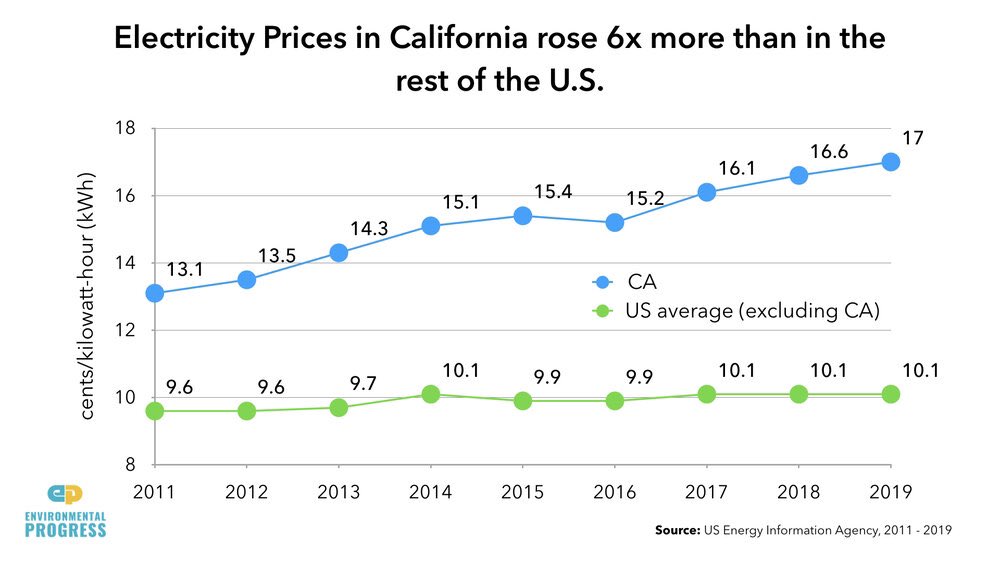
      Solar panels - create good jobs in China, not US - increased Calif. electric prices 7x more than rest of US - needs 300x land than nuclear - violates rights of indigenous - makes big $ for mega-banks

      California saw its electricity rates rise 6x more than the rest of the U.S. between 2011 and 2019, due principally to the deployment of renewables and enabling equipment.
      Image


      Consider the largest new solar farm in the United States. It will create just six permanent jobs, each earning $43,000 per year. By contrast, an average two-reactor nuclear plant employs 1,200 people.

      * * *

      You can follow Mike Shellenberger on Twitter @ShellenbergerMD 

      Related Links

      He Who Controls the Narrative Controls the People

      Purchase Apocalypse Never on Amazon

      Scary Thoughts: A Collision of Worldviews


      Disclaimer: The author of this blog does not receive any remuneration or benefit 
      from promoting this book or any other books on this blog other than my own.


      Saturday, December 5, 2020

      This Day In History: Events of Note, Events to Mourn -- With Commentary

      Young Mr. Disney with famous his pal Mickey
      Walt Disney was trending on Twitter today. He's been dead for quite some time, so it couldn't have been news about his passing. Sure enough, it was news about his coming back to life after being stored in a cryogenic state since his passing in 1966. 

      Just kidding. On this day in History Walt Disney was born in 1901.

      Upon reading this I had two directions to consider. (1) a blog post about Mr. Disney and his influence, or (2) an overview of other events that took place on this day in history. I'm choosing the latter. 

      DID YOU KNOW

      ON THIS DAY in history... 

      In 1848 the California Gold Rush began. 
      California was pretty desolate before that. There used to be three ways to get to the West Coast back before the Transcontinental Railroad. All of them took six months and were fraught with peril. One was was by boat, around the tip of South America, passing through the treacherous Straits of Magellan. The second route was to go by sea down to the Panama Isthmus and do a land passage to the other side. The danger there, of course, was malaria and dengue fever. A third route was equally challenging, by wagon train across the continent. There were no guarantees and many hazards on this journey, too.

      Two other big Gold Rush events occurred in our history. One was the Black Hills Gold Rush (1976-77) and the second was the Yukon Gold Rush (1892-1912). Adventurer and author Jack London wrote many stories about the latter. (If you can find it, look for his tale "Lost Face") As for the Black Hills, there is still "gold in them thar hills. (To this day people are still chasing gold in myriad ways, but that's a different story.)

      The Bermuda Triangle Event of 1945
      Depending on which account you read, on this day in 1945 either four or five U.S. Navy Avenger bombers disappeared approximately 100 miles off the coast of Florida. Flight 19 took off from the Ft. Lauderdale Naval Air Station on a routine three-hour training mission. Flight 19 was scheduled to take them due east for 120 miles, north for 73 miles, and then back over a final 120-mile leg that would return them to the naval base. They never returned, disappearing without a trace.

      1791--Wolfgang Amadeus Mozart dies in Vienna.
      Years ago I made lists of favorite things with one list being favorite short classical compositions. More recently I shared these in story titled 10 Classical Music Favorites of Exquisite Beauty. Two Mozart compositions were on this list. What an amazingly productive genius. He packed so much into such a short life that it seems almost inconceivable.

      Publicity still for Bob Dylan's "Heaven's Door" whisky.*
      1933--
      The 21st Amendment ends Prohibition in the United States
      13 years earlier the Volstead Act was passed and, as with many decisions, the law of unintended consequences was set in motion. Interestingly, Jack London wrote a novel in support of Prohibition titled John Barleycorn about his enjoyment of and struggles with alcohol. The fourth studio album of the British group Traffic was titled John Barleycorn Must Die. (Interesting.)

      1955 - Today was the beginning of the Montgomery, Alabama bus boycott led by Dr. Martin Luther King.
      Let's pause for a moment of silence because race is still such an issue in this country.

      1964 - Lorne Greene's song "Ringo" becomes a No. 1 hit single in the U.S.
      It's always interesting when people famous in one discipline do something in another. Dylan making sculpture for example. Or comedian Jonathan Winters making fine art
      Greene was one of the four members of the Cartwright family on one of television's longest running Weesterns, Bonanza. At our house it seems like the show was on every Sunday night from 1959 into the early 70's. Off the top of my head I am not sure how many Hollywood stars become rock stars, but I do know that fame as a rock star seems to open doors in Hollywood. Mick Jagger, David Bowie, The Beatles, Madonna come readily to mind. 

      1965--The Beatles play their last Liverpool concert
      The Fab Four performed at the Liverpool Empire. There were only 5100 tickets and 40,000 applications. That week the #1 hit in the UK was their "We Can Work It Out"/"Day Tripper"... a single that I also had bought around that time.

      1968--The Rolling Stones' Beggars Banquet was released. 
      That year for Christmas I think the one thing I wanted more than anything was Beggar's Banquet. I was into the Stones because all the girls in schools seemed to swoon over The Beatles, so it was a bit of a contrarian attitude. Nevertheless I did have most of the albums by both groups up through the early 70s. And yes, I did get Beggar's Banquet for Christmas that year. The photo inside was so cool!

      In 1992, Whitney Houston's 
      "I Will Always Love You" begins a 10 week run at #1 in the UK  
      As the saying goes, Ms. Houston had incredible pipes. She sold over 200 million records worldwide and according the Guinness Book of World Records she was the most awarded female artist of all time. What prompted me to include this bit of trivia was seeing that Dolly Parton was the songwriter. It wasn't until I watched the Ken Burns documentary on Country Music that I discovered Ms. Parton was a songwriter and not just a performer. Dolly Parton was the 4th of 12 children born in Eastern Tennessee, her earliest years in a one room house. If I recall correctly, she wrote her first song when she was five. 

      Saturday, June 27, 2009

      Fine Arts

      I was recently contacted on Facebook by an artist I went to school with at Ohio University, Kim Abeles. Kim was a fellow art student at Siegfried Hall whose innovative work showed that she clearly had a future in the arts. My recollection was of a number of very talented young people who seemed exceedingly committed to new visions, not simply getting a grade. It was a fertile time for releasing the powers of imagination. The energy was such that I believed a movement was being germinated. But alas, upon graduation we splintered in an array of directions. Ultimately, art remained important to all of us.

      Kim ended up in California and somehow, undoubtedly by means of the emerging Internet, I contacted her again in 1996. She responded by sending a book titled Enciclopedia Persona, which had been published in conjunction with the Museo de Arte de Santa Monica. Kim's work was being exhibited throughout South America.

      I visited Kim during my first business trip to California in 1998 or thereabouts, and had the privilege of seeing her studio. Impressive! Some of her work included etchings made solely by placing glass on the roof and allowing the L.A. smog to do the etch. One of these was a collection of dinner plates that had portraits of U.S. presidents from McKinley to Bush in the center of the plate with historical quotes declaring a commitment to the environment on the rim of each. The power of this collection was that each image had been created with about a week's worth of Los Angeles smog. I kid you not.

      During our visit I lamented privately that I was somewhat envious of her output and her life of ongoing creative expression. She encouraged me to re-connect with my roots in the arts and not give up.

      After more than twenty years in advertising, I have always been grateful at the opportunity to make a living and provide for my family by means of applied creativity. There are, however, other creative disciplines that have value as well. To some extent making art -- painting, drawing, sculpture, etc. -- is therapeutic, and to some extent it is an exploration of possibilities. While I am reluctant to call our visit "the" trigger event to push me back toward a more earnest commitment to the fine arts, it was certainly one such prod.

      This past week I have been in the process of framing drawings and paintings, preparing work for a first show, at The Venue in Duluth's West End. It's an adventure, and if you are in the vicinity I invite you to partake of it. I will keep you posted of the details.

      Of Kim Abeles, her newest adventure will be a show in China. I'm confident it will be a thought provoking experience for anyone who takes it in.

      Popular Posts