Showing posts with label Historic Duluth Armory. Show all posts

Monday, May 22, 2023

2023 Duluth Dylan Fest... Days Two and One are Done

Arranging the initial design.
Duluth Dylan Fest commenced shortly after dawn on Saturday, May 20th. There were two happenings at the Historic Duluth Armory and the Armory Annex. Mark Poirier led us on a tour of the Armory, with a smattering of details about its history and the vision for the future. Outside the entrance to the Annex one could participate in a collaborative creative effort to produce a welded gate.

As many know well, gates have been the most recent iteration of Bob Dylan's foray in the development of his skills as a visual artist. (EdNote: This activity is completely unrelated to the controversial billionaire Bill Gates.) It's well known Dylan has been drawing and painting for more than half a century. Fewer are aware, however, that he has been creating welded works in iron for three decades now. It's just one more example of Dylan's connections to his Iron Range roots. 

In 2022 our local Dylan Fest, in conjunction with the Duluth Forging Community, created a Dylangate Event. Visitors were invited to bring various items to be incorporated into the overall design, much like the gates Bob Dylan has produced at his Black Buffalo Ironworks studio. The project was such a success that it looks like it's becoming a tradition. One attendee brought a piece of metal from Maryland to contribute.

The big draw, for many Saturday morning, was the opportunity to tour the Historic Duluth Armory where a young Bobby Zimmerman experienced a zeitgeist moment while watching Buddy Holly perform in January 1959. Armory Arts director Mark Poirier led the tour, offering visitors a glimpse of the future for this historical place.

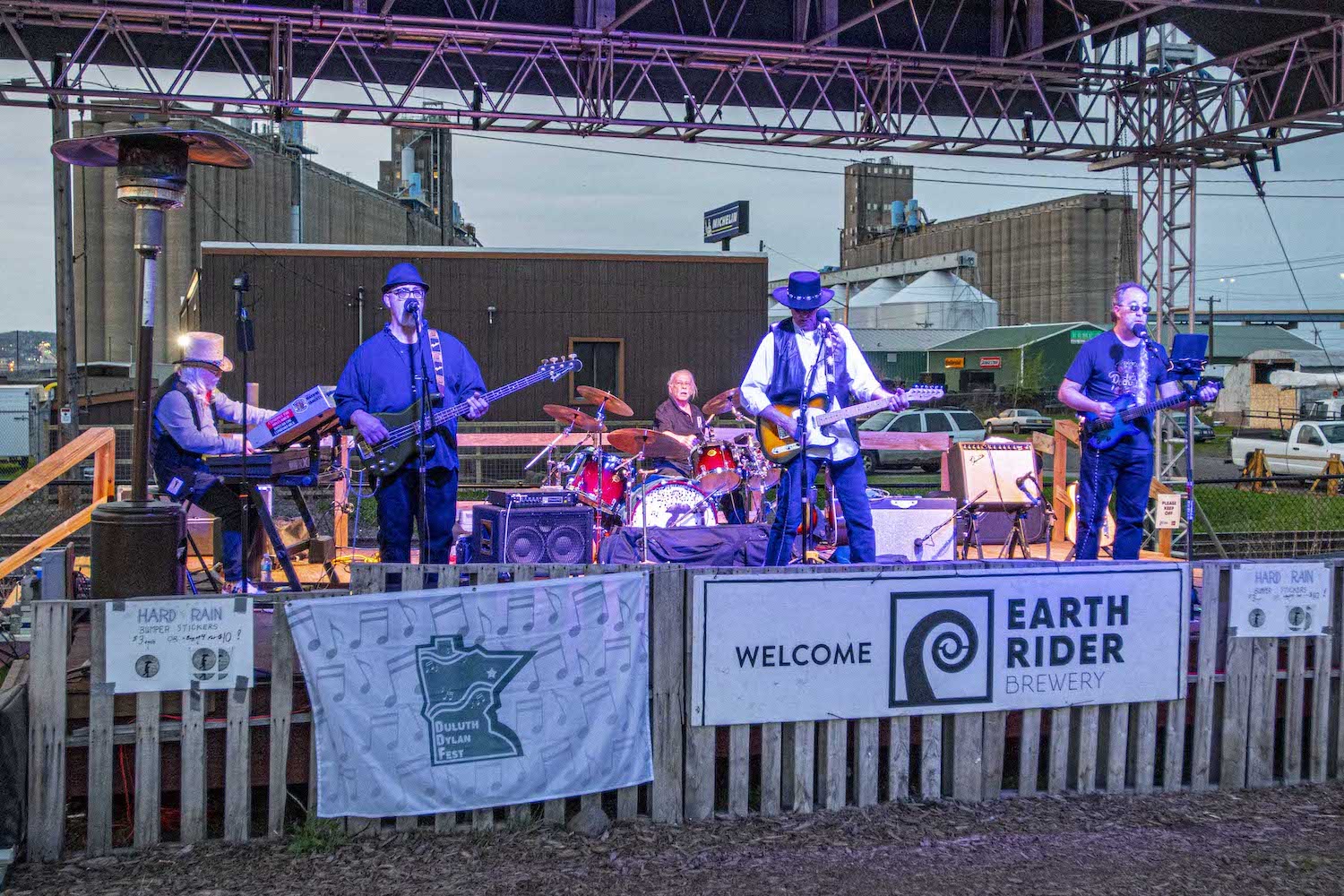
From one to four in the afternoon, the public was invited to sip samples of Heaven's Door whiskey and bourbon, another business that Dylan has spawned late in his career. At five o'clock, Miriam Hanson hosted a special edition of Highway 61 Revisited on KUMD The North radio station, and at 7:00 Hard Rain, the band from St. Louis, provided entertainment for the Duluth Dylan Fest Kickoff Party. Spirits were lifted and dancers danced at the Earth Rider Festival Grounds.  

Samples of Heaven's Door at CashWise
On Sunday, the action moved to Hibbing with a tour of places where Dylan spent his growing up years and a party on the front lawn of the Zimmerman homestead where "Bobby" came of age. In the evening had the first of two John Bushey Memorial Lectures with Seth Rogovoy, Author of Bob Dylan: Prophet Mystic Poet.

A week of events still lies ahead of us though. Here's the full schedule of what's to come, beginning tonight with more Heaven's Door bourbon and whiskey sampling and a live jam at Carmody's Irish Pub, followed by the Basement Tapes Band concert at Bent Paddle Brewery in the Lincoln Park District. It's all free and all good. 

Will we see you there?

* * * 

These guys no how to put on a Dylan show.

A former upstairs ballroom at the Armory?
And a vision for the future for the drill hall where
young Robert Zimmerman saw Buddy Holly.

Photo credits: Ed Newman, Michael Anderson and Jill Fisher (top right)


Sunday, January 31, 2021

Winter Dance Party: 62 Years Ago Today Bob Dylan Saw Buddy Holly Here at The Historic Duluth Armory

In 1972 Don MacLean's American Pie was the number 2 song on the hit parade. At the time I remember trying to decipher it, and like most who made the effort, we clearly recognized Dylan, The Beatles and the Rolling Stones as the main characters. What I did NOT realize is WHY these three were highlighted in the song. And I am guessing that you might not realize it as well. 

For most Dylan fans, and all who are part of the Dylan circles here in Duluth, it is well known that Buddy Holly was a primary influence on the young Hibbing teen who came down on a freezing cold mid-winter night to see this singer-songwriter and cohorts. Bob Dylan references the event several times in later life. "He stood six feet away"... or three feet away depending on the account. Something passed between them, he's said. 

If you come to Duluth and I will show you where he stood, right up tight against the stage, according to his pal Louis Kemp.

That the Beatles and the Stones were primary influences on a generation of 60's youth is well known. But were you aware that both these supergroups saw Buddy Holly as a primary influence. Primary. 

The Beatles performed as many as 40 of Buddy Holly's songs in the beginning. Even before becoming The Beatles, when John had his band The Quarrymen they were learning Buddy Holly songs. In 1962, long before The British Invasion, The Beatles recorded one of Holly's songs and eventually had as many as 40 Holly songs in their performance repertoire. In a letter to a fan John wrote, "Why do you think we became the Beatles? We were Insects." Buddy Holly's band on the European Tour was called Buddy Holly and the Crickets.

John saw Buddy Holly's horn-rimmed glasses not as geeky but as liberating. John, too had poor eyesight. He was free to leave that unconcealed.

As for the Stones, their Mississipi Delta blues influence is well known. It's what brought Jagger and Richards together. But they were also keen fans of Buddy Holly as well, which is why the first cut on their first album is Buddy Holly's "Not Fade Away."

* * * 

So it was that 62 years ago Buddy Holly and the Winter Dance Party rolled into town. Barely three days later Holly, Richie Valens and J.P. Richardson, a.k.a. "The Big Bopper," died in a plane crash, along with pilot Roger Peterson, in an Iowa cornfield. 

In recent years I've written stories about these events. As a tribute to Buddy Holly and a remembrance of his having passed this way, here are links to some of those stories. 

In Memoriam: Buddy Holly Stood On These Floorboards

The Day the Music Died

The Day the Music Almost Died

A Visit to the Buddy Holly Crash Site

The Winter Dance Party, Dylan and American Pie

Why Buddy Holly Still Matters

* * * 

A FEW PHOTOS AND THE MEANING OF AMERICAN PIE


The Big Bopper, J.P. Richardson


Ritchie Valens

Buddy Holly R.I.P


Floorboard from the Armory. The Joe Mann Collection

PARTING SHOT

When people ask Don McLean what does American Pie really mean, 

he likes to reply: "It means I never have to work again."


Saturday, January 19, 2019

Sunday Night's Blood Moon, Plus More Buddy Holly Memories and Insights

Yes Bobby and I went to the Armory together to see Buddy Holly. I talk about it in my not yet released book in the chapter called “Oh Boy”--Louis Kemp

On January 3, 1959 Alaska became the 49th state to enter the Union. Alaska's was the first new star added to the flag in 47 years.

One month later, on February 3, the music world lost three stars when a chartered plane transporting musicians Buddy Holly, Ritchie Valens and The Big Bopper crashed near Clear Lake, Iowa, killing all three along with their young pilot Roger Peterson.

This year will be the 60th anniversary of that event, and with each passing year new stories emerge. I reached out to Mike Tefft, a friend and long time resident of Clear Lake who shared with me some of his insights about the crash.

Locally, Jerry Dwyer, owner of the charter service out of Mason City airport (Mason City named because of FFA funding and their larger population base, although the airport is just a couple of miles from the Surf Ballroom in Clear Lake) defended the pilot's ability to his dying day, literally. Jerry was working on an exposé-type book about the flight and crash that included some inside analysis of possible violence during the flight that included Buddy Holly's pistol that had two empty chambers.

Tefft states that this story is rumored about town but has never been read since Mr. Dwyer died before he could publish.

He also claimed that the weather was not like the news had widely claimed. He was also successful in winning a lawsuit against him. There also seemed to be some question about why the Big Bopper's body was on the north side of the fence and oriented differently than the other three...as if he might have, briefly, walked away from the crash site before he died.

I had met Mr. Dwyer several times through casual encounters about town and local school events. By the way Mr. Dwyer had kept most of the wreckage that is now owned by his wife, who just happens to be working with a ghost writer to finished her husband's book. He always seemed friendly and he and his family had a good reputation about town and in the area. Here's an article in the Des Moines Register archives about Mr. Dwyer.

You can see photos of the crash site and learn more in this Des Moines Register story: RIP Jerry Dwyer, a man haunted by the Buddy Holly crash.


Purportedly Mr. Dwyer's wife is attempting to finish the book project  and tell another side of the story about what happened that night.

* * * *
Buddy Holly at the Duluth Armory
Photo courtesy AAMC
Photo credit: Sharon Johnson
Another book with still more untold stories is scheduled to come out later this year. Louis Kemp, a boyhood friend from Bobby Zimmerman's Camp Herzl days, hopes to see the book released late this summer. One chapter, titled "Oh Boy," is devoted to the impact of the Winter Dance Party and Buddy Holly's visit to the Historic Duluth Armory.

In the back of my mind I'd often wondered who Bob was accompanied by that night. I couldn't imagine him just going by himself. Sure enough, I just learned he was with his friend Louis Kemp. We often hear that it was a cold one, 20 below zero. But temps get colder than the thermometer reading. According to Kemp it was minus 44 when you add the wind chill factor.

I asked what it was like to learn a couple days later that these men were killed in a plane crash. "I was in study hall at Duluth Central when the news was circulated." It was a shock.

* * * *
Other than the Buddy Holly shot, the photos on this page were submitted courtesy Mike Tefft who also included this personal story, a Blood Moon remembrance.

On a trip out to the crash site during a Blood Moon a few years back I spent several hours out there just meditating and taking an occasional photo. A couple of eerie (to me) things happened. After sunset and soon after I had paid respectful tribute, African style, by pouring a fifth of Tequila onto the ground at the memorial. 

A small aircraft was passing in the near distance and then circled in closer. The hairs stood up on the back of neck as I realized it was on a similar approach and height as the hired Beechcraft that had crashed. Of course, the plane circled away and continued its filed flight plan but definitely had me going. Nothing else of note, besides the spectacular moon, happened... until I was leaving. 


I paid my final respects for this visit to each of the dead and then collected all of my equipment and had the tripod in place on my shoulder and then started down the trail. Almost immediately I had a strong sense that I was being followed... closely! I paused several times and carefully looked around, as best I could in the fading light of the Blood Moon, and saw nothing but the sensation of being followed didn't go away. When I approached the gravel road near the large Buddy Holly glasses memorial and trail signpost the feeling of being followed disappeared. This had not happened before the night of the Blood Moon or since on any of my visits to the site.

Mason City Airport, aerial view, courtesy Mike Tefft.
* * * *

Tonight, from around 10:00 p.m. till early Monday around 2:30 there will be a total lunar eclipse as the earth passes between the moon and the sun. Depending on how clear the night skies are, millions of people in North and South America will have a prime view of this event. At a certain point the full moon will become fully tinted with the red-orange color of sunset, hence the nickname Blood Moon.

In our age of audacious headlining, some are now calling it a Super Wolf Blood Moon. Last year, if you recall (which you may not) we had two full moons in January, the latter being a Blue Moon which coincidentally was also a lunar eclipse event. Tonight's Blood Moon total eclipse will be the last we'll experience here for 18 years.

* * * *

Related Links
How this event led to the start of Bobby Vee's career.
AP story about Bobby Vee's passing in 2016 with still more details of his start.
  

Wednesday, July 4, 2018

5 Years Ago Today: Making a Case for Preserving the Duluth Armory

The Fourth of July is a good day to remember our heritage. Because of the role this  Historic Armory played in Duluth history, it seems a good day to re-tell this story which was originally posted in 2013 on this day.

Scarlet & Geno, benefit for the AAMC
The history of a community contributes to its personality. Preserving the history of a place through its significant historic resources gives a community its unique character. Historic preservation provides a link to the roots of the community and its people. 
~Historic Hawai'i Foundation*

I moved to Duluth in 1986. I'm from Ohio and New Jersey, and knew very little about this region or its history. My first steady girl friend in high school had a Russian grandmother from somewhere here in the Northland, and Duluth was one of the cities on our Greyhound Bus board game. I knew geographically it abutted Canada and Lake Superior, but for the most part it just seemed like nowhere. I knew nothing about the Iron Range or the peoples who settled here, the Land Grant that helped populate the region, or the personalities who passed through.

Upon moving to Duluth in 1986, the Chisholm Mining Museum became an early eye-opening experience. The informative visit makes vivid the hardships these rugged people had to go through to survive here. I learned, also, why Minnesota was a stop on that board game. The Greyhound Bus Lines had been formed there on the Iron Range, transporting miners to the mines in twenty below weather with no glass on the windows. Within the year we visited Glensheen Mansion and saw how the other half lived. I was struck by the contrast of ostentatious wealth in such close proximity to the hardships of working class Minnesotans.

When Bob Dylan went to the Big Apple he sang about getting paid to blow his harmonica there, "a dollar a day's worth." That was a day's pay from those miners in Hibbing in 1910 where he later grew up. (To be fair, that would be $25 in today's inflation-adjusted dollars.)

The mining industry brought great wealth to the region, as did the Great Lake and its active shipping business, transporting ore and produce from this breadbasket of the nation to points east. The farmer's life was a hardscrabble existence as well. "Hollis Brown, he lived on the outside of town."

The history of the region includes a rich Native American heritage as well as the French Canadian Voyageurs who broke into the new territory as explorers and game hunters.

Often, local people take their history for granted and may even be unaware of where the names of roads came from, such as Cody Street, named after Buffalo Bill Cody who financed the Duluth Press Building in Duluth's West End. (His little sister lived here in town.) People like Tony Dierckens, Zenith City Press, have been actively trying to keep our past alive for the value it brings to our future.

Another somewhat non-descript building with a lot of history is the Duluth Armory down on London Road. The Armory Arts and Music Center (AAMC) website explains its importance. The Armory has been a site of great inspiration throughout its history – truly the building that made Duluth famous. It was built in 1915 at roughly five times the average cost of other armories of that era. It served as a military training facility for the Minnesota National Guard.

The building also played an important role as the cultural and entertainment hub of the Duluth region. Some of the most famous Americans appeared at the Armory – Harry Truman, Louis Armstrong, Johnny Cash, Bob Hope, and Liberace, to name a few.

In fact, I recently acquired a spreadsheet of the people who spoke or performed here and it was so long that I am only listing the first one hundred here:

Adelaide Abbot – Singer; Cederic Adams of WCCO – Mpls.; Cassious Clay – Mohamad Ali; Robert S. Allen; Whispering Bill Anderson; Marian Anderson; Ray Anthony; Elizabeth Arden – Cosmetician; Movie Star – Richard Arlen; Louis Armstrong; Eddy Arnold – Country Star; Augustana College Cappella Choir – Rock Island, IL; Gene Autry – Country Star; Bobby Bare – Country Star; Movie Star – Ann Baxter; The Beach Boys; Maj. John Hay Beith; Ralph Bellamy; Benson Orchestra of Chicago – 1920’s Jazz; Edger Bergan and Puppet – Charley McCarthy; George Bergman & his Wis. Serenaders; Leonard Bernstein; Black Devils Band - 1920’s Syncopation Ochestra; Ennio Bolognini – Cellist; Violinist Victor Borge; Charles Boyer – Actor; Les Brown and his Band of Renown; John Mason Brown; Lucielle Browning – Singer; Maxine Brown; Julian Bryan - Foreign Correspondent; Edmund Burke – Royal Opera London; Gloria Burkhart; Henry Busse & his Orch.; Erik Bye; Rear Admiral – Richard E. Byrd – Explorer of South Pole 1929; Frankie Carle & his Orch.; Dale Carnegie; Mother Maybelle Carter and the Carter Sisters – Country Singing Group; Anna Case; Johnny Cash – Country Star; Irene Castle; Bennett Cerf - Publisher; Feodor Chalinpin; The Champs – Rock n Roll Group; Charlie Chaplin - Film; Pathe Star Chicago Pops Orch.; The Chordettes – Girl Singing Group; Clare Clairebert – Brilliant Coloratura of the twentieth century; Jimmy Clanton – Rock N Roll; Roy Clark - Country Star; Mrs. Mark Clark – Wife of General Allied 15th Army in Italy; Patsy Cline – Country Star; Jerry Colonna – Comedian; The Concordia Choir; Dick Conteno - Polka; Dorothy Cordray; Don Cossack and his Russian Chorus; Dorothy Crawford - Broadway Actress; Rev. Percy Crawford – Radio Evangelist; Galli Curci - Victor Recording Artist; Rev. Richard S. Davis – Portsmouth, Ohio; Skeeter Davis; Doris Day – Singer; De Paur Infantry Chorus; Jimmy Dean – Country Star; Delta Rhythem Boys; Little Jimmy Dickens – Country; Star Peggy Diggins – Warner Bros.; Starlet (Stars over America) Dion; Jimmy Dorsey; Tommy Dorsey; Jessica Dragonette Radio’s Star of Stars; Dave Dudley – Country Star; Dwane Eddy and the Rebel Rousers; Nelson Eddy; Duke Ellington; Mischa Elman - Violinist; Everly Bros.– Rock n Roll; Geraldine Farrar; Ferrante and Teicher; Arthur Fiedler and the Boston Pops Orchestra; Gracie Fields – English Entertainer; Ted Fio Rito and his Orchestra – 1920’s Jazz; Doris Fleeson – Washington Correspondent of New York Daily News; Joyce Flissler – violinist; Florentine Choir; Father Flynns New York Paulist Choristers; Frankie Ford – Rock N Roll; Four Lads – Rock n Roll singing group; Famous French Army Band; Verne Gagne – Wrestler; Rudolf Ganz - Swiss Pianist; Mary Garden - Singer; Texas Bob Geigel – wrestler; Leon Gibb; Percy Grainger; Tito Guizar – Guitarist

And then there was Buddy Holly, with young Bob Dylan down in front in the audience. It is well remembered that this was where Buddy Holly performed one of his last concerts, along with Richie Valenz and the Big Bopper.

Nelson French, who serves on the AAMC board, has explained that their goal in preserving the Armory is not simply to mark the past but to utilize it for the future of giving back to the community. "The Armory Arts and Music Center," says French, "will be a vibrant mixed use facility housed in the historic Duluth Armory, inspiring generations to come through arts and arts education. It's mission statement: To preserve the Duluth Armory and its historic value to American culture and the arts, while encouraging its reuse, placing emphasis on arts and education."

Something I've become aware of in recent years is that people who fly to Duluth to visit Dylan's birthplace and where he grew up in Hibbing have very little to see in the way of landmarks. There are few places to have your photo taken to say you were here where Dylan was born. I know this because I have talked with a few people from Europe who were seeking just that. It's hard to lay down in the street next to a Dylan manhole cover. 

I don't believe anyone pushing for more Dylan recognition is striving to make him out to be a god. He's a mortal, we all know that. But making monuments can have value, both as a historical teaching tool and as an economic addition to the community and a historical acknowledgement. Nelson French affirms, "In this case it is more important to capture the essence of the bard, troubadour and traditional folk roots as reflected by the place, "the Armory". It is more important to recognize the above-referenced connections and linkages between the past-present-future, and it is in this spirit that it is important to "mark" through efforts such as those of AAMC as it relates to what the historic Duluth Armory represents in our arts, military and peace history. It is important that we recognize and acknowledge these connections -- and it is sometimes necessary to highlight those agents, such as Mr. Dylan, who have helped many see the connections a bit more clearly -- or reinforced the importance of those connections in time and space."

If you ever get the opportunity to see inside that building you'll note that there is a lot of work to be done. Here are some pictures of how it used to be.

* * * *
FOR MORE INFORMATION ABOUT THIS HISTORICAL FACILITY and current activities there, visit the Historic Duluth Armory Website.

* http://www.historichawaii.org/WhyPreserve/WhyPreserve.html 

Lower right photo includes, Gregg Inhofer, Billy Peterson, Kevin Odegard, Bill Berg and Peter Ostroushko of the Blood On The Tracks gang, 2006 Hibbing High School Auditorium performance for Dylan Days.

Wednesday, January 14, 2015

The Winter Dance Party, Dylan and American Pie

Everyone looks back at the cultural upheaval that was the Sixties but forgets all the debris that was leftover after that turbulent time. The early Seventies saw many interesting phenomenon, including numerous religious groups that sprang up to vacuum young minds into their fold. It was a time of burgeoning cults, or groups that were labelled as such as they gathered their members in communes, rejecting the culture they were already disillusioned with.

In 1972 one of these groups, the Children of God, came through Ohio University on a bus seeking converts. I remember this event because an friend of mine dropped out of school and went with them to a commune in Texas. I vividly remember their method of proselytizing as they hovered around the Baker University Center and Student Union passing out brochures explaining the meaning of the song American Pie.

Among other things, I recall how they emphasized the departure, in American Pie's last verse, of the "Father, Son and Holy Ghost, who caught the last train to the coast" and how after the cultural rupture of the Sixties, all the "church bells were broken."

What I do not recall is ever grasping what day it was that the music died. I remember mulling over the meaning of the song's lyrics with a friend from Kent who tried to help me understand the chorus, "I drove my Chevy to the levee but the levee was dry." I didn't get that either.

In the intervening years it's only recently that I've given much thought to the song, as it seems to be a recurring number on Pandora's Bob Dylan channel.

Even though I've always heard people say that the plane crash involving Buddy Holly, Ritchie Valens and the Big Bopper was "the day the music died" I never really understood why Buddy Holly was such a big deal. But then, that's what the song is about.

American Pie is possibly one of the most dissected songs of all time with numerous websites devoted to the meaning of its lyrics. Though Don McLean has been asked countless times what the song means, his oft-repeated reply is, "what American Pie really means is that I will never have to work again if I don't want to."

So what made Buddy Holly so significant? That's the part I didn't understand till I recently stopped to dig into it. He was only 22 when he passed on February 3rd fifty-six years ago. His public career had only lasted 18 months. Did his music set the stage for the Sixties? Or was the Sixties a departure from where the geeky-looking musician with a Fender Stratocaster had begun to take us? McLean makes a case for the latter explanation, which is why the music died that day. But in my thinking both stories can make sense.

The character of rock 'n roll music was shaken considerably during the Sixties. "American Pie" outlines one man's explanation for the new sounds that emerged. According to McLean's "American Pie" Bob Dylan was one of the culprits. In verse three Dylan, the Jester, fired the first salvo. The Beatles followed up with their new sounds. The Rolling Stones, rightly or wrongly, finish the revolution these others initiated.

But an alternate story can be told. The vibrancy of Fifties rock 'n roll mesmerized a young Bob Dylan who as a high school school student formed a band and envisioned himself as the next Little Richard or Bobby Vee. He listened to a Duluth radio station in the late evenings in an effort to catch the sounds that were now roiling through the atmosphere. This is why when Buddy Holly and his Winter Dance Party rolled into Duluth on January 31 1959, 17-year-old Robert Zimmerman was there. And what happened that night? He experienced something profound, which he then internalized, as has been his habit over a lifetime... internalizing and digesting influences so they become part of his DNA.

Twenty months later he was performing in Greenwich Village. Though in the very early Sixties Dylan made a name for himself in the New York folk scene, he didn't end there. The spark of that 1959 Winter Dance Party had lit a fire in the young man, and that flame was never extinguished. Though he transformed it and made it his own, I don't believe his passion for that music has never dissipated. Sometimes his anger made it a blistering sound and sometimes it was simply a celebration of sound, but always his wit elevated it to places this new music had never been before. That's my take, for what it's worth.

Maybe it was just the innocence of Fifties sock hops that died. With the civil rights movement, assassinations and Viet Nam coming on, that innocence was bound to get scarred sooner or later anyways.

All this to say, if you're here in the Northland and looking for an escape back in time to those nostalgic days of when we had dances in the gym, or wherever, the Armory Arts and Music Center has announced a Winter Dance Party for January 31, featuring the Travelons at Sacred Heart in Duluth's Central Hillside. Put your dancin' shoes on. It's a fund raiser and a fun raiser. Heck yeah.

This Winter Dance Party is likely to be a barn burner with a "Best 50's Costume" prize included. There will be a silent auction to preserve the Armory and a cash bar, plus snacks. And a dance contest! Don't pull a muscle, kids. Just dance your heart out.

For more information: here's the Facebook announcement with a link to purchase tickets. Or go directly to the ticket counter here. No waiting in line. Hope we'll see you there.

* * * *
There is plenty more you can read for more information. Here are some links you can follow, from the meaning of the song to why Buddy Holly still matters.

One of many sites that analyzes the lyrics of American Pie.

And here's another.

Wikipedia's Account

A Nod from the History Channel

Why Buddy Holly Still Matters 

Saturday, November 22, 2014

Items of Note Regarding the Historic Duluth Armory

The life of Dylan is one of legends. The man himself has become something of a mythological figure during the course of his lifetime. One of the signature stories in that legendary life is his trip to Duluth to hear Buddy Holly at the Duluth National Guard Armory the last evening of January 1959. Three days later Buddy Holly, Richie Valens and J.P. Richardson (The Big Bopper) were dead, killed in a plane crash.

The Armory encounter made an impression on the young Bobby Zimmerman, who referred to it later in interviews as well as in his autobiography. No doubt that tragedy that occurred in an Iowa cornfield three days later made an equally powerful impression. (Read the story here.)

I mention all this because a friend who serves on the Armory board posted on my Facebook wall a link to Zenith City Online noting that this day in 1915 was the official opening of the historic Duluth Armory.

From very early on the Duluth Armory had a stories existence. World War I was in effect, though the U.S. had not fully engaged. Nevertheless the Armory served as home for a full-scale regiment, comprised of the 34th (Red Bull) Division and the 125th Field Artillery.

It didn't take long for the Armory to get put to use and in 1918 our boys joined the Doughboys to engage in a war many people still don't understand. 317 Duluth soldiers lost their lives in Europe as a result.

But the worst was yet to come.

That autumn the Spanish Flu epidemic reached Duluth. The flu was so deadly that on October 8 the city commissioners put the entire city on lockdown. People were forbidden from shopping, going to church or congregating of any kind. It was a city-wide quarantine.

Four days after this edict, the Cloquet Fire hit. When I first visited Hermantown, just over the hill from the rim of Duluth, in the late 1970's I couldn't help but notice that there were no really tall trees. I learned then about the Cloquet Fire. The reality is that the fire burned all the was north around the entire outskirts of Duluth. Innumerable homes were lost, and more than 600 died. People who had gone to work that morning were unable to return home that night, many wondering whether their loved ones escaped or were consumed.

Where did all these people? Most were housed at the Armory and a few other structures where people could be attended to. Unfortunately, the Spanish influenza was in full force, and all these people in one place only contributed to its spread. Over 300 lives were taken by the flu.

As George Harrison once penned, all things must pass, and certainly these dark clouds of 1918 ultimately lifted for a season.

For more information:
dulutharmory.org/about/
My 2013 Armory Update

Historic Armory Post Card is from the informative Historic Duluth website Zenith City Online. Thank you, Tony, for your invaluable caretaking of Duluth's history.

Information about our tragedies of 1918 came from a presentation y Dan Hartman at the recent Libations at the Library event here in Duluth.

Popular Posts