Showing posts with label Mike Savage. Show all posts

Tuesday, January 14, 2014

Detective Dave Davecki Takes A Lambeau Leap (Book Review)

Detective Alphonse "Dave" Davecki is back. He's one of the most likable fiction characters in the Twin Ports (I would say "most likable" but I don't want to offend any other Twin Ports characters whom I may be unaware of) and Lambeau Leap is the fifth detective mystery novel by Mike Savage featuring this Superior detective who always gets his... (I will let you finish the book first lest I spoil the ending.)

Mike Savage of Savage Press has the Rocky thing going. He never quits. He never gives up. And he's always entertaining. Like his previous stories, Lambeau Leap follows a pattern: use current headline news to springboard into an imaginary murder mystery (or, in this case, another kind of crime.)

His first Dave Davecki novel, Something in the Water, dealt with those storied headlines about the 55-gallon drums that Honeywell had dropped into Lake Superior half a century ago. It was big news when I first moved to Duluth in the 80's, a first degree unsolved mystery that created quite a flap. Detective Davecki was called in to solve a murder that was interlinked with this real life mystery. In the end he found the body of Jimmy Hoffa. (Just kidding. I can't tell you the real ending.)

Davecki was immediately likeable, and it was relatively easy to ride along with him through subsequent novels like Burn Baby Burn, Lake Effect and Lord of the Rinks.

At this point I'll throw in my Graham Greene comparison. Somewhere along the road of life Greene became one of my favorite authors. His books fell into two categories. First, there's the serious fiction like A Quiet American or The Third Man, both of which became Hollywood films featuring powerful performances by Michael Caine and Orson Welles . The second category Greene called "entertainments." These were not written to win prizes for their literary value. They were written for a reader's enjoyment. And this is what Savage is up to.

Mike Savage
The story this time around involves Lambeau Field, home of the Green Bay Packers. The Packers have one of the most illustrious histories in the NFL with famously fanatical blue collar fans. The Cleveland Browns have their "Dawg Pound" where fans in the cheap seats bring dog biscuits to pelt their rivals. At Lambeau its the Green & Gold on display, a somewhat psychotic revelry takes hold when the Packers play in this illustrious arena. How crazy does it get? Thanks to television we have all seen a smattering, but when Davecki is invited to work the stands serving brats, we get the up-too-close-and-personal perspective that you won't find anywhere else.

Packers fans have had plenty to cheer about with the advent of Aaron Rodgers. No doubt this inspired the tag-along resuscitation of the now retired detective. But Davceki can't seem to take his detective lenses off, and is compelled to pay attention to details that others have missed in the midst of this Packer pandemonium.

One of the fun pieces in the story was having Alex Wizbicki show up in the book. I briefly got to know Mr. Wizbicki a few years back and learned that this skinny old Superior man played pro football with the Green Bay Packers in 1950. That was back when helmets had no face masks. Those were some tough fellows back then. I asked him to show me his 3-point stance and this 80+ year old noodle of a man locks down in position ready to lunge on the snap.

A few final comments about the book itself. Lambeau Leap is shorter than Mike Savage's other books. And the manner in which he refers to the two teams was a stumble for me. When we discussed it, he said that he needed to back off inasmuch as the NFL and teams are brands and he did not want to deal with trademark lawyers, or something to that effect. (I wasn't taking notes so this is a loose paraphrase.) Since the game is being played in Lambeau, and the other team is wearing purple, I doubt you'll need to be much of a detective to figure it out.

Enjoy.

Wednesday, March 24, 2010

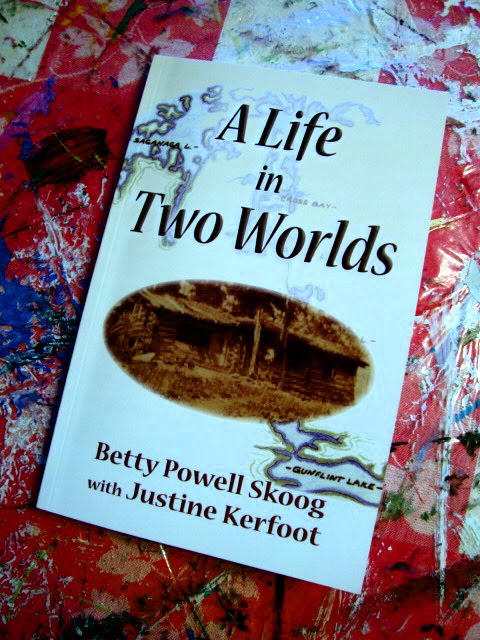
A Life In Two Worlds

In the early 1980’s I painted apartments for several years. Painters usually dress up rooms after people have moved out, but occasionally we worked in apartments with a resident still present. On more than one occasion I was called upon to paint a bathroom or repair a living room wall of an elderly person who welcomed my intrusion and was grateful for company. Through these encounters I heard many an interesting yarn about life at the beginning of the last century. Up here in Minnesota, you don’t have to go very far back in time to get in touch with lifestyles fairly primitive by contemporary standards.

A book I recently acquired that peels back the pages of time is A Life In Two Worlds by Betty Powell Skoog and Justine Kerfoot, recently re-published by Savage Press. Savage Press seems to have published a number of regional books with anecdotal snapshots of history up in this neck of the woods, so it made sense when the Schroeder Area Historical Society wanted to get Ms. Skoog's memories reprinted, they looked to Mike Savage.

Last week we spent a lunch hour together talking about writing and for a brief time digressed to discuss this newest volume.

Ed: Now this book is quite an interesting read for its historical recollections. It also shows how spoiled we are today. How did you come about publishing it?

Mike: Well, it had been published by Paper Moon Publishing in Lake Nebagamon. They're out of business now, so the Schroeder Area Historical Society called and asked if I wanted to reprint it. So they acquired the rights from the author and from the Kerfoots, so that they had everything done legally, and off we went.

Ed: Would you care to comment on Justine Kerfoot and how has she been involved with Betty Skoog's story?

Mike: Well, Justine was considered kind of like the Grand Dame of the Gunflint Trail. She and her husband started the Gunflint Lodge, and they were kind of like Gunflint royalty is what I would say. Tough old customers who, you know, raised themselves up by their bootstraps.

Ed: And you knew her, or met her?

Mike: Yeah, we had had some associations regarding her books. Justine was pretty high profile.

Ed: She published how many books?

Mike: I can't remember, quite a few. She's deceased now.

Ed: So Betty, was it Justine who motivated her or encouraged her to write her story?

Mike: I think they were childhood friends and Betty, who has a pretty good story, saw Justine being successful with her books and decided to do her own.

Ed: What's your favorite part of the book? Why don't you summarize what it’s about. I mean, just anecdotal stories, right?

Mike: It’s just her life growing up on the Gunflint Trail, the border between Ontario, or Canada, and the United States. A native mother and a white father… it’s a life in two worlds. She was a white person and an Indian person simultaneously. These are stories of rugged independence. Running after rabbits, eating porcupine…

Ed: So the book was previously published and you just recently re-published it?

Mike: It actually just came out in. We announced its reprinting in December, and shipped it on the market in January of 2010.

Ed: What kind of people would be interested in this book?

Mike: Well it's kind of a nostalgic trip, and I think actually, grade schoolers would write a heck of a good 8th great report with it. And with its Boundary Waters background, camp fire stories maybe, it's a, you know, in some ways it’s a friends-and-family book, but in other ways it goes beyond that.

Ed: I think it goes way beyond that. I think it has historical relevance because we've so forgotten our roots.

Mike: Right. And in regards to the actual day-to-day living, it really is a good historical record.

Ed: I found it interesting that when she moved into her first house that had running water, it was like, she didn't know what she was going to have to do all day. “What to do? The water is running. I don't have to go walk and get water to wash and make food.”

Mike: Right, yeah, the pace of life changes.

Ed: What is the Boundary Waters, for people who are not from this region?

Mike: Yeah, people who read your website in India aren't going to know. It's a million acres of set aside land, federal property, where motorized transportation is prohibited. So canoeing, backpacking only. It's kind of a sign of wilderness, and that's where Betty Powell Skoog grew up, on the border of Ontario.

Ed: There were no roads to where she was. She had to portage and canoe.

Mike: And hike, and carry everything. Her dad was basically a trapper, and a voyageur. A fallout. A descendant.

Ed: So who were the voyageurs?

Mike: They were the French Canadian guys who paddled canoes between Montreal and Grand Portage, and that whole area that became the Boundary Waters Canoe area. They put the packs on their backs and carried them from lake to lake, and then they loaded up the canoe and paddled them. They were basically the Interstate Commerce Commission of the 1800's

Ed: And a lot of them had hernias, too--

Mike: (laughter) …and they were short--

Ed: Low center of gravity…

Mike: Right, and they wanted small people so they could load the canoe with a lot of furs. And the story is that they also wanted to hire people who didn't know how to swim, because they would stay with the canoe and save the canoe at all costs.

Ed: Interesting! Well, the book is a nice little visit back in time and I certainly enjoyed it. Hunting moose, snowshoe rabbit footwear, unique methods of preparing fish and other game, and a lot of reminiscing about a world that's almost forgotten these days… Check it out A Life In Two Worlds, and tell me what you think.

Sunday, January 18, 2009

The Turtle at Red Mug

"Art enable us to find ourselves and lose ourselves at the same time." ~ Thomas Merton

There's something to be said about restoring old buildings to new uses once they have been abandoned. I have no problem with new buildings that have been designed with style, and with the cost to build them why not spend an extra buck to make it attractive aesthetically as well? Well, there are some very cool old ones out there with character and it's nice to see them re-cycled for good use.

In Superior, WI, where I work, the old Trade and Commerce building at the corner of Hammond and Broadway has become a rather artsy place these days. I vaguely recall going to a book reading there (it might have been one of Mike Savage's Dave Davecki novels) back in the nineties, but it's really come along and filled out well. I'm not sure how many artists are utilizing the building, but there's a bunch of them right now.

In 2004 the Red Mug coffeehouse opened in the basement of the building, serving coffee, wine and beer for anyone wishing an artsy and comfortable atmosphere for getting away from it all. Oh, and they make good soups and sandwiches as well. Mix in a little live music, wireless Internet, friendly staff and a very cool decor, and you have a keen little getaway going.

Last Tuesday I had a meeting there after hours. I saw paintings on the walls by someone who signed his or her name "Turtle." I asked the server for more info and learned Turtle was a waitress there, and that she was having an art opening Thursday. Well, I had to go back and snap a few pictures so I could share them here.

The Twin Ports, Duluth-Superior, has been gaining a reputation as an artsy place to live in recent years. You can't really compare a city like Duluth to cities like New York or Chicago in terms of quantity, but there is a lot happening here in the arts. Visual arts, musicians, theater... it's actually quite impressive. Memo to Richard Florida: The Creative Class is a-risin' right here.
Even the New York Times is jumping on the bandwagon and recognizing what we've got going, having recently referred to our home town as "an artsy shipping city." They could have called us a lot worse. We're happy to receive any tip o' the hat from the Times.

Abstract expressionist Robert Motherwell once said, "Art is much less important than life, but what a poor life without it." Turtle is a young woman who is seriously enriching others through her art. She's got a good eye for design and color, and a deft hand with a brush. Whatever the future holds for her, I get the impression it will be thoughtfully reflected in her work for as long as she lives.

Now, if only I'd gotten her phone number so I could tell her I've shared her work with you here today.
"There's no retirement for an artist, it's your way of living so there's no end to it." ~ Henry Moore

ALL IMAGES ON TODAY'S BLOG ENTRY by Turtle. Click to Enlarge.

Thursday, December 11, 2008

Ten Minutes with Mike Savage

Susie and I moved to Duluth in 1986. At the time I had been doing freelance writing for about three years (evenings) and was looking to get a full time job as a writer. I also imagined being the next Hemingway and sought to connect with literary folks up here are well.

As it turns out, there was an ad or newspaper story about a writer's group that was meeting at The Depot. It drew a fairly large batch of area writers... maybe fifteen or so. During that first meeting I was sizing up the group to find which were the serious writers and which were simply wannabes. In the course of a lifetime, there are twenty wannabes for every one who actually writes. A Native American writer named Jim Northrup was there. He read a few poems that were incredibly powerful, and since that time his work reached the national stage.

Another writer in that room was Mike Savage. I believe he was on the verge of publishing his first novel, Something in the Water. I hit it off with Mike immediately, impressed by his work ethic. He was serious about the craft and over the past two decades we have had many lunches together where we discuss the challenges of writing and publishing.

Early on Mike founded Savage Press, to help local writers find a way to get into print and their stories told to a wider audience.

ennyman: How did you get your start as writer?
MS: Poetry interested me in high school. I had an interesting teacher named Anita Helski who somehow managed to connect with me at some subterranean level because, on the surface, I acted out a lot. But, poems interested me and I started writing them in high school. I compiled the poems into a mimeographed sheaf and handed a few around and that day on the bus ride home Tommy Daubner made a big deal of my writing and publishing. It was negative reinforcement, but it was reinforcement none-the-less. So, there it is, from high school on I was a writer and a publisher.

ennyman: You one time mentioned a writing discipline which you maintained for years. Can you describe that? How important is discipline for writers?
MS: I generally write every day in the morning. Usually I awake early and do some thinking, some meditating, some praying, and then some writing. Either journaling, book writing, article writing, letters, emails, poems, political commentary, humor, whatever is alive in me at that time, I express it on screen or paper.

Discipline is important to clear, concise writing. Discipline isn’t necessarily important as a stand-alone “commodity” so to speak. Anyone can do what I do in the mornings... journal, sloppy slathering of sentimental prose and/or poetry. But, if the goal is to present copy that is either salable or succinct or enviable, discipline is required. Everyone needs an editor, either their unmerciful selves, or some outside source that recognizes bad grammar, improper spelling, awkward usage, unclear expression, poor word choice, repetition… all the hallmarks of hasty, haphazard writing.

BTW, most submissions that I read are hasty and haphazard.

ennyman: How did Savage Press evolve and what is its roll in the world of writing?
MS: Savage Press filled many needs when it started in 1989. Our literary magazine, “The Northern Reader” ran 13 or so issues and made a whole bunch of people published authors. The books filled a niche market for the Twin Ports region. Back then, I was writing much more, writing magazine articles, newspaper articles, radio stuff…and books. I wrote in the morning and published in the afternoon/evening.

ennyman: What do you enjoy most about the publishing business?
MS: I enjoy reading new work. This last weekend I read a proposal and the first four chapters of a 40-year-old man who went to Moscow, met, and eventually married a Russian woman. Then he divorced her and married a prostitute. And then he wrote a book about it. It was fairly interesting reading, but the author was pretty unsympathetic to me and I couldn’t see how we’d make any money publishing his story, even though he is adamant that he and his story are going to end up on Oprah some day.

I also enjoy editing and creating handsome books. I enjoy selling books to some degree too, but prefer direct sales to readers over wholesale distribution and marketing.

ennyman: What separates you and your company from the competition?
MS: Savage Press is not a profit-oriented business. Over the years we’ve published a lot of books that weren’t terribly profitable. But they did deserve to be published and would never have become a book if profit were the driving motive behind their publication.

ennyman: What advice would you give to someone just starting out as a writer? And specific books you’d point them to?
MS: Number one: Write every day. Two: Distinguish between writing for publication and writing for personal gratification. That book I mentioned above? The one about the guy who couldn’t marry well? His book is more of a long whiny testimony to his victimization. It is almost a rage book. The author is unqualified to judge his story because he is so caught up in the melodrama of his own life. He thinks he’s going to get published and get vindicated and get rich. In my opinion, as the story stands today, based on what I read, he will probably get only more bitter and angry.

ennyman: I like your honesty there and it is probably something I have always liked about our friendship. You are always a straight shooter. What one thing would you do with your business if you knew you could not fail?
MS: I’d publish a book that reduced readers’ fears by 90 percent.

ennyman: That probably wasn't the first thing that came to mind, but I like it. In what ways has the Internet changed the publishing world in general and your world in particular?
MS: The Internet and World Wide Web has made publishing about 75 times easier. Proofing documents using Adobe and transmitting files electronically makes prepress much more streamlined. I communicate almost exclusively via email these days. Web sales and marketing isn’t as peachy as it was cracked up to be back when the “paperless office” concept was being bandied about freely, but the Savpress website is a virtual catalog that informs people and saves paper. I gave up mass producing a catalog. If anyone wants to see a particular title I tell them to look at it on-line or I send them the specific URL.

ennyman: Describe the strangest or funniest incident you have experienced as a publisher?
MS: There are many, many such incidents. Too many to relate here. One that jumps immediately to mind is when I was called up to the dais at a book event to receive a minor award and as I approached the stage the presenter fell over in a dead faint. So much for getting my need for attention met. The entire focus went from my minor accomplishment to the poor woman’s body laying prostrate on the stage. I returned to my seat and finished my scalloped potatoes.

ennyman: Are we going to see any more Dave Davecki books? Where did Dave come from? I certainly saw some of you in this character. Were the books fun to write? What did you like most and least?
MS: One never knows, but I’m doubtful there will be another Dave Davecki installment. I have two Davecki books finished. One is called “DIErland” where Davecki uncovers a murderous band of Celtic crazies who get their jollies killing people, robbing graves, and selling priceless pre-Christian Irish artifacts to wealthy peabrains. The other is a rehash and amalgamation of “Death by Corvette.” It could be called “Death by Cadillac” or “Death by Being Terribly Stupid and Driving Your Caddy Convertible into St. Louis Bay.” I’ve got a raft of Dave Davecki plots stored away somewhere. Every once in a while I think of digging out the plot for “Death by Poetic License” and tinkering with it for my own amusement, but I always get caught up short by the utter financial foolishness of publishing another Davecki novel.

ennyman: Mike, thanks for sharing and for your contribution to the local literary scene. You've helped a lot of people find an audience. The very best to you going forward.

Popular Posts