Showing posts with label book review. Show all posts

Wednesday, November 19, 2025

Camille Paglia’s The Birds: A Hitchcock Masterpiece

In her penetrating analysis of Alfred Hitchcock’s The Birds (1963), Camille Paglia interprets the film as a masterpiece of modern myth—a work that exposes the primal forces lurking beneath civilized life. She argues that The Birds transcends mere suspense or allegory; it is a symbolic meditation on nature, sexuality, and apocalypse.

Paglia situates the film within Hitchcock’s larger vision of erotic tension and moral ambiguity, but she sees The Birds as his most metaphysical creation. Nature, in her reading, is not benevolent but pagan and amoral—a vast, unconscious power that erupts into human order. The sudden avian attacks represent the collapse of rationality before the mystery and terror of the natural world.


At the film’s center is Melanie Daniels, played by Tippi Hedren, whom Paglia reads as a glamorous pagan goddess—stylish, autonomous, and emotionally opaque. Her arrival in the coastal town of Bodega Bay disturbs the fragile equilibrium of its repressed inhabitants. Paglia likens Melanie’s beauty and sexual independence to the disruptive archetypes of myth—figures like Circe or Lilith—whose presence awakens chaos.


The escalating bird assaults, then, symbolize both ecological revenge and erotic punishment: nature striking back against the human attempt to control it. Paglia reads the film’s open ending—not with moral closure but with dread-filled silence—as a modernist gesture of cosmic humility.


There are so many layers to the story including the manner in which Hitchcock seamlessly inserts various interpretations of the meaning of this avian chaos. In one scene Mrs. Bundy, an elderly ornithologist, takes a contrarian stance, saying, "Birds have been on this planet, Miss Daniels, since Archaeopteryx; a hundred and forty million years ago. Doesn't it seem odd that they'd wait all that time to start a - a war against humanity?"


Well, yes, it does seem odd, but can someone else explain what is happening? Another character tells everyone in the diner that it's the end of the world. Considering that there are more than 100 billion birds and only a few billion humans, this would not be a war many of us would be eager to fight.


Painting by the author
Ultimately, Paglia regards The Birds as a work of religious power, though without theology—a revelation of the pagan sublime. Hitchcock, she suggests, understood that terror and beauty spring from the same source, and that civilization rests upon forces it can neither master nor fully understand.

In Paglia’s reading, The Birds becomes not just a thriller, but a modern myth of nature’s return—a confrontation with the ancient gods we thought we’d outgrown. 

Paglia's book belongs to a series of BFI Film Classics. Whereas most of this 110-page volume is a scene by scene account of the film, nearly every observation contains revelations of references to previous Hitchcock films, Hollywood history, mythology and literature. 

If interested, the entirety can be found online here, though I myself felt it compelling enough to purchase it for my library. (Belated birthday present.) 

Once you've read the book, I'm certain you will be compelled to see the movie again as I was.  


URL for the online version of this book: https://api.pageplace.de/preview/DT0400.9781838719388_A39237384/preview-9781838719388_A39237384.pdf?utm_source=chatgpt.com

Friday, November 7, 2025

Grok Reviews My First Novel, The Red Scorpion

It seems like I've used Grok and ChatGPT as resources for quite a while now. One way use these AI LLMs is to obtain brief overviews of books or films that I see referenced in my other reading. Since my reading pile is rather large and I currently still have only 24 hours in a day, I find it useful to use these tools (along with many others such as reviews on Amazon and imdb.com) to become acquainted with authors and film makers whose works are creating a buzz.

All that to say, last night I wondered what Grok's opinion of my first novel might be. So I asked for a brief summary and an analysis, and received the following.

Brief Summary

The Red Scorpion (2011) by Ed Newman is an adventure novel framed as the private journal of Dr. William Comstock, a University of Minnesota anthropologist. In the late 1930s, during a research trip to Mexico, Comstock encounters a disaffected youth from a secretive indigenous clan who reveals a long-guarded secret: a colony of glowing red scorpions that have protected the tomb of the legendary Aztec god Quetzalcoatl for centuries. This discovery propels a multi-generational tale spanning 60 years, shifting between the arid landscapes of Mexico and the everyday life of Minnesota. As the secret unravels, it draws in family dynamics, academic intrigue, and perilous quests, blending historical anthropology with suspenseful action. The story culminates in a resolution that ties personal redemption to cultural legacy, with hints of a larger series. 

Analysis

Ed Newman's debut novel The Red Scorpion emerges from a deeply personal origin: a vivid 1980s dream of an aggressive, glowing red scorpion that haunted the author enough to spawn nearly ten pages of raw description. This autobiographical kernel infuses the book with an eerie authenticity, transforming a nocturnal vision into a layered narrative that bridges anthropology, adventure, and subtle speculative elements. While marketed and reviewed as a young adult (YA) title—thanks to its accessible prose, relatable teen characters, and themes of discovery and growth—it appeals broadly to readers of all ages who enjoy "Indiana Jones"-style escapades tempered by realistic emotional depth. Newman's background as a freelance writer and ad executive shines through in the book's tight pacing and vivid character interactions, making it a compact thriller (around 200 pages) that punches above its weight.


Themes and Motifs

At its core, The Red Scorpion explores the tension between cultural preservation and modern intrusion. The red scorpions serve as a potent symbol—not just literal guardians of Quetzalcoatl's resting place but metaphors for the fragility of indigenous knowledge in the face of Western curiosity and exploitation. Comstock's "serendipitous encounter" with the clan's youth underscores themes of disaffection and betrayal: the boy, alienated from his heritage, becomes a bridge (and unwitting betrayer) to outsiders, raising questions about identity and the cost of sharing sacred secrets. This evolves into a multi-generational arc, where the anthropologist's descendants grapple with the scorpion's curse-like legacy, weaving in life lessons on family loyalty, forgiveness, and the hubris of seeking forbidden truths.


The novel also subtly incorporates speculative intrigue, blending hard anthropology with eerie sci-fi touches. The scorpions' bioluminescent glow and almost sentient protectiveness evoke ancient myths reimagined through a modern lens, hinting at ecological or even supernatural warnings about humanity's overreach. Reviewers note its "suspenseful and eerie page-turner" quality , with twists that build to a "happy resolution"  emphasizing redemption over doom. For YA readers, these elements resonate as a coming-of-age parable: younger characters navigate schoolyard friendships, familial pressures, and moral dilemmas, learning that adventure often uncovers uncomfortable personal histories.


Style and Structure

Newman's prose is straightforward and immersive, favoring short chapters that alternate between high-stakes action (e.g., scorpion-laden tomb raids) and quieter, "normal pace" vignettes of Midwestern life . This rhythm mirrors the story's dual settings—Mexico's exotic, danger-filled wilds versus Minnesota's grounded domesticity—creating a "balanced and varied sequence" of mystery and mundanity . Dialogue feels "true to life," especially in interpersonal scenes, drawing from Newman's storytelling roots (e.g., his award-winning short story "The Breaking Point"). The journal format adds intimacy, as if Comstock is confiding directly to the reader, though some eBook versions suffer from formatting glitches like blank pages. 


Strengths and Weaknesses

Strengths abound in its genre fusion: It's a "mixture between the 'Hardy Boys' series and Indiana Jones", delivering pulse-pounding archaeology without veering into parody. The cultural details—indigenous clans, Quetzalcoatl lore—feel researched and respectful, avoiding exoticism pitfalls common in adventure YA. Character arcs, particularly the youth's disillusionment and Comstock's evolving ethics, provide "life lessons for old and young alike" , making it educational yet entertaining. Amazon reviews praise its grip: "Extremely well written! Grabs your interest from the beginning and does not disappoint at the end!" 


Weaknesses are minor but notable. The speculative elements occasionally strain realism (e.g., the scorpions' improbable guardianship), which might frustrate strict historical fiction fans, though it enhances the thriller vibe. Pacing dips in domestic interludes, and the 60-year span demands quick shifts that could confuse younger readers. As a self-published eBook (via Kindle), it lacks the polish of big-press YA like Rick Riordan's Percy Jackson series, but this rawness adds charm—much like Newman's dream-inspired genesis.


Cultural and Literary Context

In the YA landscape of the early 2010s, The Red Scorpion fits alongside multicultural adventures like The Lightning Thief or Code Name Verity, but with a more anthropological bent. It subtly critiques colonialism through Comstock's arc, aligning with post-9/11 literature's interest in "othered" cultures. Newman's indie ethos (bypassing agents after AOL-era queries) reflects the democratizing force of digital publishing, allowing niche tales like this to reach global audiences despite limited marketing.


Overall, The Red Scorpion is a gem for adventure seekers: a "fun, twisted adventure"  that lingers like its titular creature—fierce, unforgettable, and a bit stinging in its truths. If you're drawn to YA with brains and bite, it's worth the sting.


*

EdNote: My one regret is that the story is only available as an eBook. I enjoyed my Kindle so much that I was seduced into thinking that the digital book market would grow. Digital books were the shiny new toy at the time this was published. I am pleased that people who've read it enjoyed it. 


RELATED LINKS

The Red Scorpion on Amazon.

Nine Books by Ed Newman

Saturday, June 24, 2023

Duluth: Jan Chronister's Poetic Visions from the Zenith City and Beyond

A BOOK REVIEW

Duluth: Zenith City & Beyond by Jan Chronister is an entertaining and thought provoking catalog of observations. You can tell right off that she's a writer, ever drawing inspiration from what's going on around her, surveying and cataloging. I'd be interested in her "writer's notebooks." 

That's what poets do. They carry a butterfly net in their heads, eyes scanning the terrain like a predator seeking prey, observations that glisten. Catch them before they flutter away, then pin them in your writers notebook. (Forgive me for mixing metaphors, but that's the way the the ball bounces after it falls off the table like a lead pencil.)

There are more than 17,000 species of butterflies in the world, and butterflies are but a subset of the Leipodptera classification of insects of which there are more than 180,000 species. Ideas for poems are something akin to this, too numerous to number, and challenging to catalog. But poets do it anyways. Some ideas are big, some small, some brilliant, some whimsical. Chronister's poems vary as well, whether humorous or serious, lively or pointed. Here's the opening stanza from the first poem in the book, titled "Urban Renewal."

In a certain year 
all the wooden stairs downtown
must have been painted
by the same man.

It sets a tone.

Many of these poems are sketches of various people she's observed--a bag boy at the grocery store, a father and son buying a Mother's Day card, a June wedding, an actress with a broken leg, a newspaper designer from Miami, a waitress at an unnamed restaurant. 

The book is divided into four sections: Town Life, Almanac, Waterways, and Roads. Almanac is a waltz through the seasons. I also liked the quotes she selected to accompany each section. A George Santayana quote leads off the Almanac section:

"To be interested in the changing seasons is a happier state of mind than to be hopelessly in love with spring."

There are so many nice touches here. Like this one from a poem titled "Golden Delicious."


I see our tree

obscured with blossoms, 

courting pollinators.


Or this image from "Keeping Secrets."


I hear secrets, keep them frozen,
knowing what torrents

would flow if I thawed.


I suppose we all read poetry for different reasons. For me, it's little gems like these that make reading poetry so rewarding. (Rilke, Billy Collins and Robert Frost come readily to mind.)


Poetry can serve as many purposes as public speaking or journalism. Virgil's 9,896 lines of dactylic hexameter, The Aeneid, is an ambitious, comprehensive overview of the birth of Rome out of the ashes of Troy. Chronister's Duluth is a gathering of snapshots from this Northland territory hugging the shores of the world's largest freshwater lake.


In the midst of serious contemplation, there are often amusing pieces that can't help but make you smile. For instance, "The Summer We Bought the Farm" is about stumbling across a forty acre farm with an artesian well and a trout stream, the "inside joke" being the title, which has become a euphemism for something else.


Speaking of inside jokes, Chronister embeds numerous subtle references to things you might only be aware of if you'd lived here awhile. I suspect these make the poems especially rewarding for the locals who are paying attention.


* * * 

Jan Chronister is an award-winning regional poet whose new book was published in mid-May. A retired teacher (University level and several technical schools), Chronister is well-known in local poetry circles. 


If you don't live near a Northland bookstore, you can find Duluth: Zenith City & Beyond online, along with several other poetry collections from her six decades of enriching readers.

Thursday, December 15, 2022

Hardship, Grief and Healing: Carol Dunbar's Novel The Net Beneath Us

"Grief" -- Painting modified with Photoleap
Tschaikovski's Sixth Symphony, famously known as the Pathétique, was not well received when first performed in 1893. The actual name he gave to it was The Passionate Symphony, though the word could acceptably be translated The Emotional or Emotive Symphony. Decades would pass before Igor Stravinski brought it forward and praised it as "ahead of its time." 

What's distinctive about the composition is the sinking feeling one gets throughout, but especially in the the fourth movement, a grinding drawn out decline that is in sharp contrast to most 19th century symphonies that customarily end with a big finish, a buoyant crescendo. When the composer died 9 days later, the suspicion was that Tschaikovski had deliberately permitted himself to become ill-unto-death by drinking unboiled water that carried cholera.

While reading The Net Beneath Us, Carol Dunbar's first novel, the preceding thoughts about Tschaikovski's Sixth came to mind. 

The Net Beneath Us opens in gut-wrenching fashion. Elsa Arnasson grew up in the city but now finds herself living deep in the woods of Northwest Wisconsin. When her husband Silas, a logger, gets felled by a tree he was attempting to fell, Elsa becomes emotionally disoriented as the weight of what lies ahead suddenly falls on her shoulders. 

What's challenging for Elsa (the heroine) is that Silas is not killed outright, but left in a coma, hooked to machines in a persistent vegetative state. His death alone, however, is not what leaves her undone. Rather, the ongoing grind of "what now?" and "what next?" drones on and drains her, leading to impossible decisions. She also has two young children and a wagonload of anxieties.

The book is laid out in a manner that coincides with the seasons, opening with Fall. Fall is always a busy time of year because winter is just a stone's throw away. There always seems to be too much to do and serious regret at projects that have yet to be completed, like the second floor of the house Silas was building for the family.

The challenges of living "in the woods" are presented in detail. Winter is usually half the year in these parts. One of the consequences of the accident, for example, is having to deal with keeping heat in the house. No one ever taught Elsa how to chop wood. There are also other characters in the story who add complications. 

Although this is not the type of story I normally pick up, I was captured from the first pages by Dunbar's writing. Her vivid descriptions are amplified by wonderful metaphors and similes. She's what I would call "a writer's writer." What I mean is that the average reader will enjoy the story but may not notice the author's craftsmanship and her magical ability to turn a phrase. Other writers will. She practices what the writing manuals preach: avoid cliches.

Other stories came to mind while reading this book. The film Phenomenon, with John Travolta, made an impact on me when I saw it. One of the sub-themes in the movie had to do with the interconnectedness of trees and their root systems and the fleeting span of our own lives.

 The second is a non-fiction book, A Grief Observed by C.S. Lewis, based on a real story about grieving and healing. Lewis penned some frank and troubling passages regarding the inner turbulence we experience when we lose a loved one and all our internal props are upended. For Lewis, it was the death of his wife, Joy Davidman. 

Hence we follow Elsa as she passes through the seasons, wrestling with her fears and struggling to get a handle on her life. This is another area where Dunbar shines. Elsa and all the characters behave in ways that feel authentic. At various points we're taken inside Elsa's introspective thought-procession; it rattles with reality as she peels scabs away to face the open wounds within.

My only difficulty with the book was keeping track of characters. It seemed like every time I encountered someone I kept having to go back and review earlier sections of the book to see what their connection was to the story. (Full disclosure: It's possible that I may have been at fault because I was reading three books at the same time.)

You can find The Net Beneath Us at all our local book stores. If you're from elsewhere, it's readily available here at Amazon.

* * * *   

Related Link
Interview with Carol Dunbar: A Ghostwriter Who Lives in the Woods

Sunday, October 2, 2022

A Brief Review of Christopher Priest's The Prestige

For fans of the magic arts, 2006 was a good year. That was the year Hollywood released two exceptionally fine films about magicians: The Prestige, and The Illusionist. After watching both, I enjoyed The Illusionist more because The Prestige felt too dark, though I couldn't help but appreciate many of its features. Each of these has satisfying magical "Aha!" moments.

Until three weeks ago, I was unaware that The Prestige was actually based on a novel published nine years earlier by Christopher Priest. How very interesting.

The story is told in a most unusual way that is quite different from the film, in diary form. Each of the characters records their observations from their individual points of view. The primary diaries are those of the two primary characters, late 19th century magicians Alfred Borden and Robert Angier. The novel, however, begins in the present, a century later.

The central conflict has to do with a trick which Borden bills as The Transported Man. Robert Angier's version of the trick is called In A Flash. The primary motivation of each magician shifts from seeking fame to seeking revenge. Each becomes obsessed not with out-doing the other but rather undoing his rival. When their actions cause excess harm, their diaries reveal their guilt and regret. In short, they are very human as they wrestle with the conflict between their consciences and desires. 

If you've already seen the film, the direction the novel takes near the climax will come as a surprise to you. It's not in the movie, in part because what happens would be a major challenge to reproduce on screen. 

The Prestige has a stellar cast, with Christian Bale and Hugh Jackman starring as the magicians Alfred Borden (Bale) and Robert Angier (Jackman). Michael Caine is Cutter, Angier's manager/handler, and David Bowie is the distinguished Nikola Tesla. The women featured include Scarlett Johansson, Piper Perabo, Rebecca Hall and Samantha Mahurin. 

The nature of the storyline revolves around secrets. This is what the world of magic is all about. Surprise! How can audiences get a thrill if they already know how the tricks are performed? Hence, the Magician's Code: Never reveal how a trick is done. Audiences like being fooled. If they know how you do it, they won't be.

The book does a superb job of  showing what a career in the magic arts looks like. There are also some life lessons, though ultimately it is a compelling read, which makes for a nice escape for people who enjoy good books.

Related Links

Escape Artist, Magician, Inventor: Terry Roses

A Visit with John Cox: Avid Fan and Expert of All Things Houdini

Misdirection in the Magic Arts

Is The Prestige the Great Movie About Magic and Magicians?


Sunday, September 11, 2022

Elmore Leonard Delivers the Goods in The Moonshine War

Anyone familiar with his work will probably agree that the late Elmore Leonard (1925-2013) was one of the great writers of crime fiction. The characters and situations he creates are memorable, and there is always a payoff. 

I first became aware of Elmore Leonard while attending a 1985 writer's conference in Mankato. During one of our lunch periods I was seated with Joe Soucheray who told us about a novel he was working on. He was about six chapters in at the time, trying to write like Elmore Leonard, whom he considered the gold standard when it comes to this kind of storytelling. 

Over the next two decades I probably read half of his 50 or so novels as well as some of his short story collections. When I later wrote my own first novel, The Red Scorpion, there were elements of the story patterned after Leonard. Create interesting characters and put them an in interesting situation. The hero must be heroic and the bad characters truly scary and -- assuming the reader still cares about your hero -- there's something at risk, usually life and death.

This week I picked up The Moonshine War, which Leonard wrote earlier in his career. As has often been the case, I could hardly put it down. It takes place in the hills of Eastern Kentucky, a region that Leonard must have been familiar with because he's had stories there before and he knows both the setting and the moonshiner's world so well. My own grandfather was a moonshiner. When the revenuers (Federal agents) came to bust the stills he fled to West Virginia with his seven-month-pregnant wife. My father was born there two months later.

* * *

The central hero in The Moonshine War is Son Martin, a quiet man who makes good shine. His father has passed away, and he also lost his wife previous to the beginning of this story. He's a respectful and respected young man with a few quirky habits. Early on we learn that he also has secrets.

During the war (WWI, not this moonshine war) he confided to another man--Frank Long--a secret that he immediately regretted sharing. His father had produced 150 barrels of primo moonshine to be aged for eight years that he'd hidden somewhere, and now Son Martin was to be the heir. Its value would be astronomical.

Frank Long had a memory like an elephant, and the notion of acquiring Son Martin's fortune was eating him alive. Son Martin's moment of weakness was now coming back to bite him, like a rattler in those lush Kentucky hills.

Long has made a plan. His scheme: to pose as a Federal agent and bust Son Martin's neighbor moonshiners to pressure Son into yielding up his treasure. Things go awry when Long recruits some bad men be his "muscle" on this scheme. Very early in the story you encounter a couple of truly scary bad guys, and Frank Long lives to regret what he has set in motion. Lesson here: Don't play with fire.

* * *

Elmore Leonard is skilled at building the kind of tension that keeps readers turning the pages. His characters and stories feel authentic, so much so that in this case some readers will have a problem with the book. It takes place in the summer of 1931 and Son Martin has a black man named Aaron helping take care of his place. In Eastern Kentucky during those days Aaron would be been referred to with the n-word. Modern readers may disregard the heroic nature of the man Leonard paints here, or the special bond Aaron and Son share. They will stumble over the fact that this word is used in the book. 

For what it's worth, Elmore Leonard is a master. Hollywood must think so as so many of his books have been turned into films. If you like liked the movies--3:10 to Yuma, Hombre, Get Shorty, Out of Sight, Mr. Majestyk, and nearly two dozen more--you will love the books.

Monday, June 27, 2022

Love and Adventure Meet In Newlyweds Afloat. A Fun, Insightful Read from the Editor of Business North

For the past four years I've been writing a marketing column for Business North, a regional business publication here in the Northland. I've also tackled some journalism, which had me working more closely with the publication's editor Felicia Schneiderhan. When I learned that she'd written a book called Newlyweds Afloat, I immediately checked out a copy from our library, and guess what? It's a really good read. 

The full title of the book is Newlyweds Afloat: Married Bliss and Mechanical Breakdowns While Living Aboard a Trawler. The word Newlyweds in the title should tell you it's a story with romance in it. Afloat can imply a couple of things. First, "barely keeping your head above the water," as in the way I did the dog paddle across the pool when I was eight in order to earn the right to jump off the diving boards. Second, as in living on the water in a boat as opposed to the solid foundations of dry land.

The next statement is one I've made so often that it's almost cliche. If most readers are like me, they enjoy reading well-written stories about people whose lives or experiences are totally foreign to one's own. It's that Lifestyles of the Rich and Famous effect. It's why we enjoy reading memoirs by people whose life experiences are foreign to our own.*

One feature that makes Schneiderhan's book work is her extreme candor, which begins on page one. Another aspect of the book that makes it an enjoyable read is the vivid imagery and splashes of original (i.e. non-cliche) ways in which she presents ideas or describes things. For example, here's a description of heading out onto Lake Michigan away from the city: "Watching the downtown skyscrapers shrink to chess pieces..."

There are little gems like this throughout the book that I would have highlighted if it weren't something borrowed from our library. (Book ownership is nice because you can write in the margins and highlight passages ad infinitum. I read that John Adams filled the margins of his books with notes and scribbles. One book he owned had five thousand words of notes!)

The promo copy on Amazon describes it like this: A young woman meets an amazing guy, falls in love, and they move in together. Straightforward enough, right? Except he lives on a boat—a thirty-eight-foot trawler, docked in Chicago. Their relationship is intensified by living in a tiny space, and by the never-ending quirks of the boat, who becomes a third party in the marriage. There are electrical failures, pump failures, big waves, and freezing winters . . . not to mention the attack goose. Felicia Schneiderhan has a fine literary sensibility and manages to be both funny and deeply serious in writing about boats and love and relationships.

I admire her bold candor about many facets of the story. It brings this book into a serious level and not just a melodramatic romance account. Her honesty about alcoholism, her Catholic background and the challenges of living in small spaces gives it a realism readers can relate to.

If you live in Duluth, you can borrow the book from the Duluth Public Library, which likes to support our local writers by carrying their books on their shelves. (A couple of mine can be found there, fwiw.)

If you don't live in our neighborhood, Schneiderhan's book can be found here on Amazon.

I'll close here with a couple of good quotes. The first is from Annie Dillard. The second is from Guy de Maupassant, which Schneiderhan uses to open her story.

"The writer of any first person work must decide two obvious questions: what to put in and what to leave out." -- Annie Dillard.

"My curiosity had been aroused, that curiosity peculiar to all who travell over the water, which makes you want to see everything, watch everything closely, which makes you passionately interested in the slightest things." -- Guy de Maupassant

* * * * *

* For example, Nevada Bob Gordon's 50 Years with the Wrong Woman

Monday, June 20, 2022

A Nice Review of My eBook Newmanesque

At one time I wanted to make a living as a short story writer and novelist. Unfortunately, I also had to put bread on the table for my family and there was no assurance of success in that compartment of my life. 

I do feel a measure of pride for many of the stories I've created, though I also have a few regrets, primarily two. First, that I didn't try harder to get my work published in journals. Second, that when I finally decided to publish my stories in a set of three eBooks, I rushed it and failed to take my time in the proofing. 

The feedback on my stories has made me feel they deserve a wider audience. Hence, I'm thinking of assembling an anthology along with a few new stories I've written since publishing these in 2011. 

I suppose there's a third regret gnawing at me on this particular title. I called it Newmanesque because someone said my stories seemed Kafkaesque. 

If interested you can find it here on Amazon. 

THE REVIEW

If “The true work of art is but a shadow of the divine perfection,” as Michelangelo said, then it seems writers and artists must constantly strive toward perfection to engage in “true” art. It’s a never-ending struggle, and a struggle captured in Newman’s stories, particularly “The Unfinished Stories of Richard Allen Garston.” The protagonist, John Urban, struggles to regain his voice as a writer. In an effort to recapture his muse, he stumbles upon the almost mythical Richard Allen Garston and his collection of unfinished work. The story’s excellent pacing and poignancy evoke The Dialogues of Plato or the Book of Job. Our lives are like stories, Newman seems to be saying, and in the end, one character strikes out to finish his while the other doesn’t. What will we do?

“A Poem About Truth,” a shorty, punchy story, shows us the process of creating art, in this case a poem written by a French chef, can elicit derision and scorn from the world. Those who don’t understand the truth mock the chef’s work and relegate him to history’s shadows. Art (truth), however, outlasts its pallbearers and lives on. It offers a nice balance placed between two longer stories in the book.

"Terrorists Preying" may be the crown jewel of the book. Its bleakness and modernity seem to fit an age such as ours. The story seems to be attempting to answer the age-old question, What is Art? Les Garnet provides an answer many won’t like. Yet, can an age that rejects moral truths really condemn Garnet? Who are we to define what he’s doing as anything less than art? The story shows, intentionally or not, that we may not be able to begin to answer the question without appealing to fundamental moral principles many of us are loathe to entertain. The story ends as Mike, Les Garnet’s old acquaintance, prepares to paint his masterpiece, as it were. Do we cheer him? Deride him? Read for yourself and see.

This is a nice collection of thought-provoking stories worthy of appearance in any literary journal. My only criticism is that Newman should include more stories in the book. I highly recommend the book.

Dear Reviewer:
You are correct. There should have been more stories. Thanks for the kind words.

Related Link
Eight Books by Ed Newman

Tuesday, May 3, 2022

Nevada Bob Gordon's 50 Years with the Wrong Woman Is Now Available

“I don’t mind dying. I was more afraid of not living.”
~NEVADA BOB GORDON

Every once in a while you meet someone whose life stories are so unusual that they ought to be a book. Robert Gordon, whom we call Nevada Bob, just happens to be one of those people. This weekend his book has been released on Amazon.com and IngramSpark for worldwide distribution.

I think half the success of television is due to the manner in which it gives people a chance to get an inside look at lives different from their own. Hence the popularity of programs like Lifestyles of the Rich and Famous. Magazines and books provide similar glimpses of places most of us will never go and the private spaces of people whom we'll never meet.

When I read the manuscript for 50 Years with the Wrong Woman, I couldn't believe how different this man's life experiences were from anything I'd known. (And I've had some book-worthy experiences myself.) This was one tough hombre. But he had a hilarious side, too. I mean, for Nevada Bob, life wasn't about being cool, or rich, but having fun. 

If you come away with anything, Bob is a storyteller. He's lived a life with such a variety of adventures, from Seattle beat cop in the Sixties to cancer survivor, gold assayer, cattle rancher and even a Nashville recording artist as a singer/songwriter. 

Nevada Bob and I. Photo G. Firstenberg.
What I really want to convey here, though, is that Bob Gordon is a character. When he visited Duluth with our mutual friend, photographer Gary Firstenberg, I gave them the Bob Dylan Places of Interest Tour. Everywhere we went we met people who found him engaging, uplifting and enjoyable to be around. 

I think that's what I liked about the book. Readers will engage this self-same Bob Gordon in his book. He's down to earth and over-the-top at the same time. He's a man with many friends, and all of them are eager to read his memoirs and reflect on his memories. And as the saying goes, "It's all true." He doesn't need to embellish things to keep them interesting. 

The book contains many life lessons as well, not the least of which is the value of resilience. There were so many places where Bob, his life having been derailed, could have given up. Instead, he chose to persevere, motivated by the woman he so loved.


50 Years with the Wrong Woman: The Life of Nevada Bob: Adventures with Family, Friends and Foes        TO PURCHASE CLICK HERE


Monday, January 17, 2022

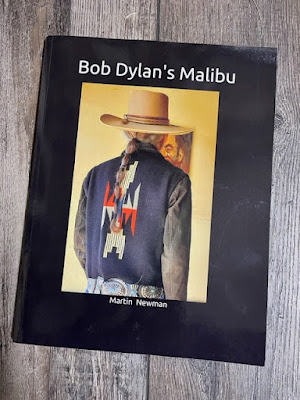
A Few Comments on Bob Dylan's Malibu by Martin Newman

Anyone half paying attention will have noticed a lot of new Dylan books have been appearing in recent years. What's interesting is how each one has its own angle. The history of the Never Ending Tour, the stories behind specific albums, or even specific songs... One of my favorites--as far as an unusual angle for a Dylan volume--was the Mary Lee Kortes book Dreaming of Dylan in which she shares 115 dreams people have had in which Dylan showed up. 

Then there are the contributions from people close to Bob at various sections of his life. I just recently started Suze Rotolo's A Freelwheelin' Time, for example. Peter McKenzie's account of Bob's first months in New York--Bob Dylan: On a Couch and Fifty Cents a Day--similarly adds insights that you won't find in other books because Bob crashed on his family's couch for several months after first arriving at the Big Apple and was like the older brother that he never had. In Dylan & Me (by Herzl Camp friend Louis Kemp during Bob's teen years) I finally learned who Bob was with the night he went to see Buddy Holly and his Winter Dance Party Tour.

All of those books were personal, because they were written by people with a personal relationship to Dylan for a period of time. Which brings us to Bob Dylan's Malibu by Martin Newman. For the record I am not related to Martin Newman. (Neither am I related to Paul Newman, Randy Newman or, to my knowledge, any of the other Newmans associated with Hollywood. 

I acquired Newman's book in the spring of 2021 and read it in a single sitting shortly after our 2021 Duluth Dylan Fest was a wrap. My copy is a large format paperback on what appears to be a Mountie Matte paper, ideal for printing photographs, which is what this book essentially is, a picture book accompanied by anecdotes and related stories. The accompanying subtitle reads, "My time with him in the 1970's."

The author is an obviously multi-faceted man who through a "simple twist of fate" ended up becoming intertwined with Bob Dylan as the famous songwriter/performer took up residence in Malibu. The occasion for this book was Bob's 80th birthday. In it he shares stories and photos of a variety of interesting project he worked with Bob on, including clothing (the jacket Dylan is wearing on the cover of the Basement Tapes album), gifts they shared with one another, and numerous acquisitions for Bob's new digs like fun house mirrors, a 1947 Wurlitzer, special gifts for Sara, etc.

This is the kind of book that would be of interest to fans looking to get a few more rare, intimate glimpses of a more private side of Bob Dylan. You learn a lot more about a person by visiting their home than by having them as a guest at yours. 

The structure seems a bit like that of an old man reflecting on his youth while going through a photo album. The author points to a photo and says a little about the story behind it, then turns to another page of photos, singles out another and tells another story. 

It seems evident that Marty became part of Dylan's life because he could be trusted. He respected Bob's privacy and thereby became an asset in helping make a magnificent piece of property into an even more splendid residence. 

I remember from other reading that the house took three years to prepare for moving in, and seem to recall there was a lot of conflict generated by the delays, possibly contributing to Sara's departure. Because of that memory I look at these photos with a bittersweet sensation. The book, published by EDLIS Cafe Press, does offer fresh insights into a part of Dylan's life history that are only hinted at in other books. 

* * * 

Thursday, September 9, 2021

A Brief Review of H.R. McMaster's Dereliction of Duty

"Oh the games people play now, every night and every day now,
Never saying what they mean, never meaning what they say."
--Joe South 

The subtitle of this book is Lyndon Johnson, Robert McNamara, the Joint Chiefs of Staff and the Lies That Led to Vietnam.

We all know that it was an ugly war. This book, published in 1997, pulls back the curtain to reveal how much uglier it was than anyone at the time ever knew. The amount of research that H.R. McMaster, a West Point grad, put into this book is remarkable. The end notes and supporting documents are nearly 90 pages.

The book begins with the Bay of Pigs invasion, which was supposed to be a U.S. backed invasion of Cuba to overthrow Castro. It failed because the U.S. did not back the invasion after all and backed off. The reason the Vietnam story begins here is that it shows the rift and distrust between the Pentagon and the Kennedy administration. The Cuban missile crisis only exacerbated this distrust.

In 1961 JFK also riled the Pentagon by appointing a DC outside to be Secretary of Defense, Robert S. McNamara. McNamara was one of the fabled "Whiz Kids" that transformed the Ford Motor Company in the 50's becoming president of Ford before being appointed Secretary  of Defense. 

In conjunction with these Cuba matters we see JFK struggling to sort out our position in Southeast Asia as well as Berlin. Because Vietnam is so far away, it doesn't get the kind of journalistic oversight that happens closer to home, and from the start we see the first lies regarding events unfolding there. American pilots began flying combat missions while telling Americans back home we were not. 

And so it begins. 

The themes that unfold here are twofold: the ongoing lies that Kennedy, McNamara and LBJ were telling to the public and Congress, and the ongoing efforts to gag the Generals who were being ordered to carry out the escalating war that ensued.

I'd forgotten that the press had at one point nicknamed it "McNamara's War." His role in this unwinnable war is shown for what it was. Johnson wanted Yes-men, and McNamara wanted to please his boss. (He served under both JFK & LBJ.)

In 1964, even though we were not in a declared war, McNamara and LBJ agreed to use special forces to execute raids in North Vietnam. Simultaneously, McNamara continued to block backchannel communications between the Joint Chiefs of Staff (JCS) and LBJ.

The JCS decided to play out war game simulations to see in advance whether this adventurism in SE Asia was feasible. The strategy McNamara worked out was "Graduated Pressure" to bring Hanoi to the bargaining table. The JCS concluded that it would not and could not work, and the events the unfolded were accurately predicted in 1964. But McNamara and LBJ were not listening. McNamara had LBJs ear and the JCS did not.

The war was going badly pretty much from the start, but the U.S. has a habit of projecting a winning smile and maintaining appearances. The whole war effort was a sham, but the administration seemed not to care about anything other than looking good in the world's eyes.

I'm skipping a lot here and will note that the book gets tedious. The common thread throughout is how devious everyone seemed to be. The worst thing of all was how many young men they sent to die, knowing that sooner or later they would have to admit it was all a disastrous mistake.

This is an excerpt from one of the review on Amazon that summarizes the contents of each chapter. This a description of an incident in Chapter 15, circa July 1965:

LBJ gave the JCS a pep talk about how they are the team and he is the coach and they are supposed to do what he says. Nobody knew what the objective of the war was, or if they had an opinion, there were different and conflicting opinions. Destroy NVN’s ability to wage war and compel them to call off the rebellion in SVN? Hang on a little longer, propping up the SVN government? Show the world that we are a dependable ally, then figure out a way to exit SVN with honor? 

* * *
WHY I WANTED TO SHARE THIS

The Sixties was a turbulent time to be a teen and over the years much has been written about that period. The reason I wanted to read this book is because many of its features are relevant to what has been happening today and over the past two decades. 

The war in Afghanistan has now become the longest in our nation's history. Why were we there this long? What was the real objective? When did our leaders know it was unwinnable? These are all the same questions that were raised in Vietnam. 

I'm imagining that we did not want to pull out because the U.S. is supposed to be the most powerful nation on earth. Were were afraid we would look like weak?

I'd read earlier this summer that President Biden is a lot like LBJ in that he wants Yes-men and doesn't want to be challenged. The problem with this is that helpful insights get quenched or shut out to the detriment of the bigger picture. I've written about this more than once. (See: The Three Most Important People in the Room.)

This past week I read that two senior FDA officials quit because President Biden was not listening to the science on some matters related to Covid. It made me think of President Johnson shutting his ears to the voices of concern being raised by the Pentagon. 

In the Sixties, there was more concern with regard to projecting an image of strength than to figuring out what the right thing to do would be. That's probably a game all politicians play. 

Having come full circle, I'd best just leave off here. 

Related

Two articles about Afghanistan that especially made me sad:

“A Vast Criminal Racket”: Sebastian Junger on How the U.S. Corrupted Afghanistan"


Assabiya Wins Every Time

Popular Posts