Showing posts with label adventure. Show all posts

Tuesday, August 26, 2025

Ibsen's Tale of the Button Molder in the Final Act of Peer Gynt

Henrik Ibsen
Sunday evening I listened to a lecture called Kierkegaard's Passion, from the Great Courses Series Philosophy as a Guide to Living. In this lecture Professor Stephen A. Erickson shared several keen insights from Kierkegaard. One of these had to do with boredom, which plays a bigger role in many of our lives than we realize. Kierkegaard viewed boredom as a symptom of existential despair, particularly in the "aesthetic" mode of existence, where individuals chase fleeting pleasures to avoid confronting life’s deeper questions. To illustrate this idea, Professor Erickson used the example of Peer Gynt's encounter with the Button Molder at the end of Ibsen's famous play.

Henrik Ibsen's Peer Gynt was a five act play based on a Norwegian fairy tale about a hunter. In Ibsen's play Peer is a self-absorbed dreamer who spends his life chasing fleeting ambitions. As a consequence he loses himself in the episodes of his life and never achieves authentic selfhood.

In Act V, after running over the world chasing adventures, the mysterious Button Molder appears as Peer’s life is unraveling, his grandiose illusions crumbling. A grim, almost bureaucratic character, the Button Molder explains that he’s been sent by a higher power (implied to be divine) to collect souls that have failed to fulfill their purpose. Peer, he says, has lived a life so lacking in authentic identity—neither truly good nor evil, just self-serving and scattered—that his soul qualifies for neither heaven nor hell. Instead, the Button Molder plans to melt Peer down in his ladle, like a defective button, to be remolded into something new, erasing his individuality entirely.

Peer, desperate to preserve himself, protests, arguing that his life’s adventures—his travels, schemes, and self-proclaimed greatness—prove he’s unique. The Button Molder counters that Peer has never truly been himself; he’s lived as a shapeshifter, adapting to please others or chase whims without committing to any higher purpose or moral core. 

To escape this fate, Peer must prove he’s been a distinct self, but his frantic attempts—seeking validation from others or clinging to past deeds—fail. The play ends ambiguously, with Peer facing the ladle’s threat, saved temporarily by the love of Solveig, a woman who represents the steadfast faith he’s squandered. The Button Molder warns he’ll return, leaving Peer’s ultimate fate unresolved.


Meaning for Us Today

The Button Molder’s encounter with Peer speaks powerfully to modern existential and societal concerns. At its core, the story is a warning about the dangers of living an inauthentic life—one driven by external validation, fleeting desires, or avoidance of responsibility. I'm reminded of the Aesop's Fable of the grasshopper and the ants. The ants spent the summer in preparation for winter, working to gather grain and other necessities. The grasshopper spent his summer fiddling and having fun. He was not ready for the coming winter, the moral being, "There's a time for work and a time for play."


The Button Molder represents a kind of existential reckoning, forcing us to confront whether our lives have meaning or if we’ve merely drifted, like Peer, through a series of roles without substance. Hence Kierkegaard's dismay that most people avoid thinking deeply about meaning, or as Gauguin put it, the title of his famous painting, "Where Do We Come From? What Are We? Where Are We Going?"


In today’s world, the Button Molder’s message resonates in this age of digital personas, endless distractions, and societal pressure to “perform” identity. Social media, for instance, encourages us to curate idealized versions of ourselves, much like Peer’s chameleon-like existence, prioritizing likes and trends over authentic selfhood. 


The threat of being “melted down” mirrors the modern fear of insignificance—being reduced to a faceless cog in a system, whether it’s corporate, cultural, or algorithmic. 


The Button Molder’s ladle evokes the erasure of individuality in a world that often rewards conformity or superficial success, or as Dylan suggests in Idiot Wind, "You'll find out when you reach the top You're on the bottom."


Yet, the story also offers hope. The Button Molder give Peer a little more time, and there is a possibility of redemption suggested by the presence of Solveig, the woman who has dedicated her life to waiting for him. Solveig's enduring faith and patience serves as a counterpoint to Peer's self-absorbed journey. (In a similar fashion Hermann Hesse explores this duality in his novel Narcissus and Goldmund, with Goldmund being the  self-absorbed adventurer living from episode to episode whichever way the wind blows.) Solveig's presence suggests that love, faith, or commitment to something greater can anchor us, helping us forge a true self. 


The Button Molder challenges us to ask: Are we living as ourselves, or are we just buttons, shapeless and ready to be remolded by the world’s demands? 


* * * * * 


Norwegian playwright Henrik Johan Ibsen is considered one of the world's pre-eminent writers of the 19th century. His plays are among the most performed plays in the world, second only to Shakespeare. He is often referred to as "the father of modern drama."  


Trivia: Norwegian composer Edvard Grieg wrote two suites for Peer Gynt. Opus 23 premiered along with the play on 24 February 1876 in what is now Oslo. My father used o ilisten to this album when I was growing up.

Friday, December 1, 2023

Flashback Friday: Italy

It's well known that Florence played a central role in the birth of the Renaissance. During my visit to Italy this past spring I learned about the various factors that converged to foster an environment conducive to intellectual and artistic flourishing. These factors included economic prosperity, patronage of the arts, political stability and civic pride.
While there I learned how much the Florentines valued intellectual exchange and the love of learning. Purportedly the literacy rate in Florence was twice that of other cities in Europe and Italy itself. (EdNote: I read this in a book about booksellers row during the Renaissance. Fact-checkers are welcome to correct me here.) Books were highly valued and ancient books most of all.

All this to say that my selection of Florence as a destination was richly rewarded when I planned my Italy trip, a 70th birthday gift from my daughter and son-in-law, this past spring. While there I took 40 pages of notes and what seemed like a thousand photos. Upon my return I began processing my experience by writing about it. Here are 16 blog posts about my trip abroad.

1. Initial Thoughts after my first trip to Italy

2. A Brief Overview of My Italy Adventure

3. 850 Years Old and Still Looking Good: The Battistero di Parma
4. The Galileo Museum in Florence Is Worthwhile Destination

5. Liberation Day: Italy Celebrates Victory Over Fascism, With Expressions of Gratitude to the U.S.

6. 1000 Rooms of Splendor: The Palazzo Pitti
7. Bob Dylan in Italy

8. The Death of Galileo

9. The Scarpelli Mosaici

10. Michelangelo’s David… A Showstopper

11. Daniela Meza Sigala: Florence Artist’s Seriously Whimsical Paintings

12. The Teatro Farnese in Parma

13. The Duomo in Florence: A History, plus Photos

14. One of the Most Famous Paintings in Florence: Ecce Homo (Behold the Man), by Antonio Ciseri

15. The Bargello: Another “Must See” Museum In Florence

16. L’Ippogrifo Stampe d’Arte: Mastery of a Grand Tradition 


Have you been to Italy? 

Where should I go next?
Leave a comment.


Wednesday, June 14, 2023

The Bargello: Another "Must See" Museum in Florence

As I prepared for my trip to Florence, I made a short list of "must see" places. I also left a lot of free time for simply exploring and following the whims of each day. This proved to be a highly profitable strategy, giving me the opportunity to see an impressive M.C Escher retrospective and attend some Liberation Day events. 

The Bargello, however, was definitely on my short list of places I fully aimed to see. It did not disappoint. 

For those unfamiliar, the Bargello is a sculpture museum. It houses a stunning collection of sculptures from the Middle Ages and Renaissance, including works by Donatello, Michelangelo, and Cellini. The museum is also housed in a beautiful building, the Palazzo del Bargello, which was once a prison and fortress.

As I entered the first room I was confronted by the statue of Mercury (above) and my first thought: "So this is where the idea for the Mercury dime came from." Indeed much of what we see in our own Capitol was inspired or influenced by Renaissance art and architecture. Here are some of the photos I took from my visit there.

Michelangelo's "Bacchus"--wine goblet in hand, a crown of grapes.
Another Michelangelo piece: Brutus  
I took this photo to show the thread patterns in his robe.

Verrocchio's bronze interpretation of David slaying Goliath. Some say
David here was modeled after the artist's pupil, Leonardo da Vinci.

In addition to Verrocchio's David, there is a bronze David by Donatello
which you can read about here. 

Related: Check out these links to my
other stories from my Italy adventure. 

Monday, June 5, 2023

Books Books Books -- Photos from Bookstores in Parma

My Brother Vincent, by his sister Elisabeth
Vincent van Gogh... not the way I've usually pictured him.
I have this book on my own shelf... in English. Without Feathers
No surprise to see books about Fellini.
Rilke, Tolstoy and other familiar names were everywhere.
Warnings from Orwell.
I thought this an interesting find in an Italian bookstore.
I first saw this book on the bookshelf of author Margi Preus.
I thought this hilarious. In English Wilde's play is The Importance of Being Earnest
Parma earned national respect for its resistance to fascism in 1922.
Elmore Leonard has been a favorite writer of mine in the past.
Hollywood has translated nearly 20 of his books into film.
James Hilton's famous story of Shangri-La: Lost Horizon 


To see more stories from my Italy Adventure visit

Monday, June 27, 2022

Love and Adventure Meet In Newlyweds Afloat. A Fun, Insightful Read from the Editor of Business North

For the past four years I've been writing a marketing column for Business North, a regional business publication here in the Northland. I've also tackled some journalism, which had me working more closely with the publication's editor Felicia Schneiderhan. When I learned that she'd written a book called Newlyweds Afloat, I immediately checked out a copy from our library, and guess what? It's a really good read. 

The full title of the book is Newlyweds Afloat: Married Bliss and Mechanical Breakdowns While Living Aboard a Trawler. The word Newlyweds in the title should tell you it's a story with romance in it. Afloat can imply a couple of things. First, "barely keeping your head above the water," as in the way I did the dog paddle across the pool when I was eight in order to earn the right to jump off the diving boards. Second, as in living on the water in a boat as opposed to the solid foundations of dry land.

The next statement is one I've made so often that it's almost cliche. If most readers are like me, they enjoy reading well-written stories about people whose lives or experiences are totally foreign to one's own. It's that Lifestyles of the Rich and Famous effect. It's why we enjoy reading memoirs by people whose life experiences are foreign to our own.*

One feature that makes Schneiderhan's book work is her extreme candor, which begins on page one. Another aspect of the book that makes it an enjoyable read is the vivid imagery and splashes of original (i.e. non-cliche) ways in which she presents ideas or describes things. For example, here's a description of heading out onto Lake Michigan away from the city: "Watching the downtown skyscrapers shrink to chess pieces..."

There are little gems like this throughout the book that I would have highlighted if it weren't something borrowed from our library. (Book ownership is nice because you can write in the margins and highlight passages ad infinitum. I read that John Adams filled the margins of his books with notes and scribbles. One book he owned had five thousand words of notes!)

The promo copy on Amazon describes it like this: A young woman meets an amazing guy, falls in love, and they move in together. Straightforward enough, right? Except he lives on a boat—a thirty-eight-foot trawler, docked in Chicago. Their relationship is intensified by living in a tiny space, and by the never-ending quirks of the boat, who becomes a third party in the marriage. There are electrical failures, pump failures, big waves, and freezing winters . . . not to mention the attack goose. Felicia Schneiderhan has a fine literary sensibility and manages to be both funny and deeply serious in writing about boats and love and relationships.

I admire her bold candor about many facets of the story. It brings this book into a serious level and not just a melodramatic romance account. Her honesty about alcoholism, her Catholic background and the challenges of living in small spaces gives it a realism readers can relate to.

If you live in Duluth, you can borrow the book from the Duluth Public Library, which likes to support our local writers by carrying their books on their shelves. (A couple of mine can be found there, fwiw.)

If you don't live in our neighborhood, Schneiderhan's book can be found here on Amazon.

I'll close here with a couple of good quotes. The first is from Annie Dillard. The second is from Guy de Maupassant, which Schneiderhan uses to open her story.

"The writer of any first person work must decide two obvious questions: what to put in and what to leave out." -- Annie Dillard.

"My curiosity had been aroused, that curiosity peculiar to all who travell over the water, which makes you want to see everything, watch everything closely, which makes you passionately interested in the slightest things." -- Guy de Maupassant

* * * * *

* For example, Nevada Bob Gordon's 50 Years with the Wrong Woman

Tuesday, November 23, 2021

Tech Tuesday: Close Encounter of the Wrong Kind (An AI Adventure Story)

Close Encounter of the Wrong Kind

Photo by Donovan Reeves on Unsplash
Burt is an intimidating giant of a man, a great hulk of a man, a man of a sort not seen in a long time, hence his fearless demeanor. He's as tall as a tree, as wide as a bull, as strong as a bear. In the depths of winter he has a beard as black as a raven's wing. His skin is as hard as iron, as smooth as the scales of a fish, as sweatless as a pine tree. The man's achilles' heel is a strand of blue rope that he never sees.

He’s young, maybe thirty, maybe younger, with fair hair. His eyes are brown, lost in a fog of alcohol. He shuffles along, shuffles his feet, smiles at every corner, and manages to find every newly littered alley to take a tumble in.


Yesterday Burt became separated from his friends after an altercation at The Hot Spot, a club in the seamier part of London. After staggering about in a part of the city that was strange to him he stumbled into yet another unfamiliar alley. The air was cold, crisp, and wet, the heart of winter beating against him, the air damp with the smell of rotting fish and watery oysters, the smell of decay.  


The alley was lined with abandoned buildings, broken windows, broken lamps, broken chairs, broken bottles, and all the brokenness of a broken world. It was dark, as if night had swallowed the sun. The light of the day was gone, and the taste of the day was gone. All the colors were gone; there was only fog, mist, and darkness.


Out from this darkness a creature emerged and slammed into him. It was not human, but something else, some sort of beast with a head that was too big for its body. Its eyes shone red, and its teeth glowed white.


"Hey, watch it," Burt mumbled.


The beast growled, it's breath a meaty stench, the odor of blood and rot.


The hairs on the back of Burt's neck stood on end. He became instantly alert, heart racing, fear coursing his veins, a fear that smelled of seaweed and of wet rock, of diesel and of the sea, of storm clouds and of rain, of dark water and of dark shadows. He cursed under his breath. He'd been caught alone and had nowhere to turn. Suddenly, an involuntary prayer rolled off his tongue.


It was a prayer, but not one Burt recognized. It was not the kind of prayer you said every day, the kind of prayer that was used to white-wash a sin or to get your mom off your case for not taking out the trash. It was a prayer of terror and of fear and of need and of desperation and of love and of grief and of loss and of hatred and of anger and of horror and of despair and of hope and of praise and of forgiveness and of all of it and more--ten of it and a hundred of it and a thousand of it and an infinity of it and all of it. Words flowed out like the unrolling of a leather scroll, like a song from the sea, full of longing and filled with light.


He felt a shiver rush up his spine as the beast fell backwards, clattering against a dumpster. As the shadow of the beast moved away Burt felt a comforting touch. His lungs filled with wet dust, his eyes stung, the familiar scent of rain and tree branches flooding into his nose.


As he blinked back the moisture, he wondered, "Have I been dreaming?"


He'd always believed there was evil in the world, but it had never before been so tangible. The beast's dark shape was only part of the horror. Its every movement, smooth as silk, lithe, serpentine. He imagined it slithering through dumpsters like the world's largest python.


From somewhere in his past Burt seemed to recall rumors about such a resident evil in the world's darkest cities, but he'd always dismissed them. Till now.


# # # #

Afterword
I have been experimenting with an AI website that writes poetry and stories. This story was a hybrid team effort involving the creator (myself) working in conjunction with a digital ghost in the machine.  My "partner" created the character and together we spun a tale. My role was simply to give a nudge (prompt) here or there. 

Some of the language was clunky in places, so my second role was as editor, something akin to Maxwell Perkins working with Hemingway, except in this case my bot is unable to take a swing at me when we're not in agreement. And I always get the final say.  

* * * * *

Wednesday, November 10, 2021

Northland Visit Was Great, The Ending Somewhat Startling

ALMOST WORDLESS WEDNESDAY

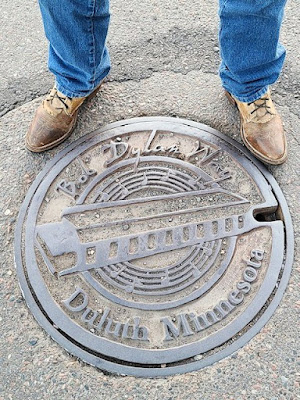
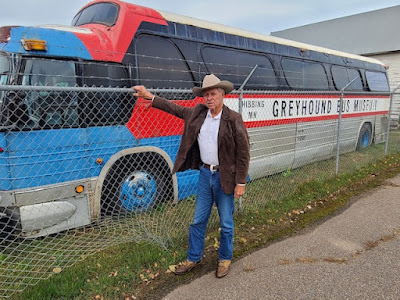
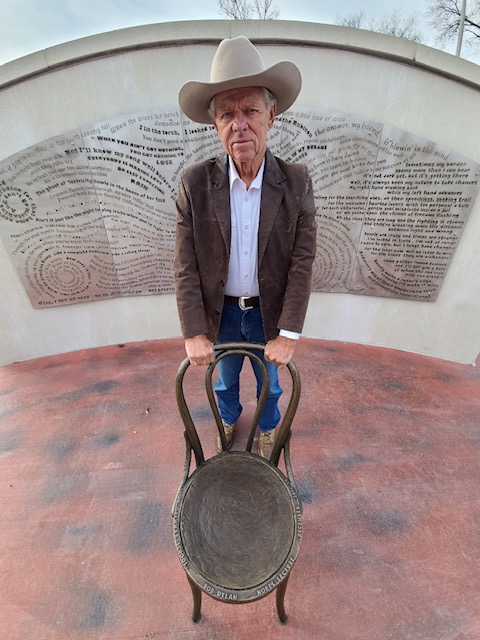
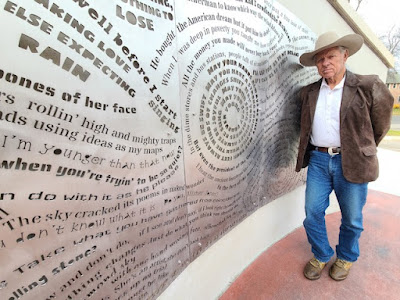
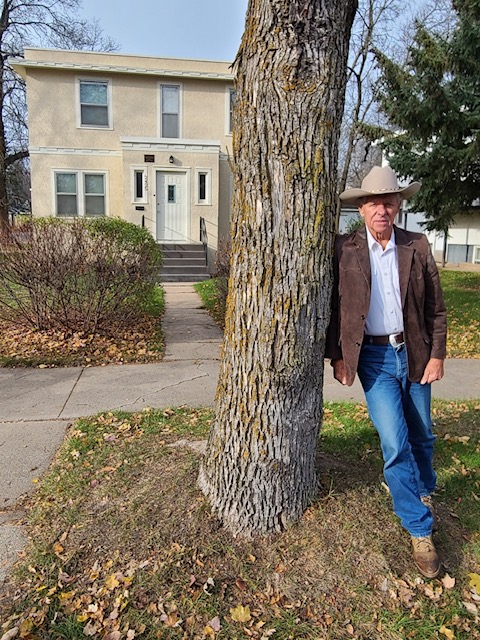
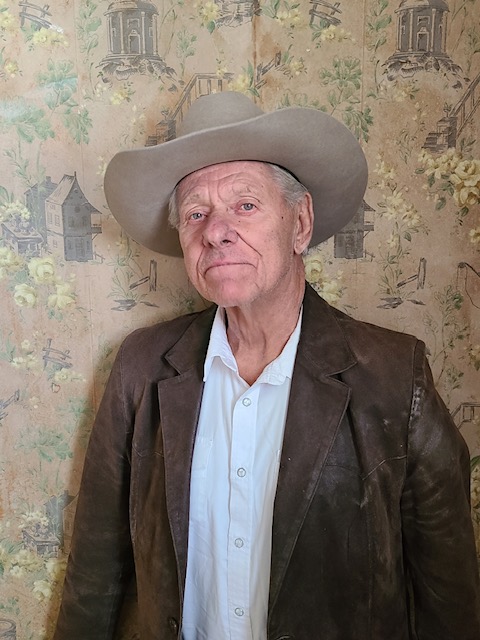
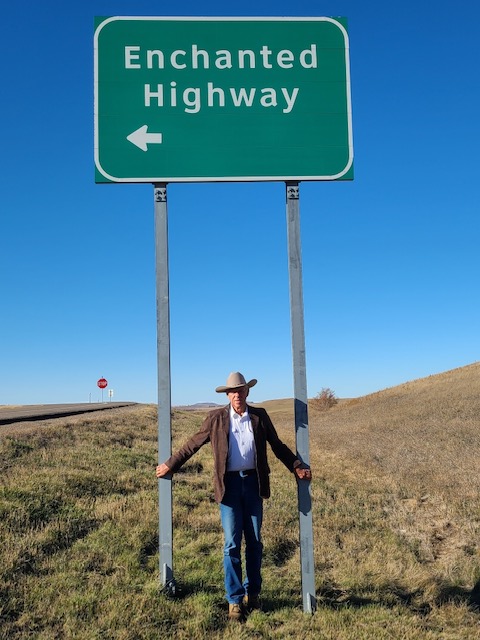
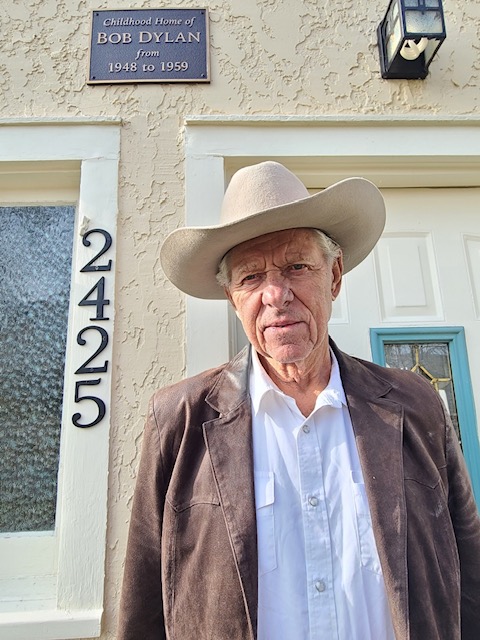
This weekend I finally had a chance to meet Nevada Bob, who arrived Thursday to see Bob Dylan related sites and continue working on his book 50 Years with the Wrong Woman. It's a memoir, undergirded by a lifelong love that enabled him to achieve far more than he ever could have imagined. 

The three of us enjoyed meals together at the Pickwick, Taste of Saigon, the Anchor in Superior and a brunch at the Duluth Grill. 

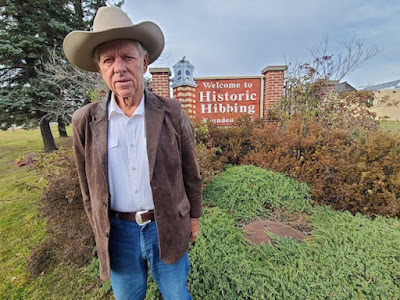
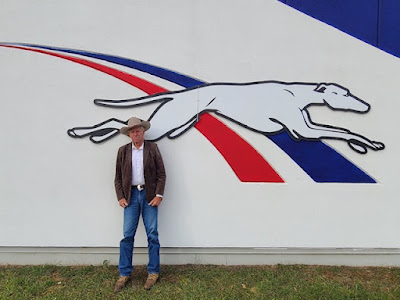
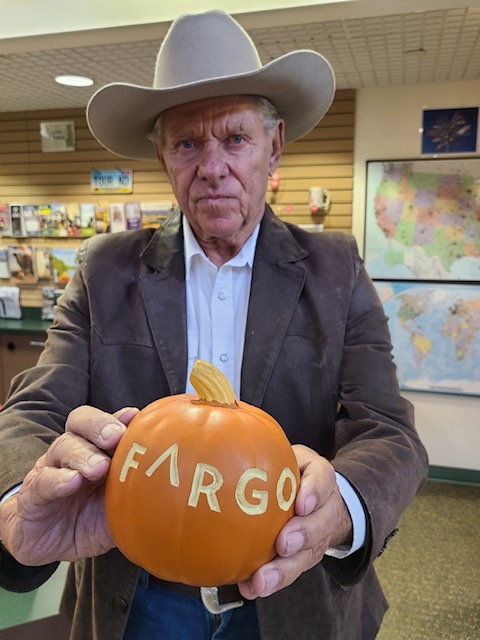
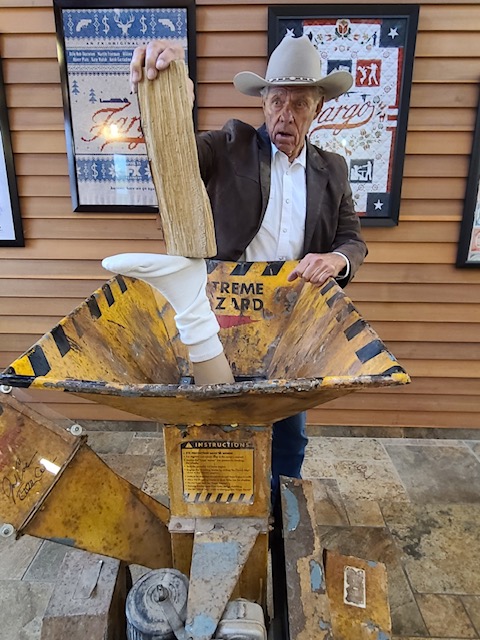
His photographer has been documenting their journey and sending me some great photos. When they left Hibbing they headed west. The last photo here was sent to me fro a tourist of Gary and Nevada Bob in Fargo. Don't scroll to the end if you are squeamish.

* * * 

Welcome to Hibbing.
The Greyhound Bus Museum

"Go ahead. Dream. And dream big."
Dylan tribute, Hibbing High School

Robert Zimmerman lived here.
"Tell ol' Bob when he comes home..."
Hard work and dreams make everything possible.
This is where Gary and Nevada Bob had their falling out.

This next photo is not for the faint of heart.

"So long, been good to know yuh."--Woody Guthrie
(Actual wood chipper from Coen Brothers' film, Fargo)
* * * * *

Special thanks to Gary Firstenberg for all the fine pictures he's been
sending us throughout this adventure, on the road with Nevada Bob.

Popular Posts