Showing posts with label Amazon. Show all posts

Friday, November 7, 2025

Grok Reviews My First Novel, The Red Scorpion

It seems like I've used Grok and ChatGPT as resources for quite a while now. One way use these AI LLMs is to obtain brief overviews of books or films that I see referenced in my other reading. Since my reading pile is rather large and I currently still have only 24 hours in a day, I find it useful to use these tools (along with many others such as reviews on Amazon and imdb.com) to become acquainted with authors and film makers whose works are creating a buzz.

All that to say, last night I wondered what Grok's opinion of my first novel might be. So I asked for a brief summary and an analysis, and received the following.

Brief Summary

The Red Scorpion (2011) by Ed Newman is an adventure novel framed as the private journal of Dr. William Comstock, a University of Minnesota anthropologist. In the late 1930s, during a research trip to Mexico, Comstock encounters a disaffected youth from a secretive indigenous clan who reveals a long-guarded secret: a colony of glowing red scorpions that have protected the tomb of the legendary Aztec god Quetzalcoatl for centuries. This discovery propels a multi-generational tale spanning 60 years, shifting between the arid landscapes of Mexico and the everyday life of Minnesota. As the secret unravels, it draws in family dynamics, academic intrigue, and perilous quests, blending historical anthropology with suspenseful action. The story culminates in a resolution that ties personal redemption to cultural legacy, with hints of a larger series. 

Analysis

Ed Newman's debut novel The Red Scorpion emerges from a deeply personal origin: a vivid 1980s dream of an aggressive, glowing red scorpion that haunted the author enough to spawn nearly ten pages of raw description. This autobiographical kernel infuses the book with an eerie authenticity, transforming a nocturnal vision into a layered narrative that bridges anthropology, adventure, and subtle speculative elements. While marketed and reviewed as a young adult (YA) title—thanks to its accessible prose, relatable teen characters, and themes of discovery and growth—it appeals broadly to readers of all ages who enjoy "Indiana Jones"-style escapades tempered by realistic emotional depth. Newman's background as a freelance writer and ad executive shines through in the book's tight pacing and vivid character interactions, making it a compact thriller (around 200 pages) that punches above its weight.


Themes and Motifs

At its core, The Red Scorpion explores the tension between cultural preservation and modern intrusion. The red scorpions serve as a potent symbol—not just literal guardians of Quetzalcoatl's resting place but metaphors for the fragility of indigenous knowledge in the face of Western curiosity and exploitation. Comstock's "serendipitous encounter" with the clan's youth underscores themes of disaffection and betrayal: the boy, alienated from his heritage, becomes a bridge (and unwitting betrayer) to outsiders, raising questions about identity and the cost of sharing sacred secrets. This evolves into a multi-generational arc, where the anthropologist's descendants grapple with the scorpion's curse-like legacy, weaving in life lessons on family loyalty, forgiveness, and the hubris of seeking forbidden truths.


The novel also subtly incorporates speculative intrigue, blending hard anthropology with eerie sci-fi touches. The scorpions' bioluminescent glow and almost sentient protectiveness evoke ancient myths reimagined through a modern lens, hinting at ecological or even supernatural warnings about humanity's overreach. Reviewers note its "suspenseful and eerie page-turner" quality , with twists that build to a "happy resolution"  emphasizing redemption over doom. For YA readers, these elements resonate as a coming-of-age parable: younger characters navigate schoolyard friendships, familial pressures, and moral dilemmas, learning that adventure often uncovers uncomfortable personal histories.


Style and Structure

Newman's prose is straightforward and immersive, favoring short chapters that alternate between high-stakes action (e.g., scorpion-laden tomb raids) and quieter, "normal pace" vignettes of Midwestern life . This rhythm mirrors the story's dual settings—Mexico's exotic, danger-filled wilds versus Minnesota's grounded domesticity—creating a "balanced and varied sequence" of mystery and mundanity . Dialogue feels "true to life," especially in interpersonal scenes, drawing from Newman's storytelling roots (e.g., his award-winning short story "The Breaking Point"). The journal format adds intimacy, as if Comstock is confiding directly to the reader, though some eBook versions suffer from formatting glitches like blank pages. 


Strengths and Weaknesses

Strengths abound in its genre fusion: It's a "mixture between the 'Hardy Boys' series and Indiana Jones", delivering pulse-pounding archaeology without veering into parody. The cultural details—indigenous clans, Quetzalcoatl lore—feel researched and respectful, avoiding exoticism pitfalls common in adventure YA. Character arcs, particularly the youth's disillusionment and Comstock's evolving ethics, provide "life lessons for old and young alike" , making it educational yet entertaining. Amazon reviews praise its grip: "Extremely well written! Grabs your interest from the beginning and does not disappoint at the end!" 


Weaknesses are minor but notable. The speculative elements occasionally strain realism (e.g., the scorpions' improbable guardianship), which might frustrate strict historical fiction fans, though it enhances the thriller vibe. Pacing dips in domestic interludes, and the 60-year span demands quick shifts that could confuse younger readers. As a self-published eBook (via Kindle), it lacks the polish of big-press YA like Rick Riordan's Percy Jackson series, but this rawness adds charm—much like Newman's dream-inspired genesis.


Cultural and Literary Context

In the YA landscape of the early 2010s, The Red Scorpion fits alongside multicultural adventures like The Lightning Thief or Code Name Verity, but with a more anthropological bent. It subtly critiques colonialism through Comstock's arc, aligning with post-9/11 literature's interest in "othered" cultures. Newman's indie ethos (bypassing agents after AOL-era queries) reflects the democratizing force of digital publishing, allowing niche tales like this to reach global audiences despite limited marketing.


Overall, The Red Scorpion is a gem for adventure seekers: a "fun, twisted adventure"  that lingers like its titular creature—fierce, unforgettable, and a bit stinging in its truths. If you're drawn to YA with brains and bite, it's worth the sting.


*

EdNote: My one regret is that the story is only available as an eBook. I enjoyed my Kindle so much that I was seduced into thinking that the digital book market would grow. Digital books were the shiny new toy at the time this was published. I am pleased that people who've read it enjoyed it. 


RELATED LINKS

The Red Scorpion on Amazon.

Nine Books by Ed Newman

Thursday, October 30, 2025

What Do Data Centers Do and Why Are They Necessary?


Data centers play an important function in our modern digital world. The problem is that they are physical entities in the real world, and though nearly everyone uses this technology, it's no surprise that many people ascribe to the NIMBY view: Not In My Back Yard.

So, what is a data center? Data centers are specialized facilities that house the computing infrastructure powering our digital world. They're essential because modern society relies on massive, reliable, and scalable data processing that can't be handled by individual devices or homes. Here's a break down the key reasons, with real-world context.

Centralized Power for Massive Scale
Everyday apps (like streaming Netflix, searching Google, or running AI ) generate trillions of data requests daily. A single smartphone can't process this—it's like asking one ant to lift a mountain.


In contrast to the limited capabilities of our laptops, iPads, desktop devices and smartphones, DCs pack thousands of servers into one secure building, providing the raw computing power (CPU/GPU) and storage needed. For example, Google's data centers handle 8.5 billion daily searches, using energy equivalent to a small city. Without DCs, the internet would grind to a halt; loading a webpage could take minutes. 


24/7 Reliability and Uptime

My year in Puerto Rico (1978-79) gave me many memories and taught me many lessons. One of them was the importance of our energy grid, hence my desire to see Minnesota lift its nuclear moratorium. 


In Puerto Rico we had blackouts or brownouts nearly every week. Sometimes they lasted hours and occasionally all day. Power outages, hardware failuility res, or internet glitches happen everywhere. Although it is only an inconvenience for most of us, for businesses downtime can be costly—for example, Amazon loses $66,000 per minute during outages. 


This is what data centers are all about. They include redundant systems: backup generators, cooling (to prevent server meltdowns), and failover tech. Tier IV data centers guarantee 99.995% uptime (less than 30 minutes of downtime per year).


Security and Compliance

Data Security is also an important attribute of DCs. Breaches cost $4.45 million on average (IBM, 2023). Storing sensitive info (health records, financials) on personal devices invites hacks.


DCs offer physical security (guards, biometrics), encryption, and compliance with laws like GDPR or HIPAA. Servers are in locked vaults, monitored 24/7 and protect against cyber threats.


Efficiency and Cost Savings

Running servers at home is wasteful—your PC uses 10x more energy per task than a data center server which optimizes with shared resources, economies of scale, and green tech (e.g., Microsoft's underwater data centers for natural cooling). One center can serve millions, slashing costs by 80% vs. on-premise setups. As a result cloud services are affordable for all; AWS powers 33% of the web for pennies per use.


Enabling Innovation and the Future

Emerging tech like AI, IoT (50 billion devices by 2030), and VR needs exascale computing—far beyond consumer hardware. Data centers fuel breakthroughs in technology. NVIDIA's AI training for self-driving cars requires 100,000+ GPUs in centers. Hyperscalers (Google, Meta) build them to handle exponential data growth (90% of all data created in the last 2 years). This is where the power comes for ChatGPT, autonomous vehicles, and personalized medicine. Without data centers, AI wouldn't exist at scale.


In short, data centers are the "electric grid" of the digital age—unseen but indispensable. Global demand is exploding (expected to consume 8% of world electricity by 2030), driving innovations like edge computing to bring them closer to users. If we didn't have them, we'd revert to a pre-internet world. 


Do you have questions on specifics, like sustainability? Fire away!

Wednesday, October 8, 2025

Top Marketing Issues of 2025

In the Sixties, when Duluth’s native son Bob Dylan famously sang “For the times they are a-changin’” he was spot on. As he declared on Another Side of Bob Dylan, "Everything passes, everything changes..." Fifteen years later, he sang, “Gonna change my way of thinking.” Twenty years ago he reiterated this sentiment in his Oscar-winning song, written for The Wonder Boys, “Things have changed.” In short, change seems to be the one constant in our world and in our lives.

So here we are in 2025 and what has changed in the realm of marketing? To answer this I thought I’d ask Google what the top marketing issues of 1985 were. To my surprise, though things were different, much actually appears to be the same. It’s as if we’re facing many of the same issues, dressed in different clothes, that marketers and ad agencies did forty years ago


1985 was the year of the "New Coke" Disaster, when Coca-Cola tried to replace its classic 99-year-old soda recipe with a new version called "New Coke." Fans of the original Coke went ballistic. Coca-Cola was forced to bring back the old recipe as "Coca-Cola Classic" just a few months later. Fast-forward to 2025 and we continue to see brands make missteps and offend fans. One difference is the megaphone of social media, which can create instant, deafening responses.


In 1985 people’s lives were getting busier and they had more product choices than ever before. Shopping habits began to change, though it’s nothing like today. Check out the toothpaste or deodorant options at Wal-Mart. For a variety of goods many people hardly go shopping at all, having everything delivered to their homes via FedEx, UPS, USPS or DHL, and—potentially soon—via drones. Now, as then, marketers had to figure out how to keep up with what customers want and stay relevant in this fast-paced world.


The rise of cable TV and viewer-side ad blocking, which began in the late 70’s, meant people could watch more channels and skip ads more easily. Marketers were forced to rethink how to reach audiences, as traditional TV commercials weren’t working as well anymore. That was before the web changed those rules entirely.


Back then new government regulations made advertising trickier, with stricter rules about what companies could say or do. Consumer advocates like Ralph Nader were getting louder, demanding better products and more honesty, which added pressure on marketers to play fair.


Adapting to evolving data privacy regs is another headache. Stricter privacy laws (e.g., GDPR, CCPA*) and the phasing out of third-party cookies limit access to customer data, complicating personalized marketing and ad targeting.


In our Internet age, people who build online businesses can be wiped out overnight by government rulings or platform decision makers. When online poker was made illegal in 2006, dozens of online businesses making millions vanished. Other businesses have been sent reeling by algorithm or policy changes at Facebook, Google, Amazon Marketplace or the Apple App Store.


As I see it, if you don’t own the platform, you don’t own the business. Or as the adage goes, “Don’t build your business on rented land.” The solution: your long-term strategy should involve building independent customer relationships (email lists, direct websites, diversified sales channels) so you’re not at the mercy of sudden changes beyond your control.


Two other issues that I’ve seen over the past 40 years are (1) the lack of alignment between sales and marketing teams, and (2) the issue of attracting and retaining talent.


In many companies, sales and marketing operate as separate departments with distinct leadership, budgets, and priorities. These silos discourage shared accountability and make it harder to coordinate strategies, leading to conflicting efforts or duplicated work.


Marketing and sales can become almost adversarial because they have different goals and timelines. The marketing mindset focuses on the big picture; sales teams live in the now.


Marketing teams typically focus on generating leads, increasing brand awareness, or driving website traffic, measured by metrics like impressions or click-through rates. Sales people prioritize closing deals and meeting revenue quotas. These differing objectives can create a disconnect, when marketing delivers leads that sales deems unqualified, or sales fails to follow up on marketing’s efforts effectively.


As for attracting and retaining talent, Stacy Johnston, founder of Audacity HR Solutions said, “I think an area of opportunity from a marketing lens is internal and external alignment with branding, mission, and core values.” She also stressed the importance of having a clear “why” message. That is, here’s why you should work for us.


“Many organizations spend lots of time and money on marketing. Harness that message not only to connect with customers, but also to connect with potential employees and current employees,” Johnston said. Having an authentic brand that resonates with candidates and employees will bolster recruiting and retention efforts, she explained.


Of course, the big “new thing” that has been rattling cages in 2025 is the integration of A.I. into all aspects of marketing today. In the digital marketing space A.I. is challenging traditional SEO strategies. If you have a question for Google, the search engine no longer begins with sponsored links and page links based on traditional SEO. Instead, Google’s A.I.-powered Gemini 2.0 will offer instant answers to your questions. Whereas Google was formerly a friend to help you promote your website, it seems that now Google is becoming your competition. On top of this

we’re being threatened by a flood of A.I.-generated low-quality content, making it even harder for brands to stand out.


On this topic, there’s more to say. With A.I., the times really are changing.


# # # #


*GDPR: General Data Protection Regulation; CCPA: California Consumer Privacy Act

Illustration: A drawing of mine modified with Gemini 2.5 Flash


This article originally appeared in my Marketing Matters column, Business North, October 2025

Friday, June 9, 2023

Beginning with Paul Metsa: Alphabet Jazz and Bob Dylan in Minnesota

"I live in Bob Dylan’s house. Many of you live there metaphorically (as do I), but while I was writing this, I actually lived on the first floor of the house on Central Hillside in Duluth, Minnesota, where Abe and Beatty Zimmerman rented a second-floor apartment and welcomed bouncing blue-eyed Bobby on May 24, 1941." 

So begins Paul Metsa in his Foreword to the latest release in the Troubadour Series, Bob Dylan In Minnesota: Troubadour Tales from Duluth, Hibbing and Dinkytown.


K.G. Miles, author of this series, leaned on four Minnesota writers to assist with bringing this book to life: Paul Metsa, Marc Percansky, Matt Steichen and myself. 


Metsa, a veteran Minnesota singer/songwriter from the Iron Range who has won 7 Minnesota Music Awards, may be possibly best known for his Wall of Power radio and TV shows. He's also authored several books where he demonstrates his flare for the written word. One of these, to be released this fall, is called Blood in the Tracks, a book about the Minnesota musicians who contributed to Dylan's masterpiece. His first book was an autobiography called Blue Guitar Highway (University of MN Press-2011). The book received a flurry of positive reviews including this one from Kirkus Review: "Metsa is as likeable a narrator as ever graced a barstool."


This post aims to give a nod to Metsa's Alphabet Jazz: Poetry, Prose, Stories and Songs. Released in the fall of 2022, Metsa read excerpts from the book at our 2022 Duluth Dylan Fest, including a swashbuckling, Positively-Fourth-Street-style tongue-lashing of a City Pages writer who dissed Bob Dylan as a performer. The letter to the editor was published in September 1992 and is still a lively read today.


The book is a catch-all of sorts, Metsa playing tango with his readers, shuffling tributes with poems, and giving a greater permanence to many of the songs he's crafted through the years. One of his more well-known songs is "Jack Ruby" but if you've never quite caught all the lyrics, you'll find them here. You can probably hear Metsa's gruff electric-viper vocals in the chorus as you read the lyrics. 
 

The poetry, prose, stories, letters and songs were penned, or typed, between 1984 and 2022. Metsa describes it as "a personal diary of sorts--midnight blasts of inspiration, love letters in poem, personal tributes to musicians and friends who have passed on, true stories, letters to the editor and friends, and songs I have written along the way that I still perform." 


It has been in my "book pile" next to my easy chair since last fall. It's easy to pick up and dip into when you're relaxing at the end of long day. There's no real narrative, so you can't lose the thread if you are reading other things in between chapters and favorite passages.


There were a few surprises for me as I got into it. First, Paul Metsa is more sentimental than I'd originally imagined. This especially comes out when he talks about his family or his dogs. Second, he's a very good writer. What I mean by this is that with the prevalence of print-on-demand and self-publishing today, everyone seems to be writing books. I think the uneven quality of all this new reading material causes some of us to tone down our expectations. With Metsa, he's got the goods.  


Metsa grew up on the Iron Range, contributing to a portion of the Hibbing section of Bob Dylan in Minnesota. He makes no bones about acknowledging Dylan's influence and importance in his career. He currently lives in Duluth, MN after decades in the Twin Cities.

One Amazon.com reviewer had this to say about the book:

In The War of Art, Steven Pressfield examines the abiding force called resistance that is the enemy of artist and art. Paul Metsa, in Alphabet Jazz, describes a life lived in opposition to that restraint. Talent, if we take Pressfield's definition, is the ability to see two things and make a third out of them. Metsa has it in spades.

This wonderful collection of poems, lyrics, anecdotes and reflections reveals that his eye is meticulous, his heart at turns lonesome and fulsome, his ear perfectly attuned, as he gathers the coincidences to extol those who would heed this command echoing out from his poem, "Memo From Rego Park":

Raise your hand in a moment of silence
But don't cease to dream
For they can't steal that
In our irregular moments of grace

* * * 

There are a lot of notable, quotable turns of phrase here. At the beginning of his tribute to Dave Morton he has this quote posted as a subhead: "When another student was ready, the teacher reappeared." There are quite a few of these.* 

You can find Alphabet Jazz here at Amazon, and Blue Guitar Highway here. (BGH will soon be re-released in paperback by U of MN Press.) You can find out more about Paul and order his music at www.paulmetsa.com

Purchase Bob Dylan in Minnesota here.

* * *

Additional Related Links

Metsa performing "Jack Ruby" at Live Aid V.

Co-written with Rick Shefchik, Blood in the Tracks: The Minnesota Musicians behind Dylan's Masterpiece will be out in stores September 12, 2023. It is available for pre-order here on Amazon.

* * * 

In 2018, the Minnesota musicians who recorded five of the songs on Dylan's much-lauded Blood on the Tracks album got the long-overdue recognition they deserved for their contributions to that very special album. Paul Metsa featured their stories on his Wall of Power program, a very special event for everyone present. Their stories are referenced in Bob Dylan in Minnesota as well. Here are my three blog posts about that special day.

Part One  
https://pioneerproductions.blogspot.com/2018/10/inside-studio-still-more-blood-and.html 

Part Two
https://pioneerproductions.blogspot.com/2018/10/paul-metsas-wall-of-power-featuring.html


Part Three
https://pioneerproductions.blogspot.com/2018/10/lives-touched-and-changed-dylan-blood.html


*The Morton subhead is a paraphrased description of Morton from Robert Shelton's Dylan bio No Direction Home.


Monday, January 9, 2023

More Thoughts About Books In Response to a Statement by Greil Marcus

Music journalist and cultural critic Greil Marcus has an eNewsletter called Ask Greil. Readers ask Marcus questions and he responds publicly. This seemed like an interesting way to get to know this writer and cultural observer as other people publicly pick his brain. In addition to being well-read, there's no question he's been around and seen a lot.

Here's a excerpt from his January 3 reply to someone who asked if he planned to review The Last Chairlift by John Irving. (Irving is author of The World According to Garp and more than a dozen other novels.)

"I’m unsure about The Last Chairlift." Marcus replied. "First, I distrust any book that says it’s about the last anything. Second, it’s so long I’m afraid I won’t finish it, or worse, look at it on my nightstand for a year before I realize I’m never going to start it."

I'M USING THAT STATEMENT as a stepping off point into a few thoughts about books. I, too, have a few internal red flags that cause me to distrust certain kinds of marketing lingo. Here are three.

First, I will revise his comment about "the last anything" to encompass "the last word" on anything. Is there really a last word on toppling statues or climate change? We can have convictions, but are we going to close the door on all discussion, even when new evidence comes in? Apart from the either/or manner in which most discussion takes place, there are countless nuances to most issues. 

Second, I distrust endorsements by Kirkus Review. Silly me, I used to believe that it actually meant something if a book review cited comments by Kirkus review. It wasn't till I got into self-publishing on Amazon that I discovered I can purchase a Kirkus Review and quote it in my marketing copy on the back of the book, or wherever else. This was a moment of disillusionment for me. 

Third, I distrust NYTimes Bestseller status as anything meaningful. Popular does not correspond to quality. Many important books have limited sales for a variety of reasons. Other books never make the Times' bestseller list because the Times only measures bookstore sales. 

Marcus also states his reluctance to start a massive tome that will sit unread on his nightstand for a year. Yes, I have a few of those massive volumes and I understand his hesitancy. This doesn't stop me from selecting long books when the urge is present. I usually have several books going at the same time, and the "long one" will be at my end of the dining room table which I'll plod through during my lunch periods. I'm not what it will be this year but last year it was Halberstam's The Fifties, and two or three years ago Solzhenitsyn's August 1014. As much as I love David Foster Wallace's writing, I've thus far managed to dodge Infinite Jest.

Another rule that guides my reading decisions is this: what do other readers think? The critics often praise something they've never read but feel they must weigh in on. Also, like movie critics they embrace what's trendy, which on occasion can be appallingly bad. Jodie Foster's Home for the Holidays was her first film as a director. High praise ensued. "Women crossing over into the director's chairs," the said. We walked out after 20 minutes. 

A quick peek at the Amazon reviews by readers pretty much tells you that Marcus was probably wise to avoid The Last Chairlift. Here are comments from one reader who has been a big John Irving fan:  

I may someday forgive John Irving for this book, but not yet. I gave up about 35% of the way in when I realized that everything in this book that was not a repetition of a theme in his earlier work was badly described sex (and "badly" may be generous). I figured that, if I went any further, I might even lose the will to live.... If I were John Irving, I would probably complain that at 80, he may have used up all his novelist skills. Instead, I will try to pretend this book never happened and continue to list Irving among my top 20 favorite modern authors."

This review feels honest and very likely accurately reflects the contents. Sometimes, when books are political, you might get hostile reactions not because of the quality of the content but because the "other side" simply does not want the book read. That can go either way, if you know what I mean. 

Whether writing about them, talking about them or reading them, books are a great gift to all of us. May we never stop supporting our libraries and our authors.

* * * *

There are worse crimes than burning books. One of them is not reading them. ~ Joseph Brodsky

For what it's worth, the QR code at the top right will bring you to a page describing my books. If you don't have a "Smartphone" you can just click on it with your cursor and reach the same destination.


Wednesday, October 19, 2022

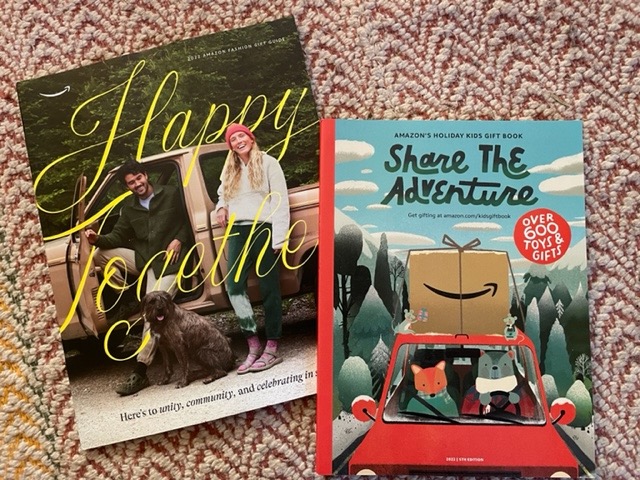
Amazon Offers Proof Again That Print Is Not Dead

It's interesting how at the very same time that Facebook is investing in virtual worlds where most people will never go, Amazon is reaching out to people in the tangible real world where we live and breathe and have our being. 

I don't believe Amazon is doing this just to spend tons of money on paper and printing. They've tested the waters and know the power of print, including catalogs and direct mail.

Catalogs have a certain nostalgic appeal for a lot of us, I believe. When I was a kid my dad would bring home a Sears catalog (which seemed like it was two inches thick) and mark the section featuring children's toys. This was Santa's way of learning what we might want.

The photo on this page is of two Amazon catalogs I've received this fall. One is the Amazon equivalent of that kids section of the Sears catalog. The other is a fashion gifts guide. 

Yes, magazines and newspapers have taken a hit these last 25 years since the advent of the Internet. This doesn't mean print media has been abandoned altogether. 

Here's the beginning of my 2018 article Why Print Still Matters for Marketers.

Whereas it’s true that magazine and newspaper publishing has taken a hit these past fifteen years, it would be wrongheaded to assume these forms of connecting with readers-–that is, consumers — would disappear altogether. In fact, a recent study indicates that print continues to be among the most effective media for reaching customers with your marketing messages.

A new study by the marketing analytics group Ebiquity, conducted in October 2017 and January 2018, has provided numerous insights to help businesses evaluate their marketing mix. One of the study’s aims was to not only determine the most effective marketing channels, but to discover how much the facts align with what agencies are telling (or selling to) their clients.


Get the facts. You can read the rest of the article here. 

In the meantime, the seasons are in transition. Are you ready?

Popular Posts