Showing posts with label massacre. Show all posts

Saturday, November 20, 2021

DiCaprio to Play Cult Leader Jim Jones In New Hollywood Biopic

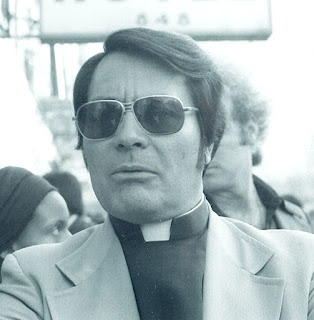
Jim Jones (Creative Commons photo)
This past week I learned that Leonardo DiCaprio was in talks to play cult leader Jim Jones in a new film about the Jonestown massacre. It brought to mind another memory from my year in Puerto Rico.

I was working in a Christian bookstore in Puerto Rico that fall when, on November 18, 1978, 909 members of The Peoples' Temple, a cult that had taken up residence in Guayana, participated in a mass suicide by cyanide. It was a shocking story.

My fiancĂ© happened to be working on an apple farm in Maine at that time. Donna Foster, the wife of a couple who lived on the farm that year, at one time babysat Jim Jones' children in Indiana where Jones and his family lived for two decades.

It's almost creepy how close we can be to history. I know more than a few such stories.

On another occasion, a few years before the Jonestown massacre, my brother showed me a newspaper story about a faith healer in South America with an unusual twist in his ministry. He would call people up to the stage, purportedly reach into their bodies and pull out cancerous tumors. My brother asked my opinion and I thought it strange. Yet someone thought it noteworthy enough to cover this man's activities in the news. 

In retrospect, I am guessing that Jim Jones would not have passed Penn and Teller's scrutiny. The "trick" no doubt had the appearance of being real only because a gullible audience was so willing to believe.  

* * * 
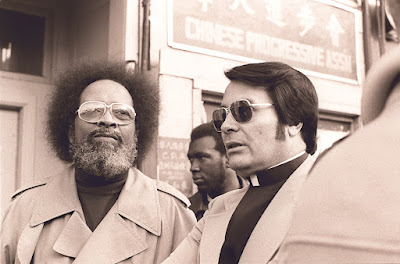
Rev. Cecil Williams with Jim Jones. Photo Amy Wong
When the Jonestown mass suicide occurred, what shocked me almost as much as the tragic massacre itself was the release of two books about Jonestown in time for Christmas. How could this be? 

It's apparent that there were authors or journalists who had been following this evolving story for some time. It didn't just happen out of the blue. When this grand finale story broke, it triggered a rush to be first to deliver a more comprehensive account regarding what happened. 

Wikipedia has an extensive overview of Jim Jones' life and career that may be of interest to some of you. His "ministry" began in the mid-50's when he was but 24. For two decades he developed an eclectic approach drawn from a variety of sources. He was 47 when he died. 

This won't be Leonardo DiCaprio's first role as a famous quirky person. His role as the complicated Howard Hughes in The Aviator was a noteworthy achievement. 

* * *

It will be interesting how Hollywood interprets the story of Jim Jones. Born in 1931, Jones became a fan of Hitler in his youth. Later he became enamored with Communism. He was also a major critic of the separation of the races and became an advocate for blacks, adopting some African-American children into his own family.

It should be noted that not everyone "drank the Kool-aid" in Jonestown. (The drink was a cyanide-laced grape drink.) Those who didn't drink willingly (they were all supposedly going to meet up on the other side somewhere) were shot. It must have been a scary scene that day. 

Related Links

The Jonestown Massacre

Jim Jones (Wikipedia)

Entertainment Weekly Announces DiCaprio to Play Jim Jones

Wednesday, November 20, 2019

The Korean War Was More Brutal Than We Remember

Gregory Peck, Pork Chop Hill
I was seven when the movie Pork Chop Hill starring Gregory Peck was released. I probably saw it on Saturday Night at the Movies a year or two later. At the time, it seemed like a pretty good war movie. It was intense, had characters you could root for, and had heroes. I was too you, though to catch the real message of the film, that men are being asked to put their lives on the line for a meaningless objective.

U.S. howitzer position near the Kum River
There's a sense in which the Korean War is something of a forgotten war. The objectives in World War II seemed clear. The Axis powers had to be stopped. The Korean war was a different kind of war, the beginning of a series of conflicts that had fuzzier rationales.

At the end of World War II my father enlisted in the army and was sent first to the Philippines and then Korea. This was before the Korean conflict escalated to what it became several years later.

Combat in the streets of Seoul.
As I've been reading Don't Know Much About History the past ten days or so, I just finished Ken Davis's section on the Korean War. Last year I learned from Paul Thomas Chamberlin's The Cold War's Killing Fields that Korea was not some innocent escapade. Civilians suffered terribly in that conflict. It's hard to believe that we almost used atomic bombs in that war. In an interview published posthumously General Douglas MacArthur recommended dropping between 30 and 50 atomic bombs on targets across Manchuria. One shudders to consider the implications of this.

While pulling together some research for this blog post I came across another blog post that tied to my thoughts here. The title of this November 15, 2019 story by Darien Cavanaugh is The Korean War Was So Brutal That America's Most Hardened Soldiers Were Shaken.

Cavanaugh wrote, "On a per-capita basis, the Korean War was one of the deadliest wars in modern history, especially for the civilian population of North Korea. The scale of the devastation shocked and disgusted the American military personnel who witnessed it, including some who had fought in the most horrific battles of World War II."

It was Chamberlin's book that brought my attention to what Cavanaugh went on to say.

B-29 Superfortress
"Several factors contributed to the high casualty ratios. The Korean Peninsula is densely populated. Rapidly shifting front lines often left civilians trapped in combat zones. Both sides committed numerous massacres and carried out mass executions of political prisoners. Modern aircraft carried out a vast bombing campaign, dropping massive loads of napalm along with standard bombs."

The U.S. dropped 20% more bombs on North Korea than were dropped in the Pacific during the entire World War II. In addition we dropped over 32,000 tons of napalm, which has to be one of the most inhuman weapons ever conceived by humans.

By the war's end North Korea lost ten percent of its population, chiefly due to this scorched earth bombing campaign.

But the worst of this conflict was what Paul Thomas Chamberlin draws attention to in his book, which is a devastating indictment of our post WWII behavior in the various theaters beginning with Korea. This is what we never heard about before, that we openly massacred civilians. Writes Cavanaugh:

It wasn’t until 1999 that the United States acknowledged—after a lengthy investigation by the Associated Press—that a 1950 letter from U.S. Ambassador John J. Muccio authorized commanders in the field to adopt a policy of openly massacring civilians.

USS Missouri firing 16-inch guns.
* * * * 

Related Links
Interview with Paul Thomas Chamberlin, author of The Cold War's Killing Fields
Photo of Gregory Peck, source: imdb.com
All other photos on page: GoodFreePhotos.com
If you're a blogger looking for Free Historical Photos, here is a website you may wish to consider bookmarking:
https://www.goodfreephotos.com/historical-battles/korean-war/column-of-the-us-1st-marine-division-move-through-chinese-lines-battle-of-chosin-reservoir.jpg.php

Tuesday, December 2, 2008

Why Mumbai Massacre Matters To Us

The amazing power of the internet is being demonstrated once again. A terrible assault occurs in a major city half a world away. It is posted on our Twitter feeds before it is on the news.

Then, as the story breaks in the U.S. newspapers, the magnitude of the crime appears muted, even distorted. The Internet, however, tells it like it is, as it happens.

When I first learned that the terrorists took hostages and then tortured them, I wondered why this was not yet covered in U.S. media. The torture has become a major feature of the story in Israel where six Jewish citizens where tortured so horribly the doctors became disturbed. Last night I watched a news broadcast from Israel via internet after these six dead were returned to their Homeland.

But as of yesterday there were no mentions of the torture in our local paper. And now today still nothing. In fact, nothing about Mumbai at all.

Blogs and news organizations around the world are talking about this event. Some are saying it is a landmark because it has the potential of starting an Indo-Pakistan war. Others cite the specific horrors done to Jews as a setback to Israeli-Muslim relations, especially if Muslim leaders do not step up and denounce these crimes.

But U.S. stories, when I Googled Mumbai torture have the following at this moment in time. An L.A. Times story with the sentence, “An infuriated Malvia said she would torture the attackers if she ever got her hands on them.” But there is no mention that the hostages were tortured, that the U.S., British and Israeli hostages purposely captured in this well planned horrorshow were tortured. It only talks of a “killing spree.” The out of context quote almost makes the U.S. citizen seem like the bad person in the story.

According to Don Feder, editor of Boycott The New York Times, it is a deliberate stance the U.S. news regime is taking because "The Times adamantly refuses to recognize a connection between Islam and worldwide terrorism."

The Washington Post downplays the torture in this way. In a story titled Terror Groups in India, the Post cites a report that calls torture in India “normal”, noting that more than 2750 people were killed across India in “terrorism-related violence” in 2006.

The article details a host of terrorist organizations that have been active in the world’s second largest country. Are they saying then that Mumbai is just another incident?

The world press is not treating it this way.

The story being repeated on many sites seems to have as its origen this Nov. 30 account account by Krishnakumar P and Vicky Nanjappa which appeared in the Rediff India Abroad.

Doctors shocked at hostages's torture

They said that just one look at the bodies of the dead hostages as well as terrorists showed it was a battle of attrition that was fought over three days at the Oberoi and the Taj hotels in Mumbai. Doctors working in a hospital where all the bodies, including that of the terrorists, were taken said they had not seen anything like this in their lives.

"Bombay has a long history of terror. I have seen bodies of riot victims, gang war and previous terror attacks like bomb blasts. But this was entirely different. It was shocking and disturbing," a doctor said.

Asked what was different about the victims of the incident, another doctor said: "It was very strange. I have seen so many dead bodies in my life, and was yet traumatised. A bomb blast victim's body might have been torn apart and could be a very disturbing sight. But the bodies of the victims in this attack bore such signs about the kind of violence of urban warfare that I am still unable to put my thoughts to words," he said.

In other accounts it is noted repeatedly that "the worst tortured were the Jewish victims."

Unless the media tells about these things, Americans will not understand if there is a strong Jewish reaction against what happened.

Maybe the torture accounts will eentually emerge in our media. Maybe the U.S. coverage is restrained in an effort to obtain second sources to verify these accusations. But there seems to be plenty of evidence. Doctors at the hospital saw and were made ill by it. The bodies were returned to Israel where other witnesses saw what was done to Rabbi Gavriel and Rivka Holtzberg, among others. You can see the pools of blood online in photos of the Chabad House Massacre where some of these terrible events took place. Very bad things did happen.

There are three reasons the events in Mumbai matter to us.

1. Indo-Pakistan relations have been jeopardized. Both countries have nuclear weapons. There may be political ramifications in U.S.-Pakistani relations.
2. Israeli-Islam relations set back. If the torture is confirmed, this could potentially become a catalyst for more incendiary events.
3. It forces us to question whether our U.S. news sources are reliable.

The power of the Internet to put all these stories, photos, and videos just a mouse click away is remarkable, though somewhat frightening as well. Pray for the peace of Jersusalem.

Thursday, November 27, 2008

Mumbai Heartbreak Hotel

"The way in which the world is imagined determines at any moment what people will do." ~ Walter Lippman


The story broke on Twitter. Evidently someone in the middle of the Mumbai massacre was tweeting. Long before CNN could get a correspondent on the scene, the chatter was spreading 'cross the Internet. http://tinyurl.com/5g2a3n Terrorists went on a spree with assault rifles in Mumbai's financial district killing more than a hundred, leaving hundreds more wounded and bleeding.

One blog entry I came across stated this was a night life hot spot, with the upscale Oberoi and Taj Mahal Hotels being where the action was. American and British citizens were being sought as potential hostages. Other stories described the chaos and fear. There were photos accompanying some stories that showed blood stained sidewalks and streets.

It must have been a horrible thing to go through. But one of the stories I came across had a statement that especially surprised me:

"THE US State Department has consistently listed India as the country with the second-highest number of terrorism casualties after Iraq. However Western media has given scant regard to the problem and this is sometimes resented in India." ~ Sydney Morning Herald

Second highest number of terrorism casualties after Iraq. Wow. Something shifted in my thinking about India the fall. My image of India was painted by Thomas Friedman's The World Is Flat when he describes a golf fairway there with large corporate logos on the left and right of a long scenic fairway. 400 million Indians are moving into the Middle Class. These are people with money, brains, talent. This is a country on the move. The picture in my head was modern times.

This image ruled my mental pictures till recently when I read of the harsh and brutal assaults on Christians by Hindus in Orissa. The Orissa horror has gone relatively unreported. And despite the State Department warnings cited in the Sydney Herald, Americans are not reading about all these things in the news. More than a thousand churches have been burned. Missionaries and pastors hide in the jungles to avoid being slaughtered by very dangerous people.

Then we have this week's highly visible event, which did make world headlines... But how much can we understand what it all means if we have no context? It would be bad public relations for India tourism and commerce if Americans saw India as "dangerous." But if our State Department is calling it dangerous, how come no one knows this? How can we make decisions where we'll be vacationing if we are not told of the dangers in those places we're enticed to see? How can we feel safe on business trips if we're not told that Americans are being kidnapped there?

When the story broke, many people probably wondered where in the world is Mumbai. Well, it's old Bombay, with a new name. Externally, the city glitters, but at its heart there is grief.

Popular Posts