Showing posts with label power of music. Show all posts

Monday, January 31, 2022

The Music of Our Lives: A Visit with Podcast Host Mindy Peterson on the Power of Music

Mindy Peterson has been hosting the Enhance Life Through Music podcast about music since 2019 and a piano teacher since 1991 to students ages kindergarten to

adult. She began taking piano lessons at the age of 6. Like many who had an early intro to playing an instrument, music has been an integral part of her life ever since. She not only enjoys listening to live music and expressing herself through music, her podcast shows how interested she is in learning more about the benefits of music, and passing on that love of music to her students and others.  

This past fall Mindy visited Duluth to learn more about the influence our city and the Northland had on Minnesota's latest Nobel Prize recipient. This visit became the foundation for a December podcast on the impact of Bob Dylan and his music. 


EN: Can you briefly share your background with regards to music? What you have created here— your podcast‐‐clearly didn’t spring out of thin air.

Mindy Peterson: I started taking piano lessons in first grade, and have taught piano lessons since 1991. I’ve always been intrigued by the many ways music benefits our lives, and was fascinated with news articles, books, and studies showing music’s power in protecting the brain from dementia; transforming our experience of a movie scene; increasing athletic endurance; increasing literacy skills in children with dyslexia; and more. I believe passionately in the power of music to enhance our lives, and wanted to shout it from the rooftops in order to help others make life better through music, and also to advocate for musicians and music education. Music advocacy and education are two sides of the same coin; and when people understand the value that music brings to our shared human journey, I believe they will want to invest in musical experiences and training. 


EN: Music is probably something important to most of our lives. What was it that triggered you to start a podcast about music?

MP: You’re so right – music affects ALL of our lives, whether we consider ourselves musicians, or not! While there are exponential benefits for those who actively make music, I was struck by how music can make life better in so many ways for all. I observed how frequently my non‐ musician friends made casual comments referencing music, such as: 


   “I heard this song in a store the other day, and it instantly took me back to senior prom!” (Music is the sound of emotions, and one of the last memories to fade from our brains.) 


   “After waiting on hold, I could NOT get that hold music out of my head the rest of the day!” (Earworm!) 


   “Thank goodness ‘Don’t Stop Believin’ was playing – that’s the only way I made it through the last set of that workout.” (Music has been called “legal doping” because it can enhance athletic performance and endurance up to 15%.) 


When I first discovered podcasts, I was hooked! As I explored shows and found new favorites, it occurred to me that podcasting was the perfect medium for showcasing the myriad applications of the power of music. Surely such a podcast must exist! I went on the hunt for a podcast fitting this description, but couldn’t find it. Enhance Life with Music was my creation of the podcast I wanted and couldn’t find. 


EN: You cover such a wide variety of topics showing ways that music is such an important component of our lives. What have been some of the biggest insights for you personally? 


MP: It is such a treat to meet and speak with people from around the country and globe about music’s application in fields as seemingly disparate as sports, social justice, science, business, medicine, mental health, entertainment, education, and history. I’m continually amazed by two things: 


Music’s ability to bring people together. It is one of very few things (food possibly being another?) that can lower walls and bond people who otherwise may have nothing in common – and in fact may have reason to see one another as enemies (such as the Israeli and Palestinian youth featured in Ep. 123).


The endless applications of the power of music. One of my hesitations in starting this 
podcast in August 2019 was the apprehension that I might run out of topics. I didn’t want to launch a podcast, only to have the well of ideas run dry within a few months. Well... over two years and 120 episodes later, the list of potential topics continues to grow. Music is the salt of life – it just makes every aspect of life better! 


EN: I think the way Hollywood directors use music to add dimensions to films is intriguing. Stanley Kubrick’s films are a superb example. So many classic films give us songs or tunes as a takeaway. “Ding dong, the witch is dead!” What an anthem. I read that “Somewhere Over the Rainbow” was the number one song of the 20th century. Care to comment on this? 
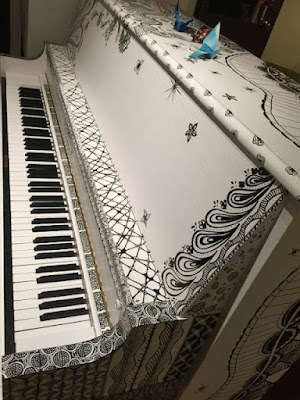

Zentangled Piano by Esther Piszczek
MP: I’m endlessly fascinated by music’s ability to affect our TV‐ and movie‐viewing experience! The phrase that comes to my mind is the courtroom phrase, “leading the witness.” Music can lead us as viewers to pretty specific emotions and biases. I used to drive my kids crazy when they were young with my commentary while watching movies together. I was constantly pointing out things like, “Ooh, the creepy music just started when this person entered; they must be the ‘bad guy!’” 

Another factor of film music that is intriguing is the fact that sometimes the most skillfully composed scores are the ones that we don’t even notice. The score plays into the storyline and overall experience so skillfully and seamlessly that we’re not consciously aware of the music as it’s playing. And you can have equally skillful and outstanding scores that are epic and totally do capture your attention (such as John Williams’ Star Wars scores). 


I suppose this fascination is one reason that several episodes explore facets of music in movies/TV! 


By the way, your reference to “Somewhere Over the Rainbow” reminds me of one of my all‐ time favorite music quotes, which is by that song’s composer, Yip Harburg: 

"Words make you think a thought. Music makes you feel a feeling. A song makes you feel a thought." 


EN: I like how you discuss practical things like how to find a piano teacher, but also get into neuroscience and the ways music shape us, inspire us, lift and even heal us. Do you have a set of guiding rules regarding what you cover and don’t cover on your Enhance Life With Music blog? Can you share them?


MP: In addition to making life better through music, I look for subjects that:

--Educate me.  

--Expand my world.

--Inspire me.

--Help me.

--Entertain me.

The more boxes I can check with an episode, the better!

EN: Thanks for everything you're doing. I have no ideas where we'd be if it weren't for music, especially this past two years.

Check out Mindy Peterson's podcast here: Enhance Life with Music 
www.mpetersonmusic.com  

Related Links
Music of Our Lives: Songs That Make Me Think of Various People I've Known
My Early Introduction to Classical Music... And My Father's
Oli Braithwaite of Stars & Catz on the Power of Music 
Episode 118: Bob Dylan Case Study on the Power of Music to Change the World 
Quiet Heart Comfort: Music CDs and Videos

Friday, March 26, 2021

My Early Introduction to Classical Music... and My Father's

When I was growing up in Cleveland, my father built a console of blonde wood for his record player. Inside he kept a modest collection of primarily classical music. On Sunday mornings Mom would take us to church while Dad listened to his classical records and read the Sunday paper at home. Albums with titles like Echoes of Offenbach and Scheherazade intrigued me. Beethoven’s Fifth became a favorite of mine then. Beethoven’s indelible sense of the dramatic is evident in both the opening and the climax, stirring the blood in little boys like myself. 

This early introduction to classical music gave me a lifelong appreciation for the genre. I’m no expert, just one who appreciates the form. One of my father’s favorites was Dvorak’s Ninth Symphony, better known as the New World Symphony, which I’m listening to now as I write these reflections.


If you knew my father’s life story you might be surprised at how he came to appreciate the classical greats. He grew up exceedingly poor. Six children slept in the living room of a three-room house with no bathroom and perhaps no running water. When my dad was born Grandpa was working in a coal mine, on the run from feds who’d come to bust him for moonshining during prohibition. Grandma taught Grandpa how to read so he could fill out a job application when they moved to Southwest Ohio.


The day my father graduated high school he joined the army. Upon completing his tour of duty, he attended Hiram College on the G.I. Bill where he met my mother. When Dad and Mom eloped, they moved to Little Italy in Cleveland, renting a second-floor apartment on Murray Hill Road where Mom could walk to the hospital to work and finish nurses training. 


“I never had to work nights or evenings while in school, so I could usher in Severance Hall, where the world-famous George Szell was conductor,” my mother recently told me. The Hungarian-born conductor and composer came to Cleveland after World War II to take charge of the respected but undersized orchestra there. During his 24 years as music director, Szell brought the Cleveland Orchestra international recognition and acclaim.


“The first year I ushered on Thursday nights. We wore burnt orange uniforms,” my Mom said. “The next year we wore white blouses with black skirts.” 


One of the perks of the job was that my dad was permitted to attend performances if there were empty seats, which there almost always were. “That is where he got his love for classical music,” Mom added. “Dad had classical records even then. I was only a volunteer, but we both got to hear wonderful music for free.” I can imagine him being transported by the music, much like Harry Haller in Herman Hesse’s Steppenwolf, or Joseph Knecht in The Glass Bead Game.

* * * 

Here's the incredible finale to Beethoven Symphony no. 5  
George Szell conducting the Cleveland Symphony Orchestra

Fantastico! 

BONUS TRACK
Szell and Cleveland LIVE: Beethoven symphony no. 3 in E flat (Eroica)
https://www.youtube.com/watch?v=VGjF5mWYnHo

This live performance of Beethoven's symphony no. 3 took place three days after the shooting at Kent State in the spring of 1970. Before beginning the performance, George Szell asks the audience to stand for a moment of silence to honor the victims of the shooting. 

As is the case with many YouTube videos, there are comments. This one stood out as a nice postscript for this blog post:

"Incomparable! Along with the Sibelius 2nd recorded live in Tokyo, THIS EROICA is a testament to the greatness of George Szell. Among the small pantheon of musician conductors Szell is at the summit!" --Ian Harper

 * * * 

Related Links
10 Classical Music Favorites of Exquisite Beauty
Oli Braithwaite of Stars & Catz on the Power of Music

Saturday, February 27, 2021

Oli Braithwaite of Stars & Catz on the Power of Music

Oli Braithwaite, founder Stars & Catz
If you ever need scientific ammunition to lend support to your conviction that music has power to improve peoples' lives, look no further. Oli Braithwaite, founder of Stars & Catz, has assembled more than 200 research papers on the power of music to bring hope and healing. Listening to music and learning to play an instrument have many other benefits. Music improves our mood, improves our memory, reduces anxiety, distracts us from pain, lowers blood pressure, and much, much more. 

Earlier this month Oli Braithwaite, after stumbling upon my interview with Henry Wiens about the power of music to heal and give hope, reached out to ask if I might put a link from that page to his web page featuring the aforementioned research papers. When I saw the page I wanted to do more than a link. An interview with Braithwaite seemed in order. 

Stars & Catz is much more than a repository for music research. In fact, that's just a side alley. Connecting students and teachers is a bigger part of his vision. When all has been boiled down to its essence, the message is clear. Music ought to be part of all our lives, for the sake of our mental, physical and spiritual health.

EN: You are something of an evangelist for the power of music. How did this come about for you?


Oli Braithwaite: As a musician, music teacher and then the author of the articles on Stars & Catz, I have always found music to be a powerful and essential part of life and an end in itself. But what came to my attention as I researched and wrote on ever widening music topics is that the scientific community is publishing a steady stream of studies supporting various benefits of music beyond the experience of the art itself, and that these benefits are significant.

Since I’m also interested in the mind and the human condition in general, I was naturally curious about these additional benefits. When I tried to find a single, central place that summarized and categorized all (or at least many) of the most important music related studies, it became clear that no such page existed on the internet. I knew the value that such a page would have for the wider music education community, teachers and students, so I undertook to put it together and publish it on Stars & Catz. That’s how our page on the benefits of music and music education, with over 200 studies, came into being.


EN: When did you begin Stars & Catz, and what is the story behind the name?


OB: The name is a bit weird, right? We wanted something a bit different because there are so many generic names around. How it came about was that we originally started in 2010 with only two instruments, guitar and piano. So students had the opportunity to become a ‘guitar star’ or a jazzy ‘piano cat’, hence Stars & Catz. When we expanded beyond those two instruments, we decided that being a star or a jazzy cat still applied, so we kept it.


EN: How does Stars & Catz fulfill its mission to help people realize their music dreams?


OB: We achieve this with three core pillars:

1. A free suite of music tools including, for example, this online metronome

2. Our learning hub articles, mostly catering for beginners in various instruments and singing

3. A teacher matching service to find either a local or online music teacher


EN: What prompted you to begin assembling all these research reports on the impact of music?


OB: As mentioned above, I realized that a comprehensive collection was missing from the web and knew how valuable it would be for music teachers, students and just anyone writing about the benefits of music. I also knew we’d be able to do justice to it, so we rolled up our sleeves and set aside the time (many weeks) needed to do the job properly. We also intend to update the page annually, if there’s enough interest in it.


EN: The list of benefits from music is impressive. What are the most surprising to people?


OB: Great question. The general reaction to the page as a whole is ‘wow’ and then people tend to

comment on the sheer weight of evidence and the wide range of benefits derived from listening or playing music. Most people, aside from music teachers, simply aren’t aware of the power of music on the human mind and body. I don’t tend to get specific feedback on which benefit was most surprising though. For me, it was definitely music’s ability to boost the immune system that was most surprising.


EN: Anything else you would like to add?


OB: If anything is clear from the body of scientific work on the benefits of music, it’s that it really doesn’t matter what age you are, learning a musical instrument or singing is a wonderful and potentially very beneficial thing to undertake on many levels.


* * *

Key Links

About Stars & Catz

The Benefits of Music & Music Education (200+ Studies)
242 Music Quotes to Share & Inspire

Quiet Heart Comfort  

Armory Arts & Music Center


Copyright 2021 Stars & Catz PTY LTD 

Tuesday, October 30, 2018

Can We Talk About Beauty for a Minute? 10 Pieces of Classical Music That Can Lift You Higher

Photo courtesy John Heino Photography
"Where words fail, music speaks." --Hans Christian Anderson

Beauty. It transports us. It inspires us. 
It takes our breath away... when we let it.
It captures us... when we yield to it.

Harry Haller in Herman Hesse's Steppenwolf was a troubled man who felt himself a misfit, ill-suited for the world of everyday, regular people. The one place where he felt a deliverance from this discomfort was at the concert hall where he found himself lifted, by beauty, beyond the cares of this world. Music served as a form of salvation.

I've known the feeling, the power of music. Like Harry Haller, the sweet strains of anguished beauty have also transported me, at times, enabled me to forget the cares of this world.

For this reason I offer you here some of the music I've found comforting, soul-soothing, uplifting, nourishing. The links will take you to YouTube videos that you may enjoy as time permits in this harried age in which we live.

* * * *

1. Air on the G-String, Johannes Bach
This YouTube video has had over 50 million views, a tribute to the enduring legacy of Johannes Bach. This is not my favorite version, however. The version that most transports me is a solo piano version played by Henry Wiens. His CD Quiet Classics can be found on CD Baby. Hear a brief sample here.

2. Prelude in E Minor, Op. 28, No. 4, by Chopin
When I heard this piece of music in the film Five Easy Pieces it spoke to me, as did all things Chopin. French novelist George Sand once wrote that she considered the beauty of Chopin's music to be evidence that there was a God. I took two and a half years of piano lessons and learned a number of simplified versions of his music when I was young. When I saw the film again in the 90s I bought the sheet music and worked at learning it. The chord progressions are marvelous, the lingering pace that makes you ache... words fail again.

3. On Earth As It Is In Heaven, by Ennio Morricone
This is a live performance of the Theme from The Mission. It elevates me like almost nothing else.

4. Adagio opus 11, by Samuel Barber
This piece of music served as a thread that wove its way through Oliver Stone's tragic Platoon. It is also effective in the very sad story of John Merrick, the Elephant Man (Anthony Hopkins, John Hurt). A powerful film about what it means to be human.

5. Clarinet Concerto In A Major K 622 Adagio, by Mozart
It is remarkable how much this young man achieved in the course of such a short life. How did he do it?

6. Ballade No. 1 in G minor, by Chopin

7. Sonata for Piano No. 8 in C minor, Op. 13, Pathetique, Adagio, by Beethoven

8. Elvira Madigan, by Mozart

9. Beethoven's Seventh Symphony, Second Movement

10. Erik Satie's Once Upon A Time In Paris
This opens with such poignant lilting delicacy... How was it conceived? It moistens eyes and causes one bow the head.

* * * *

Related Links
Healing the Hurting Through Music
Quiet Heart Music

Meantime life goes on all around you. Listen to the music.

Tuesday, March 6, 2018

Henry Wiens Talks About the Power of Music as an Agent of Healing and Hope

I've always liked good titles, whether of films, music, art or poems. One of my favorite book titles is Jacques Ellul's Hope in Time of Abandonment. Ellul argues that hope is one of the great needs of our time.

That kernel of thought was the first thing that came to mind when I heard about an event that Yamaha recording artist Henry Wiens was going to be part of titled Restoring Hope: Community Healing Service. In 2003 the career pianist consciously began directing his music toward people suffering from grief, stress or chronic pain. He had learned the power of music to comfort and heal.

EN: You said you and a trombone player were doing a special program or service for someone who died as a result of gun violence. Can you share a little about the event and how it came about? 

Henry Wiens: Several churches are coming together for a Community Healing Service to support victims of trauma. Folks will have an opportunity to express their grief in a worship setting and to experience healing through music and words spoken. There will be activities for adults and kids. Refreshments and resources will be available after the service.

An African-American woman in our community experienced trauma when her teen-age son was shot and injured to the point of permanent disability. She started a non-profit organization and asked if our church would host an event involving several other African-American churches on the north side of Pittsburgh.

Our pastor took a lead role and I volunteered to organize music for the event. Part of this has involved my composing a "blues lament" for piano, trombone and percussion based on 2 spirituals. A photographer friend is creating a slide show based on the recording I provided. So this "lament" will also have a visual dimension.

The service will continue with the presentation of ashes, similar to Ash Wednesday, and a candle-lighting time of remembrance for victims of urban violence. Readings, scripture and communion will follow.

EN: When and how did you first realize the power of music as an agent of healing?

HW: I think our mutual friend (Dr.) Dwenda Gjerdingden was one of the first people to bring this to my attention at Bethel Temple. She told me after a church service that a solo I played had a powerful, emotionally healing effect.

The Quiet Heart Story video includes several stories that heightened my awareness, leading to the formation of Quiet Heart Music.

EN: What is the mission of Quiet Heart Music?

HW: To honor the memory of loved ones' lives with personalized gifts of music and to comfort family members. When given by nursing homes, these gifts also provide a lasting reminder of the faithful, loving care provided by their staff and volunteers. But no matter who does the giving - individuals, churches, businesses, etc. - music is uniquely capable of expressing the transcendent beauty of a human life. Personalized CDs exist to honor the completion of life's journey. Many choose the following message for the accompanying card: "Loved ones' lives are like a song, every note rare and precious. We feel blest to have heard the music and shared in their life."

EN: Can you tell us about your new website and what you are trying to achieve?

HW: Although I was very pleased with the lovely graphics on my old site, it looked cluttered on a mobile device. In the process of de-cluttering the site, it became simple, clean and more user friendly on all platforms. My hope is that a broad spectrum of people will discover this meaningful, inexpensive alternative to sending flowers to their friends, co-workers and employees who have lost loved ones. I know this will happen if people visit the site, listen to the music and read testimonials like this: "I was so pleased to find your web site that enabled me to give something meaningful. Flowers are beautiful, but last only days. Music lives on like the spirit & gives peace to the soul."

EN: There are quite a few advocates for music therapy. Do you have connections with any of these people?

HW: The "Music and Memory Program" has probably gotten the most attention and it’s well deserved. Their moving documentary “Alive Inside” has had a huge impact on the long term care community. But no, I'm not personally connected in any way.

EN: Have you followed the research in this area in recent years? It seems that science is verifying what you have known intuitively all along. What are the biggest things you have heard or learned these past five years?

HW: Regarding research, the music itself is central & essential to this program's impact. Many thousands of gift recipients have listened to these CDs and have been comforted and encouraged during a difficult time in their lives. Current research supports the extensive anecdotal feedback I have received since 2003. Consider this excerpt from"Treatment of bereavement through music therapy":

"Both qualitative and quantitative studies have been completed and both have provided evidence to support music therapy in the use of bereavement treatment. One study that evaluated a number of treatment approaches found that only music therapy had significant positive outcomes where the others showed little improvement in participants." --Rosner, Kruse & Hagl, 2010


EN: Has the decline in popularity of CDs affected the relevance of your program?

HW: Although that decline is undeniable, they’re still selling well over a hundred million per year. “CDs are far from dead, and I don’t believe they will be any time soon,” said Zack Zarrillo of Synergy Artist MGMT and Bad Timing Records. Mainstream CD buyers LIKE the familiarity of the CD and value physical ownership.

 That said, I’m also attempting to bridge the generational digital divide.

Free Download Cards are included with each CD so that gift recipients to share a digital copy of their gift of music with other friends and loved ones. Many recipients, regardless of age, have younger relatives who will appreciate this feature, so it's a way to multiply the effect of your gift of music. The iTunes value of each CD download is $9.95.

My music is also available via iTunes, Amazon, Apple Music, Spotify, etc. It’s exciting to see detailed sales reports each month that reflect listeners from around the globe.

Spotify or Apple Music: You can use apps to stream my music in your facility for the benefit of residents receiving palliative care or to calm others who are agitated. You can also download MP3s on Amazon or iTunes.

* * * *
For more, visit and bookmark the Quiet Heart Music website.

RELATED LINKS
200+ Studies on the Benefits of Music and Music Education

Tuesday, September 17, 2013

Quiet Heart Music Celebrates Ten Years In Business

Yesterday on the radio I heard an interview with someone who made music for people with Alzheimers or in their declining years. The interviewee made some interesting statements about the healing power of music, but his approach was different from what I usually read in one particular way. He said that he was in the business of creating music that had no attachments to memories of earlier years. That is, it was all original with no connection to memories, though still designed to comfort.

Because of my longtime friendship with Yamaha Recording Artist Henry Wiens, I wasn’t sure how to take this. In  my 2007 interview with Henry I asked why music has such power to reach so deeply into peoples’ hearts. He replied:

Music is like beauty for the ears and mind. The answer to why people are moved by beauty is rooted in what it means to be human. For me, creating and listening to music is linked to expressing love for everything that is beautiful about life. As a listener, I respond to what I "read between the lines"; as a composer-performer, I try to express that love & beauty to others. Any power that music may have to touch others is rooted in the authenticity and depth of the artist's expression.

As people experience music throughout their lives, they build up associations with that music which reinforce each other. Hearing a familiar melody will bring past experiences to life. For example, hearing a song that you danced to when you were 18 and in love will probably elicit some of those good feelings even decades later. Hearing a song that was sung in church while you were held on your mother's lap may bring comfort the rest of your life.

Joan Baez
It may be that the person I heard on the radio is right in some instances, but I’m going to imagine that when we Baby Boomers are in nursing homes or hospice care we’re more likely to be transported to fond memories and beautiful landscapes when we hear "Bridge Over Troubled Water" or "Jesu, Joy of Man's Desiring" than when we hear something unfamiliar. Maybe I’m wrong but I’m guessing that three decades from now our souls will continue to resonate with Bach, the Beatles and "Wind Beneath My Wings."

Ten years ago Henry started a business called Quiet Heart Music based on the widespread response to his CDs as a source of comfort. His primary customers were nursing homes, hospice and funeral homes that purchased personalized CDs, but he’s not averse to individuals purchasing his music. This week he gave his website a facelift and if you’re in need of comfort or a quiet background as you write or draw, I can attest that Henry’s music offers a soothing accompaniment to nearly any activity.

There 's another feature of this kind of "comfort music" that's worth noting. According to many sources the music is not only like a soul-balm for the dying or grieving, but for the caregiver as well. Sherri Snelling's post in this Alheimer's Association blog is titled Music as Therapy: A Five-Note Plan For Caregiver Calm. Snelling explains, "Music as therapy is not just for your loved one. We know caregivers encounter increased stress over caring for a loved one — in fact caregivers who reported their health was impacted by caring for a loved one cite stress as their No. 1 challenge." She goes on to note that our reaction to music is actually physiological in that listening to music releases the hormone melatonin which reduces aggression and depression and can help us sleep.

No wonder we feel so good when we're listening to the music. Let's dance!

Centerville All Stars

Popular Posts