Showing posts with label piano. Show all posts

Tuesday, October 29, 2024

A Night to Remember: Cookin' at the O' with Danish Jazz Sensation Sinne Eeg

Tucked away on the North edge of Carlton, the Oldenburg House offers a truly intimate and unforgettable jazz experience. On select evenings, the historic home transforms into a jazz lover's haven with its signature event series, "Cookin' at the O'"


These past two weekends the Oldenburg House welcomed Sinne Eeg, a Danish jazz vocalist whose voice carries a warmth and sophistication that can only be described as mesmerizing. Eeg’s performance perfectly captured the essence of the evening, drawing in the audience with her velvety tones and effortless range. Whether she was delivering a soulful ballad or an up-tempo swing, her passion for jazz radiated through every note.


The evening wasn’t just about the music, though. Chef Paul Sapyta* crafted a meal that was as much an experience as the jazz itself. Each course seemed to flow in harmony with the music, offering a feast for the senses. The combination of expertly prepared dishes and Eeg’s stunning vocals made for a perfect night—one where you could sit back, relax, and let the world outside fade away.


Of course nothing brings out the best in a singer like a world class backup band. This past Saturday Billy Peterson was back on bass, young Juilliard virtuoso Will Kjeer on piano and veteran Glenn Swanson on drums.


The historic Oldenburg House is Emily Fuerste and Glenn Swanson's gift to the community, playing host to an assortment of music and arts events. It's also a Bed and Breakfast. Their motto, "Find Your Nature," says much about this hidden pocket of paradise that abutts Jay Cooke State Park in the back and is walking distance to Thompson Dam.


If you haven’t had the chance to attend Cookin' at the O', it’s the kind of event that leaves a lasting impression. The Oldenburg House isn’t just a venue; it’s a place where music, food, and atmosphere come together to create something magical. And if you’re lucky enough to catch an artist like Sinne Eeg, well, it’s an experience you won’t soon forget.


"Nothing ever seems to glow

Like the beauty of sadness"
--Sinne Eeg


According to Wikipedia, Eeg has won the Danish Music Awards prize in the category Best Danish Vocal Jazz Album of the Year four times: in 2007, 2010, 2014 and 2015, for her albums Waiting for Dawn, Don't Be So Blue, Face the Music, and Eeg - Fonnesbæk. She also received the Ben Webster Prize in 2014. The Webster Foundation describes her as "a true jazz singer, who both shows sensitivity, improvisational skills, maturity, broad range and timing in her singing."


Here's another laudatory salute: The Danish songstress is versatile, equally comfortable fronting big orchestras in concert halls as well as smaller ensembles in intimate jazz clubs. Everywhere she sings – Tokyo, Copenhagen, Los Angeles or Madrid – audiences are mesmerized by her incandescent phrasing and scatting, all with natural, perfect pitch.  After putting in her time for years on the road, performing at small clubs and cafes, Sinne won her first Danish Music Award for her album “Waiting For Dawn” in 2007.

A brief summary of Saturday's set list. What a night. 

Opening Set
    (lyrics by Sinne Eeg)
Bridges    (Brazilian song)
Button Up for Me    (Gershwin Bros.)
The Barista
Walt Fidetti tune by Bill Evans, intimate upscale.
Cry Me A River (A bitter love song)
I Am An Evil Girl

After Dinner Second Set
James Bond music
    From Russia wit Love
    You Only Live Twice
Waiting for Danny
Better Than Anything. (blues waltz)
Samba
    A song about community for all, whoever you on.
    Turn your radio on.
Song created by Will, "All Is Sunset"
    Erik Satie vibe
I'm Talking To Myself    (Danish song)

Related Links

Cookin' @ the O -- My Visit with Pippi Ardennia


*Paul Sapyta is chef for the Cloquet forestry center and runs a catering business and food truck, Room at the Table, from there. 

Tuesday, January 16, 2024

Unspeakable Beauty: Chopin

Photo taken in the year that he died.
What can I say? I was in love with Chopin's music from the first time my piano teacher introduced me to a Chopin Polonaise when I was eight. It was a simplified version, no doubt, as I was but a beginner on the piano. But my appreciation for Chopin's music has never wavered. 

Here are a dozen or more quotes about his music with some links at the end.

"Chopin wrote poetry that only a soul could hold."

-- George Sand


"Each of Chopin’s compositions is a conversation between two souls; one never perceives a distinction between a soloist and an accompanying instrument."
-- Robert Schumann


"Chopin's work is one of the peaks in the development of piano music. You could say he was a prophet of the piano. He was different from the people of his time. He created a new epoch."
-- Vladimir Horowitz


"Chopin was a kind of creator who valued ideas and emotions more than anything. He was always eager to provide unexpected harmonies."
-- Ignacy Jan Paderewski


"Chopin is the border between romanticism and modernism."
-- Artur Rubinstein


"Chopin spoke in his music directly to the hearts of the people. His music is direct, spontaneous and clear."
-- Arthur Honegger


"Chopin's music resembles a universe. It is self-contained, it is perfect, it is complete."
-- Leopold Godowsky


"Chopin has written some waltzes that are actually love letters." 

-- Wilfrid Mellers


"Chopin is the only soul who has revealed the genius of that instrument."
-- Franz Liszt


"Chopin is the greatest of them all – he reached the highest point of enlightenment and I have the feeling he is speaking directly to me with each piece."
-- Pyotr Ilyich Tchaikovsky


"His creation was spontaneous, miraculous. He found it without searching for it, without foreseeing it. It came to his piano suddenly, complete, sublime, or it sang in his head during a walk, and he would hasten to hear it again by, tossing it off on his instrument. But then would begin the most heartbreaking labor I have ever witnessed. He would spend six weeks on one page, only to end up writing it just as he had traced it in his first outpouring."
--George Sand


"After playing Chopin, I feel as if I had been weeping over sins that I had never committed, and mourning over tragedies that were not my own."
--Oscar Wilde

       * * * 

      FrĂ©dĂ©ric François Chopin (born Fryderyk Franciszek Chopin; (1 March 1810 – 17 October 1849) was a Polish composer and virtuoso pianist of the Romantic period, who wrote primarily for solo piano. He has maintained worldwide renown as a leading musician of his era, one whose "poetic genius was based on a professional technique that was without equal in his generation" --Wikipedia

      "The most vigorous applause seemed not to suffice to our enthusiasm in the presence of this talented musician, who revealed a new phase of poetic sentiment combined with such happy innovation in the form of his art."--Franz Liszt

      * * * 

      You may remember this from The Truman Show, where Truman first meets Lauren, the girl who captures his heart.


      Simplicity is the final achievement. After one has played a vast quantity of notes and more notes, it is simplicity that emerges as the crowning reward of art.
      --FrĂ©dĂ©ric Chopin

      TW0 MORE FAVORITES

      ETUDE  Opus 10 No. 3

      PRELUDE  Opus 28 No. 4

      Monday, January 31, 2022

      The Music of Our Lives: A Visit with Podcast Host Mindy Peterson on the Power of Music

      Mindy Peterson has been hosting the Enhance Life Through Music podcast about music since 2019 and a piano teacher since 1991 to students ages kindergarten to

      adult. She began taking piano lessons at the age of 6. Like many who had an early intro to playing an instrument, music has been an integral part of her life ever since. She not only enjoys listening to live music and expressing herself through music, her podcast shows how interested she is in learning more about the benefits of music, and passing on that love of music to her students and others.  

      This past fall Mindy visited Duluth to learn more about the influence our city and the Northland had on Minnesota's latest Nobel Prize recipient. This visit became the foundation for a December podcast on the impact of Bob Dylan and his music


      EN: Can you briefly share your background with regards to music? What you have created here— your podcast‐‐clearly didn’t spring out of thin air.

      Mindy Peterson: I started taking piano lessons in first grade, and have taught piano lessons since 1991. I’ve always been intrigued by the many ways music benefits our lives, and was fascinated with news articles, books, and studies showing music’s power in protecting the brain from dementia; transforming our experience of a movie scene; increasing athletic endurance; increasing literacy skills in children with dyslexia; and more. I believe passionately in the power of music to enhance our lives, and wanted to shout it from the rooftops in order to help others make life better through music, and also to advocate for musicians and music education. Music advocacy and education are two sides of the same coin; and when people understand the value that music brings to our shared human journey, I believe they will want to invest in musical experiences and training. 


      EN: Music is probably something important to most of our lives. What was it that triggered you to start a podcast about music?

      MP: You’re so right – music affects ALL of our lives, whether we consider ourselves musicians, or not! While there are exponential benefits for those who actively make music, I was struck by how music can make life better in so many ways for all. I observed how frequently my non‐ musician friends made casual comments referencing music, such as: 


         “I heard this song in a store the other day, and it instantly took me back to senior prom!” (Music is the sound of emotions, and one of the last memories to fade from our brains.) 


         “After waiting on hold, I could NOT get that hold music out of my head the rest of the day!” (Earworm!) 


         “Thank goodness ‘Don’t Stop Believin’ was playing – that’s the only way I made it through the last set of that workout.” (Music has been called “legal doping” because it can enhance athletic performance and endurance up to 15%.) 


      When I first discovered podcasts, I was hooked! As I explored shows and found new favorites, it occurred to me that podcasting was the perfect medium for showcasing the myriad applications of the power of music. Surely such a podcast must exist! I went on the hunt for a podcast fitting this description, but couldn’t find it. Enhance Life with Music was my creation of the podcast I wanted and couldn’t find. 


      EN: You cover such a wide variety of topics showing ways that music is such an important component of our lives. What have been some of the biggest insights for you personally? 


      MP: It is such a treat to meet and speak with people from around the country and globe about music’s application in fields as seemingly disparate as sports, social justice, science, business, medicine, mental health, entertainment, education, and history. I’m continually amazed by two things: 


      Music’s ability to bring people together. It is one of very few things (food possibly being another?) that can lower walls and bond people who otherwise may have nothing in common – and in fact may have reason to see one another as enemies (such as the Israeli and Palestinian youth featured in Ep. 123).


      The endless applications of the power of music. One of my hesitations in starting this 
      podcast in August 2019 was the apprehension that I might run out of topics. I didn’t want to launch a podcast, only to have the well of ideas run dry within a few months. Well... over two years and 120 episodes later, the list of potential topics continues to grow. Music is the salt of life – it just makes every aspect of life better! 


      EN: I think the way Hollywood directors use music to add dimensions to films is intriguing. Stanley Kubrick’s films are a superb example. So many classic films give us songs or tunes as a takeaway. “Ding dong, the witch is dead!” What an anthem. I read that “Somewhere Over the Rainbow” was the number one song of the 20th century. Care to comment on this? 
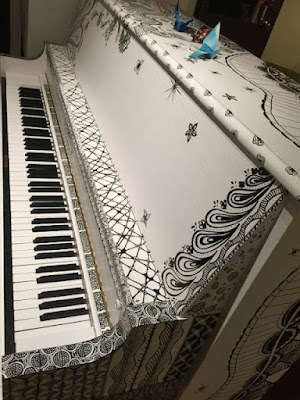

      Zentangled Piano by Esther Piszczek
      MP: I’m endlessly fascinated by music’s ability to affect our TV‐ and movie‐viewing experience! The phrase that comes to my mind is the courtroom phrase, “leading the witness.” Music can lead us as viewers to pretty specific emotions and biases. I used to drive my kids crazy when they were young with my commentary while watching movies together. I was constantly pointing out things like, “Ooh, the creepy music just started when this person entered; they must be the ‘bad guy!’” 

      Another factor of film music that is intriguing is the fact that sometimes the most skillfully composed scores are the ones that we don’t even notice. The score plays into the storyline and overall experience so skillfully and seamlessly that we’re not consciously aware of the music as it’s playing. And you can have equally skillful and outstanding scores that are epic and totally do capture your attention (such as John Williams’ Star Wars scores). 


      I suppose this fascination is one reason that several episodes explore facets of music in movies/TV! 


      By the way, your reference to “Somewhere Over the Rainbow” reminds me of one of my all‐ time favorite music quotes, which is by that song’s composer, Yip Harburg: 

      "Words make you think a thought. Music makes you feel a feeling. A song makes you feel a thought." 


      EN: I like how you discuss practical things like how to find a piano teacher, but also get into neuroscience and the ways music shape us, inspire us, lift and even heal us. Do you have a set of guiding rules regarding what you cover and don’t cover on your Enhance Life With Music blog? Can you share them?


      MP: In addition to making life better through music, I look for subjects that:

      --Educate me.  

      --Expand my world.

      --Inspire me.

      --Help me.

      --Entertain me.

      The more boxes I can check with an episode, the better!

      EN: Thanks for everything you're doing. I have no ideas where we'd be if it weren't for music, especially this past two years.

      Check out Mindy Peterson's podcast here: Enhance Life with Music 
      www.mpetersonmusic.com  

      Related Links
      Music of Our Lives: Songs That Make Me Think of Various People I've Known
      My Early Introduction to Classical Music... And My Father's
      Oli Braithwaite of Stars & Catz on the Power of Music 
      Episode 118: Bob Dylan Case Study on the Power of Music to Change the World 
      Quiet Heart Comfort: Music CDs and Videos

      Tuesday, November 9, 2021

      How to Buy a Used Piano and What is a Good Age to Start Piano Lessons?

      "Practice makes perfect." 

      Nowhere is this adage drummed into little heads with such metronomic regularity as with piano playing. And it's true: If you have dreams of little Kim soloing with the Boston Symphony when she grows up, or even playing a few simple tunes for Grandpa the next time he visits, she's going to need more than a weekly piano less. She's going to need a piano at home so she can practice every day.

      So begins the article I co-authored with piano tuner and friend Ed Beaver that appeared in the January issue of Parenting Magazine in 1992. The title of the piece was Pianos: A Sound Investment. Our aim was to share insights regarding how to buy a used piano so you don't get stuck with a 900-pound lemon. Here'a a little backstory on how that article came to be.

      Esther Piszczek's Zentangled Piano
      And here are some tips I learned from my friend Ed and shared with readers. 

      1. Stand back and look at the keyboard. Are the keys level and all the same height? Do they wobble from side to side? Are the ivories cracked and broken?

      2. Try out the piano. Do the keys feel loose a floppy? Do you hear any clicks, rattles or buzzes? Do you like the tune? Is the touch too heavy for a child? Play each keey four times rapidly to make sure none of the keys stick.

      3. Do the pedals work? Press down the "sustain" (right) pedal and run your fingers up and down the keyboard. Now let the pedal up. The sound should stop promptly.

      4. Check the hammers for wear. Deep string cuts in the felt cause poor tone; loose hammers tend to rattle annoyingly.

      Pianos are too big to be used as a door stop if you make a problem purchase. So choose wisely.

      * * * 

      A love of music is one of the greatest gifts we can give to our children. And there's no better way to make the introduction than the having music in the home. 

      * * * 

      A few months back I became aware of a podcast by Mindy Peterson, a Nationally Syndicated Music Teacher. I listened to a couple of her podcasts this week and thought this one should be paired with the article I wrote above. It's titled, "What is a Good Age to Start Piano Lessons?Check it out.

      Related Links

      Oli Braithwaite of Stars and Catz on the Power of Music

      Henry Wiens Talks About the Power of Music to Comfort and Heal

      Quiet Heart Music: CDs and Grief Videos

      Monday, April 22, 2013

      Eric Himy's Homage to Liszt

      “Art is Heaven on earth, to which one never appeals in vain when faced with the oppressions of this world.” ~ Franz Liszt

      I like surprises. Two weeks ago I discovered the Oldenburg House Bed & Breakfast. Located on the outskirts of Carlton it was the birthplace of Jay Cooke State Park. The Oldenburg House is listed on the National Register of Historic Places, bordering not only the park but also the Willard Munger State Trail, the National Kayak and Canoe Center and Thompson Reservoir.

      In addition to being tangent to a corner of North Country paradise, the Oldenburg House is also host to music and arts events, one of which is taking place May 9 when the world-renowned pianist Eric Himy performs here. Himy, who’s training from his youth is an amazing story in-and-of itself, has been compared to pianists as distinguished as Vladimer Horowitz. The “short list” of nations where he has played to critical acclaim include Canada, Argentina, Brazil, Bulgaria, Chile, Czech Republic, Egypt, France, Germany, Italy, Malta, Monaco, Morocco, Poland, Portugal, Russia, Spain, and Slovenia… and, of course, the United States where he was born to immigrant parents in New York.

      I’ll share a little more about Mr. Himy another time, but wanted to make sure you had a chance to put May 9 on your calendar because there are so many things happening in May with the inaugural North X North music and arts experience.

      I took lessons in classical piano when I was a boy, falling in love with the staggering beauty of Chopin (whom I am listening to as I write this) and Beethoven and Tschaikovski at that time. Any comparison, however, between Mr. Himy and myself stops there. In additino to having the wonderful privilege of being able to obtain rich musical experiences and training at an early age, Himy followed it through to some great experiences on both coasts and all the way to Juilliard. Among his earliest teachers was a 90-year old Madame Rosa who claimed to be a student of the man who is clearly his hero, Franz Liszt.

      This past week I asked Mr. Himy a few questions, one of which was to make a comment on each of several classic masters and what distinguishes them. Here were his replies.

      Chopin: His soul, poet of the piano.
      Beethoven: His defiance and will, triumph of the human spirit.
      Gershwin: Cool independent unique genius, American par excellence.
      Ravel: Craftsman, sensational piano writing and colors.
      Tschaikovski: All heart and passion.
      Rachmaninov: In the lineage of Liszt, pianist composer, thus knows how to write for piano, harmonies that overripe and wrenching.
      Liszt: The MASTER pianist…. the ROMANTIC, the DEVIL, the VIRTUSOSO…. has it all.
      Mozart: Music to get purged with after, such simplicity, honesty and purity.

      In addition to being an amazing pianist he’s also an insightful writer. The liner notes to his Homage To Liszt CD make for an excellent reading experience even if you are not a lover of classical music. The essay begins with a gripping opening.

      “To speak of Liszt is to speak of an immense force of nature. His music has been described as powerful, radical, enigmatic and spellbinding. With his music Liszt seems to have captured the very spirit, heart, soul and genuineness of humanity.”

      For an even more satisfying experience I encourage you to set aside May 9 for this memorable evening of music. The program will be hosted by Keith Swanson, conductor of the Itasca Symphony Orchestra with cellist Jeffrey Erband opening. Purchase your tickets online at  oacc.oldenburghouse.com


      Photo courtesy Eric Himy 

      Saturday, April 10, 2010

      How to Buy a Used Piano

      In 1992 I published an article on how to buy a used piano. It was actually co-written with former piano tuner and friend Ed Beaver, appearing in the January issue of Parenting magazine. I learned a lot about the freelance writing occupation through that experience. But first, a little background.

      When I was about eight (1960) the Coopers, a neighbor in Maple Heights, moved to a different part of town. I believe I was asked if I would like to take piano lessons and upon displaying a suitable level of enthusiasm for the idea my parents bought the Coopers' piano for five dollars, plus whatever it cost for the movers to roll it down to our basement three houses away.

      I took lessons for almost three years and have played ever since. It was a wonderful investment that paid dividends. So when my wife and I moved to Duluth in 1986 that fall my dad bought me another used piano for my birthday. We found it at a garage sale and this one was twenty dollars. Plus a $125 fee for the piano movers. Later, when we moved to the country, that piano cost $185 to move, plus tuning and new replacement ivories for some of the keys. At this point that twenty dollar piano had cost over five hundred green ones.

      It's a big old upright, one of those former player pianos without the works, and we painted it forest green. It sat in our living room from 1993 to 2006 when we were offered yet another upright piano (for free) and after my arm was twisted we paid to have it moved to the living room, and the first upright moved to the garage.

      All this is to say that I have some experience with used pianos. One evening, possibly over the grill, I was talking with Ed B. about the piano business and he shared some of his knowledge with me regarding pianos. I was impressed at how practical the information was that he shared, and I suggested we do an article together for a magazine like Parents. He was game and I proceeded to write a strong query letter.

      In the query I probably explained how a piano is not only a nice piece of furniture, it's a wonderful way to bring music into the home and the hearts of your children. I also noted that if you do not make a good purchase, you can have a 900-pound lemon in your living room that is not very easy to dispose of. Since a piano has more than 7500 parts, it really helps to know what you're doing when you buy. Our article would give useful, practical advice on this matter.

      So in January 1990 I sent queries to every magazine listed in Writer's Digest that might be interested in such and piece. And we waited.

      In November we received a reply. Parenting magazine wrote to say they were interested in seeing an article called How to Select a Piano for Your Children. We had pitched a feature of 1200 to 1800 words, but they wanted a 500 word condensed version for their Care & Feeding section. Whatever. It would be due December 14, 1990. No problem. This was a national publication and seemed a nice feather in the cap when it appeared in print. We signed the contract, agreeing we would be paid 25% if they did not like the piece in the end. Hmmm. $50. Better than nothing.

      The query promised a four week turnaround and we delivered. Then we waited again. In January the editor we were working with replied. She wanted us to revise the piece, incorporating information about the Piano Technician's Guild and another professional source. Alas, we were getting close. It wasn't an outright rejection. We quickly made the suggested modifications and posted the finished piece one more time. And we waited.

      Weeks, then months, went by. At the time I had a system for keeping track of queries out, rejections, submissions and all the details you're taught in writer's magazines to do if you're a serious freelancer. Every now and then I would notice that the article was still "out" but I had been trained to be patient. You're not supposed to call editors or pester them, we're told.

      Finally, in September the news came. Our article was accepted and would appear in the January issue of Parenting. The check for $200 was split between us, so we each received $100... not a lot of bread for a two year stint getting a piece published in a national magazine, fifty dollars a year each. And in January 1992 we received our complimentary copies with the story, "Pianos: A Sound Investment," on page 208.

      Trust me, there really is a need for writers, but don't believe all the hype you read in those writer mags about how easy it is to live your dream life as a freelancer. Most of the people you're competing with aren't needing the income, so the market is glutted with people (like Ed and I were) willing to work for a pittance.

      The byline was nice, though.

      In the meantime, if you were reading this in the hopes of finding help buying a used piano, here's one link that I found with a simple Google search with a few tips. I'm sure you'll find more.

      Thursday, May 7, 2009

      Last Night At Icehouse Studios

      "Without music life would be a mistake." ~Friedrich Wilhelm Nietzsche

      Last night after work I went to Icehouse Studios to make a little music with Elliot Silberman, a kindred spirit who is likewise an artist, musician and lifelong fan of Mr. Bob Dylan. Maybe one difference between us is that Elliot's made a living doing these things (kudos!), and this is what I do just because I can't help myself. Music really is best appreciated when you can be part of it. If I may quote Carlyle here, "All deep things are song. It seems somehow the very central essence of us, song; as if all the rest were but wrappages and hulls!"

      For part of the session last night we played a few Dylan tunes including Pressing On, The Man In Me and Three Angels, plus fragments from Boots of Spanish Leather, Went To See The Gypsy and Day of the Locusts, and chord progressions and the opening verse from Ballad of a Thin Man. The trigger event was the release of Bob Dylan's latest album, Together Through Life, and yet another Dylan photo on the cover of the Rolling Stone.

      At one point Elliot tried to give me a little lesson on how to play a Hohner button-box accordion. From what I've read, there's some button-box accordion on Dylan's new CD, giving some of the songs a Tex-Mex flavor. But most of the time, it was Elliot on guitar, myself on piano, a lot of crooning and some good vibes in the air.

      Just so you know, we have a few gigs approaching now. You might say I'm getting to be a pawn in his game, having had the privilege of performing with the band a few times. I sing harmonies, play blues harp, rattle some bones and shuffle a bit on the washboard.

      The big gig coming up fast is the annual Battle of the Jug Bands at Amazing Grace, downstairs in the DeWitt Seitz Building, Memorial Day Weekend. Put it on your calendars. You owe it to yourself to be there. If you like down home music, it's an event you won't want to miss.

      In the meantime, here are a few more quotes to about music to ponder and enjoy. And if you ever want to join us some evening, be sure to let us know. I think you'll be more than welcome.

      "A painter paints pictures on canvas. Musicians paint their pictures on silence." ~Leopold Stokowski

      "Music washes away from the soul the dust of everyday life." ~Berthold Auerbach

      "If the King loves music, it is well with the land." ~Mencius

      AS ALWAYS, IMAGES LOOK BEST WHEN YOU CLICK TO ENLARGE

      Monday, December 10, 2007

      Music Brings Comfort and Healing

      Music is one of the more fantastic gifts of God. It lifts the soul on wings to ethereal inner spaces. Nothing more effectively breaks life’s monotonous hold on us, transporting us to the portals of paradise. How do musicians and composers do it? From nothing & emptiness they bring forth combinations of sounds, melodies, themes, so pregnant with feeling it seems an inexplicable mystery. Rainbows of sound, trembling with life, causing our hearts to break open with rapture, or sweet sorrow. ~June 30, 1993

      Whether providing comfort for grief, inspiration for action, relief from stress, or alleviating pain, music pierces the core of our beings like nothing else. If you or someone you know is grieving a loss or going through hard things, you might find healing power in the music of Henry Wiens.

      According to one consultant who sent this testimonial: From a consultant: "Henry Wiens' soothing and relaxing improvisations on 'The Quiet Heart' have a unique way of quieting and speaking to one's soul. His sensitive and unique musical touch provides the listener an oasis of contemplation that leaves them refreshed and comforted."

      Popular Posts