Showing posts with label Bill Shipley. Show all posts

Monday, February 19, 2018

February Tweevenings: Bill Shipley Shares Stories About Art Collectors

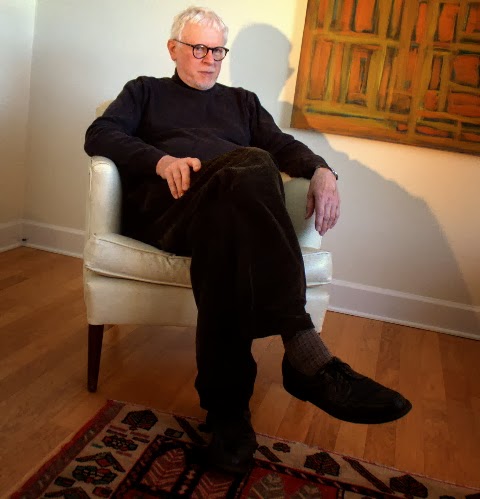
February's Tweevenings speaker was Bill Shipley, Tweed Museum docent and lifelong artist who spent most of his career in the Big Apple, occasionally rubbing shoulders with some of the most famous artists of the past fifty years. His topic had to do with collecting art.

After being introduced by museum director Ken Bloom, Shipley prefaced his remarks with a little background on how the Tweed Museum came about.

George P. Tweed and his wife Alice were themselves art collectors. For three decades they collected art until he died 1946. In the 1950s Mrs. Tweed opened her home on Sundays to share the collection with the community. Eventually she developed the funding to build the museum, which opened in 1958, making the collection more accessible still.

In its early years Bill Boice guided the museum and began adding to the collection. The Sax brothers purchased work and added still more. Over time others contributed and today the Tweed maintains an extensive body of work.

By means of storytelling Shipley introduced us to different kinds of collectors.


Four Kinds of Collectors

1. Eugene Victor Thaw

"Lincoln in Dalivision" -- Dali
Born in 1927, Eugene Victor Thaw died just last month. Thaw was a major collector and art dealer. Every museum in country has a portion of their collection that passed through this man's hands. His master drawings went to the Morgan. After meeting Lee Krasner he eventually became the man who wrote the catalog on Jackson Pollock.

Thaw collected bronzes, French ceramics and was a major force in collecting world. When Georgia O'Keefe died he went to Southwest to evaluate her work, but then began collecting Native American work. He was on cusp of everything that was happening.

Though he started with little money he managed to amass a fortune, then gave it all away to the Fenimore Museum.

Shipley noted, "You don't need a lot of money to be a collector." The three things necessary to be a collector, he said, are an Eye, Education and Experience.

2. Dorothy & Herbert Vogel

The Vogels bought minimalist art. Tiny things, small, portable. Tthey talked to artists and collected artists who were working small. (In contrast to the massive Motherwells at the MoMA.) They were so into collecting that they got rid of all their furniture so they could have more room for art. They lived like monks.

Herbert died in 2012. When he died, it took five moving trucks to carry it all away, donated to the National Gallery in D.C. This gift was a work of art in itself because of the way they amassed it and kept it. Bill noted that he got to know them through his late partner.

3. Judith Rothschild

"Cervantes" -- Etching by Salvador Dali
Nanette and Herbert Rothschild were her parents. They built an amazing collection of European works. When the parents died she inherited it.

She liked to hang paintings in her apartment without identifying the artists. Her collection included Mondrian, Milton Avery, Brancusi sculptures…

Judith got zoning for a large glass structure atop her building. She never advertised her collection. An artist, too, she had a studio above Carnegie Hall. Metropolitan wanted her collection so badly, they gave her a show of her own paintings, with a lavish dinner opening… the best champagne, and all the rest. They pulled out all the stops. But the next day the NYTimes called it a scandal.

Judith used some of her money to set up a foundation to help under-recognized artists.

4. Hudson Walker 

"Three Angels Entertained by Abraham"
Marc Chagall
Walker separated himself from his grandfather, and collected American modernists. He gave his work to the University Gallery, which later became the Weisman (U of MN).

Shipley told a story about a controversial event involving a large Motherwell in his collection. Katherine Ordway bought the Motherwell and hung in the Kirby Center at UMD. Evidently it was too modern for some peoples' 1957 tastes because the students protested and were not going to attend graduation unless the Motherwell was taken down. (Student protests evidently didn't begin with the Viet Nam War.)

Hudson Walker modeled his collection after the Frick Collection. The Walker fortune came from lumber industry. An interesting trivia bit: some of the Walker collection was left hanging in his home even after it became a rental home.

* * *

Art displayed on this page is from the Tweed show "Treasure From Home."

Do you collect art? There is plenty to go around. Enjoy it.

Monday, March 20, 2017

Talkin' Warhol With Tweed Docent Bill Shipley

Friday morning I took advantage of an invitation to visit with Bill Shipley, Tweed Museum docent who spent much of his adult life in New York art scene, ultimately returning to Duluth in 2004 after the passing of his partner Leslie Bohnenkamp.  Last weekend Mr. Shipley gave a gallery talk on Andy Warhol and the current Pop Art show now on display there, an event I was sorry to have missed. "I consider last week's lecture the best I ever did."

Mr. Shipley spent two months preparing, extracting stories from a range of sources including Death and Disaster: The Rise of the Warhol Empire and the Race for Andy's Millions. I'll share his "big three" insights in a minute.

The reason I'd come to visit was actually to see some of the art I'd heard he's collected over the years. Naturally one is first struck by the tidiness of his Park Point residence, something akin to a art gallery space. Next one immediately observes these sculptures by Bohnenkamp that look a bit like a cross between a cone and the horn of a longhorn steer. There are several of these and each gives the appearance of being substantial as if formed in bronze. Instead they are quite lightweight, hollow and made of paper.
Two Shipley paintings flanked by Bohnenkamp sculptures.
In addition to giving tours of the Tweed, Bill Shipley is himself a painter. Like many artists he go through seasons where a single theme maintains primacy over his subject matter. At this time he has been painting Mondrian's Amarylis flowers. Whereas most people are only familiar with Mondrian's colorful abstract squares, such as Broadway Boogie Woogie, that it may come as a surprise how fixated Mondrian on flowers.


When people speak of modern art they frequently have images like Duchamp's cubist Nude Descending A Staircase, and some of Picasso's later works. Perhaps Jackson Pollock comes to mind, and are thus confronted with the question of what really qualifies as art.

The irony is that just as the modernists proclaimed their freedom from rules that bind you as regards what is acceptable as art, the fine art power brokers made sure that their own rules got enforced. The purists considered what many craftspeople were doing to be craft and not art. The role Leslie Bohnenkamp played was to bridge the gulf between fiber arts and fine art. His sculptures are made of coiled, woven and spiraled fiber. When you look at photos of the 2004 Bohnenkamp show, you immediately notice the endless variety of shapes and forms.

After a brief tour we settled down to talk a bit about Warhol. I asked what the Big 3 takeaways were from his presentation. He identified the following.

Shipley's flowers.
1. My biggest discovery: how Warhol based almost all he did on photography.
Shipley noted an experience Warhol had with Richard Avedon, the celebrated fashion designer. He had been making a living as a commercial artist, but when he switched into "fine arts" he became a Brand.

2. The idea of portraiture.
Art historians can point to an abundance of portraits of the rich and famous through the centuries. In the 20th century this tradition seemed to have fallen out of favor. That is, until Andy Warhol brought value back to portraiture. Warhol did 50-100 portraits a year and was paid $25K apiece for them. The waiting list was long, but those with the cash recognized an investment that would produce returns...

3. Warhol's enduring influence.
Andy Warhol is considered by many to have been the most important artist of the second half of the 20th century. His importance can be measured by the market value of his works. His witty pronouncement about 15 minutes of fame is so ubiquitous it has become cliche.

Bill told me an anecdote about Andy Warhol's visit to the Tweed in 1970. He was doing a campus tour, giving lectures and keeping his celebrity status alive. (His films were doing the same thing, being shown on campuses around the country. I remember going to see a portion of his eight-hour film of the Empire State Building.) As it turns out,  people learned later that Warhol had sent an impersonator to do the campus tour lectures.

Much more was shared about his life, his near death experience when he was shot, and the 100,000 photos he left behind when he did finally pass.

Since I'd also come to see the art, here are a couple more photos I snapped.


Eric Dubnicka piece was Best in Show at DAI five years back. 
* * * *
Reminders:
Tuesday 4:00-6:00 p.m. is the opening reception for Nevada Littlewolf's Senior Art Exhibition at the Tweed Museum of Art on the campus of UMD. The title of the show is, THIS IS WHAT DEMOCRACY LOOKS LIKE. It promises to be most insightful.
Thursday 5:30 p.m. gallery talk at the DAI Morrison Gallery, 4th floor of the Depot. Ms. Kuth will talk about her show Rooted Expression.

Meantime, art goes on all around you. Engage it.

Tuesday, December 1, 2015

After 40 Years on the Road, Elliot Silberman Is Getting Off

When Elliot Silberman notified me that he is giving up life on the road, it was only natural to ask why. "Man-o-pause," he replied.

Seemed like a good way to introduce his new art exhibition at Beaner Central during the month of December. The opening reception for Duluth artist Elliot Silberman is slated forThursday Dec. 3, 6:00 p.m.—9:00 p.m. For the month of December Silberman will be showing a collection of 5-minute portraits from his travels to art and craft shows and Renaissance Festivals around America for the past four decades. At the opening he will doing live demonstrations.

Elliot's approach to portrait drawing is both educational and fun to watch. The exhibition features a cross-section of the public as seen through his eyes, from New York, Florida, Arizona, and the Midwest.

Silberman has many passions including fishing, making music and Dylan. Over the past 19 years he has been the Master of Ceremonies for the annual Battle of the Jug Bands at Amazing Grace each Memorial Day weekend.

Silberman began doing portrait drawings more than forty years ago here in Duluth. “There were no arts and crafts shows in the early 70's,” Silberman explained. “Sidewalk sales, Canal Park, West Duluth Days celebration, the Folk Festival – these were really the only ones. I don’t recall having much of a display. Just two chairs, and a small easel with one framed sample on it. I charged $1 back then, happy to get it. Never did make more than $30 a day at Canal Park.” Eventually he branched out by taking the skills he had been honing to the road.

“Why am I finally coming home and leaving this life on the road? Man-o-pause. A change in life,” he says. For the rest of the answer, you will have to ask him yourself Thursday, Dec. 3rd at Beaners Central, Coffeehouse and Gallery.

Can't make it to Thursday's opening? Visit his new website to see examples of his work. Or to simply get in touch.

* * * *

Tweevening Lecture Series Continues Tonight
Tonight at the Tweed Museum of Art Bill Shipley will talk about the work of the late New York sculptor Leslie Bohnenkamp (1943-1997) whose work in paper and fiber is part of the museum's permanent collection. Bill Shipley is an expert on the artist's work and history and also represents the artist's estate.

Friday at the Red Herring
There will be an opening reception for a three-person show featuring work by Ryan Lemahieu, Chris Monohan and Esther Piszczek. Details here.

Thursday at the Red Mug
Chris Monroe will be having another event at The Red Mug in Superior from 5-7 p.m. The show is titled Creatures Were Stirring. Sounds cool. Seems like everyone loves Chris's illustrations. Her books are fun.

Meantime, art goes on all around you. Check it out.

Wednesday, August 6, 2014

Yesterday, Today and Tomorrow.... Minnesota Arts Scene

Last night's Tweevenings was invigorating. I had been asked to speak about an artist whose works were represented in the Tweed Museum collection and I chose Picasso's etchings created to illustrate Honore de Balzac's The Unknown Masterpiece. The etchings were commissioned by Ambroise Vollard for the Centiennial edition of Balzac's story of three artists. The illustration here is my original "working outline" as I loosely captured my thoughts and created the stories for my presentation. You may see better if you click to enlarge.

Thank you to everyone who came out to hear. The next Tweevenings will be October 7 featuring ceramics and Broc Allen.

I was introduced last night by Bill Shipley, head docent of the Tweed, who will have some work at Gallery 13 in Minneapolis this weekend. The opening for "Remains of a Beautiful Nowhere" will be from 7 - 10 p.m.

Tonight in Maple Grove there will be another Salute to the Music of Bob Dylan, a free concert by an impressive set of musicians. The event will run from 6:30 - 9:30 p.m.  Can't make it? There will be a sequel in St. Louis Park on Saturday the ninth.

Central High by Marunowski
Thursday there will be an opening for Kenneth Marunowski's show at the Red Mug. Ken is a plein air painter who has really come on strong in recent years. I've been seeing his work in a whole variety of spaces and if you get the chance you should go out of your way to see what's on display at Red Mug this month, even if you can't make the opening.

Be sure to go upstairs to the North End Gallery to see the watercolor show there if you can arrange your schedule to be there when it's open during the day.

The 8th is Second Friday and the PROVE Gallery in Duluth is pumped to present a show that I have been looking forward to titled With Sirens Blaring. Prøve Collective member Kathleen Roberts has teamed up with a group of artists to bring her written pieces to life in a variety of formats. When Roberts first joined the Prove team I had a good instinct about it, as she brought literary features to the collective. Her PROOF Magazine was the first proof, and shows like With Sirens Blaring only add to the record. It looks like a great lineup of artists and musicians. Details here.

One more event to squeeze in here: Art in Bayfront Park will be coming soon. If you missed the Park Point Art Fair like I did for the first time in many years, this is a variation on the same theme, pulling together artists from all around for a weekend in the park. The setting can't be beat, especially when the weather's nice. The dates are August 16 and 17.

There's always more to see than there's time, but if you have an hour here or there, go explore.

Meantime, make the most of your day.

Monday, December 16, 2013

Talking Art with the Tweed's Bill Shipley

 Beginning the first Tuesday of October the Tweed Museum initiated a new program called Tweevenings in which guest speakers would discuss works from the Tweed collection and help the public gain a greater sense of art appreciation. Bill Shipley, who spent his career in the midst of the burgeoning New York arts scene from 1974 into the 21st century, was the presenter that first Tweed evening, discussing a sculptural aluminum relief by abstract artist Charles Biederman called “Redwing #29.” This was my first encounter with Mr. Shipley, and I’ve already concluded he is both a rich resource and welcome addition to our arts community.

EN: You had a friend who had a studio at a place where Hans Hoffman once had his studio. What was it like for a young Midwestern art student to be living in the heart of the New York art scene?

BS: When I think of moving from the Midwest to New York I remembered visiting the city many times before moving there. Once you live there however it is a very different place and you find that your neighborhood is a little like a small town within the scale of Manhattan. It was like that in the East Village and on Sullivan Street where I first lived. My next door neighbor was Marcia Tucker but I didn't know who she was until later when the New Museum got going. I had friends who worked for her in the early days.

St. Mark's Church in the Bowery was a vital part of the art and literary scene in those days. My apartment was almost across the street from it and when it burned badly we all mourned the loss. It was rebuilt but never quite the same after. And the neighborhood changed as New York University took over more blocks. Always though the artists led the way for the development and gentrification of the surrounding blocks and I would say that the biggest changes that I witnessed in the New York art world came from artists and galleries who were pioneers in SoHo and Lower Broadway and later in Chelsea.

EN: You had the privilege of being in the center of the New York art scene right after the Pop Art revolution had shattered all the rules. In what ways did the art world change over the thirty years you were there?

BS: In the 1970's and 1980's I could visit every single gallery in New York at least once in the art season. I would go to SoHo on Friday afternoons and then Madison Avenue and 57th street galleries on Saturdays. When I left the city in 2000 it would have been an impossible task. By then Chelsea alone had over 300 or more galleries. I also saw the development of what I call museum level galleries like Gagosian and Pace. Many dealers could open a gallery to represent small niches in the art market and find it profitable. Galleries devoted to just one part of the history of photography are a good example of this.

In Minneapolis, especially in the Northeast Minneapolis Arts District and the Northrup King Seed Building, similar things are happening now. In April I had my first show in a commercial gallery there at Carbon Chroma Gallery. Right now Steve Sugarman at Gallery 13 at 811 LaSalle in downtown Minneapolis has a few of my recent paintings. They are acrylic works on an abstract landscape theme - horizons and sky ideas mostly inspired by Lake Superior's variable atmosphere.

The Tweed Museum of Art is my second "home" so to speak as I continue to give tours of the museum collection. I have also taught classes on art history and the history of the Tweed Collection for University seniors at UMD. I hope that the students I meet now remember me as a mentor and fellow artist in the same way that I was helped by Myron Stout and Jack Tworkov and Judith Rothschild when I was starting out. The artists from Provincetown continue to inspire me now – from some forty years ago. Many other artists from that time I did not know personally but their presence nonetheless kept me going and kept me working and re-working my pictures. I can now look back on what I was living for and for what I still see ahead of me.

EN: Why is it important for us to support the arts as a community? 

BS: It is troubling that a question like that should even be asked in our society. A civilization and a country is defined by its laws and its art. No way to get around it. For a long time I have thought that art history should be part of a school's core curriculum -- from primary school age onward. What is really awful is that too often a school cuts art and music and theatre and dance and writing and poetry completely, or relegates it to an after-school program. No excuse for that.

Art was as central to the life of the students at the private school where I taught in New York as it is to New York City itself. As educators we make a big mistake in not realizing how crucial art is to a child's development at every age. The emphasis lately on testing and math and science is very short-sighted to say the least. The "will" to make something, to build something, to paint something or write something is at the heart and soul of every one of us. We can decide to support it or not but the consequences in both situations are real and tangible, for better or worse.

EN: Your time in New York overlapped Basquiat's rise to significance and sudden end. You mentioned crossing paths with Warhol on more than a few occasions. What's your take on Basquiat?

BS: I was not a part of Andy Warhol's inner circle but I knew people who were. At a lavish party in the downtown loft of the artist Arman and his wife Corice I noticed two large portraits of Mr. Arman and his wife painted by Warhol. My last sighting of Warhol just before his death was at a soda fountain coffee shop place just off Astor Place. As I walked by I saw him sitting by himself at a table by the window eating a large ice cream sundae. As for Basquiat (who was later mentored by Warhol) I always think of the importance of having children in museums at early ages because Basquiat literally grew up inside the Brooklyn Museum. But very talented young artists often fall into traps they cannot get out of and it takes their life way too early.

EN: Thank you, Bill. And it's good to hear that you're still very active in your studio. Keep it going.

Thursday, October 3, 2013

Tweevenings October: A Deeper Look at Charles Biederman and the Tweed's Redwing #29

Tuesday night the Tweed Museum of Art in Duluth kicked off its new program to help the public gain a greater sense of art appreciation. Bill Shipley, who spent his career in the midst of the New York arts scene from 1974 to the 21st century, was the presenter. Mr. Shipley discussed a sculptural aluminum relief by abstract artist Charles Biederman called “Redwing #29” which is now in the Tweed collection.

The presentation and subsequent discussion was rich and rewarding. My only criticism is that the event coincided with a lecture just down the hall by Michael Duffy, a former conservator at the Museum of Modern Art in New York who had the privilege of working on Picasso’s "Les Demoiselles d'Avignon." Just one more incident in which I wish I could clone myself. Fortunately I did not know what I was missing till I missed it, which means that I was fully absorbed in Biill Shipley’s discussion of Mr. Biederman and his work.

Charles Biederman was an unusual man who had the good fortune to have had a patron who provided the artist with a monthly stipend. Biederman has been variously described as a revolutionary, a rascal and a recluse. Shipley calls him “the reformer of Redwing.”

Biederman was born in August 1906 and lived through one of the most amazing epochs in art history. His primary influences were the early works of Piet Mondrian (not the Broadway Boogie Woogie of Mondrian’s later years) and the later works of Paul Cezanne. Like myself he was born in Cleveland, Ohio, and took his first art classes at the Cleveland Art Institute (he as a teen, myself as a five year old.) Because of his commitment to art, when he moved to Chicago at age twenty he chose not to pursue a more lucrative career but, rather, pursued his art and supported himself with odd jobs along the way.

Redwing #29 by Charles Biederman
Shipley shared that Biederman was also a writer, having penned an elaborate 800-word manuscript called Art as the Evolution of Visual Knowledge. His ideas were progressive and at often incomprehensibly on the bleeding edge of what modernism was doing to the art scene. His book of ideas and theories laid the foundation for the abstract explorations that followed.

The piece that we examined Tuesday evening was a three-dimensional piece which exhibited a measured energy, almost musical in its chord-like construction. Redwing #29, created in March, 1950, was gifted to the Tweed by M. Ghia in the year 2000. At the time it was valued at $30,000, but worth considerably more now as now Biederman’s works are included in collections at the Whitney, the MOMA, the Metropolitan and the Tate.

Charles Biederman might not have been a man most of us would like to have been close to. He drank heavily and stank of Cuban cigars. The headstrong, socially frustrating Czechoslovakian tended to insult and alienate people and, to use today’s vernacular, “didn’t play well with friends.” Nevertheless, as an artist he had uncompromising high standards. He was extremely rigorous about craftsmanship.

Mr. Shipley shared how Biederman returned to Redwing, MN and softened with age. Ultimately he ended his life away from the world’s art centers on the bluffs of the Mississippi.Due to failing eyesight Biederman abruptly quit making art on January 7, 1995.

A simple Google search will show you the range and beauty of Biederman’s abstract, romantic constructions and designs. He called his work structuralism. Shipley called it a symphony of colors.

Art dealer and collector Betty Parsons once famously said, “Never confuse the artist with the art.” Biederman, like the famously difficult Jackson Pollock, exemplified this matter. Interestingly enough, when he died in 2004 he received more recognition in Europe than in America.

Minimalists noticed the work he was doing in the post-war New York scene. Donald Judd was especially aware and influenced.

The thing I took away from this discussion more than anything was Shipley encouragement to join the “slow art movement.” That is, take five minutes to study a single piece before moving on. Usually there is far more in each than meets the eye, or the soul. As I have frequently stated here in this blog over the past several years, engage. Engage the piece fully. Take your time and take it in. Don’t go to a museum and try to see everything. The faster you move through the corridors the less you see. Take your time.

Thank you, Bill, for this presentation, and especially your reminder that to fully appreciate a work of art we should take it slow.

Reminder: Artist Kamikaze V tonight from 7-9 at Pizza Luce, Downtown Duluth.

Featured eBook of the Day: The Breaking Point and Other Stories


Popular Posts