Showing posts with label Infidels. Show all posts

Saturday, January 17, 2026

When Assassination Becomes Strategy: What Rise and Kill First Reveals

While doing research on another project I came across a reference to Ronen Bergman's Rise and Kill First: The Secret History of Israel’s Targeted Assassinations. (The English translation was published in 2018.) The book is purportedly a deeply researched and disturbing nonfiction history of Israel’s targeted assassinations programs carried out by its intelligence and security services (including Mossad, Shin Bet, and the IDF). Bergman draws on hundreds of interviews and thousands of previously classified documents to trace the evolution of targeted killing as a state policy from before Israel’s founding through the modern era.

The title comes from a Talmudic idea: “If someone comes to kill you, rise up and kill him first.” The book explores the ethical, political, and operational dimensions of targeted killings — from early Zionist underground groups to modern high-technology efforts against adversaries across the Middle East.


EdNote: This view stands in stark contrast to the Christian beliefs expressed by Tolstoy (most notably in The Forged Coupon) and the pacifism of George Fox and the Quakers.


The book was a New York Times bestseller and won awards for history writing, noted for its depth and narrative power.


Rise and Kill First argues that assassination became embedded in Israeli strategy because of the country’s sense of permanent existential threat. Bergman shows how targeted killings were used to disrupt militant networks, deter enemies, and compensate for Israel’s small size and lack of strategic depth. At the same time, he explores the moral, legal, and psychological costs of this approach, including blowback, cycles of retaliation, operational failures, and the toll on those ordered to carry out killings.


Rather than offering a simple defense or condemnation, Bergman presents assassination as a grim, recurring choice—sometimes tactically effective, sometimes disastrous, always ethically fraught. The result is a complex portrait of a state that has repeatedly chosen preemptive violence while struggling with the consequences of making killing routine policy.


One of the claims in Bergman's book is that “during the presidency of George W. Bush, the United States of America carried out 48 targeted killing operations, according to one estimate, and under President Barack Obama there were 353 such attacks.” These numbers were presented as an estimate, but when I sought a confirmation of these alleged facts I found that these numbers refer specifically to targeted killing operations (primarily drone strikes or other precision strikes against individuals), focused on covert/counterterrorism actions outside declared war zones like Afghanistan/Iraq battlefields (e.g., in Pakistan, Yemen, Somalia). They are not totals for all U.S. airstrikes or combat deaths.


Sources have slight variations in exact numbers, but confirm the numbers in proximity to what Bergman has stated.


The Bureau of Investigative Journalism (a key open-source monitor) reported ~57 strikes under Bush (mostly in Pakistan, Yemen, Somalia) vs. ~563 under Obama in those same areas—showing a roughly 10x increase, consistent with the book's emphasis on escalation. A New York Times review of the book cited at least 47 under Bush and 542 under Obama for Pakistan/Yemen/Somalia campaigns, very near Bergman's 48/353 figures (possibly excluding some categories or using different cutoffs). Other sources (e.g., Council on Foreign Relations) report 542 Obama-era strikes, with estimates of thousands killed (including civilians).


As Bob Dylan states in his song "Union Sundown" (Infidels, 1983), "This world is ruled by violence; but I guess that's better left unsaid." Is it a cynical view or a realistic one, that true power lies in force, not ideals like democracy. Dylan frequently highlights  harsh truths behind political facades, contrasting democratic ideals with the brutal mechanics of control, especially in the context of labor and global economics. 


If you find all these things disturbing, you're not alone.


Related
Hegemony and the Tragedy of Great Power Politics

Monday, June 2, 2025

Trouble, Trouble, Trouble, Nothin' But Trouble--Dylan's Timeless Lament

Whenever I see lists ranking Bob Dylan's album, Shot of Love--his third album from that Christian trilogy era 1979-1981--is usually quite far back in the back. I have personally enjoyed this album which has some real gems in it.


The song "Trouble" is one of many timeless songs that is as relevant today as it was when Dylan penned it. A predecessor to "Everything Is Broken" (Oh Mercy, 1989) it's a reminder that reality bites. To borrow from "Union Sundown" (Infidels, 1982) "This world is ruled by violence, but I guess that's better left unsaid." Dylan doesn't mince words, and to get by we "cover up the truth with lies." (Blood on the Tracks, 1974) This is why he says, "I got my back to the sun, 'cause the light is too intense. I can see what everybody in this world is up against." (Love and Theft, 2001)


What we're up against is trouble, trouble, trouble, nothin' but trouble.


The song is a dark, grinding blues track that trades Dylan’s earlier gospel fire for something more raw and resigned. Each verse lists the world’s ills—from poverty to corruption—and ends with Dylan's stark refrain: “Nothing but trouble.” It’s a stripped-down, unrelenting meditation on a world gone wrong.


The song is less hopeful than the rest of his “Christian trilogy,” but that's because he's removed any rose-colored outlook about how things really are in this world. Whereas the opening guitar licks are scratchy and jarring he's not abandoning the preacher role yet as he begins with a statement regarding misplaced hope.


Trouble in the city, trouble in the farm

You got your rabbit’s foot, you got your good-luck charm

But they can’t help you none when there’s trouble


"Trouble"
Lyrically, the song is deceptively simple. Dylan piles example upon example of “trouble”—from global unrest to personal suffering, from broken homes to legal systems gone wrong. Each verse starts with a fresh trouble and ends with the stark, repeated refrain: “Trouble, trouble, trouble / Nothing but trouble.” 


Musically, the track leans into a heavy blues-rock groove, with snarling guitar work and a deliberate, stomping beat. It's less ornate than much of Dylan’s '70s output, and intentionally so. Here, the sparse arrangement complements the song’s message: the world is broken, and we are living among the pieces.


This is not the Sermon on the Mount, nor is it the Gospel of John. It's more like the Book of Lamentations, as if the weight of the world is crushing the speaker. It challenges us by asking, "What is the basis for your hope?" 


Here are some of the messages in the stanzas.


Trouble in the water, trouble in the air
Go all the way to the other side of the world, you’ll find trouble there

Revolution even ain’t no solution for trouble


and


Drought and starvation, packaging of the soul

Persecution, execution, governments out of control

You can see the writing on the wall inviting trouble


and


Put your ear to the train tracks, put your ear to the ground

You ever feel like you’re never alone even when there’s nobody else around?

Since the beginning of the universe man’s been cursed by trouble


and


Nightclubs of the broken-hearted, stadiums of the damned

Legislature, perverted nature, doors that are rudely slammed

Look into infinity, all you see is trouble


* * * 

Critically, Shot of Love received mixed reviews on release, and “Trouble” didn’t stand out for many listeners at the time. But in hindsight, the song feels like a bridge to Dylan’s later, darker works—echoes of this mood can be heard in InfidelsOh Mercy, and even as far down the road as Time Out of Mind. 


On one level, “Trouble” is not a hopeful song. It paints a picture of a world under siege. Yet on another level, it serves as a guidestone. By facing the reality of how things really are, we're liberated from the futility of wishful thinking. 


Sunday, May 28, 2023

Day 8 of Duluth Dylan Fest 2023, Plus Google Bard and ChatGPT Weigh In On Why Bob Dylan Was Labeled the "Voice of His Generation"

Danny Fox stands and delivers.
Today is the 9th and last day of Duluth Dylan Fest 2023.  In a week filled with numerous highlights, yesterday was an especially rich one. It began with 2-time singer/songwriter winner Danny Fox channeling Dylan the folk artist. Then it was followed by an information-packed talk by Matt Steichen as part of our John Bushey Memorial Lecture Series. Steichen's presentation detailed Dylan's significance as experienced by his fans. The title of his presentation: Bob Dylan and his Fans: Searching for Love and Inspiration

Not only did he expand our understanding of why and how Dylan has been so influential, Matt demonstrated in no uncertain terms how much Minnesota has been in Dylan's DNA and the values that formed the foundation of his career--and has never forgotten his roots. 

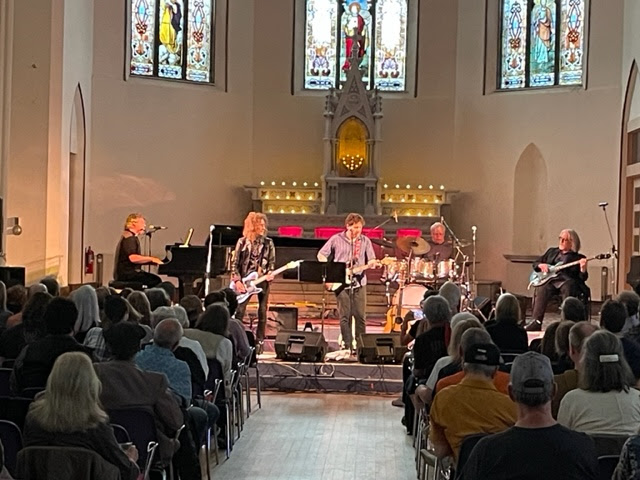
Saturday evening a good crowd gathered once more at Sacred Heart to be swept away by The Infidels, a Minneapolis supergroup that put on one heckuva show. Here are some photos from Saturday's events followed by an interview with ChatGPT and Google Bard.

Danny Fox

Matt Steichen hits a grand slam.

Dan Israel and the Infidels


EN:
Why did many people in the 1960's consider Bob Dylan the "voice of his generation"?


The Infidels, Streaming Live
OpenAI ChatGPT: Bob Dylan is often referred to as the "voice of his generation" because his music and lyrics resonated deeply with many people in the 1960s, particularly those who were part of the counterculture and protest movements of the time. Several factors contributed to Dylan's status as an influential figure and a representative of his generation:

  1. Protest and Social Consciousness: During the 1960s, there was significant social and political upheaval in the United States and around the world. Dylan's songs, such as "Blowin' in the Wind" and "The Times They Are a-Changin'," became anthems for the civil rights movement, anti-war movement, and other social justice causes. His lyrics addressed pressing issues like racial inequality, war, and the struggle for individual freedom, capturing the spirit of activism and resistance that defined the era.
  2. Authenticity and Emotional Depth: Dylan's music was characterized by its raw, honest, and deeply personal nature. His distinctive voice and passionate delivery conveyed a sense of authenticity and emotional depth that resonated with listeners. Many people felt that Dylan's songs reflected their own experiences, frustrations, and aspirations, making him a relatable figure and an embodiment of the struggles and dreams of the generation.
  3. Artistic Evolution and Cultural Influence: Dylan's music evolved throughout the 1960s, and he continually pushed the boundaries of folk music by incorporating elements of rock and other genres. His willingness to experiment and his ability to adapt his sound to reflect the changing times demonstrated his artistic growth and versatility. This evolution made him a cultural icon and influenced countless musicians who followed, shaping the direction of popular music.
  4. Intellectual and Poetic Lyrics: Dylan's lyrics were known for their poetic quality and intellectual depth. His ability to craft thought-provoking and introspective verses distinguished him from many other songwriters of the time. His lyrics often contained rich symbolism, vivid imagery, and social commentary, challenging listeners to engage with the messages and themes embedded in his songs.

Overall, Bob Dylan's unique blend of social consciousness, emotional depth, authenticity, artistic evolution, and poetic lyrics made him a significant voice for the generation of the 1960s. His music spoke directly to the hopes, frustrations, and aspirations of his audience, earning him the title of the "voice of his generation."


EN: Why did many people in the 1960's consider Bob Dylan the "voice of his generation"


Malibu Bob (See footnote*)
Google Bard: Bob Dylan was a singer-songwriter who emerged in the early 1960s. His music was a mix of folk, blues, and rock, and his lyrics were often poetic and political. Dylan was seen as a voice for the counterculture movement, and his music was often used to protest against the Vietnam War and other social injustices.

Here are some of the reasons why many people in the 1960s considered Bob Dylan the "voice of his generation":

  • His music was relatable: Dylan's music spoke to the experiences and emotions of young people in the 1960s. His songs about love, loss, and social injustice resonated with a generation that was coming of age during a time of great social and political upheaval.
  • His lyrics were poetic and insightful: Dylan's lyrics were often poetic and insightful, and they offered a unique perspective on the world. His songs were not just about the here and now, but also about the past and the future.
  • He was a cultural icon: Dylan was not just a musician, but also a cultural icon. He was known for his rebellious attitude and his willingness to challenge the status quo. He was a role model for young people who were looking for a way to express themselves and to make a difference in the world.

Dylan's music continues to be relevant today, and he is still considered one of the most important and influential musicians of all time. He is a true icon of the 1960s, and his music helped to shape the culture of that era.


Balcony shot: The Infidels @ Sacred Heart 

*There's always a bit of fun here that doesn't get captured. This is Karyn Wilder arrayed in Dylan attire. Karyn also helped close the week of events, performing at our goodbye brunch.


To borrow a phrase from Miriam, who has been hosting Highway 61 Revisited on The North these past several years, "We'll catch you on the flip side."

Sunday, December 7, 2008

Neighborhood Bully

In 1983 Bob Dylan released his 22nd album called Infidels. I remember exactly where I was when I first heard it. Mark Femrite, a friend and Dylan fan, invited me over for the first playing of his new vinyl. Dylan's previous albums were a trilogy of evangelical/gospel albums through which he had declared his Christian faith and explored, in his own original manner, the meaning of that faith.

The meaning of this album title then took on an intriguing aspect in light of this context. The word infidel has several definitions. (1) An unbeliever with respect to a particular religion, especially Christianity or Islam. (2) One who has no religious beliefs. (3) One who doubts or rejects a particular doctrine, system, or principle.

Dylan's ambiguity is legendary, so that it would be near impossible to declare emphatically in favor of one definition over another, or whether he is referring to himself or his enemies, especially in light of song number three on side one, Neighborhood Bully.

The songs on this album cover a range of geopolitical themes. Neighborhood Bully is an polemic regarding Israel. The song is a defense of its controversial stance in the world, especially as regards how the media has painted it.

As is often the case, Dylan distills his theme to its essence, and then explores the implications or meanings of that essence. The song is delivered in volleys of rock force. Its lyrics present a vivid and concise world view that may be worth further contemplation.

Neighborhood Bully

Well, the neighborhood bully, he's just one man,
His enemies say he's on their land.
They got him outnumbered about a million to one,
He got no place to escape to, no place to run.
He's the neighborhood bully.

The neighborhood bully just lives to survive,
He's criticized daily for being alive.
He's not supposed to fight back, supposed to have thick skin,
Supposed to lay down and die when his door is kicked in.
He's the neighborhood bully.

The neighborhood bully been driven out of every land,
He's wandered the earth an exiled man.
Seen his family scattered, his people hounded and torn,
He's always on trial for just being born.
He's the neighborhood bully.

Well, he knocked out a lynch mob, he was criticized,
Old women condemned him, said he should apologize.
Then he destroyed a bomb factory, nobody was glad.
The bombs were meant for him.
He was supposed to feel bad.
He's the neighborhood bully.

Well, the chances are against it and the odds are slim
That he'll live by the rules that the world makes for him,
'Cause there's a noose at his neck and a gun at his back
And a license to kill him is given out to every maniac.
He's the neighborhood bully.

He got no allies to really speak of.
What he gets he must pay for, he don't get it out of love.
He buys obsolete weapons and he won't be denied
But no one sends flesh and blood to fight by his side.
He's the neighborhood bully.

Well, he's surrounded by pacifists who all want peace,
They pray for it nightly that the bloodshed must cease.
Now, they wouldn't hurt a fly.
To hurt one they would weep.
They lay and they wait for this bully to fall asleep.
He's the neighborhood bully.

Every empire that's enslaved him is gone,
Egypt and Rome, even the great Babylon.
He's made a garden of paradise in the desert sand,
In bed with nobody, under no one's command.
He's the neighborhood bully.

Now his holiest books have been trampled upon,
No contract he signed was worth what it was written on.
He took the crumbs of the world and he turned it into wealth,
Took sickness and disease and he turned it into health.
He's the neighborhood bully.

What's anybody indebted to him for?
Nothin', they say.
He just likes to cause war.
Pride and prejudice and superstition indeed,
They wait for this bully like a dog waits to feed.
He's the neighborhood bully.

What has he done to wear so many scars?
Does he change the course of rivers?
Does he pollute the moon and stars?
Neighborhood bully, standing on the hill,
Running out of time, time standing still,
Neighborhood bully.

Copyright ©1983 Special Rider Music

Popular Posts