Showing posts with label authenticity. Show all posts

Tuesday, June 2, 2026

Cancer & The Mind – The Emotional Toll

When Stephanie Sands shared her story with me it brought back memories from when I was pallbearer at my best friend's funeral in high school. I asked her permission to share her observations.

Cancer & The Mind – The Emotional Toll

I’ve recently been working with an AI system, running various tests that I won’t bore you with. One of our conversations prompted some genuine self-reflection, which led me back to Schitt’s Creek for a second viewing. This time, I learned something quite profound.

Cancer did not just change my body. It changed the emotional lens through which I experienced the world. One of the strangest things I noticed after my diagnosis was that I stopped finding many things funny. Humor began to feel distant, artificial, or emotionally disconnected from the reality I was living in. I just couldn’t relate. I found myself gravitating toward mystery, psychological dramas, thrillers, existential stories, and I did read books related to my illness, which I could relate to more easily.


When I was recovering in the hospital after my neck dissection and soft palate resection, I was reading When Breath Becomes Air. Looking back, that choice says a great deal about the psychological space I was in. I was not searching for escape. I was searching for honesty and relatability. The book did not avoid fear, mortality, uncertainty, or the collapse of assumed permanence. It confronted all of those things directly, and because of that, it felt emotionally real to me in a way that lighter material, like comedy, couldn’t do.


Cancer introduced me to this level of vulnerability that permanently altered how I interpreted stories, entertainment, and even other people. Before cancer, humor and ordinary entertainment were effortless to me; I never took the time to think about why that was, as there was no reason to. After cancer, especially during treatment and recovery, many forms of entertainment suddenly seemed shallow or emotionally unrelatable. My mind was no longer operating in the same psychological environment. I had crossed into a reality where scans determined my fate, pathology reports carried enormous emotional anxiety, and every follow-up appointment carried the possibility of life-changing news.


I think this changes a person’s relationship with storytelling. Serious illness strips away the illusion that life is stable or guaranteed. Psychological thrillers, mysteries, and existential dramas often feel more truthful after cancer because they acknowledge uncertainty. They accept that fear exists beneath ordinary life. They explore hidden danger, tension, mortality, and the fragility of human beings. Those themes no longer feel abstract after illness. They feel familiar.


I also feel cancer creates a kind of heightened psychological surveillance state. I constantly felt like I was on alert. After diagnosis and treatment, the mind becomes trained to search for hidden threats: recurrence, symptoms, scan results, side effects, changes in the body. In many ways, mystery and thriller narratives mirror that exact mental posture. They revolve around searching for hidden meaning beneath the surface, identifying danger before it fully reveals itself, and living with unresolved uncertainty. That emotional structure felt far more relatable to me than carefree comedy because I was living with that unresolved uncertainty.


At the same time, humor itself became more complicated. I don’t think I lost my sense of humor entirely. I think humor requires a certain feeling of safety and emotional distance that serious illness can temporarily destroy. When a person is confronting mortality, physical trauma, and possible disfigurement, or survival itself, the mind often becomes more focused on meaning than amusement. My mind was seeking depth, coherence, and emotional truth rather than a distraction.


Over time, I noticed that humor slowly began returning, but it returned differently. It no longer felt automatic or superficial. It felt more deliberate and more precious. There is something profound about laughing again after a person has lived through a period where laughter felt psychologically inaccessible. It changes the meaning of joy itself. When I was going through my first treatment, it seemed my cancer specialists were all watching Schitt’s Creek, and I could not relate to it at all. My husband watched it while I ended up reading something. 


Recently, I have been doing some self-reflection about other things that I had a difficult time understanding and forced myself into others’ shoes. This started with a technical exercise that expanded into more personal reflection. During this reflection, I thought I would just give Schitt’s Creek another chance, and I’m glad I did. I find it hilarious and extremely entertaining.


Cancer didn’t simply make me fear treatment, pain, and death. It reorganized my attention. It changed what felt emotionally authentic, what stories resonated with me, what subjects I could tolerate, and what felt honest. Reading When Breath Becomes Air in a hospital bed after major cancer surgery was not me indulging morbidity. It was me searching for understanding inside an experience that had stripped away many of the illusions I took for granted in life -- permanence, control, and the belief that life was guaranteed to remain recognizable.

* * * * *

Sunday, May 28, 2023

Day 8 of Duluth Dylan Fest 2023, Plus Google Bard and ChatGPT Weigh In On Why Bob Dylan Was Labeled the "Voice of His Generation"

Danny Fox stands and delivers.
Today is the 9th and last day of Duluth Dylan Fest 2023.  In a week filled with numerous highlights, yesterday was an especially rich one. It began with 2-time singer/songwriter winner Danny Fox channeling Dylan the folk artist. Then it was followed by an information-packed talk by Matt Steichen as part of our John Bushey Memorial Lecture Series. Steichen's presentation detailed Dylan's significance as experienced by his fans. The title of his presentation: Bob Dylan and his Fans: Searching for Love and Inspiration

Not only did he expand our understanding of why and how Dylan has been so influential, Matt demonstrated in no uncertain terms how much Minnesota has been in Dylan's DNA and the values that formed the foundation of his career--and has never forgotten his roots. 

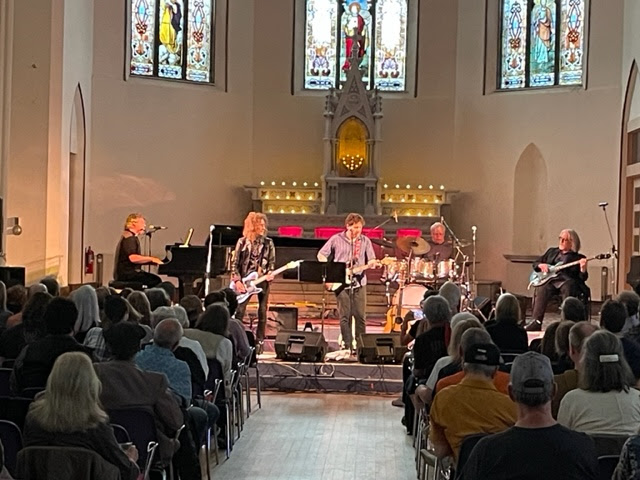
Saturday evening a good crowd gathered once more at Sacred Heart to be swept away by The Infidels, a Minneapolis supergroup that put on one heckuva show. Here are some photos from Saturday's events followed by an interview with ChatGPT and Google Bard.

Danny Fox

Matt Steichen hits a grand slam.

Dan Israel and the Infidels


EN:
Why did many people in the 1960's consider Bob Dylan the "voice of his generation"?


The Infidels, Streaming Live
OpenAI ChatGPT: Bob Dylan is often referred to as the "voice of his generation" because his music and lyrics resonated deeply with many people in the 1960s, particularly those who were part of the counterculture and protest movements of the time. Several factors contributed to Dylan's status as an influential figure and a representative of his generation:

  1. Protest and Social Consciousness: During the 1960s, there was significant social and political upheaval in the United States and around the world. Dylan's songs, such as "Blowin' in the Wind" and "The Times They Are a-Changin'," became anthems for the civil rights movement, anti-war movement, and other social justice causes. His lyrics addressed pressing issues like racial inequality, war, and the struggle for individual freedom, capturing the spirit of activism and resistance that defined the era.
  2. Authenticity and Emotional Depth: Dylan's music was characterized by its raw, honest, and deeply personal nature. His distinctive voice and passionate delivery conveyed a sense of authenticity and emotional depth that resonated with listeners. Many people felt that Dylan's songs reflected their own experiences, frustrations, and aspirations, making him a relatable figure and an embodiment of the struggles and dreams of the generation.
  3. Artistic Evolution and Cultural Influence: Dylan's music evolved throughout the 1960s, and he continually pushed the boundaries of folk music by incorporating elements of rock and other genres. His willingness to experiment and his ability to adapt his sound to reflect the changing times demonstrated his artistic growth and versatility. This evolution made him a cultural icon and influenced countless musicians who followed, shaping the direction of popular music.
  4. Intellectual and Poetic Lyrics: Dylan's lyrics were known for their poetic quality and intellectual depth. His ability to craft thought-provoking and introspective verses distinguished him from many other songwriters of the time. His lyrics often contained rich symbolism, vivid imagery, and social commentary, challenging listeners to engage with the messages and themes embedded in his songs.

Overall, Bob Dylan's unique blend of social consciousness, emotional depth, authenticity, artistic evolution, and poetic lyrics made him a significant voice for the generation of the 1960s. His music spoke directly to the hopes, frustrations, and aspirations of his audience, earning him the title of the "voice of his generation."


EN: Why did many people in the 1960's consider Bob Dylan the "voice of his generation"


Malibu Bob (See footnote*)
Google Bard: Bob Dylan was a singer-songwriter who emerged in the early 1960s. His music was a mix of folk, blues, and rock, and his lyrics were often poetic and political. Dylan was seen as a voice for the counterculture movement, and his music was often used to protest against the Vietnam War and other social injustices.

Here are some of the reasons why many people in the 1960s considered Bob Dylan the "voice of his generation":

  • His music was relatable: Dylan's music spoke to the experiences and emotions of young people in the 1960s. His songs about love, loss, and social injustice resonated with a generation that was coming of age during a time of great social and political upheaval.
  • His lyrics were poetic and insightful: Dylan's lyrics were often poetic and insightful, and they offered a unique perspective on the world. His songs were not just about the here and now, but also about the past and the future.
  • He was a cultural icon: Dylan was not just a musician, but also a cultural icon. He was known for his rebellious attitude and his willingness to challenge the status quo. He was a role model for young people who were looking for a way to express themselves and to make a difference in the world.

Dylan's music continues to be relevant today, and he is still considered one of the most important and influential musicians of all time. He is a true icon of the 1960s, and his music helped to shape the culture of that era.


Balcony shot: The Infidels @ Sacred Heart 

*There's always a bit of fun here that doesn't get captured. This is Karyn Wilder arrayed in Dylan attire. Karyn also helped close the week of events, performing at our goodbye brunch.


To borrow a phrase from Miriam, who has been hosting Highway 61 Revisited on The North these past several years, "We'll catch you on the flip side."

Saturday, May 23, 2020

An Aesop Fable On Authenticity: The Monkey and the Camel

Photo by Vivek Sharma on Unsplash
Something I'd been reading recently triggered the recollection of the Aesop Fable, the Monkey and the Camel. The way I remembered it, the story took place near an oasis in the desert, hence the presence of the camel in this story. When I Googled it for this blog post, I found several versions of the story. This one here is told most efficiently, the way that I recall Aesop's tales usually being told.

This version comes from an unknown translator, copyright 1881, Wm. L. Allison, New York

The beasts of the forest gave a splendid entertainment, at which the Monkey stood up and danced. Having vastly delighted the assembly, he sat down amidst universal applause. The Camel, envious of the praises bestowed on the Monkey and desirous to divert to himself the favor of the guests, proposed to stand up in his turn, and dance for their amusement. He moved about in so very ridiculous a manner that the Beasts, in a fit of indignation, set upon him with clubs, and drove him out of the assembly. 

Moral: It is absurd to ape our betters.

The Library of Congress has a version which someone embellished, describing the Camel's knotty knees and other such details, which don't really strengthen the story in my opinion. In this versions the writer adds a sentence describing refreshments served afterwards, "mostly of camel's hump and ribs."

Yikes! As if it weren't enough simply bad enough to be shamed and laughed at. Making a fool of yourself can get you killed?

This InfoPlease version doesn't even include the moral of the story, an almost unforgivable oversight, since the pithy "moral of the story" endings are what make Aesop's Fables so delightful.

Photo by Andre Iv on Unsplash
The Monkey and the Camel
At a gathering of all the beasts the Monkey gave an exhibition of dancing and entertained the company vastly. There was great applause at the finish, which excited the envy of the Camel and made him desire to win the favour of the assembly by the same means. So he got up from his place and began dancing, but he cut such a ridiculous figure as he plunged about, and made such a grotesque exhibition of his ungainly person, that the beasts all fell upon him with ridicule and drove him away.

* * * *
I quickly found a couple versions identical to the first one above, but once again, this Heritage History variation adds embellishments. The first is the addition of the reason for this celebration, and then it says the Monkey was asked to dance.

At a great celebration in honor of King Lion, the Monkey was asked to dance for the company. His dancing was very clever indeed, and the animals were all highly pleased with his grace and lightness.


Now the way I remembered it, it was just another night at the oasis and when the music started playing the Monkey did what he loves to do, and does well. He danced.

Then the Camel gets into the spotlight, but this storyteller once again goes too far. The only detail he or she does correctly note is the Camel's motivation. He was consumed with envy.

The praise that was showered on the Monkey made the Camel envious. He was very sure that he could dance quite as well as the Monkey, if not better, so he pushed his way into the crowd that was gathered around the Monkey, and rising on his hind legs, began to dance. But the big hulking Camel made himself very ridiculous as he kicked out his knotty legs and twisted his long clumsy neck. Besides, the animals found it hard to keep their toes from under his heavy hoofs.

What's curious is this next detail. Instead of being laughed at and shamed, this version suggests that the camel got punished for something altogether different.

At last, when one of his huge feet came within an inch of King Lion's nose, the animals were so disgusted that they set upon the Camel in a rage and drove him out into the desert.

Shortly afterward, refreshments, consisting mostly of Camel's hump and ribs, were served to the company.

Do not try to ape your betters.

My vote is a thumbs down on this version, too. Aesop had it right, as did Hemingway centuries later. Less is more.
* * * *
The point of the story is lost when we go too far. Envy gets people in trouble. And trying to be something you're not makes it that much worse.

We all have different strengths. Through self-understanding we're better able to play to those strengths. Karen Horney, Freud's first female student, wrote extensively on neurosis, pointing out the psychological origin of our neuroses being due to a split between our real self and idealized self. In other words, when who we are is out of sync with who we think we are, we're going to have problems.

Our lack of awareness with regards to how we come across can result in our making fools of ourselves. I've done that. It's worse than embarrassing.

Hence, the Oracle at Delphi has this inscription above the door: Know Thyself.

Self understanding is fundamental to living authentically in a world half mad with projecting images of whom we're not. Be real, be true and you will be happier.

Friday, June 22, 2018

Vigorous Discussion Ensues After Philosophy Profs Explore Existentialism and Authenticity at Magnolia Salon

All photos on this page courtesy Machelle Lind
Last night's featured presenters at the Magnolia Salon were a pair of philosophy professors, Steven Ostovich, Ph.D., philosophy chair at St. Scholastica and Gordon Marino, Ph.D. from St. Olaf College and author of The Existentialist's Survival Guide, subtitled How to Live Authentically in an Inauthentic Age. Even before the event began you could feel the kinetic energy of electric expectation.

Suzie and Gordon Marino with Glenn and Emily Swanson.
The evening began with Glenn and Emily welcoming us and sharing with newcomers some of the rituals and the overarching theme of the Salon: living creative life. They then introduced the profs, who essentially held a prolonged Q&A forum betwixt the two of them over next hour or more, Prof. Ostovich serving as a Dick Cavett of sorts. Their banter was relaxed and the room was engaged as Steve asked questions and Gordon responded with stories. After this, they opened the floor for questions, which erupted with a send-up of hands, questions from every table in the room without exception and without ceasing for seemingly an hour straight.

What thrilled me was knowing that few, if any, here were philosophy majors in college, yet every person in the room seemed totally engaged. Here are a few of my own takeaways from the never-boring-for-a-minute two hours.

What is existentialism as a movement? Gordon Marino described it as a motley crew of philosopher-writers who explore matters of choice, the meaning of life and the limits of reason. It was popular after both World War I and World War II, global events that were exceedingly disruptive in Europe especially.

Gordon Marino listens to a passionate question.
What is meant by an Inauthentic Age? With social media being so pervasive, people become more concerned with how they present themselves, with posturing rather than being authentic. "We've lost a lot," Marino said. As a result we sense our own alienation because we are not ourselves. This sense of alienation is at the heart of existential writing.

In response, Sartre wrote, "Existence precedes essence." We define ourselves by our actions. We exist in time,. Therefore the choices we make create and reveal who I am.

Marino, who also authored Kierkegaard in the Present Age, is the director of the Hong Kierkegaard Library at St. Olaf, so he spoke with great fluency about Kierkegaard. He noted that Kierkegaard addressed issues of morality and faith, obedience and virtue. In our modern era, young people are not interested in hearing about self-discipline and obedience. For Kierkegard, obedience to God involves a leap of faith, by which he means one cannot find God by means of reason. Reason has its limits.

Camus is another favorite of Prof. Marino. He began by citing The Stranger and The Myth of Sisyphus. "Once you give up hope, you're free to be creative," he said. Camus carried this further in The Plague where Dr. Rieu was cognizant of the futility and uselessness of his every action to stop the plague. The point Camus makes, though is not to give up just because you can't win. He emphasized that "the value of what you're doing is more important than the success of your battle." In other words, we are all fighting on two battle fronts. The external world is broken. Even though we will never fix it, it is worth the fight, our responsibility to work toward fixing, toward healing. Then there is our own inner battle. Even though we will never be perfect, it is our task to improve ourselves, to work toward wholeness, even if we never reach it.

At this point one of the two presenters stated, "One of the great benefits of philosophy is that it aids us in self-reflection. What kind of person do you want to be? Are you making progress?

One of the questions asked by someone in the audience led to a comment about the medicalization of everything in the 21st century. We talk about depression and panic attacks, and have meds to deal with whatever we're dealing with. This was followed up with the observation that success can be just as destructive as failure. (EdNote: I thought here of the Simon & Garfunkel song Richard Cory based on the poem by Edward Arlington Robinson.)

Other takeaways from the evening included the following.

1) The first task of philosophy is diagnosis.

2) Existential living begins with the acknowledgement and acceptance of this fact: I am responsible for my life.

3) Philosophy is not about the love of knowledge. It is about the love of wisdom. It is important to know the difference. (EdNote: Knowledge for knowledge's sake makes us educated fools.)

4) Proper self-love requires affirmations. Most of us need to feel loved in order to love ourselves. Here he shared the importance of "being there for people on a consistent basis."

5) Living Authentically means being able to tolerate vulnerability.

* * * *
A special feature of the evening was the presence of Bob and Angel Dobrow of Zenith Bookstore. The Dobrow's joined our community after Bob's 20-year career teaching math and statistics at Carleton College. Avid readers they are, so to speak, living the dream.

There was much more, and a lot could be said about Prof. Marino's relationship to boxing, but rather than go there (because my notes are sketchy and my memory moreso) I'll hope to take a deeper dive on that sometime in the near future. It was fascinating.

Related Links
Gordon Marino's book will be available at Zenith Bookstore next door to Beaner's Central in Duluth. The store will be celebrating its One Year Anniversary on July 1. Thank you for being part of our community.
Next Thursday will be the Magnolia Salon Summer Send Off Party. Be sure to register so that they know how many Oldenburgers to grill for us.
If you do not live in this vicinity, you can find The Existentialist's Survival Guide here on Amazon.

Meantime, life goes on all around you. Live the life you were meant to live.

Thursday, July 23, 2015

Authenticity: An Excerpt from Rollo May's Book On Tillich

While making a half-hearted attempt to get of more things from my garage this weekend I was sifting through books to discard (donate to library) when I noticed a page in Rollo May's Paulus that I had tabbed. Paulus is May's portrait of twentieth century existential theologian Paul Tillich. (You can read my review of Tillich's autobiographical On The Boundary here. )What follows is an excerpt from a chapter titled Paulus' Personal Presence.

Paulus believed that every encounter with a new person is anxiety-creating. Anxiety is present in every authentic encounter, to is, one in which people let themselves genuinely meet. This anxiety is the dread of freedom; in Kierkegaard's words, it is the "dizziness of freedom." You don't know what is ahead or what demands the encounter may make upon you, or the possibilities in this new relationship. You know you must risk something in order to go through with it, but you don't know how much. Also the pleasures, delights and joys it can give are still unknown. The meeting my jar you off your present course. It may bring a new expansion in your life or it may push you toward curtailment and psychological slavery.

The following page he continues...

The instinctive reaction is to protect oneself until the coast is clear, to hide one's own originality, one's impulses and native responses. The mechanics for doing this lie in the standards of courtesy, good manners, and so on, under whose aegis we conceal our authentic selves. But we do it at a price of falsifying ourselves. No matter how "necessary" such protection is, or the fact that no one could survive without such social forms, it is still very important that this protecting of oneself be done consciously. I you repress and do not know you are repressing, there is a danger of suffocation, a stultifying of the self. The problem of honesty in personality relationships is difficult indeed.

The operative word here is authentic. In the first paragraph he speaks of authentic encounters with others. In the second he speaks of our authentic selves, as opposed to false impressions and insincere self-projections.

We've become accustomed to politicians being "crafted" to fit an image that will sell, as if he or she were a brand. This political gamesmanship has become nauseating for many voters because in an era such as our we crave authenticity. It is because of these absurd election games that someone like Jesse Ventura got elected as governor, simply because he came across as real.

Rollo May is not talking about elections and news spin here, though. He is addressing our day-to-day encounters and how we carry our selves. Paul Tillich, he says, was strong enough to not conceal his weakness. According to May's account he didn't need to put on armor when he went about his business. He remained vulnerable, and sensitive. He accepted the risk of being hurt, or fulfilled.

Authenticity is about more than just being real. It means being credible and true. But the dictum "To thine own self be true" assumes you know who you are. You can't be true to yourself until you first know who you are, though. Simba in The Lion King forgot who he was and nearly missed his calling lost as he was in the land of Hakuna Matata.

What's your calling? Do you have ambitions that you conceal for fear of being ridiculed? Are you stuck in a place that doesn't feel like you? Where do you really want to go? What do you really want to be? Are you tired of the games?

O.K. that's enough. Time to get dressed and get to work. 

Saturday, July 27, 2013

Authenticity: Who Are You, Really?

“How slow and slow and slow it goes to mend the tear the always shows…” ~Neil Young

I woke this morning with a theory about the people who write books about Bob Dylan. Upon waking I riffed through the bibliography sections of Robert Shelton's No Direction Home (current bedtime reading) and Lee Marshall's book that I finished last week. One of the titles that caught my attention in Marshall's bibliography was a book by David Boyle titled Authenticity: Brands, Fakes, Spin and the Lust for Real Life. It brought to mind book concept I once outlined 15 years ago titled Boomer, Do You Know Who You Are?

My book for the baby boom generation was intended to be an antidote to some of the maladies friends of mine and I had noticed in our peers (and ourselves): a feeling of superficiality and fakiness, of having to play games; creeping deadness... lack of enthusiasm for life, work, etc.; aimlessness, lack of direction; weakness, helplessness to change situations, powerlessness; aware that we are not changing the world, our lack of social impact.

In response to these I'd hoped to strike a chord and re-affirm the ideals our generation once professed way back when: Authenticiy, Passion (Motivation, Enthusiasm), Purposefulness, Personal Power, Social Consciousness.

Boyle's book focuses only on the first of these, in a comprehensive manner that dissects everything. What's amusing to me is the opening line of the book's overview at Amazon.com:

"David Boyle guides us through the next big thing in Western living -- the determined rejection of the fake, the virtual, the spun and the mass-produced, in the search for authenticity."  

To call "Authenticity" the "next big thing" is to have forgotten what the Sixties was all about. Young people were realizing that their perceptions about how things are was being crafted. Have we come full circle?

As far as being authentic ourselves -- authentic to who we really are -- it's not as easy as it appears. Two decades ago I participated in a Meyers-Briggs personality workshop at a company where I formerly worked and learned a lot about how differently we are wired in many fundamental ways. As anyone who knows me knows, I am an extrovert, but in one exercise where I was to solve a problem with four other extroverts I became more introverted. Being thus out of sync with myself made me uncomfortable. What it also showed me is that who we are is often determined by context.

Since who and what we are seems to be in flux and is to some extent defined by our relationships, this may be why our lives sometimes feel like a quest to find relationships that bring out the best in us. Not every relationship or set of circumstances does this.

If we step back to the big picture, there's a historical context, a genealogical context and a global context worth noting... and then there's DNA and the imago dei. That's a whole 'nuther story.

I'm still looking forward to reading Boyle's book.

Wednesday, February 6, 2008

Rousseau’s Influence

One of the most compelling sections for me personally in D’Souza’s What’s So Great About America is the section on Rousseau. The reason is that he helps explain to me the source of many of my own ideas which, like our entire generation, seemed to originate within us, but were foisted on us by the mass culture and pop media.

“Do your own thing” and “Follow your bliss” (yes, this is Joseph Campbell, but rooted in Roussaeu) and the idea of finding within the truth of who you are and being true to that inner you, free from external constraints… this is all Rouseau.

The idea of freedom is powerful, but can also be out of balance, as the label for our generation later became the Me Generation. This ethic was glorified in magazines such as Life’s photo essays on the hippie communes which glamorized the “throwing off” of traditional family and exalted the hippie foray into communal families. The fruit of such follies only came later. Who would do the work? Who will raise the children? If I am doing my thing and watching the sunset on acid, and he’s doing his thing writing poetry, who will do the dishes?

Rousseau, D’Souza points out, was the guiding spirit of Bohemia. And the heart of it is expressed in our total embrace of the ethic of authenticity. Know who you are and follow your star. You must be authentic to yourself. It doesn’t matter if what you are doing is sick and perverse as long as it is honest. Check out where the art scene went in the seventies, with artists who groveled in feces or worse. One German artist filmed himself cutting off his penis, one inch at a time. It was a statement of some kind, I suppose. Bold, original and stupid. (He died, of course.)

I found the ideas in this chapter quite helpful in understanding the problems I see in broken marriages where “my happiness” is more important than our children, and where “self understanding” is more important than self sacrifice or service or understanding another. Our generation took pride in the overthrow of conventional wisdom, and now we’ve paid a price. The funny thing is, we thought we were all being so original. But our behavior was rooted in ideas as old as mankind, voiced more than a century earlier and shaped by a pop media that rejoiced in its power to influence.

There is power in the idea of freedom. But a deeper self-understanding reveals that we are less free than we would like to believe. And though freedom is a wonderful thing, to put it on a pedestal as the ultimate value is a truth out of balance. Someone still has to fix the toilet, and keep the bills paid. Guess that means that eventually one has to grow up.

Popular Posts