Showing posts with label philosophy. Show all posts

Sunday, August 23, 2026

More Miscellaneous Notes I Found While Cleaning My Office

22 August 2026
Notes found on various scraps of paper.

Philosophical Anthropology

Political Philosophy

Contemporary Modern Philosophy

Philosophy of Science

Descartes / Kant

Some people want (need) clear cut answers, not ambiguity

Some are anti-fact / anti-science

Historical Responsibility

I worry about the way we set up issues

The fact that we don't agree -- how do we keep the conversation going?

Inflated Data

Willard Munger Wetlands Act destroyed usable real estate

Where do Duluth's unemployment numbers come from?

"We were so proud of you when you could draw when you were two. Grandpa Newman would send reams of paper so we could draw."

I have visions but lack the skill and motivation to follow through.

Blog Post: Learning to See

Atticus: To Kill a Mockingbird
Rhett: Gone with the Wind
Stella: Streetcar Named Desire
Kurtz: Heart of Darkness
Ishmael: Moby Dick
Pyle: The Quiet American
Harry Lime: The Third Man
Ann Sullivan: The Miracle Worker
Robert Jordan: For Whom the Bell Tolls
Winston: 1984
Billy Pilgrim: Slaughterhouse Five
Henry Wilcox: Howard's End
Sonny: The Godfather
Nurse Ratched: One Flew Over the Cuckoo's Nest

Scribbled Signatures

Review the impacts of Executive Orders

What really matters?

Begin at the bwginning.


Saturday, June 27, 2026

An Outline of Great Books: The Best Ten Cents I Ever Spent

This past week I was triggered by a New York Times article titled, The Books Times Readers Are Most Excited About This Summer. The subhead reiterates. "As summer kicks off, here are the new books that our readers say they’re most eager to dive into."

When I see articles like this, my first thought is, "How many of these books will stand the test of time?" It seems to me that since there are so many truly great books from the world's great writers that most of us have never read, why not spent your summer reading a few of the great works from the past that have shaped our minds and our world? It's just so "modern" to ever be chasing "the latest shiny new toys."

The Best Ten Cents I Ever Spent

In 1982 or '83 I stopped at the yard sale of someone who was clearly educated. This was in the vicinty of Hamline Unversity in St. Paul. They were selling books by the bag, ten books for a dollar. 


One of the the books I acquired was a battered copy of the 1936 Outline of Great Books, edited by Sir J. A. Hammerton, an ambitious attempt to make the world's classic literature accessible to ordinary readers. Rather than reproducing the complete texts, it provides substantial outlines, summaries, and excerpts from approximately 250 of the Western world's most important works in history, philosophy, science, religion, poetry, biography, travel, and criticism. 


Hammerton's project was an attempt to give readers a guided tour of civilization's intellectual heritage. These were the days before television and long before the internet.


Click to enlarge
For me, it was a useful tool for broadening my education. In Sherwood Wirt's You Can Tell the World, he begins by emphasizing our need (he is addressing Christian writers, but his admonition applies to all writers) to understand the great minds and read the great books if we are aiming to influence the world. Outline of Great Books is thus a tool for becoming aware of the important players in the various scholarly disciplines. It's more than a Cliff's Notes version of the great ideas and themes of Western literature. It is comprised of excerpts from their actual writings. A person living in a small farming town might never have access to Aristotle, Dante, Gibbon, Goethe, Cervantes, or Tolstoy, but they could obtain a familiarity with their ideas and writings here.


What I find especially interesting is that the book no doubt inspired people to read the originals. Many families owned only a few dozen books. Outline of Great Books functioned almost like a literary map. You could read a 10–20 page condensation of a work and decide whether you wanted to pursue the full text.


The work belongs to a larger "outline" movement of the early twentieth century, alongside books like The Outline of History and other educational compendia that sought to democratize knowledge. Will and Ariel Durant released the first six volumes of The Story of Civilization around this same time, a history in more layman's terms than academic.


Outline of Great Books reflects a worldview that was common among educators of the era: An educated person should possess at least a working acquaintance with the great books that shaped Western civilization. Sadly, that assumption has largely disappeared today.


I won't deny that the book has limitations. It's focus is primarily on the great books of Western civilization, and even the section on religion omits the religions of other regions of the world. Nevertheless, it's an impressive compendium and I've pulled it off the shelf more than a few times over the years. (In fact, just two weeks ago I pulled it out to see what scientists were covered, and specifically to check out which of Sir Isaac Newton's works were cited.


It's interesting who is included and excluded in a volume such as this. Also, I'm curious if books like this will ever be published again. Everything people want can be found somewhere on the Internet now, it seems. If you can't find it, you ask Gemini, Grok, ChatGPT or some other LLM. 


What interests people today seems to be podcasts of contemporaries talking about their contemporary writing and contemporary history, so that Adam Smith, Edmund Burke, Thomas Hobbes, Carlyle, Hume, Schopenhauer, Goethe and the like are now relics. Who reads Gibbon's Rise and Fall of the Roman Empire any more? We've been told we are now living it, but what really happened in Rome 1600-1700 years ago that resulted in its downfall?


The real point I want to make, though, is how I found this gem for 10 cents. It was a treasure at a bargain price. If your eyes are open, there are probably countless overlooked treasures all around us. When it comes to books, library sales and used book stores are repositories of riches. Open your eyes.


Sunday, February 22, 2026

Against the Idols of the Age: A Contrarian's Critique of the Twentieth Century

There is something appealing about contrarians. People who see things from a different perspective may often be on to something. Hence my attraction to David Stove's Against the Idols of the Age, a provocative collection of essays that challenges dominant intellectual trends of the 20th century. 

The book gathers Stove’s critiques of scientific irrationalism, modern philosophy, and cultural orthodoxies, arguing that many influential ideas—especially in the philosophy of science and evolutionary theory—rest on faulty reasoning and misplaced reverence for fashion-able thinkers. Stove targets figures like Popper, Kuhn, and Darwinist interpretations of human behavior, while defending common sense, empirical realism, and logical clarity.

I've read a few books over the years by authors dissecting and debunking contemporary "experts" by pointing out the king had no close on. One of these examined papers in physics that were called brilliant when, in fact, they were primarily gobbledygook. When Camille Paglia tears into Michel Foucaut, and Norman Finkelstein slaughters contemporary golden calves (e.g. I'll Burn That Bridge When I Get To It), I applaud.

You don't have to agree with everything, but there's a lot of meat on them bones. Our capacity to think more deeply may be challenged. So be it. Exercise that brain muscle. Make it sweat. It feels good.

Here's the table of contents for Stove's book:


Against the Idols of the Age

Introduction: Who Was David Stove?

Acknowledgments and a Note on the Text

The Cult of Irrationalism in Science

Cole Porter and Karl Popper:

The Jazz Age in the Philosophy of Science

Sabotaging Logical Expressions

Paralytic Epistemology, or The Soundless Scream

Idols Contemporary and Perennial

D'Holbach's Dream:

The Central Claim of the Enlightenment

"Always apologize, always explain":

Robert Nozick's War Wounds

The Intellectual Capacity Of Women Racial and Other Antagonisms

Idealism: A Victorian Horror-story (Part Two)

Darwinian Fairytales

Darwinism's Dilemma

Where Darwin First Went Wrong about Man
Genetic Calvinism, or Demons and Dawkins

"He Ain't Heavy, He's my Brother," or Altruism and Shared Genes


For an introduction to this author, read Roger Kimball's
Who was David Stove? 
in The New Criterion. It may give you just the courage you need to swim upstream against the current in your own battles.

His beef with Darwin is elaborated on in his 1995 book Darwinian Fairytales, which critiques sociobiology and evolutionary psychology. He argues that Darwinism fails to explain human behaviors like altruism, which he sees as contradictory to the "selfish gene" theory. Though a non-creationist, Stove argues that while natural selection is a successful biological theory, its application to human behavior is overblown and often relies on "fairytales" to explain away inconsistencies, such as why humans engage in self-sacrificing or non-reproductive behaviors. 


Stove is best known for scathing attacks on a variety of concepts, especially Popperian falsificationism, Marxism, feminism, and postmodernism. 

David Stove's comments on Cole Porter are classic. Evidently Stove repeatedly quoted Cole Porter’s lyric “Anything goes” (from the 1934 musical of the same name) as a shorthand critique of modern intellectual culture. For Stove, Porter unintentionally captured the spirit of relativism: the idea that there are no firm standards of truth, reason, or evidence.

Here are a few reviews of this book, pilfered from Amazon:


"Stove was undoubtedly the most stylish and witty writer of all philosphers of the last one hundred years, if not of all time. When it comes to attacking the absurdities of twentieth century intellectual movements no one else came close, and certainly no one else was as funny." --The Review of Metaphysics


"What separates Stove from your average angry-eyed reactionary is the startling brilliant way that he argues, combining plain horse sense with the most nimble and skillful philosophical reasoning this side of Hume, along with a breathtaking wit."
--The Parisian Review


"As most reviewers before have acknowledged, it seems impossible to be able to agree with everything Stove says. But that only adds to the enjoyment. The book may be controversial but it certainly is FUN. What's more, even when making the most preposterous claims, Stove will usually do two other things: 1) lay out his argument in an innovative, surprising and clear way, 2) make several brilliant and true observations on the side, which otherwise would probably never have crossed your mind." --MrOzik


And one more from Amazon:
Critically, Against the Idols of the Age offers sharp, lucid, and often entertaining arguments, marked by wit and rigor. Reviewers praise Stove’s analytic precision and polemical force, though not all will agree with his conclusions; his style is combative and opinionated, which makes the book both stimulating and controversial. It serves as an engaging introduction to Stove’s thought and a trigger for readers to question prevailing assumptions in science and culture.


Thursday, December 11, 2025

What Cameron Crowe's Vanilla Sky Said To Me

"Every passing minute is another chance to turn it all around." --Sofia

In 2001 Cameron Crowe created an incredible film. Why some movies resonate with us and others fail to connect, I'm not sure. In part, the masterpieces simply have no hollow notes. The director somehow brings out stellar performances from his cast and makes no compromises along the way. It helps, of course, to have a magical script, and the film Vanilla Sky explodes with layers of meaning that go deep to make it a very special film.

I can think of three reasons this film has been panned by a segment of the public. One is that Tom Cruise is the star, and for this reason alone it might be dismissed by some. This is an incredible performance, however, and can’t be so easily dismissed. A second reason is that the film is a remake in English of a Spanish version of the same story, starring the same Penelope Cruz. Who cares? I did not see the Spanish version. I saw this one. The third? Some people just didn't get it. Complicated, cerebral, perhaps a bit labyrinthine, but from the start I was on board, holding on to Ariadne's thread.

The film is complicated, and requires a measure of work on the part of the viewer. If you have to see it twice to see that the continuity is there, maybe that is OK. The film hangs together and is not a manipulation with a twist ending. Yes, the ending twists, but it's a logical extension of the story.

For me, the scene in the middle where Tom Cruise is dancing in a nightclub with the mask on the back of his head is so fabulously conceived for its symbolic value, as Cruise become Janus, the Roman mythological figure with two faces. Janus was the god of gates or doors, doorways, beginnings and endings. In this film, though we know it not, the scene telegraphs the pivotal transition for David Aames, who has been tragically disfigured as a result of his own choices. Sometimes, you can learn from the past but can’t change it.

I'm not certain what it is that so resonates with me about this film. In part, it may be the philosophical questions it raises about who we are, and the life we would live if we could truly live our dreams. At its root
 it asks this fundamental existential question: “What if everything you think is real… isn’t?"

It is interesting, too, that the Cruz character is named Sofia, the Greek word for wisdom. The symbols, the erudite references throughout, the layers of complexity may be simply too much for a typical audience immersed in pop entertainment values. Am I being too sentimental to be properly critical? At least one poll rated this as one of the worst films of all time.

On its most basic level, Vanilla Sky presents the philosophical conundrum of the “brain in the vat.” What is reality when it’s all in your head? And what’s wrong with a perfect fantasy, even if we are nothing more than a disembodied brain hooked up to wires, stimuli and altered perceptions? The story line ultimately brings Tom Cruise to a place where he must choose whether he wants to live in reality or his perfect fantasy, which for the time being has gone awry. Perhaps this, more than anything, is what speaks to me, because many people prefer their fantasies to the harder challenges of reality. How would you choose?

Here are some comments from a review at imdb.com. For me its kudos to Cameron Crowe for a true achievement, and a great follow-up shot to his wonderful surprise, Almost Famous.

Director Cameron Crowe has crafted and delivered much more than just another film with this one; far more than a movie, `Vanilla Sky' is a vision realized. Beginning with the first images that appear on screen, he presents a visually stunning experience that is both viscerally and cerebrally affecting. It's a mind-twisting mystery that will swallow you up and sweep you away; emotionally, it's a rush-- and it may leave you exhausted, because it requires some effort to stay with it. But it's worth it.


As to the performances here, those who can't get past the mind-set of Tom Cruise as Maverick in `Top Gun,' or his Ethan Hunt in `Mission Impossible,' or those who perceive him only as a `movie star' rather than an actor, are going to have to think again in light of his work here. Because as David Aames, Cruise gives the best performance of his career, one that should check any doubts as to his ability as an actor at the door. He's made some interesting career choices the past few years, with films like `Magnolia' and `Eyes Wide Shut' merely warm-ups for the very real and complex character he creates here. And give him credit, too, for taking on a role that dispels any sense of vanity; this is Cruise as you've never seen him before. `Jerry Maguire' earned him an Oscar nomination, and this one should, also-- as well as the admiration and acclaim of his peers. Cruise is not just good in this movie, he is remarkable.

Penelope Cruz (Sofia) turns in an outstanding, if not exceptional performance as well, as the woman of David's dreams. There's an alluring innocence she brings to this role that works well for her character and makes her forthcoming and accessible,... Crowe knows how to get the best out of his actors, and he certainly did with Cruz.

* * * * 
"I want to live a real life... I don't want to dream any longer."--David Aames

* * * * 
Life goes on all around you. Open your eyes.

Wednesday, December 3, 2025

Film as a Philosophical Lens

Last week I uploaded all my blog posts from 2008 to an A.I. called NotebookLM. I requested an analysis and overview of the contents of my daily entries from that year and was both intrigued and surprised by the feedback. 

The six page report outlined six categories which most of my content fit into. One of these, which surprised me but should not have, had to do with reviews or references to movies. There's a sense in which it became clear how much our culture shapes up more than we realize.

Here's the section of that report assessing my 2008 writings about film. This is followed by links to five movie reviews, three from 2008 and two others from later.

* * *

Film as a Philosophical Lens

The author’s film analyses consistently transcend simple plot summary or critique, instead using cinematic narratives to probe intricate philosophical and ethical themes. This approach is evident in his treatment of a wide range of films from 2007 and 2008.


Morality and Chaos: A preoccupation with the nature of evil and the struggle for order emerges from the reviews of No Country for Old Men and The Dark Knight. The author is captivated by Javier Bardem's portrayal of Anton Chiguhr as a relentless, "pathological, human version of The Terminator," a force of pure chaos operating outside conventional morality. In The Dark Knight, he identifies a similar dynamic in The Joker, whose goal is to "destroy all notions of order and decency." The author is drawn to how these films explore the ethical compromises necessary to confront such chaos, noting that Batman must "violate his own code of ethics in order to reach an ethical conclusion." His assessment of No Country for Old Men is marked by a telling ambivalence. While he praises the film's execution as "flawless," he simultaneously identifies "a number of problems," including a performance by Tommy Lee Jones he found to be a "caricature of himself," the questionable "star power" of Woody Harrelson for such a brief role, and a "confusing" ending that undermined the film's intense buildup.


Reality and Illusion: The author uses the films Vanilla Sky and The Prestige to engage with classic philosophical questions about perception, reality, and self-deception. He praises Vanilla Sky as a "vision realized" that explores the "philosophical conundrum of the ‘brain in the vat’" and forces the protagonist—and the viewer—to choose between a perfect fantasy and the harder challenges of reality. He highlights the film's use of the two-faced Janus figure as a key symbol of this pivotal transition. Similarly, in his review of The Prestige, he quotes the film's central premise: "You don't really want to know. You want to be fooled," using it to discuss the human desire for illusion over truth.


Character and Storytelling: A strong preference for authentic, character-driven narratives over formulaic productions is a consistent thread. He praises a film like There Will Be Blood as a powerful "character study" and celebrates its director for employing the "preeminent rule of storytelling: show, don’t tell." Conversely, he criticizes films he views as shallow. Sofia Coppola's Marie Antoinette, for example, is described as being trapped in a "bubble" without historical context. This contrast underscores his high valuation of deep character exploration and masterful storytelling craft over surface-level spectacle.


The Prestige

https://pioneerproductions.blogspot.com/2014/01/is-prestige-greatest-movie-about-magic.html


The Mission

https://pioneerproductions.blogspot.com/2010/10/missions-pointed-question.html


There Will Be Blood

https://pioneerproductions.blogspot.com/2008/04/there-will-be-blood.html


No Country for Old Men

https://pioneerproductions.blogspot.com/2021/04/throwback-thursday-no-country-for-old.html


Vanilla Sky

https://pioneerproductions.blogspot.com/2008/02/vanilla-sky.html


Wednesday, February 26, 2025

What Is Hitchens' Razor?

I can't recall precisely when I first heard the expression Occam's Razor. You'd think I came across it in one of my philosophy classes in college, though actually I believe I first heard it from my mom. It's meaning used to be common knowledge amongst educated folks, I believe.

Dating back to the 14th century, Occam's Razor is a problem-solving principle that is credited to the English philosopher and theologian William of Ockham. It’s often summed up as: "Entities should not be multiplied beyond necessity." 

I looked that up, but what I remember is something like this: when you’re faced with competing explanations for something, the simplest one is usually your best bet. Here's a practical example.


When your car won't start the first thing is to check the battery rather than assume a rare engine defect and a fuel line issue and a cosmic ray interference all hit at once. The idea is to start with what’s most straightforward and only complicate the explanation if evidence demands it. It’s a tool for reasoning, not a hard rule, and it’s been influential in science, philosophy, and even everyday decision-making. It's a mix of logic, common sense and experience.

I bring this up because today in my mornng reading I saw a reference to Hitchens' Razor. I thought, "Hmm, I wonder what that is?" And I also wondered if it were some old time concept from some Hitchens of the past (like the Occam example) or the contemporary Brit journalist. As it turns out, it's the latter.

Hitchens' Razor is a philosophical principle that states "What can be asserted without evidence can be dismissed without evidence."


In other words, if someone makes a claim but doesn’t back it up with proof, you’re free to reject it without needing to disprove it. It puts the burden of evidence on the person making the assertion, not the skeptic. Hitchens often used this in debates, especially on topics like religion, to challenge unbacked claims. It’s a sharp, no-nonsense way to cut through fluff and focus on what can actually be substantiated.

Friday, December 22, 2023

False Presence of the Kingdom: Notes and Quotes

Jacques Ellul (1912-1994) was a French writer whom I found influential and thought provoking. Sociologist, lay theologian, and professor, Ellul made significant contributions across various fields. As a social critic and philosopher of technology, his books provided keen insights into the challenges of a modern world in transition. Many of his books were founded in a Christian worldview that was at odds with the secular world dominated by technology and mass culture. His writings often referenced biblical themes and explored the tensions between faith and modern society.

Now out of print, Ellul's False Presence of the Kingdom made an impression on me when I first read it 40 or more years ago. It's unlikely you will find a copy so I offer you glimpses of its contents by means of the extracts quoted below. The book is a strong anti-dote to the seduction of political power.

 * * * 

False Presence of the Kingdom
by Jacques Ellul

"Similarly, modern man makes happiness the primary aim of life, and how many articles have been written by Christians expressing approval of that principle.... that the pursuit of happiness (a pagan attitude) is entirely legitimate." - p. 31

The whole Bible tells us that these people in the world are enslaved by the world. They belong to it. They are slaves of the political, economic, and intellectual forces. The Church is there to proclaim and to bring them freedom. But if she is an agent of those forces, and shares in them herself, she cannot be for people at all..." - p. 39

"The Protestant lives like everybody else, thinks like everybody else and reacts like everybody else. He is seduced by technology. He shares the same hopes and fears as everyone... and follows the news feverishly. Thus he participates in the hopes and terrors of all." - p. 46

"Incompetence is inadmissible on the part of Christians... when providing others with a sense of direction, speaking with authority and encouraging young people to become involved... But Christians allow themselves to be taken in by the prevailing vogue. They see everybody expressing his own ideas so why shouldn't they do the same? That's all right as far as I'm concerned... only let them be less pretentious about it, less authoritative, less inclined to expect everyone to follow in their wake. And let them not claim to be representing Jesus Christ!" - p. 155-6

"Political questions can be burning questions in the world, but if they are burning questions, that is the spirit of the world. The One-who-divides, the Deceiver, he it is who makes them that way." - p. 98

"When a person has no responsibility to exercise power, and has no direct share in it, that person should be moderate in his judgments, and should first of all make an attempt to understand the difficulties, the actual problems, which surround the struggle of those in power. That would be a good exercise in keeping the commandment to honor the power*."
*Rom. 13:7 I Pe 2:17 - p. 174

"There is a great temptation today to confuse sociological evolution with spiritual progress, and Christians are the first to succomb to that temptation." - p. 20

"This Christian who brings the world into the Church is also a man who, like everyone else, is up-to-the-minute. He has undergone that bias of modern man...(which) causes him to be interested in only the latest news. Moreover, he forgets it as soon as something else comes along. In consequence of this up-to-the-minute attitude, he no longer exhibits any interest in the eternal, in that which endures, in the reading of the Bible, which at least we must by all means apply to present day "problems", otherwise he cannot see what good it is." - p. 48

"That does not mean that we are to be indifferent to the sufferings of mankind. But it does mean that my only actual concern is the one which is near enough to me, and close enough to my size, so I might really do something about it. Revelation, in its rigorous realism, doesn't ask us to torture ourselves over universal ideas and information, nor to lose sleep over news items from everywhere." - ibid. p. 70-1

 * * * 

The Need: a demonstration of Christian love ~ incarnational, personal, local...
"What, in truth, the person of our day can find most helpful is a break in his loneliness, in his psychological misery, through agape. That is much more important than political action." - ibid p. 70

On Making Statements
"Everyone knows full well that these statements are of no practical use. They are not a way of influencing the government or public opinion. Neither are they a Christian witness." - ibid. p. 92

"For a great many of the participants in congresses, synods, and committee meetings, there is a feeling of not having accomplished anything unless a 'statement' has been made." - ibid. p. 92

"Now statements are never issued except as occasion by recent events, which means their value declines as rapidly as the events in question are forgotten." - ibid. p. 93

It is a false conception to think that "at every moment the Church should know exactly what to say about every exciting occurrence." - ibid. p. 94

Our True Calling
"Against all this [making of political statements], we must insist rigorously that the preaching of the gospel has as its sole meaning the hope that a person should come to know the grace available to him in Jesus Christ, that through this he should come to recognize that Jesus is truly the Christ, the Savior, the Lord, in other words, that this person might be converted to the True God." - ibid. p. 105

The fact is "that Christians adopt all the possible political positions, and we have no right to suspect their good faith, nor their Christian faith... That must mean, therefore, that the choices are made for reasons which have nothing to do with the faith... purely personal factors."
ibid. p. 142

Examples cited:
1. Temperament
2. Sensitivity to importance of certain values (justice, freedom, peace...)
3. Past personal experiences, circumstances
4. Present milieu and station in life

* * *

Ellul's legacy remains relevant today: His critique of technology and modern society continues to resonate with those concerned about the negative impacts of technological advancement and the increasing homogenization of global culture. His call for individual responsibility, ethical reflection, and engagement in social issues remains a valuable message for navigating the complexities of our world.

Monday, September 18, 2023

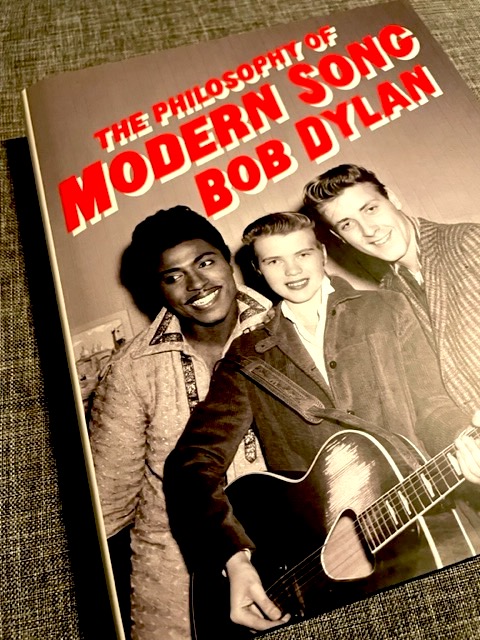
Weighing In on Bob Dylan's Philosophy of Modern Song

Despite waiting years for Dylan's sequel to Chronicles: Volume One, I did not order my copy of his Philosophy of Modern Song in advance last year, as I might normally have done. Rather, I requested it as a Christmas present and thus received it after weeks of reviews had already appeared. The "controversy" regarding his "autograph scandal" didn't phase me. Nor did the misogyny brickbats.

So here it is, sitting before me on the coffee table/wooden chest, beckoning me to express my initial first reactions.  

* * * 


The Philosophy of Modern Song is not anything like what most of us expected as the sequel to Chronicles Vol. 1. The writing, however, feels like a Dylan volume. Most Dylan fans who have listened to his Theme Time Radio show will very likely hear Dylan's voice reading it aloud as they read the text.

The book itself is a collection of essays on 66 songs by other artists, spanning from Stephen Foster to Elvis Costello. It has the look of a scrapbook in some ways. To some extent that makes sense in a pop culture sort of way. (When I was in Italy, I was talking about Dylan with a fellow who owned a craft brewery. He had a couple Dylan posters on the wall so I commented on my surprise at how much Dylan had been imported into Italy. He said, "America gave us two things: Bob Dylan and Pop Culture.")

According to the text on the inside cover flap Dylan began working on it in 2010. The sales-copy describes it as "a master class on the art and craft of songwriting," though quite a few critics demur on this proclamation. 

John Carvill at PopMatters.com, for example, wrote, "There’s very little of what we could sensibly consider ‘modern song’ in The Philosophy of Modern Song, and any ‘philosophy’ is strictly of the cracker barrel variety. That’s ok, though, because we’ve learned never to take Dylan at face value, and the title was just too pretentious to have been meant seriously." The subhead to that article calls it "an awful book, awash with misogyny and crusty old man rants."

I found that last barb to me a little harsh, but having become an older man myself I do understand why folk become "crusty" in their later years.

Sasha Frere-Jones called it "a fractured memoir and punch list of nightmares." And follows up with "what begins as a set of interpretations ends up as a sour little diary."
(4columns)

On the other hand, if you're seeking reviews with a little more enthusiasm for the subject matter (Bob's sequel to Chronicles: Volume One) then here's the place to be: 130+ Published Reviews of Dylan's Book.

I believe I did see at least one reviewer agree it that was "master class on the art and craft of songwriting." I saw it as something different. 

I enjoyed seeing the variety of songwriters selected. No surprise to find spotlights on Elvis, Little Richard, Johnny Cash and Hank Williams, as long-time fans know his respect for the music of these giants. Happy surprises include Stephen Foster, Nina Simone and many others. As for Dylan's impressions on pop hits from my own Boomer-era lifetime, there were many, such as "Ball of Confusion" by the Temptations, "Black Magic Woman" by Santana, "By the Time I Get to Phoenix" by Jimmy Webb, etc.  And then there are all the slices and slivers from other assorted musical genres that you probably would not have expected. 

The writing style is, as I noted, more of a rhythmic impressionism, a Dylan style you find in songs like "Subterranean Homesick Blues," punchy phrases falling all around like shrapnel from a hand grenade. 

Here's an excerpt from his chapter on Cher's "Gypsies, Tramps and Thieves" which is accompanied by old photos of a Peep Show carnival barker and a Side Show Zoo sign. 

You've evolved over thousands of years and you're still traveling through, setting up the tent and making ends meet. Hoaxes, tournaments and spectacles, that's your line of business. Drugstore cowboys, girl watchers, night owls--everybody and their uncle, you lighten them up and bleed them with ease. You give nightmares to people while they're fully awake. People whisper behind your back--lampoon you, satirize, mock and ridicule you, make bitchy comments but your place in the sun is secure.

Some of the book is almost as strange as his Tarantula.

A novel with a plot this is not. It's entertainment. Dean Martin's "Blue Moon" is accompanied by a cover photo of Robert Heinlein's The Moon is a Harsh Mistress. Carl Perkins' "Blue Suede Shoes" ends with a shoe ad.

Here's a digression from another chapter.

You're in an exclusive club, and you're advertising yourself. You're blabbing about your age group, of which you're a high-ranking member. You can't conceal your conceit, and you're snobbish and snooty about it. You're not trying to drop any big bombshell or cause a scandal, you're just waving a flag, and you don't want anyone to comprehend what you're saying or embrace it, or even try to take it all in. You're looking down your nose at society and you have no use for it. You're hoping to croak before senility sets in. You don't want to be ancient and decrepit, no thank you. I'll kick the bucket before that happens. You're looking at the world mortified by the hopelessness of it all.

In reality, you're an eighty-year-old man, being wheeled around in a home for the elderly, and the nurses are getting on your nerves. You say why don't you all just fade away. You're in your second childhood, can't get a word out without stumbling and dribbling. You haven't any aspirations to live in a fool's paradise, you're not looking forward to that, and you've got your finger....

In the first paragraph you are you, in a hopeless world. But suddenly, you are an eighty-year old man in a home for the elderly. Is that a pivot? Is Dylan saying what he means or is it the opposite? Is this his take on the sunset years? 

MY TAKE
Philosophy of Modern Song is fun, but is best enjoyed if you treat it like a book of poetry 
next to your easy chair which you can dip into and savor any time of day or night. Don't take it too seriously. Just enjoy it.

Related Links
Bob Dylan In Italy
What Does Charles Trenet's "La Mer" Have to Do with Dylan's Philosophy of Song?

Postscript
"an enthralling farrago of fabrications and tangents that occasionally, when it circles back to his early life on the Greenwich Village folk scene, offers rare bits of vivid personal disclosure, including meditations on artists and songs that helped shape him."
--Bob Dylan, Philosophy of Modern Song

Illustration Credit: Collaboration with Dream by Wumbo. 
Photo credits: the author, the latter at the train station in Florence, Italy.

Popular Posts