Showing posts with label pop culture. Show all posts

Monday, September 18, 2023

Weighing In on Bob Dylan's Philosophy of Modern Song

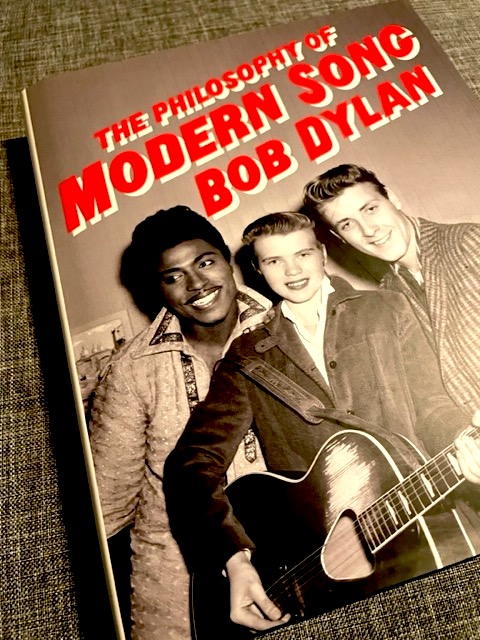
Despite waiting years for Dylan's sequel to Chronicles: Volume One, I did not order my copy of his Philosophy of Modern Song in advance last year, as I might normally have done. Rather, I requested it as a Christmas present and thus received it after weeks of reviews had already appeared. The "controversy" regarding his "autograph scandal" didn't phase me. Nor did the misogyny brickbats.

So here it is, sitting before me on the coffee table/wooden chest, beckoning me to express my initial first reactions.  

* * * 


The Philosophy of Modern Song is not anything like what most of us expected as the sequel to Chronicles Vol. 1. The writing, however, feels like a Dylan volume. Most Dylan fans who have listened to his Theme Time Radio show will very likely hear Dylan's voice reading it aloud as they read the text.

The book itself is a collection of essays on 66 songs by other artists, spanning from Stephen Foster to Elvis Costello. It has the look of a scrapbook in some ways. To some extent that makes sense in a pop culture sort of way. (When I was in Italy, I was talking about Dylan with a fellow who owned a craft brewery. He had a couple Dylan posters on the wall so I commented on my surprise at how much Dylan had been imported into Italy. He said, "America gave us two things: Bob Dylan and Pop Culture.")

According to the text on the inside cover flap Dylan began working on it in 2010. The sales-copy describes it as "a master class on the art and craft of songwriting," though quite a few critics demur on this proclamation. 

John Carvill at PopMatters.com, for example, wrote, "There’s very little of what we could sensibly consider ‘modern song’ in The Philosophy of Modern Song, and any ‘philosophy’ is strictly of the cracker barrel variety. That’s ok, though, because we’ve learned never to take Dylan at face value, and the title was just too pretentious to have been meant seriously." The subhead to that article calls it "an awful book, awash with misogyny and crusty old man rants."
I found that last barb to me a little harsh, but having become an older man myself I do understand why folk become "crusty" in their later years.

Sasha Frere-Jones called it "a fractured memoir and punch list of nightmares." And follows up with "what begins as a set of interpretations ends up as a sour little diary."
(4columns)

On the other hand, if you're seeking reviews with a little more enthusiasm for the subject matter (Bob's sequel to Chronicles: Volume One) then here's the place to be: 130+ Published Reviews of Dylan's Book.

I believe I did see at least one reviewer agree it that was "master class on the art and craft of songwriting." I saw it as something different. 

I enjoyed seeing the variety of songwriters selected. No surprise to find spotlights on Elvis, Little Richard, Johnny Cash and Hank Williams, as long-time fans know his respect for the music of these giants. Happy surprises include Stephen Foster, Nina Simone and many others. As for Dylan's impressions on pop hits from my own Boomer-era lifetime, there were many, such as "Ball of Confusion" by the Temptations, "Black Magic Woman" by Santana, "By the Time I Get to Phoenix" by Jimmy Webb, etc.  And then there are all the slices and slivers from other assorted musical genres that you probably would not have expected. 

The writing style is, as I noted, more of a rhythmic impressionism, a Dylan style you find in songs like "Subterranean Homesick Blues," punchy phrases falling all around like shrapnel from a hand grenade. 

Here's an excerpt from his chapter on Cher's "Gypsies, Tramps and Thieves" which is accompanied by old photos of a Peep Show carnival barker and a Side Show Zoo sign. 

You've evolved over thousands of years and you're still traveling through, setting up the tent and making ends meet. Hoaxes, tournaments and spectacles, that's your line of business. Drugstore cowboys, girl watchers, night owls--everybody and their uncle, you lighten them up and bleed them with ease. You give nightmares to people while they're fully awake. People whisper behind your back--lampoon you, satirize, mock and ridicule you, make bitchy comments but your place in the sun is secure.

Some of the book is almost as strange as his Tarantula.

A novel with a plot this is not. It's entertainment. Dean Martin's "Blue Moon" is accompanied by a cover photo of Robert Heinlein's The Moon is a Harsh Mistress. Carl Perkins' "Blue Suede Shoes" ends with a shoe ad.

Here's a digression from another chapter.

You're in an exclusive club, and you're advertising yourself. You're blabbing about your age group, of which you're a high-ranking member. You can't conceal your conceit, and you're snobbish and snooty about it. You're not trying to drop any big bombshell or cause a scandal, you're just waving a flag, and you don't want anyone to comprehend what you're saying or embrace it, or even try to take it all in. You're looking down your nose at society and you have no use for it. You're hoping to croak before senility sets in. You don't want to be ancient and decrepit, no thank you. I'll kick the bucket before that happens. You're looking at the world mortified by the hopelessness of it all.

In reality, you're an eighty-year-old man, being wheeled around in a home for the elderly, and the nurses are getting on your nerves. You say why don't you all just fade away. You're in your second childhood, can't get a word out without stumbling and dribbling. You haven't any aspirations to live in a fool's paradise, you're not looking forward to that, and you've got your finger....

In the first paragraph you are you, in a hopeless world. But suddenly, you are an eighty-year old man in a home for the elderly. Is that a pivot? Is Dylan saying what he means or is it the opposite? Is this his take on the sunset years? 

MY TAKE
Philosophy of Modern Song is fun, but is best enjoyed if you treat it like a book of poetry 
next to your easy chair which you can dip into and savor any time of day or night. Don't take it too seriously. Just enjoy it.

Related Links
Bob Dylan In Italy
What Does Charles Trenet's "La Mer" Have to Do with Dylan's Philosophy of Song?

Postscript
"an enthralling farrago of fabrications and tangents that occasionally, when it circles back to his early life on the Greenwich Village folk scene, offers rare bits of vivid personal disclosure, including meditations on artists and songs that helped shape him."
--Bob Dylan, Philosophy of Modern Song

Illustration Credit: Collaboration with Dream by Wumbo. 
Photo credits: the author, the latter at the train station in Florence, Italy.

Monday, July 31, 2023

The Taylor Swift Phenomenon: How Her Music and Image Have Impacted Pop Culture

No matter how much you dismiss pop culture, at some point one has to ask why this icon or that icon is so popular. While going through the checkout lines recently I couldn't help but notice the fan-mags dedicated to Taylor Swift as well as the mainstream mags striving to capitalize on her popularity. I understand the Beatles and Dylan being milked for more profits for their six decades-long fame, but Taylor Swift? I couldn't name a single song she's recorded even if I were put on the rack by the Spanish Inquisition.

Nevertheless, I found it valuable to investigate a little deeper and was impressed by this phenom who can pack stadiums and hold fans captive for three hour concerts and longer.

Click to enlarge.
Let's first review her achievements starting with her Guinness World Records. Taylor Swift is in the record books for selling the most albums by a female artist in the 21st century as well as the most number-one singles by a female artist in the US. 

That's a pretty eye-opening achievement right there. But here's more.

Swift has won 12 Grammy Awards, including Album of the Year for Fearless (2008), 1989 (2015), and Folklore (2020). She's the most awarded woman in Grammy history and the second most awarded artist overall. 

Like, wow. Like where have I been?

On top of this Swift has won 40 American Music Awards, the most of any artist in history. She has won in categories such as Artist of the Year, Favorite Female Artist – Pop/Rock, and Favorite Album – Pop/Rock.


OK, and what else?


Swift has also won 29 Billboard Music Awards, the most of any female artist. She has won in categories such as Top Artist, Top Female Artist, and Top Billboard 200 Album.

In addition to her awards and selling 200 million records worldwide, she has also been praised for her songwriting skills. She has been credited with revolutionizing the country music genre and bringing it to a wider audience. Her honesty and vulnerability in her lyrics have also contributed to her success.

To be frank, I've been somewhat out of touch with regards to Taylor Swift's career and her contributions to music and pop culture. What I do respect her for is her apparent stamina and character as demonstrated by more than two decades of being in the spotlight. There are countless others who have wilted under the heat of that focused beam.


So, why is Taylor Swift so popular? 


2023 Eras Tour (Creative Commons)
Her songwriting skills
: Swift is a gifted songwriter with a knack for writing relatable and catchy lyrics. Her songs often deal with themes of love, loss, and self-discovery, which resonate with her fans.

Her ability to connect with her fans: Swift is known for her close relationship with her fans. She often interacts with them on social media and at her concerts, and she makes them feel like they are part of her inner circle.


Her image: Swift has a carefully crafted image that is both relatable and aspirational. She is seen as a down-to-earth girl who is also successful and glamorous. This image has helped her to appeal to a wide range of fans.


Her longevity: Swift has been in the music industry for over 20 years, and she has consistently released successful albums and singles. It may not be the half century we find in Sixties' legacy artists (McCartney, Dylan) but it's a longevity that has played a role in building a loyal fan base that has only grown over time.


The rise of social media: This is possibly one of the biggest factors in her success. We live in a celebrity culture. With the megaphone of social media, stars and fans connect in new ways that give celebrity artists a reach unheard of before and, in Swift's case, helps her stay relevant in the ever-changing music industry.


Are you a Taylor Swift fan? How did it happen? Do you have a favorite album or song? Feel free to leave a comment.


Photo: Mostly Creative Commons

Sunday, July 30, 2023

The Decline of America's Culture Industries: The Struggle Between Bureaucracy and Creativity

While I was in Italy  this spring I was surprised to see the pervasiveness of Bob Dylan books, art and music. There was a Dylan Retrospectum (art) in Rome, and books about or by Dylan featured in every bookstore. I struck up a conversation with a craft beer brewer in Parma regarding this observation, and he noted that it's not just Bob Dylan that America has exported, but Pop Culture in general.

This notion of American pop culture as a product being exported led to my noticing an increasing amount of commentary about the widespread dissatisfaction with the products Hollywood has been feeding us over the past decade or more. Here are some thoughts generated by feeding a sentence into ChatGPT, regurgitated in essay form.

In recent years, America's culture industries have faced a formidable challenge, grappling with the effects of decay, monopolization, and increasing bureaucracy. As the pursuit of profit has intensified, creativity has become stifled, leading to a worrying decline in the quality and diversity of cultural productions. 


Let's examine the claim that America's culture industries have been transformed into anti-competitive, risk-averse monopolists, suffocating real creativity under the weight of mind-numbing and politically driven bureaucracy.


The rise of corporate giants within the culture industries (esp. Hollywood, literature, music) has undoubtedly fostered a monopolistic environment. Large media conglomerates have acquired numerous entertainment companies, consolidating their control over various creative outlets, from music and film to television and publishing. This monopolization has led to a lack of competition, as smaller players struggle to compete in an industry dominated by a select few. As a result, fresh and daring ideas are often sidelined in favor of formulaic, mass-appealing content that guarantees a return on investment.


Furthermore, the fear of taking risks has permeated the culture industries. Executives, driven by the pressure to maximize profits, tend to prefer established franchises and sequels, diminishing the opportunities for originality and innovative storytelling. This risk-averse approach stifles the potential for groundbreaking works of art and entertainment that push the boundaries of creativity.


To compound the problem, culture industries have become entangled in layers of bureaucracy. The quest for efficiency and streamlining often results in cumbersome approval processes and decision-making hierarchies that slow down productions and impede the free flow of ideas. 


The weight of bureaucracy also affects the individual creatives, subjecting them to creative restrictions and inhibiting their ability to express themselves fully. The prioritization of market research and focus groups over genuine artistic vision further exacerbates the problem, leading to a homogenization of content and an erosion of creativity.

Moreover, the rising politicization of the culture industries has added another layer of complexity. In an attempt to appeal to specific demographics or avoid controversy, creative decisions are sometimes shaped by political considerations rather than artistic merit. This approach may lead to watered-down narratives, sanitization of historical events, or the avoidance of sensitive issues, ultimately undermining the power of storytelling to address important societal challenges. 

In conclusion, the decay of America's culture industries can be attributed to a combination of anti-competitive monopolistic practices, risk aversion, and the burdensome bureaucracy they have imposed on their productions. Creativity, once the driving force behind cultural innovation, is now suffocating under the weight of profit-driven decision-making and politically motivated constraints. To revitalize the culture industries and foster an environment of genuine creativity, it is crucial to address these issues, encourage healthy competition, and prioritize artistic vision over short-term gains. Only then can American culture industries regain their vibrancy and contribute meaningfully to the enrichment of global artistic expression.

* * * 

Here's the prompt I used to produce the above brief essay:  "As America’s culture industries have decayed into anti-competitive, risk-averse monopolists, they have imposed layers upon layers of mind-numbing and increasingly politicised bureaucracy on their productions that make real creativity all but impossible." I pulled it from a much longer essay titled America's pop-culture armageddon by David Samuel at Unherd.

In short, the more that is at stake, the less people are willing to take risks. And because the giants control the channels of distribution, the most creative, outside-the-box original ideas never see the light of day.  

* * * 

Where things go from here is anyone's guess. What do you think?

Friday, May 12, 2023

Bob Dylan in Italy

Photo taken at a Parma craft brewer's place.
During my time in Italy a few weeks back I made a serious effort to look like an Italian and not a tourist. That I'd succeeded, to some extent, was certified when a younger Italian man asked me for directions to the train station. I replied and he never knew that I had just used up a third of my vocabulary. He thanked me and went on his way.

In most of my encounters, my lack of language skills were a dead giveaway. The follow up would usually be, "Where are you from?" I would say, "Duluth, Minnesota. Where Bob Dylan was born."

Bob Dylan's presence was everywhere I went. As I have several times noted, I was in Florence and Parma for 11 days. Both cities have offered much evidence that Dylan has a bit of Italy in his heart, and Italy has Dylan in theirs. This may be why Dylan's Retrospectum, a comprehensive collection of his visual art, was on display at the MAXXI Museum in Rome this spring. 

Every bookstore I went into had Bob Dylan books. The Florence train station and airport bookstores featured his Philosophy of Modern Song. And people from all walks of life acknowledged their fandom. 

While traveling by train from Parma back to Florence I was seated with a musician who plays bassoon with the Berlin Philharmonic Orchestra. He said he hailed from Turin and I mentioned that my father-in-law was in Turin at the end of WW2. I commented that I'd considered starting my Italy vacation in Milan so that I could visit Turin. Our conversation was in English and he asked where I was from. I gave my standard reply. He immediately said, "Bob Dylan is my hero."

I mentioned to him that Dylan was scheduled to perform a series of concerts in Italy in July and he was thrilled. I recommended he check out boblinks.com to see where Dylan would be and when. 

Here are a couple more photos from the stores.

I own a copy of Jim Marshall's book on the Never Ending Tour.

While in a Parma record store (vinyl) I had a discussion with another young man about how it was apparent that America had exported rock music to the world. He replied that it was not just rock, but "Pop Culture." Andy Warhol had indeed keyed in on something with his exploitation of all things pop.

For Dylan enthusiasts who may be interested in an Italy vacation this summer, Bob's five shows will be July 3 & 4 in Milan, July 6 in Lucca (in the beautiful Tuscany region), July 7 in Perugia (halfway between Florence and Rome), and July 9 in Rome.

Check out these photos of Lucca and Perugia. Don't tell anybody, but I'm ready to return. 

Monday, January 11, 2021

A Comparison of Sequels: MIB I & II vs. Terminator I & II

I just finished watching MIB and MIB II this past week. Afterwards, I tried to figure out why the first was so engaging and entertaining, and why the latter left me flat. Both feature Tommy Lee Jones and Will Smith, doing the usual things they do with deadpan wit. Both had innovative aliens and SFX. Both have given our heroes a task to accomplish or else life on earth as we know it will end. In other words, there is something at stake.

And yet, only the first seemed to really grab me. Why was this? 

It honestly seemed like the actors were bored with their roles in the second story, and if they're not into it why should I be? Could that possibly be?

I'm curious what the producers thought as they screened this when it first came out of the can. Many of the imdb.com reviewers were not kind at all. One called it, "The most forced, joyless comedy ever." Another called it, "Recycled garbage." A third wrote, "At Best, it's just a Lame Sequel to an Awesome Summer Movie."

This review perhaps does the best job of capturing what may have been the film's weakness:

`Originality,' is, almost by definition, a one-time thing. In 1997, the original `Men in Black' struck a nerve with movie audiences by showing that even a big budget blockbuster, heavily loaded down with state-of-the-art, computer-generated special effects, could still manage to seem light on its feet. The makers of that film pulled off this feat of gravitational legerdemain by coming up with a concept and a script overflowing with creativity, wit, imagination and a cachet of `hipness' to go along with its tone of anarchic playfulness.

Well, five years have passed and we now have `Men in Black II' to confirm what most of us suspected all along: that works that rely on `uniqueness' as their prime selling point are rarely ever able to duplicate their success a second time around. 

Nevertheless, with that last thought in mind, what was it that made Terminator 2: Judgment Day so successful then? MIB II got a 6.6 audience rating, whereas Terminator 2, directed by James Cameron (Titanic) received accolades and an 8.5 rating, even higher than the first. 

The Terminator films feature cyborgs who come from the future to kill John Connor, who will be a leader of the resistance in that future era. Arnold Schwarzenegger is the "star power" here in these films, much like Jones and Smith. But this sequel shuffles the deck and deals a different hand. 

First, whereas Schwarzenegger is a deadly, terrifying adversary in the first--and a truly original concept--he comes back in the second with the mission of being John Connor's bodyguard against a new, even more resilient and terrifying cyborg adversary. It's the psychological confusion (for Connor and his mother) that adds a level of intrigue in this story, and the fact that the new enemy is also so seemingly invincible and unique.

It you go back to the beginning of this Terminator series, though, you can't help but notice that The Terminator, also directed by James Cameron, was actually a very low budget film, barely over six million bucks. (Roughly the same as Iron Will, the Disney film shot here in Duluth that many here were extras in.) Worldwide gross for that first Terminator flick was 78 million. Clearly, by the time the sequel was produced, Cameron had established his cred and could be trusted with the 100 million dollar budget to turn this inventive sequel into something even more substantial. Worldwide gross: over a half billion. 

* * *

The Point Is This: The word "Sequel" has unfortunately become a byword meaning "Inferior" when it comes to Hollywood pictures. James Cameron did not succeed here simply by having a bigger budget. MIB II had an ample budget as well. Rather, it was the manner in which he took the original story to a new level, something the MIB team failed to do. 

What do you think?

Monday, April 20, 2020

Dylan Indeed Contains Multitudes

“I’m a man of contradictions, I’m a man of many moods
I contain multitudes.”--Bob Dylan


Of course Dylan contains multitudes. We've known this for ages, but only in more recent years have we discovered how vast the span of those multitudes really was.

He'd begun inhaling multitudes when he took deep dives into friends' record collections when he went to Dinkytown in Minneapolis upon leaving home. When he landed in New York Dylan's first stop was Izzy Young's Folklore Center at 110 MacDougal Street. It became a place to hang out, where he could continue his threshing of the American songbook.

I use the word threshing because it's the process of separating the wheat from the chaff. I'll carry that notion further and compare what he does to the magical process of baking bread. The ovens in Dylan's mind were continuously processing, reconfiguring all these human experiences into the songs of his experience.

This process of sifting, baking and serving his delicious aromatic product (songs) to the world also got him accused of plagiarism. What's apparent is that those accusations came from people who didn't understand the historical basis of intertextuality.

It wasn't till I heard Harvard Classics professor Richard F. Thomas speak at Duluth Dylan Fest in 2018 that the light went on most fully for me. Among other things, he talked about Intertextuality. At one point he cites a statement from T.S. Eliot: “Immature poets imitate; mature poets steal; bad poets deface what they take, and good poets make it into something better, or at least something different.”

Dr. Thomas, who had been a lifelong Dylan fan, began to see Dylan's later source material more clearly than most because Thomas teaches the Harvard Classics and was thus more intimately acquainted with Ovid, Virgil and Homer than the average man or woman on the street. Here's an excerpt from an interview with Dr. Thomas by the editorial staff of Harvard's Persephone:

P: When did you first begin to notice intertextuality between Bob Dylan and classical authors?

RFT: It really wasn’t until 9/11. Dylan had an album that came out on that morning called “Love and Theft.” Now I had noticed intertextuality of a similar sort in 1997 with the song “Highlands” from the album Time Out of Mind, a very long, narrative song that 2 has the refrain “My Heart’s in the Highlands.” So [that was from] Robert Burns... But it wasn’t really until the 2001 album “Love and Theft” [that I noticed intertextuality with classical authors]…Now if the intertexts are activated in the mind of the listener, it’s not just Vietnam, the war of Dylan’s youth, it’s all of these literary wars, including the Roman wars of Aeneas and the Civil Wars, for which they in some way stand.

* * * *
Like many others who listened to I Contain Multitudes the day after it was released, my mind noticed how all these pieces were stitched together into a whole, but it would take a few days to isolate its component parts. Murder Most Foul similarly is an enormous patchwork quilt of references. What I'm going to suggest is. that there's a common denominator in the two.

If we consider I Contain Multitudes as a self-portrait, Murder Most Foul is a portrait of our generation. That is, that these are influences that we--or more precisely, the generation of Bob's peers--have shared in common. Wolfman Jack, conspiracy theories about the assassination we all witnessed and lived through, the music, films, a historical tsunami of life-shaping inputs, including those Dylan himself showered on us, sometimes pelting, sometimes nourishing.

The string of images in both these songs strikes me as similar in construction to Desolation Row of his early songwriting, another sprawling cast of characters lined up along a flowing music track that serves as a lyric background landscape.

David Kinney, in his book The Dylanologists, breaks Dylan fans into eight categories from Pilgrims and Collectors to Front Rower-ers and Scholars. And then there are the Lyric Dissecters. This last category is probably the most energized by these kinds of songs. There are simply so many endless clues to follow, rabbit holes to enter. As Dr. Rollason notes on his Bilingual Culture Blog, "‘I Contain Multitudes’, clocking in at 4:36 minutes and, while shorter than its lengthy predecessor, still replete with allusions in numbers enough to keep the planet’s Dylanites happily occupied."

* * * *
Page from The Measure of His Song, Holy Cow Press
The references to other poets have already been noted by many these past few days, most readily to Poe, Blake and Whitman.

I'm not going to do lyrics dissection here, as so many have been undertaking this already, but I did think the opening lines interesting enough to lay side by side with Whitman's Song of Myself 51.

Today and tomorrow, and yesterday, too
The flowers are dyin’ like all things do.
      --Dylan, I Contain Multitudes

The past and present wilt--I have fill'd them, emptied them.
And proceed to fill my next fold of the future.
      --Whitman,'Song of Myself, 51 

Both poems begin with the trisection of time, Dylan's conveying a looking back, and Whitman still looking to fill his next fold.


As with all things Dylan, much more can be said. Though many things have changed since he first appeared on the scene, one thing that's unchanged is that you never know what revelations tomorrow will bring.

When I was young I audited a class on the Book of Revelation at Princeton Seminary taught by the esteemed Greek scholar Dr. Bruce Metzger. There's a sense in which dissecting Dylan lyrics can be a little like interpreting the Book of Revelation, so rich with symbols. At the end of the semester, after teaching all the various ways that this last book of the Bible had been interpreted he was asked by a student, "And what do you believe?" He smiled and said, "The Book of Revelation attracts people who are cracked, or leaves them that way."

Can the same be said of obsessive Dylanite Lyric Dissecters? I dunno. The puzzles are many and considerably problematic while remaining immensely entertaining.

“I carry four pistols and two large knives."

Related Links
"Go Away Bomb:"---Dylan Writes A Song for Izzy Young
Walt Whitman: The Measure of His Song       
Whitman's Song of Myself, 51
Harvard Classics Prof Pulls Back the Curtain to Reveal New Insights on Dylan's Art
An Interview with Richard F. Thoomas on Bob Dylan and the Classic by the Harvard Persephone Editorial Staff 
Why Bob Dylan Matters

Sunday, March 22, 2020

A Kenny Rogers Memory

Creative Commons.*
Kenny Rogers was savvy. When the Sixties psychedelic rock thing was happening he produced a hit single that went like this: "I just dropped in to see what condition my condition was in."

In one way it was nothing different from many entertainers at the time. Sonny & Cher got a stellar hit with "I Got You Babe" because Dylan had made the word "babe" popular in a couple songs, including "It Ain't Me Babe." [Cher: "Sonny, can you write a hippie love song with the word babe in it?"]

Country star Rogers leveraged his crossover hit and became a brand with hits like "The Gambler" and his famous duet with Dolly Parton, "Islands in the Stream." Only after reading his obit did I learn he had produced 65 albums and sold more than 165 million records during his lifetime.

He actually began recording in the late 50s, and like many other 60s artists he'd spent years honing his talents to later become an overnight sensation. Petula Clark and the Beatles come readily to mind.

In 1966 Rogers joined the New Christy Minstrels, catching the tail end of the folk era, and a year later left with several of the Minstrels to form the First Edition, where he garnered that first big hit.

When we moved to Duluth in 1986, Susie and I became friends with Ed and Cheryl Beaver whom we met at the Presbyterian Church downtown here. Cheryl and Susie were both roughly seven months pregnant, and both Ed and I shared the same first name, plus our last names each had six letters and two syllables, and Ed and I were both writers.

Ed. was also a piano tuner, which is where this whole story is going. Because of Ed's occupation he was occasionally called in to tune the pianos that performers shipped in for concerts. On one occasion Ed tuned a piano for Johnny Cash, and at another Duluth concert at the DECC Ed tuned Kenny Rogers' white piano.

Entertainers can sometimes have a reputation for being egotistical jerks. Ed said Kenny Rogers came in while he was tuning, and was just a super nice down to earth guy.

Here's a song that Rogers wrote, and sang during that concert, with life advice that every one of us can relate to.

Every gambler knows
That the secret to survivin'
Is knowin' what to throw away
And knowin' what to keep
'Cause every hand's a winner
And every hand's a loser
And the best that you can hope for is to die
in your sleep

And when he finished speakin'
He turned back toward the window
Crushed out his cigarette
And faded off to sleep
And somewhere in the darkness
The gambler he broke even
But in his final words
I found an ace that I could keep

That's how I've felt about most of the great books I've read, great movies I've experienced, seminars I've attended or great songs that speak to one's heart. Even if the philosopher is out of sync with your own convictions and faith, there's almost always an ace you can keep, an insight to tuck into your breast pocket for future redemption.

Meantime...

You've got to know when to hold 'em
Know when to fold 'em
Know when to walk away
And know when to run
You never count your money
When you're sittin' at the table
There'll be time enough for countin'
When the dealin's done

* * * *
Here's a live performance of Kenny Rogers' first superhit: Just Dropped In


*Photo credit: John Mark Smith, www.celebrity-photos.com

Monday, March 9, 2020

Frank Zappa Explains Why the 60s Music Scene Scene Was Such a Kick

Last week I shared some of the songs that brought to mind memories of various people who were important to me in one way or another. One of these songs was the zany one-hit-wonder They're Coming to Take Me Away Haha. Assuming you're familiar with the song (and I won't blame you if you're not), have you ever noticed the similarity between the opening notes (no notes, but percussion) and the intro to Bob Dylan's Rainy Day Women #12 & 35.

It's not identical, but similar, until Dylan adds that Salvation Army Band accompaniment, including trombone, the slide trombone being the second most memorable feature of the background players, the heartfelt laughter being first--none of which detracts in any way from the lyrics, which have nothing to do with rainy day women and everything to do with the punch line.

So, the question on the table is this: How did all those crazy songs like They're Coming to Take Me Away Haha get produced, and even promoted?

First off, silly songs had always peppered the pop charts, and were no doubt features of traditional folk music from the Hngarian hills to the Scottish Highlands. Nevertheless they became more visible via the advent of radio, and that didn't start in the Sixties either. Examples include the Monster Mash (1962), Flying Purple People Eater (1958), and Alley-Oop (1960).

But the late Sixties, when I was in high school, gave us plenty of unexpected music that one would be hard pressed to find a record label for today. Here are just a few memorable tunes that may bring back memories if you're a Boomer: Snoopy vs. The Red Baron, Wild Thing, Green Tambourine and Gitarzan to name a few.

Painting by the author.
Bob Hoffman, in his new book Advertising For Skeptics, shared an insight from Frank Zappa about why this period in pop music was such a swirl of creativity. Here's a link to a 1987 interview where Zappa explains the decline of the music business.  

The 60s were a time of transition where book publishing and the music industry weren't sure what would or would not work in the marketplace. I've written elsewhere about how the New York publishing houses eventually got out of the religious market because they were getting pummeled by not understanding the Jesus Movement.

In the music scene they're attitude was something akin to throwing spaghetti on the wall to see what stuck. They were often surprised.

“One thing that did happen in the 60s,” he (Zappa) says, “was some music of an unusual and experimental nature did get recorded, did get released.” The executives of the day were “cigar-chomping old guys who looked at the product and said, 'I don’t know. Who knows what it is? Record it, stick it out. If it sells, alright!'”


Freak Out (Mothers of Invention) was born in this spirit, as was "They're Coming To Take Me Away, Haha."

That's all for now. The doorknob's broke.

Related Link
Zappa Quotebook

Sunday, September 15, 2019

A Few Comments On Bob Dylan's I Shall Be Free No. 10

Ain't no use a-talkin' to me.
It's just like talkin' to you.
Last week as I read about JFK and the space race, various thoughts fluttered through my head like butterflies, which I often feel obligated to capture and pin down. While reading, the Dylan line, "what if the Russians get up there first" from "I Shall Be Free No. 10" got me scurrying to find the rest of that stanza.

Well, turns out he sang  about the streets of heaven being lined with gold, and
I ask you how things could get much worse 
If the Russians happen to get up there first 
Wowee! pretty scary!

It's actually a mixed metaphor. No one at that time was worried about Russians getting to heaven first. On the other hand, plenty of people, ever since Sputnik, were anxious about the Russians being the first to land men on the moon.


* * * *
If you're not familiar with "I Shall Be Free No. 10," the fifth track on Another Side of Bob Dylan, you really should give it a listen.

I frequently get insights about Dylan songs at Tony Atwood's Untold Dylan blog/website. In this entry he notes how Dylan recorded several additional songs that didn't appear on the album, which has been a custom of his. What I recall, from another source, is how he recorded many, if not most, of the songs here in one take.

I remember a friend who years ago commented that there were always a few throw away songs on Dylan's albums. I found this a curious statement and can't say I ever bought into that. I mean, there were songs that didn't move me or that I didn't connect to, but I couldn't call them throwaways. Or I never considered them in that terse of a dismissal.

As for this song, I don't see it that way at all. It's perfectly in line with a number of other amusing pieces, such as Talkin' World War III Blues and his Bear Mountain Picnic rag. And what's Bob Dylan's 115th Dream if it's not a mix of comic wit and satire.

When I hear I Shall Be Free #10 I'm immediately curious what #9, #8, #7 and the rest were like. Without doubt it's a sequel to I Shall Be Free of sorts.

1962. Photo Ted Russell. William Pagel Archives.
Atwood points out echoes of Lead Belly and Chuck Berry in the song.

As much fun as the song is, understand where Atwood is coming from when he he says "it was a bit of a bore to listen to over and over when one played the LP." That is, after the first few listens, you already get all the punch lines and want to move on. For some reason I don't tire of it.

I am that way with "Bob Dylan's 115th Dream" on Bringing It All Back Home sometimes. The sequence of Dylan tunes beginning at Tambourine Man is so potent still that I get impatient waiting for it to arrive and skip 115th Dream.

* * * *
With "I Shall Be Free No. 10" each stanza has its own comedic feature. The first stanza plays off being common. The second springboards off the champion boxer's celebrity. Stanza three is our light-hearted Cold War scenario spoof. "Wowee! Pretty scary!" Stanza four is a playful reversal of the usual quip about who can and can't live in the house next door.

Stanzas five and six are just plain hilarious, playful and weird. And like the song, it's another side of Bob Dylan. Comin' to think about it, so's the rest. And guess what? It is what it is.

* * * *
Author Tim Cain, in his 2006 article Bob Dylan is a funny, funny man: XM radio reveals humor in enexpected places, also cites I Shall Be Free, among other things. The article was written in response to Dylan's radio hour along with the release of Modern Times.

The late John Bushey, host of the KUMD radio show Highway 61 Revisited, loved Dylan's sense of humor also. On one occasion when I was a guest on his show, John wanted to play a song from a live concert in France in which Dylan spends the first four minutes tuning his guitar. John asked me with a grin, "Do you think I can get away with this?"

There's humor woven all through Dylan's lyrics. Just listening to the dialogue between God and Abraham ought to be a clue. A bit later, "Howard just pointed with his gun. That way, down Highway 61." Who are all those crazy characters anyways?

When I interviewed Bob this spring he didn't say a word.
Photo courtesy Michael Anderson.
Maggie's Farm has some hilarious characters, too. Maggie's pa is one of them. "Well, he puts his cigar out in your face just for kicks .His bedroom window it is made out of bricks.  The National Guard stands around his door--"

What makes his comic side work so well is that it serves as comic relief from the sobering nature of much of his content. Find me one example of Dylan singing with a cheerful tone, "It's Alright, Ma (I'm Only Bleeding)." Yet right in the middle of that song we have a line that continued to get laughs decades later. "But even the president of the United States
Sometimes must have to stand naked."

That last humorous image brings to mind (for me) Kevin Kline's interrupted shower in the movie Dave when the First Lady (Sigourney Weaver) confronts him, perfectly demonstrating the double meaning of the word "exposed."

Louie Kemp, in his book Dylan & Me, has more than a few comic anecdotes in it revealing this other side of Bob Dylan. Kemp insists that the Bob Dylan everyone knows publicly is just a persona. Where one ends and the other begins--the person and the persona--is not my problem.

Here's the song. You can find an outtake on YouTube in the links at the bottom of the page.

I Shall Be Free No. 10

I’m just average, common too
I’m just like him, the same as you
I’m everybody’s brother and son
I ain’t different from anyone
It ain’t no use a-talking to me
It’s just the same as talking to you

I was shadow-boxing earlier in the day
I figured I was ready for Cassius Clay
I said “Fee, fie, fo, fum, Cassius Clay, here I come
26, 27, 28, 29, I’m gonna make your face look just like mine
Five, four, three, two, one, Cassius Clay you’d better run
99, 100, 101, 102, your ma won’t even recognize you
14, 15, 16, 17, 18, 19, gonna knock him clean right out of his spleen”

Well, I don’t know, but I’ve been told
The streets in heaven are lined with gold
I ask you how things could get much worse
If the Russians happen to get up there first
Wowee! pretty scary!

Now, I’m liberal, but to a degree
I want ev’rybody to be free
But if you think that I’ll let Barry Goldwater
Move in next door and marry my daughter
You must think I’m crazy!
I wouldn’t let him do it for all the farms in Cuba

Well, I set my monkey on the log
And ordered him to do the Dog
He wagged his tail and shook his head
And he went and did the Cat instead
He’s a weird monkey, very funky

I sat with my high-heeled sneakers on
Waiting to play tennis in the noonday sun
I had my white shorts rolled up past my waist
And my wig-hat was falling in my face
But they wouldn’t let me on the tennis court

I got a woman, she’s so mean
She sticks my boots in the washing machine
Sticks me with buckshot when I’m nude
Puts bubblegum in my food
She’s funny, wants my money, calls me “honey”

Now I got a friend who spends his life
Stabbing my picture with a bowie knife
Dreams of strangling me with a scarf
When my name comes up he pretends to barf
I’ve got a million friends!

Now they asked me to read a poem
At the sorority sisters’ home
I got knocked down and my head was swimmin’
I wound up with the Dean of Women
Yippee! I’m a poet, and I know it
Hope I don’t blow it

I’m gonna grow my hair down to my feet so strange
So I look like a walking mountain range
And I’m gonna ride into Omaha on a horse
Out to the country club and the golf course
Carry The New York Times, shoot a few holes, blow their minds

Now you’re probably wondering by now
Just what this song is all about
What’s probably got you baffled more
Is what this thing here is for
It’s nothing
It’s something I learned over in England
Copyright © 1971 by Special Rider Music; renewed 1999 by Special Rider Music


Related Links
Humorous Bob Dylan Lyrics
Jokerman: The Humor of Bob Dylan
Tony Attwood's take on this song.
And this Outtake you can find on YouTube
And the beat goes on.

Wednesday, October 17, 2018

The Cars of Alcatraz East Crime Museum

"Break the rules and you go to prison. Break the prison rules and you go to Alcatraz." 

Alcatraz East, new home of the Crime Museum.
They say crime doesn't pay, but it has certainly sold a lot of newspapers and generated plenty of stories. From the earliest years of Hollywood, tinseltown has produced a wide array of films and TV shows about bootleggers, hustlers, mob violence and the consequences of a life of crime. In 1931 Edward G. Robinson made a splash as a small time criminal who goes to the big city to make a fortune in Little Caesar. The following year Howard Hughes' Scarface hit the silver screen, loosely based on the Chicago mob boss of the same nickname whose career had just come to a close. In fact, Hollywood produced seemingly countless Capone films. More than 20 actors have played the notorious mob boss, and a dozen more have played characters based on the man. Books are equally numerous, one of them by Deidre Marie Capone, whose grandfather was "Uncle Al's" brother.*

When we were kids my brother and I loved watching The Untouchables on television, with Elliot Ness heading up the good guys trying to reign in Capone and company. At that time we thought the bad guys were cool, so when we played I'd be Machine Gun Kelly, and others would play Baby Face Nelson, Scarface or Johnny Torrio. When all of us kids grew up we were a ripened market for Brian De Palma's slick, no-holds-barred version of this Chicago gangland story starring Kevin Costner and Sean Connery as the good guys and Robert de Niro as the ultimate Capone.

John Dillinger's 1933 Essex Terraplane, purchased in 1934. FBI agents
nearly got him, but he escaped with his girl friend Evelyn Frechette.
You can still see a bullet inside the car from the shootout.
Another name that resonated with readers of crime stories was John Dillinger. And when Warren Beatty wore the mantle of Clyde Barrow, that film put a human face on the life of crime. Beatty must have enjoyed playing the role because he later decided to wrap himself in the character of Bugsy Siegel, the gangster who helped create The Strip in Las Vegas and the glam in glamour.

We visited our kids when they were in California for a spell and one of the highlights of the trip included a visit to the Rock, the island of Alcatraz. In 2016 a Washington D.C. crime museum closed and its artifacts, memorabilia and collections were moved to Pigeon Forge, Tennessee to a new home called Alcatraz East.

The Alcatraz East museum features 20 different exhibit areas focused on five themes: the history of American crime, the consequences of crime, crime scene investigation (CSI), crime fighting, and pop culture. Authentic pieces used as evidence in well-known criminal cases, and interactive exhibits and activities, are on display. And some rather famous cars as well.

Replica of Bonnie & Clyde's 1934 Ford V-8, shot full of holes for the film.
The flathead V-8 engine was introduced in 1932, and soon became an instant hit. 
You can see we've travelled far afield of the purpose of this blog post which was to share a few of the cars featured at Alcatraz East. Cars have played a defining role in U.S. history since Henry Ford's invention of the assembly line. Cars are featured in at least two of F. Scott Fitzgerald's books (we especially remember the role cars played in The Great Gatsby) and GM wasn't far off when it pegged Chevy as "the heartbeat of America."

Prohibition-era gangsters rushed through the city with Tommy-guns blaring, and bank robbers made their daring escapes in their getaway cars with running boards. In Bonnie and Clyde, those shootout scenes and especially the final takedown in this cream-colored '34 Ford (pictured above) probably set new standards for realism in Hollywood violence.

Serial killer Ted Bundy's 1968 Volkswagen Beetle is also featured in the museum. His name alone gives one the creeps. The vehicle was integral to both his murders and his ultimate conviction when it yielded important DNA evidence. The car is displayed without the front passenger seat in the same way Bundy used the car.

Until OJ attempted to make his great escape in his white 1993 Ford Bronco, the slowest white Bronco in this country was John Elway. That Bronco driven by Simpson’s friend Al Cowlings is now parked inside Alcatraz East. Do you remember where you were during that slow speed chase with OJ in the back seat? I do.

For the record there are a couple vehicles from the "good guys" side here as well including a County Sheriff's car and a Surveillance Vehicle that had been used by the Food & Drug Administration.


Pigeon Forge is located Southeast of Knoxville near the Great Smoky Mountains National Park, a most beautiful part of the world. According the Rachael Penman, director of artifacts and exhibits,“Our crime cars each represent a cautionary tale, symbolizing a warning about the consequences of crime, while our law enforcement vehicles are positive reminders of all that law enforcement does every day, both in public and behind-the-scenes, to keep us safe.”

Related Links
For more info or to purchase tickets: www.alcatrazeast.com
* My interview with Deidre Marie, Last of the Capones
Claudia Oltean's Another Chance to Die
Writing Crime Fiction In Prohibition Era Detroit
Our Visit To Alcatraz 

Meantime, life goes on all around you. Engage it.

Popular Posts