Showing posts with label entertainment. Show all posts

Monday, September 1, 2025

"If at First You Don't Succeed" and Other Modern Words of Wisdom

I was looking for a folder in one of my backup drives and came across a document titled "Modern Words of Wisdom." I share these here for entertainment purposes only. 

* * *

If at first you don't succeed, destroy all evidence that you even tried.


A conclusion is the place where you got tired of thinking.


Experience is something you don't get until just after you need it.

For every action, there is an equal and opposite criticism.

Never do card tricks for the group you play poker with.

No one is listening until you make a mistake.

Success always occurs in private, and failure in full view.

The colder the X-ray table, the more of your body is required on it.

The severity of the itch is proportional to the reach.

To steal ideas from one person is plagiarism; to steal from many is research.

To succeed in politics, it is often necessary to rise above your principles.

The problem with the gene pool is that there is no lifeguard.

Monday is an awful way to spend 1/7th of your life.

The sooner you fall behind, the more time you'll have to catch up.

A clear conscience is usually the sign of a bad memory.

Change is inevitable .... except from vending machines.

A fool and his money are soon partying.

If you think nobody cares about you, try missing a couple of payments.

How many of you believe in telekinesis? Raise my hands ....

Attempt to get a new car for your spouse -- it'll be a great trade!

Drugs may lead nowhere, but at least it's the scenic route.

I'd kill for a Nobel Peace Prize.

Everybody repeat after me....."We are all individuals."

Love may be blind, but marriage is a real eye-opener.

Bills travel through the mail at twice the speed of checks.

Hard work pays off in the future. Laziness pays off now.

Borrow money from pessimists -- they don't expect it back.

Half the people you know are below average.

99 percent of lawyers give the rest a bad name.*

42.7 percent of all statistics are made up on the spot. 


If you've read this far, maybe you'd like add a couple witticisms of your own in the comments. And do enjoy the rest of your day.


* * * 


* This line deserves elaboration. My take aligns with Jonathan Swift (Gulliver's Travels author) who said the following in a letter to Alexander Pope: “I have ever hated all nations, professions, and communities; and all my love is toward individuals: for instance, I hate the tribe of lawyers, but I love Counsellor Such-a-one, and Judge Such-a-one: so with physicians— I will not speak of my own trade—soldiers, English, Scotch, French, and the rest. But principally I hate and detest that animal called man, although I heartily love John, Peter, Thomas, and so forth.”


Thursday, February 8, 2024

The Golden Triangle (A Short Story)

DISCLAIMER: THIS IS A WORK OF FICTION

The Golden Triangle


A young woman in her early-30s attempts to reach out to a friend in Minneapolis whom she’d been visiting the week before. She accidentally connects with some old guy in Duluth. For some strange and improbable reason, they keep chatting. 

As it turns out he’s a writer, she’s a high-end, international jewelry dealer from Hong Kong, now living in L.A.


As they talk, they discover that each shares a common dream: Is there any possible way that one person alone could solve all the problems in the world? How much can one person accomplish if they have unlimited resources and a half century to do it in?


* * * 


Here's one possibility of how it plays out on the silver screen.


The movie opens with the Hong Kong woman, now very old, receiving a Nobel Peace Prize. In her acceptance speech, or maybe it's a press conference, she acknowledges someone who opened her eyes to the possibilities and responsibilities that come with wealth. 


As the movie’s opening credits finish rolliing, she is young again and the story begins.


It’s an amazing story because together they rally the human race to work together, to put an end to poverty, hate, violence, etc.  


* * * 


In an alternate version, he’s the billionaire. He's also a retired secret agent, and she is the creation of an A.I., with intentions initially unclear. As it turns out, the contact wasn't an accident at all but a ruse. He's an avid art collector. The AI's objective is to acquire his two Vermeers and a set of original Da Vinci sketches that no one knows about, but which the AI discovered by deconstructing the details of his life. The Vermeers both turn out to be fakes. The sketches are anatomical studies, both delicate and daring. 


Tension in the story is generated by the AI's quest to carry out the art heist without a body. The backstory question is this: did the AI initiate the heist on its own? 


Should the crime be solved by an AI detective, an AI version of Columbo or an algorithmic Hercule Poirot? 


Wednesday, October 25, 2023

Out of the Spotlight, Into the Saddle

I was thinking about cancel culture and an idea for a story emerged. I asked ChatGPT to write a 400 word story based on my idea. I then edited and expanded it to this 800 word story. Hope you find it entertaining.

Out of the Spotlight, Into the Saddle

Illustration by the author.
In the small, dusty town of Dusty Gulch, a once-famous TV star had found solace in the forgotten corners of the past. His name was James "Jay" Thornton, once adored by millions, until a single tweet razed his career to the ground. 

Driven by the desperate need to escape the relentless wrath of his fans, Jay acquired a time machine on the black market. Life as he’d known it was over forever.


One fateful day, he decided to try out his new toy, to give it a test drive. He wanted to see the future. Maybe he could find himself there. Unfortunately, the time machine malfunctioned, propelling him back to the year 1885 where he landed on a remote cattle ranch in the foothills of the Rockies.


Working as a humble ranch hand, Jay kept his past a well-guarded secret. He perpetually shunned the spotlight, now preferring the companionship of the open range and the simple folk of Dusty Gulch. One evening, in the dimly lit bunkhouse, Jay found himself sharing a bottle of whiskey with the other cowboys. As the alcohol flowed, the tales of their lives spilled out. 


With a heavy sigh, Jay decided to reveal his own story. "You know, back in my time, I used to be famous.”


“Really? How’s that. You shoot somebody? Rob a train?”


“No, no, no, no. I was a famous actor on television," he began.


The cowboys exchanged perplexed glances. "Television? What's that, Jay?"


"Well," he continued, "it's a magic box that shows moving pictures, stories, and news on a screen. People used to watch it for hours on end."


“You mean, something like a Magic Lantern,” the Finn said. 


“Sorry,” Jay said. “What’s a Magic Lantern?”


The Finn said, “I don’t know how it worked but it was kind of a thing where they used an oil lamp or lantern to shine through these glass plates and you would see images.”


Another cowboy interrupted. “We had a travelling showman come through these parts on the way to California and he put on a show with it, telling stories and projecting images onto a sheet we hung over a wire.”


“He said he was trying to sell them to schools or something like that,” a third added.


“Well,” Jay continued, “That's very interesting. I never heard of Magic Lanterns but you have something of an idea of pictures in boxes. In the future these boxes will show moving pictures. The box I'm talking about will be called a television set.”


“How do the pictures get into the box, Jay?” 


Jay shook his head and rubbed at his chin with his knuckles. “It’s all very strange really. The box is connected to a device called an antenna, which receives a stream of signals from a broadcast station. The pictures go through the air and –“   


He could tell by their expressions and the way they were fidgeting that they would never understand. The cowboys were scratching their heads, struggling to fathom this new concept. 


"How'd you end up here, Jay?"  


Jay took a deep breath. Another impossible question. He confessed, "I tweeted something that made a lot of people angry, and they canceled me. It ended my career."


"Canceled?" one cowboy asked.


“Tweeted?” another said. “You mean you made a sound like a bird or somethin’?”


“No, it’s sort of a communication platform.”


“Platform?” 


“It’s kinda like an online Wild West show,” Jay said, shaking his head dismissively as the words “Wild West” popped out of his mouth.


The boys all chuckled. 


“You’re not making any sense, Pard,” Big Burt said as he held out the bottle. “Better take another swig.”


Jay waved it away. “A tweet is like a message. Like those wanted posters back at the sheriff’s place.”


“Ah,” said a quiet cowboy off to his left. “So, you’re wanted.”


“No, no,” Jay replied. “I’m actually un-wanted. They took away my job.”


The cowboys burst into laughter. "Well, Jay, 'round these parts, we live by our own rules.”


Jay smiled, relieved by their reaction. "You're right. Life here is simpler, more honest."


The cowboys, now accepting him as one of their own, raised their glasses in a toast. "To Jay, the cowboy without a past!"


As Jay shared more stories of his time in the entertainment business, the cowboys listened in amazement, trying to imagine a world they could scarcely comprehend. For Jay though, the Wild West had become a sanctuary, far removed from the brutally unforgiving judgments of his former life. 


In the bunkhouse in Dusty Gulch Jay Thornton found a second chance among people who judged him not by his past, but by the man he had become. They might never understand his world of television and tweets, but they respected him for who he was now – a cowboy who had found redemption in the embrace of the Wild West, far from the relentless scrutiny of the digital age.


* * * * 

Just having fun. If you enjoyed this, feel free to leave a comment.

Thursday, September 21, 2023

There's No Business Like Show Business

Show business is the entertainment industry. It includes all aspects of creating, producing, and distributing entertainment, such as music, film, television, theater, and live performance. Show business is a global industry that employs millions of people and generates billions of dollars in revenue each year.

The term "show business" is thought to have originated in the early 19th century, when it was used to describe the business of putting on shows and theatrical productions. Over time, the term has come to encompass all aspects of the entertainment industry, from the creation of content to its distribution and consumption.

But also, over time, this tendency to turn everything into entertainment has spread into nearly every market crevice like an oil slick on a Minnesota lake. It was probably easy for Muhammed Ali to transform boxing with his audacious antics, helped in large part by Howard Cosell standing by with his Wide World of Sports megaphone.

With the advent of television it was inevitable that sports--from football and baseball to basketball, hockey and golf--would become more about entertainment than the games. Sure, the players were serious about bringing home titles and championship rings, but the big bucks rolled in when media moguls learned how to turn these competitive games into "stories."

Scottish thinker Thomas Carlyle once called economics "the dismal science." But even this has been turned into an entertainment vehicle by the likes of the flamboyant, volcanic Jim Cramer. Even NPR presents an entertaining look at the markets, albeit with a different tone. Informative? Yes, but similarly recognizing that to keep listeners coming back there has to be some crafting taking place. "Now, let's look at the numbers."

In the realm of crime things have gotten especially bizarre. Today while browsing X (formerly known as Twitter) I saw a video of a woman violently assaulting a 13 year old girl in a store. As many as ten or more onlookers stood their watching and recording it on their cell phones, most likely to share on social media themselves. No one intervened.

When I was a kid I had a cousin in Ohio whose father was a volunteer assistant fire chief. They had a squawk box in their house so that when there was an accident or fire or some other incident my uncle could quickly take off to assist. Today, there are people who buy these squawk boxes just to listen to what's happening in the realm of law and disorder. Why wait till you read it in the paper or see it on TV? Listen as it happens.

And of course, there's politics. Elections must one of the strangest forms of entertainment devised by humankind. The debates? How deep can you go into a topic when you have one minute for a rebuttal.

Even we ourselves have been swept up in this show biz stance toward the world around us. From the way we present ourselves on social media to the way some people interact with their colleagues at work, we are constantly performing for others.

What are Instagram and Tik Tok all about? YouTube the same. "Look at me. I'm a star!" You bet you are. But what I want to know is what's underneath that veneer?

Related Link


Sunday, July 30, 2023

The Decline of America's Culture Industries: The Struggle Between Bureaucracy and Creativity

While I was in Italy  this spring I was surprised to see the pervasiveness of Bob Dylan books, art and music. There was a Dylan Retrospectum (art) in Rome, and books about or by Dylan featured in every bookstore. I struck up a conversation with a craft beer brewer in Parma regarding this observation, and he noted that it's not just Bob Dylan that America has exported, but Pop Culture in general.

This notion of American pop culture as a product being exported led to my noticing an increasing amount of commentary about the widespread dissatisfaction with the products Hollywood has been feeding us over the past decade or more. Here are some thoughts generated by feeding a sentence into ChatGPT, regurgitated in essay form.

In recent years, America's culture industries have faced a formidable challenge, grappling with the effects of decay, monopolization, and increasing bureaucracy. As the pursuit of profit has intensified, creativity has become stifled, leading to a worrying decline in the quality and diversity of cultural productions. 


Let's examine the claim that America's culture industries have been transformed into anti-competitive, risk-averse monopolists, suffocating real creativity under the weight of mind-numbing and politically driven bureaucracy.


The rise of corporate giants within the culture industries (esp. Hollywood, literature, music) has undoubtedly fostered a monopolistic environment. Large media conglomerates have acquired numerous entertainment companies, consolidating their control over various creative outlets, from music and film to television and publishing. This monopolization has led to a lack of competition, as smaller players struggle to compete in an industry dominated by a select few. As a result, fresh and daring ideas are often sidelined in favor of formulaic, mass-appealing content that guarantees a return on investment.


Furthermore, the fear of taking risks has permeated the culture industries. Executives, driven by the pressure to maximize profits, tend to prefer established franchises and sequels, diminishing the opportunities for originality and innovative storytelling. This risk-averse approach stifles the potential for groundbreaking works of art and entertainment that push the boundaries of creativity.


To compound the problem, culture industries have become entangled in layers of bureaucracy. The quest for efficiency and streamlining often results in cumbersome approval processes and decision-making hierarchies that slow down productions and impede the free flow of ideas. 


The weight of bureaucracy also affects the individual creatives, subjecting them to creative restrictions and inhibiting their ability to express themselves fully. The prioritization of market research and focus groups over genuine artistic vision further exacerbates the problem, leading to a homogenization of content and an erosion of creativity.

Moreover, the rising politicization of the culture industries has added another layer of complexity. In an attempt to appeal to specific demographics or avoid controversy, creative decisions are sometimes shaped by political considerations rather than artistic merit. This approach may lead to watered-down narratives, sanitization of historical events, or the avoidance of sensitive issues, ultimately undermining the power of storytelling to address important societal challenges. 

In conclusion, the decay of America's culture industries can be attributed to a combination of anti-competitive monopolistic practices, risk aversion, and the burdensome bureaucracy they have imposed on their productions. Creativity, once the driving force behind cultural innovation, is now suffocating under the weight of profit-driven decision-making and politically motivated constraints. To revitalize the culture industries and foster an environment of genuine creativity, it is crucial to address these issues, encourage healthy competition, and prioritize artistic vision over short-term gains. Only then can American culture industries regain their vibrancy and contribute meaningfully to the enrichment of global artistic expression.

* * * 

Here's the prompt I used to produce the above brief essay:  "As America’s culture industries have decayed into anti-competitive, risk-averse monopolists, they have imposed layers upon layers of mind-numbing and increasingly politicised bureaucracy on their productions that make real creativity all but impossible." I pulled it from a much longer essay titled America's pop-culture armageddon by David Samuel at Unherd.

In short, the more that is at stake, the less people are willing to take risks. And because the giants control the channels of distribution, the most creative, outside-the-box original ideas never see the light of day.  

* * * 

Where things go from here is anyone's guess. What do you think?

Wednesday, May 17, 2023

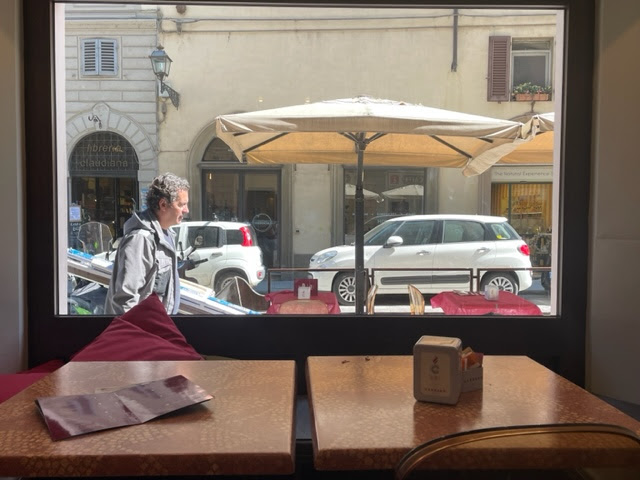
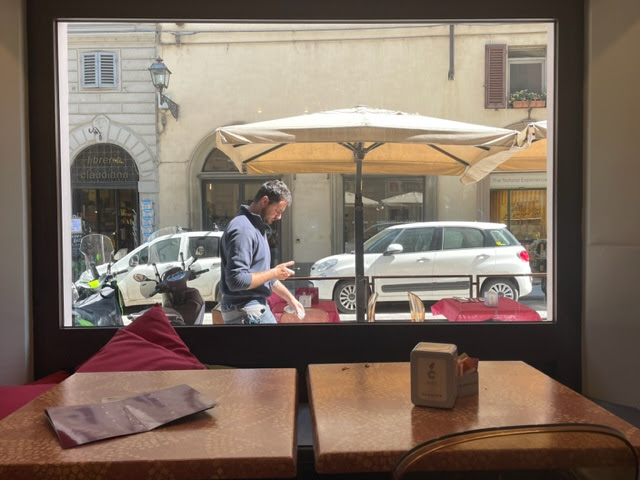
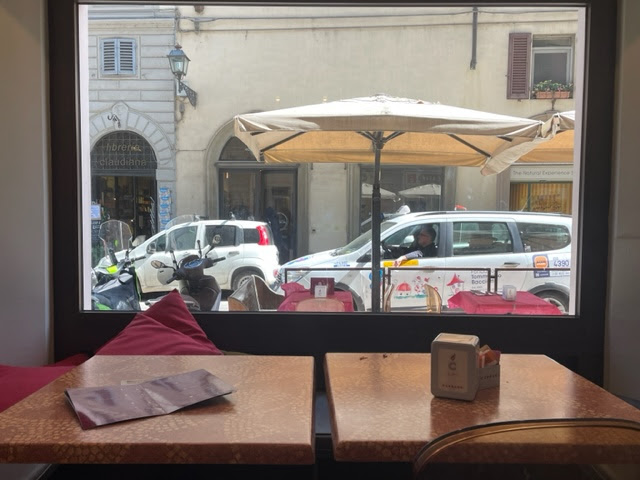
Florentine Breakfast Entertainment: Variations on a Theme

I had an American breakfast of eggs and toast twice while in Italy. On one occasion, I was at a table in front of a window through which I could do people watching. I found it interesting because some people walked past on the sidewalk nearest to me, some across the street, some went by on bikes or in cars or trucks and some on motorbikes. When I finished my breakfast I took photos for a bit, snapping the shutter each time a moving object entered my "window on the world." Here are the photos.


Whether people watching or simply engaging in your surroundings,
open your eyes and enjoy life's seemingly endless reality show.

Saturday, January 15, 2022

Story Idea: The Party and Its Aftermath

This idea for a novel or film is based on an incident from the life of Cary Grant. (I'm currently listening to a Cary Grant biography while commuting here and there, running errands, etc.)

I've not settled on a title yet, but the story concept is set. As in real life, situations lead to decisions which create new situations. As a working title we'll call it ...

The Party and Its Aftermath

On a gorgeous summer evening in Duluth several dozen prominent people have gathered for a private dinner party at the Great Lakes Aquarium. Tables have been rolled in and set up to seat 52, six tables set for 8 and an additional table for the band. The invitation implied that anyone who is anyone will be present, along with some special surprise guests. 

The hosts of the party are newly minted Twin Cities billionaire Brent Chance and his wife Bev. The event was preceded by a News Tribune story about how Chance, who grew up in Edina but made his fortune in California real estate, was considering a serious investment in Duluth. The article cited Duluth's reputation as a growing arts mecca along with its well-known quality of life benefits. 

The gathered guests came from a variety of backgrounds. There were local political figures, lawyers, contractors, and people in the local hospitality industry. Two or three ad agencies were represented as well as business owners, a few local media personalities, the head of the Duluth Playhouse, a few professors, the new LISC director, a couple from the Duluth NAACP, and descendants of several prominent "old money" families. A few weren't really sure why they'd been selected, and several were a little insecure as to the purpose of the party.

It was a curious event. There had been an dance floor assembled with a jazz ensemble that entertained throughout the evening. At a certain point in time Brent Chance stood and went to the podium in the far corner of the room. The scenery behind him was glorious, the water shimmering on the bay creating an aura that made him appear to shimmer as well.

Chance introduced his wife, thanked everyone for coming, and made note of two or three individuals who had made him feel especially welcome when visiting the city during the past couple years. He also thanked The Boat House for catering the meal and Tom Hanson for the hors d'oeuvres beforehand and desserts after. He briefly shared how growing up in Minnesota made him the man he had become, then talked about his business ventures that had grown under the umbrella of Fast Pivot Enterprises.

"Be sure to tour the Aquarium and enjoy the new exhibits," he added. "There's also a rather nice display of new paintings by Adam Swanson down the hall from where you came in. Stay as long as you like. The bar will remain open till the band packs up." 

Shortly after returning to his seat the mayor's husband leaned over and asked, "The invitation implied a couple V.I.P.s might be present."

Chance gave a laugh. "Really, we're all V.I.P.s. But if you look at the musicians, over on the right is Billy Peterson on stand-up bass. He comes from three generations of jazz musicians in the Twin Cities. He recorded with Dylan on Blood on the Tracks. He'd planned to bring his friend Steven Tyler from Hawaii, but something came up." 

Everyone at the table craned their necks at this.

"Swanny Swanson, the drummer, is a friend of Billy's. The fellow on keyboards is an A-team player from California, Mario Landolfi. He's a personal friend and now one of the biggest names in both L.A. and San Diego. And if you check out the fellow standing over by the window, he's with the Vikings. He already asked if I have any connections to get him traded to a West Coast team. He doesn't like our weather." Chance laughed again. "I don't have any pull with the 49ers, and even if I did the report card on him is that he's lost a step since his injury in 2020. But he's smart, and who knows. He might make be an asset for one of my Fast Pivot companies in Malibu."

The food was remarkable, the desserts equally so. Most of the guests at one point or toured the Aquarium exhibits their tax dollars helped design and maintain.

As the crowd began thinning the jazz trio got into a swinging improv set so that as the guests made their exits it created an upbeat end to the evening. 

* * *

A week after this grand affair at the Aquarium everyone who had attended received a thank you card and an invitation to a follow up party. It will be full of surprises, the invitation read. "Nothing like you have ever experienced before," it promised. "It is very important you be there. You won't want to miss it." 

The follow up event indeed lived up to its promise.

TO BE CONTINUED

Tuesday, January 11, 2022

CES 2022: Welcome to the Future

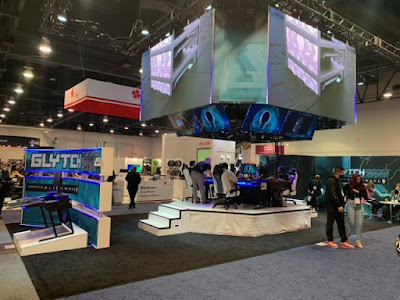
Photo courtesy Karl Strom
For 20 years I attended the Specialty Equipment Market Association (SEMA) trade show in Las Vegas which takes place the first week of November each year. Many of those years I would be on a shuttle or bus and would here someone say, "CES must be in town." SEMA was one of the few shows that rivaled the Consumer Electronics Show when it came to drawing mobs of that size to Vegas. 

CES is the perfect way to kick off a new year. The scale of this show is mind-boggling. Over 2200 exhibitors were on hand this year, with media representatives in the thousands flying in from 159 countries. 

It must have been around 20 or so years ago that the top six companies in the Fortune 500 were automakers and oil companies. How things have changed. Tech companies like Apple, Microsoft, Google and others have become fixtures as the world's leading brands. Ironically, cars are becoming tech companies. Before 1968, when VW introduced the first transistorized, electronically controlled fuel injection system, cars were essentially mechanical devices. 

Photo courtesy Karl Strom
This year's CES showed just how sophisticated technology has become with regards to motor vehicles, autos and trucks. The future was on display in all its forms. 

I asked Karl Strom, editor-in-chief of The Hearing Review, to send me his impressions of this year's CES. Here's a brief summing up that he provided this past weekend.

"The CES conference is like walking into the future. Lots of dazzling displays from the huge corporations like Sony, Panasonic, and Samsung, but also a couple thousand exhibits from established companies to start-ups. My beat is hearing healthcare but it’s difficult not to get sidetracked by the incredible ideas that range from self-driving cars to watering the lawn. There are essentially 3 giant convention halls with one of them being almost completely devoted to fledgling companies and start-ups from all over the world, often grouped by countries or geography. It’s a physically and mentally exhausting event, but fascinating!"

* * * 
TECHNOLOGY touches us in such a wide variety of ways today. Here are some of the categories of products you will find at CES:
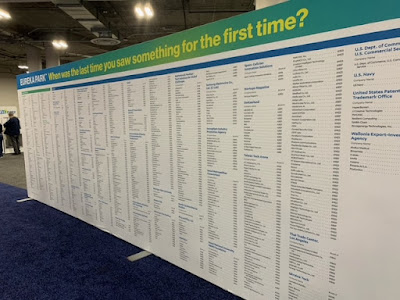
Photo: courtesy Karl Strom
Accessibility

Products and services with innovative features that enable ease of use by disabled persons to improve accessibility for seniors and persons with disabilities, regardless of cognitive, mobile, hearing or visual abilities.


Computer Hardware & Components

All desktop and notebook computer systems and internal components, including tablets, e-readers and mobile computing devices.


Computer Peripherals & Accessories

Products designed to connect to and extend the functionality of desktop or portable computer systems or to enable, enhance, connect, power and/or maintain desktop or portable computer systems.


Cybersecurity & Personal Privacy

Products that serve to protect, enhance, manage or analyze digital security. This is a category that has really grown in recent years. Our next war may be a cyber war rather than nuclear.


Digital Imaging/Photography

Products designed to enhance the visual experience and/or allow the user to capture, store and edit still images or video.


Drones & Unmanned Systems

Consumer drones, consumer UAVs and other unmanned systems that are able to fly, or otherwise move and be operated from a remote location. May include secondary features such as photo/video recording, movement of materials, mapping, wayfinding, search/rescue or other capabilities. It even includes agriculture an energy applications. 


Embedded Technologies

Silicon chips and integrated components designed to provide functionality to finished products or subassemblies.


Fitness & Sports

Products designed to test, monitor or analyze the fitness and/or sports performance of an individual. May also include sports apparel and equipment that incorporate sensors or other technology.


Gaming

Products (hardware, software, services) designed to allow one or more users to interact with electronic games.


Headphones & Personal Audio

Devices that allow users to listen to audio content, such as music, radio, video, TV, gaming and/or telephone conversations. The devices may incorporate microphones for user voice response or input and do not have to be designed for use with any specific type of device. 


Health & Wellness

Consumer devices, mobile apps and other technologies designed to monitor and analyze health, support well-being, manage disease or provide a therapeutic benefit.  


High-Performance Home Audio/Video

Separate audio components and speakers that provide for optimal performance and sound reproduction. Items are typically produced in limited quantities and are often handcrafted.


Home Appliances

Products that have a primary function of being used in the home, including major and portable appliances. Products technology may provide home heating and cooling, comfort, aesthetics, convenience, food storage and preparation, and/or cleaning. Products should have significant electronic functionality as a central part of the item’s operation. 


Home Audio/Video Components & Accessories

Systems and/or speakers designed to provide playback, storage and/or distribution of audio and video signals and content in the home, as well as products designed to enable, enhance, connect, and/or maintain home audio/video systems and components. 


In-Vehicle Entertainment & Safety

Products and components designed to be part of an in-vehicle entertainment and information systems.


Mobile Devices & Accessories

Smartphones (iOS and Android) and other mobile handsets. Also includes accessories designed to work with mobile devices, such as cases or chargers. 


Portable Media Players & Accessories

Well as the accessories for enabling, enhancing, connecting, carrying and/or maintaining them.


Robotics

Programmable or otherwise Intelligent machines capable of performing specific tasks or replicating human movement or interactions.


Smart Cities

Products, applications and technologies designed to be incorporated in a smart city, or smart venue, technology ecosystem. Smart cities are designed to improve and enhance the lives of the citizens and businesses who inhabit them.


Smart Home

Products and accessories that provide a home's inhabitants with sophisticated monitoring and control over the building's functions, and/or enable users to maintain a wired or wireless data network. May also include products and software that provide for remote or conditional access.


Photo credit: Greg Bulla. Creative Commons
Software & Mobile Apps

Programs or operating systems meant to be used on a computer system or mobile device, whether being distributed for free or at a cost.


Streaming

Devices, apps or services that allow a user to transmit audio and/or video over a network. Offerings can be free or at a cost.


Sustainability, Eco-Design & Smart Energy

Innovative features incorporated into products that are environmentally-friendly. For example, efficient and clean energy use, manufacturing processes that reduce use of harmful environment substances (e.g., lead, mercury), durability/end of-life (e.g., reuse, refurbish, remanufacture, recycle), resource conservation, facilitate the powering and/or charging of consumer electronic products.


Vehicle Intelligence & Transportation

Automotive and other transportation products and services that integrate technology into the driving or riding experience, whether by enhancing safety, navigation, improving the passenger experience or enabling self-driving functionality.


Video Displays

Devices whose primary purpose is the display of video content, excluding items marketed and sold primarily as computer monitors.


Virtual & Augmented Reality

Products (hardware) designed to provide a virtual or augmented reality experience for one or more users.


Wearable Technologies

Electronic devices worn by the user that may include sensors, processors, displays or other technology for the purpose of sensory enhancement, measurement, computing or data-collection/transmission.

* * * 

So many things go through my mind when I read through this list. Here are few off the cuff, not in order of importance:

In a world where there has been a fair amount of criticism of consumerism, how much of this technology is necessary and how much is luxury? As we become increasingly immersed in technology--from social media to virtual reality to streaming media and interactive games--is there a danger of becoming so removed from nature and the natural world that it will damage our humanity in some way? 

On the question of luxury and necessity, what are our expectations for the future of consumption and natural resources? How does this impact the have nots of our world? 

I personally find all this applied creativity to be a dazzling spectacle. Will the next generation be dazzled or simply take it for granted? 

When I read about the decline in math skills in our country, what impact will this have in the advances and maintenance of all these incredibly complex systems? When everything we own requires technical knowledge in order to fix it, what then? Auto mechanics who wrench engines will not be qualified to fix EVs. Will we have a shortage of qualified people to keep all our cars and toys running?

What does all this say about the jobs of the future? One thing is apparent, there is going to be no end of opportunity for those willing to hit the books and stay abreast of the changes that are coming. In 20 years from now there will be jobs that don't even have a name yet. 

For optimists, this is an amazing time to be coming of age. For pessimists, the future is shrouded in a fog of doom. 

When I was in school there were doomsayers as well. That didn't stop the possibility thinkers. Its probable that a visit to CES will offer ammunition for both camps. As the saying goes, we'll see what happens. 

How many of you who were coming of age in the Sixties could have imagined Bob Dylan or the Rolling Stones still performing concerts in 2021? 

May you stay forever young!

Popular Posts