Showing posts with label stories. Show all posts

Sunday, June 1, 2025

Why Time Travel Films So Fascinate Us

Christopher Lloyd and Michael J. Fox make time travel
look easy. All you need is a tricked out DeLorean.
What do 12 Monkeys, Back to the Future, Terminator, Peggy Sue Got Married and Midnight in Paris all have in common? The title of this blog post is your revealer. Each is a Hollywood film that involves time travel. Three involve people in the present being transported to the past. Two (12 Monkeys and Terminator) involve intrusions from the future.

Time travel isn't just a Hollywood thing. H.G. Wells took readers for a ride in The Time Machine, Mark Twain transported us in A Connecticut Yankee in King Arthur's Court and Arthur C. Clarke, in a short story titled Time's Arrow, carried readers back to the era of dinosaurs. Oh, and Stephen King used a time portal to see if his character Jake Epping might somehow stop the Kennedy assassination.

The stories are imaginative and vary widely, yet delve into fascinating philosophical conundrums. In both Back to the Future and Clarke's sci-fi story, characters discover the law of unintended consequences and the dangers of tampering with the past. 

In Woody Allen's Midnight in Paris, Gil Pender (Owen Wilson) falls in love with an idealized past--Paris during the period of Picasso, Gertrude Stein, Hemingway, Fitzgerald, Dali, etc.--only meet a woman there whose discontentment with her present makes her yearn for a more exciting, earlier time. The solution to our disillusionment with present circumstances cannot be found by embracing nostalgic fantasies. The film is witty and fun while effectively making its point. 

The Terminator films are also wildly inventive but terrifying, a cautionary tale about unchecked technology, the future of robots and AI. Despite their efforts, the past is left unchanged. 12 Monkeys and King's 11/22/63, both propose that the past can't be altered. We can wish it, these stories suggest, but altering or revamping history is not something mere mortals have the power to accomplish.

* * *

When it comes to imaginative philosophical stories, Jorge Luis Borges (1899-1986)  is one of my favorites. He, too, has a variation on the time travel theme. In his rendition, a short story called "The Other," Borges sits down on a park bench in New England and becomes aware that a younger man seated further down is his younger self. He finds the encounter exceedingly disturbing. It's written as if it really happened, and is quite a compelling read. It begins like this:

The incident occurred in February 1969, in Cambridge, north of Boston. I didn't write about it then because my foremost objective at the time was to put it out of my mind, so as not to go insane. Now, in 1972, it strikes me that if I do write about what happened, people will read it as a story and in time I, too, may be able to see it as one.


You can read the rest of the story here.

* * * 

Time travel stories are also an excellent way to explore "what if" scenarios. My own story "An Unremembered History of the World," is an exploration of this sort. What if there had never been any wars these past 250 years? How could that have happened? How would things have been different? (You can find this story in my first collection of stories titled Unremembered Histories.)

 * * * 

For more:

"A Connecticut Yankee in King Arthur's Court" (1889) and "The Time Machine" (1895) by H.G. Wells


Monday, June 17, 2024

Crossing Over Into The Twilight Zone

"There is a fifth dimension beyond that which is known to man. It is a dimension as vast as space and as timeless as infinity. It is the middle ground between light and shadow, between science and superstition, and it lies between the pit of man's fears and the summit of his knowledge. This is the dimension of imagination. It is an area which we call the Twilight Zone."

* * * 

"You're traveling through another dimension -- a dimension not only of sight and sound but of mind. A journey into a wondrous land whose boundaries are that of imagination. That's a signpost up ahead: your next stop: the Twilight Zone!"

* * * 

"You unlock this door with the key of imagination. Beyond it is another dimension: a dimension of sound, a dimension of sight, a dimension of mind. You're moving into a land of both shadow and substance, of things and ideas. You've just crossed over into... the Twilight Zone."

* * *

My hand has not yet recovered from my stroke seven weeks ago, so I've been seeing a physical therapist who has given me exercises to do. This week I latched on to a new routine. While doing my finger exercises I've been watching episodes of The Twilight Zone, the original black and white show that began airing in October 1959. I was seven years old at that time and when I reached episode 4 the other day I was surprised that I remembered it. Perhaps it was the subject matter, a man who was somewhat obsessed about books and reading.

I have also been surprised at how dark these stories are. The mood conveyed by the narrator is one of impending doom or heartbreak of some kind. And like O. Henry's famous twist endings, Rod Serling's tales likewise end with a startling twist. 

More than 150 episodes, 80 of them written by Rod Serling, creator of the series.

One episode that I watched this past week was titled "Time Enough at Last." Here's the opening: 

"Witness Mr. Henry Bemis, a charter member in the fraternity of dreamers. A bookish little man whose passion is the printed page, but who is conspired against by a bank president and a wife and a world full of tongue-cluckers and the unrelenting hands of a clock. But in just a moment, Mr. Bemis will enter a world without bank presidents or wives or clocks or anything else. He'll have a world all to himself... without anyone."

It turns out that Mr. Bemis decides to take his coffee break in the bank's vault where he be alone with his book. Unexpectedly, his world is shaken by a nuclear war outbreak. When he emerges from the vault, most of the town's buildings have been destroyed. He is the lone survivor.

To his delight he finds the public library still standing and he proceeds to stack piles of books to be read during the months ahead. And no one will ever again criticize his love of reading.

SPOILER ALERT
Besides his passion for reading, one other detail from the opening scene stands out. He wear glasses with coke-bottle lenses. The twist at the end? As he bends over to pick up his first book, with all the tme in the world now available for reading, his glasses slip off and shatter on the concrete sidewalk. His "heaven" suddenly turns to hell.

* * *

Here are a couple other episodes that offer viewers the flavor of this show.

"The Silence" In this episode, a wealthy man bets a poor man a million dollars that he cannot keep silent for one year. It turns out that the rich man was not rich at all and did not have a million dollars, while the poor man had cut his own vocal cords in order to win the bet.  {I hear an echo of Chekov's "The Bet" here.}

"To Serve Man" Nine foot creatures from space descend on the UN and leave a book. The title is decoded to read, "To Serve Man". Thinking that this title illustrated the creatures' noble goals, Earthlings begin migrating to their planet. They soon find out that the book was a cookbook.

* * * 

There's a sense in which this year's presidential election circus feels a bit like an episode from The Twilight Zone. We'll soon see what kind of twist ending has been written into the script.

Tuesday, November 7, 2023

A Postmodern Prophet: Hemingway's Insights Applied to the Gaza Conflict

I was re-introduced to Hemingway in the late '70s through his first collection of short stories titled In Our Time. I was stunned by the power of Hemingway's prose. Though I'd never worn glasses, the stories there were like being a grandma who gets hit in the face with a fist, glasses flying across the room from the impact. I read the book continuously two-and-a-half times through. The description of the doctor in one scene of The Doctor and the Doctor's Wife is so loaded with tension, yet achieved with sleight of hand, never once saying the guy was mad or outraged, or any such thing... it is nothing short of miraculous how he accomplishes so much with such simple prose.


I'd read Old Man and the Sea in high school, but it wasn't till years later that I came to appreciate Hemingway as a writer. The first Hemingway novel that followed my return to classic literature during this period in my life was For Whom the Bell Tolls with its setting being the Spanish Civil War. The hero's quest turns out to be a futile mission. The characters are vividly drawn, and tragic. Can one man make a difference? Robert Jordan believes he can.

The Spanish Civil War was a major turning point in the rise of fascism in Europe. It was notable for its
 pillaging of a section of European real estate in order to try out new war technologies. Franco fascists were not armed with Mussolini's planes for nothing. Hitler and friends watched with avid interest as the peoples were subjugated. Technology, not ideology, proved the winning variable in this situation.

In the novel, idealism and realism collide. Pablo, the local leader of a small guerilla band of anti-fascists, represents one shade of realism. Pilar, his wife, epitomizes another. Robert Jordan, the American teacher who has joined the war effort, is the idealist.

What really happened in Spain has still not fully been understood. The events of that time were significant, though soon lost in the shadows and mists of the world war that followed. Orwell lost his faith in communist socialism as a result of things he saw. Others were appalled by fascism's jackboot horrors. Picasso was inspired by the destruction of a town called Guernica to paint his famous statement decrying the brutality of this kind of "total war," which the U.S. continued to carry out in Viet Nam, and which we see daily now in the current tragedy called Gaza.

What follows here is an excerpt from one of Michael Mazza's reviews at amazon.com. I find reading reviews to be a mentally stimulating exercise. Movie reviews at imdb.com and the Amazon reviews are frequently cogent, insightful offerings from people who are thinking at least a little beneath the surface of things. For intellectually stimulating debate read the comments at the end of articles at a site called Unherd. 

"Hemingway offers a grim and graphic look at the brutality of 20th century warfare. War is not glamorized or sanitized, and atrocities are described in unflinching detail. The characters explore the ethics of killing in war. As the story progresses, Hemingway skillfully peels back the layers of Jordan and other characters to reveal their psychological wounds. But the book is not all about pain and violence. In the midst of war Hemingway finds the joy and beauty that keep his characters going. He also incorporates storytelling as a powerful motif in the book; his characters share stories with each other, recall missing untold stories, or resist a story too hard to bear."

In short, Hemingway laces the personal stories into the larger story, thereby making the whole more intimate and memorable. 

Storytelling has connections with so many facets of society today. Genealogists are no longer satisfied with identifying the roots of their family tree. They dig for stories about their ancestors. In marketing, ad agencies push companies to not simply promote the brand, but to showcase your "brand story." In selling, you're missiong the boat if you don't use storytelling to make the sale. In politics, "feel good" sound bytes are used to make candidates appear more human and caring. 

In Gaza, efforts are being made to get the stories out that will energize the world to take action. Israel uses stories from the horror of October 7--and resurrected Holocaust narratives--to justify the brutality of its response.

When the tragedy of this current war in the Middle East is over, I'm certain there will be new stories told for years to come.

Wednesday, October 25, 2023

Out of the Spotlight, Into the Saddle

I was thinking about cancel culture and an idea for a story emerged. I asked ChatGPT to write a 400 word story based on my idea. I then edited and expanded it to this 800 word story. Hope you find it entertaining.

Out of the Spotlight, Into the Saddle

Illustration by the author.
In the small, dusty town of Dusty Gulch, a once-famous TV star had found solace in the forgotten corners of the past. His name was James "Jay" Thornton, once adored by millions, until a single tweet razed his career to the ground. 

Driven by the desperate need to escape the relentless wrath of his fans, Jay acquired a time machine on the black market. Life as he’d known it was over forever.


One fateful day, he decided to try out his new toy, to give it a test drive. He wanted to see the future. Maybe he could find himself there. Unfortunately, the time machine malfunctioned, propelling him back to the year 1885 where he landed on a remote cattle ranch in the foothills of the Rockies.


Working as a humble ranch hand, Jay kept his past a well-guarded secret. He perpetually shunned the spotlight, now preferring the companionship of the open range and the simple folk of Dusty Gulch. One evening, in the dimly lit bunkhouse, Jay found himself sharing a bottle of whiskey with the other cowboys. As the alcohol flowed, the tales of their lives spilled out. 


With a heavy sigh, Jay decided to reveal his own story. "You know, back in my time, I used to be famous.”


“Really? How’s that. You shoot somebody? Rob a train?”


“No, no, no, no. I was a famous actor on television," he began.


The cowboys exchanged perplexed glances. "Television? What's that, Jay?"


"Well," he continued, "it's a magic box that shows moving pictures, stories, and news on a screen. People used to watch it for hours on end."


“You mean, something like a Magic Lantern,” the Finn said. 


“Sorry,” Jay said. “What’s a Magic Lantern?”


The Finn said, “I don’t know how it worked but it was kind of a thing where they used an oil lamp or lantern to shine through these glass plates and you would see images.”


Another cowboy interrupted. “We had a travelling showman come through these parts on the way to California and he put on a show with it, telling stories and projecting images onto a sheet we hung over a wire.”


“He said he was trying to sell them to schools or something like that,” a third added.


“Well,” Jay continued, “That's very interesting. I never heard of Magic Lanterns but you have something of an idea of pictures in boxes. In the future these boxes will show moving pictures. The box I'm talking about will be called a television set.”


“How do the pictures get into the box, Jay?” 


Jay shook his head and rubbed at his chin with his knuckles. “It’s all very strange really. The box is connected to a device called an antenna, which receives a stream of signals from a broadcast station. The pictures go through the air and –“   


He could tell by their expressions and the way they were fidgeting that they would never understand. The cowboys were scratching their heads, struggling to fathom this new concept. 


"How'd you end up here, Jay?"  


Jay took a deep breath. Another impossible question. He confessed, "I tweeted something that made a lot of people angry, and they canceled me. It ended my career."


"Canceled?" one cowboy asked.


“Tweeted?” another said. “You mean you made a sound like a bird or somethin’?”


“No, it’s sort of a communication platform.”


“Platform?” 


“It’s kinda like an online Wild West show,” Jay said, shaking his head dismissively as the words “Wild West” popped out of his mouth.


The boys all chuckled. 


“You’re not making any sense, Pard,” Big Burt said as he held out the bottle. “Better take another swig.”


Jay waved it away. “A tweet is like a message. Like those wanted posters back at the sheriff’s place.”


“Ah,” said a quiet cowboy off to his left. “So, you’re wanted.”


“No, no,” Jay replied. “I’m actually un-wanted. They took away my job.”


The cowboys burst into laughter. "Well, Jay, 'round these parts, we live by our own rules.”


Jay smiled, relieved by their reaction. "You're right. Life here is simpler, more honest."


The cowboys, now accepting him as one of their own, raised their glasses in a toast. "To Jay, the cowboy without a past!"


As Jay shared more stories of his time in the entertainment business, the cowboys listened in amazement, trying to imagine a world they could scarcely comprehend. For Jay though, the Wild West had become a sanctuary, far removed from the brutally unforgiving judgments of his former life. 


In the bunkhouse in Dusty Gulch Jay Thornton found a second chance among people who judged him not by his past, but by the man he had become. They might never understand his world of television and tweets, but they respected him for who he was now – a cowboy who had found redemption in the embrace of the Wild West, far from the relentless scrutiny of the digital age.


* * * * 

Just having fun. If you enjoyed this, feel free to leave a comment.

Saturday, September 2, 2023

Uncomfortable Situations: The Wasp in the Changing Room

AI-generated illustration collaboration.
My senior year in high school I was a bus boy at Fiddler's Elbow, a prestigious private country club in Bedminster, NJ. Bedminster has historical significance dating back to the Revolutionary War. It has maintained distinction by being a high end community with private homes owned by some rich and famous (Jackie O, for example). On Burnt Mills Road there was a polo field for the equestrian-minded. By means of zoning, the township kept its rolling hills populated with only the best of the breed. 

Doug Paretti is the one who recruited me to be a bus boy there. His aim, I suspect, was to bump up staffing in preparation for Mother's Day, an always busy weekend at this ritzy, high end facility. I served a little over a year there, from Mother's Day to a month after that the following year. It was, for me, a significant experience on many levels and I learned a lot about the bigger world beyond my neighborhood and my school.

When Doug left that summer I was selected by Annie, the head waitress, to be lead bus boy, perhaps due to my attitude and my work ethic. 

Membership at Fiddler's Elbow gave you the right to host a major event at the club one day a year. Weddings were frequent. As Christmas neared there were parties almost nightly from December through January. 

From Spring to Fall most of these parties would be held outside under a tent which served as a canopy for the swimming pool. The large in-the-ground pool was never used for swimming though. A wide dance floor had been built across the middle of it. Tables ran along the sides. On the far end, away from the Revolutionary War era mansion, there would be microphones, mixers and speakers brought in for the entertainment. 

On one occasion that entertainment consisted of a famous group of Polynesian or Hawaiian dancers. I can't recall the name of the troupe but there was a "Big Mama" headliner and six to ten attractive dancers whose purpose was to mesmerize.

To prepare for their performance we bus boys set up some folding panels to create a private changing area for this contingent of young exotic performers. 

During one of the costume changes Annie, the head waitress, came running over to me and asked me to take care of "a situation." I asked for more details, and was told that there was a wasp in the dancers' changing room.

Well, I was 17 and not prepared for what came next. 

I entered the changing area where all of these women were in mid-costume-change. That is, they were topless. They were in an agitated state because of this pesky wasp flying over them and through them and above them again. 

My eyes were focused on one thing only: the wasp. I watched as it circled, gliding this way and that till it finally descended. To my horror, it landed directly on the tip of the nipple of the young woman standing next to me.

After briefly sizing up the situation--I don't know if the women were staring at the wasp or at me--I lifted my arm, opened my hand and with a perfectly aimed downward motion, I swiped the wasp from her nipple and as fast a a game of hot potato I was flinging the wasp out into the night.

Surrounded by smiles and thank yous, I made a hasty retreat. I still can't believe I didn't get stung!

Tuesday, January 4, 2022

A Battalion Agent: War Poems Tell Stories

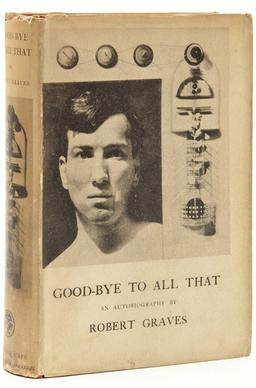
I recently mentioned that since Christmas day I've been wading through several books on World War One. In addition to Poilu (Barthas) and The Great War (G.J. Meyer), I've been dabbling in Goodbye To All That by Robert Graves. 

Graves, who was an officer in that First World War, became a career writer and poet. It's interesting to me how many soldiers were inspired by their wartime experiences to write poetry. Somehow simply writing descriptive sentences feels inadequate to the emotions unearthed by life's biggest disruptions, whether it be love or standing on death's door. 

Hence the great number of poets that emerged from those inexpressible experiences on the Western Front. Graves is numbered among a long list of poets from that war, many whose lives ended there. Wilfred Owen, Siegfried Sassoon, Charles Sorley, Edward Thomas, Rudyard Kipling, Ford Maddox Ford, Jessie Pope, Guillaume Apollinaire, Robert Service, Archibald MacLeish and countless others felt a compulsion to capture their inward angst in poetic verse.

Robert Graves served as an officer at the nightmare known at the Battle of the Somme. He was so badly wounded in this conflict that a notice was sent home to his family that he had died. Days later he wrote a letter home and the family announced in the paper that he was not dead, but alive. 

* * * 

Reading about Robert Graves has led me to read some of the poetry of others from that war. Ultimately this brought to mind the poetry my father-in-law wrote during his 3+ years of service in World War Two. 

Wilmer "Bud" Wagner was a cook, machine gunner and ultimately a battalion agent in the North Africa and Italy campaigns. Throughout the war he kept a diary in pocket-sized notebooks. He also took photos and wrote poetry. The following is titled The Battalion Agent. You will notice that he uses the word "peep" here and throughout his memoir And There Shall Be Wars. When the soldiers returned to the States after the war, they were surprised to find these all purpose vehicles were now called jeeps. 

Here is his poem about life as a battalion agent.

A Battalion Agent


He works at night, in rain and grime,

Moonlight or not, he tries to find

His Battalion's position, it's quite a game.

Good roads or bad, it's all the same.


He's tired as heck, when he lays down at night,

Then someone wakes him, he's in for a fight.

He's given a message, what he doesn't know.

He starts for his peep, he's off to the show.


The road is rough, and it might be wet,

But he's rough and tough, he's always set.

His peep will respond at the slightest touch,

For he's bound to get there, it matters much.


If the road's under shell-fire, or being strafed by a plane,

Through wheat or mine field, it's still the same.

His faithful peep must take him through,

It's his very best friend, he keeps it like new.


He can use the lights, but he'd rather not,

Perhaps they would get him on the spot.

He travels along at a pretty good clip,

In spite of the roads, with all those dips.


He's wide awake now for he has to be,

There's a truck stalled on the road, so hard to see.

He slams on his brakes, missed it by an inch,

Turns to his left, off again, this job is no cinch.


It's still the right road, seems he tells by the smell,

With all these turns and trails, it's hard to tell.

He gets through the bomb craters, lucky as yet. 

Lucky this African Campaign hasn't cost him his neck.


There's the road, that he takes to the right,

But what meets his eyes, is an awful sight.

A bridge blown out, where the water is deep,

But nothing can stick his faithful peep.


He throws it in low, the motor roars,

Shoves the front wheels in gear, as he nears the shore.

Puts the transfer in low range, tramps down the gas,

He's going through, and he's going fast.


Now where is the place where this officer  lives?

He has a sealed message to him he must give.

There's his pup tent, but he's sound asleep.

How can he do it, with the noise of that peep?


The message is taken, and he starts back,

It's cold and raining, the night is still black,

So again he goes through, it's the same either way,

Oh, why can't he do this during the day?


He finally gets back, his nerves are on edge,

Turns off his peep, heads for his bed,

Drops on the ground and prepares for a snooze.

Leaves on his clothes, he's too tired to move.


He awakes in a daze, someone yelling his name,

"You have a message to deliver, don't mind the rain."

He jumps in his peep; his mind is still hazy,

For he's a Battalion agent, and it's driving him crazy.


Wilmer Wagner
And There Shall Be Wars


* * * 

I think it noteworthy that at the war's end he received a commendation for always having gotten the message through. A portion of the citation reads:
o
"Cpl. Wagner continuously drove blackout over unfamiliar roads that were almost impassable due to rainfall. Cpl. Wagner furnished valuable information as to the conditions of the roads and the location and use of short cuts. Frequently roads traversed by Cpl. Wagner were subjected to heavy enemy harassing fires and information regarding minefields was lacking, but Cpl. Wagner never failed to reach his destination in time for operational changes and new plans to be effected. Cpl. Wagner's
 courage and devotion to duty reflect great credit upon himself and the military service."

Charles L. Bolte
Major General, U.S. Army,

Commanding.

Saturday, November 6, 2021

Nevada Bob Enjoys Warm Welcome In Minnesota

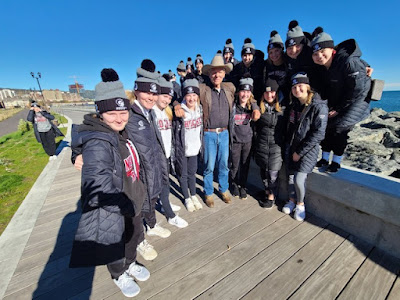
Nevada Bob with a high school hockey team 
in Canal Park, Duluth.
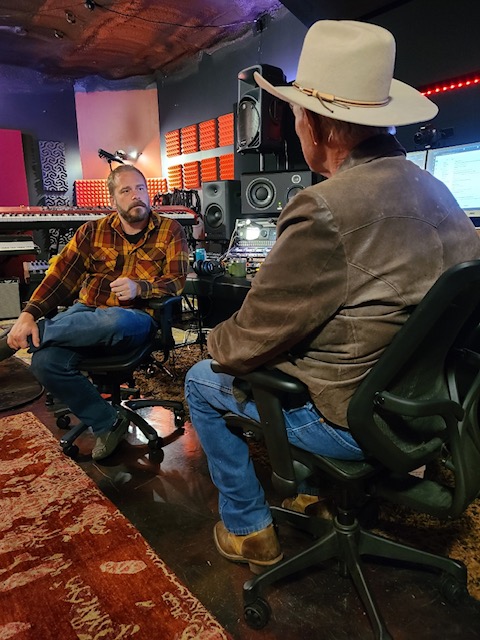
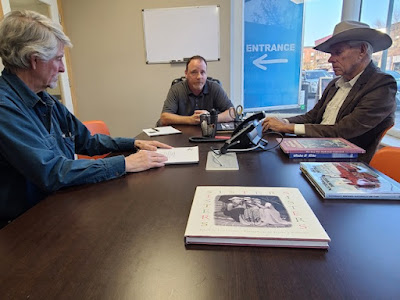
Robert D. Gordon, aka Nevada Bob, arrived in Duluth Thursday with his personal photographer Gary Firstenberg after visiting a recording studio in Stillwater. The pair have been touring points of interest, gathering stories for a pair of upcoming books.

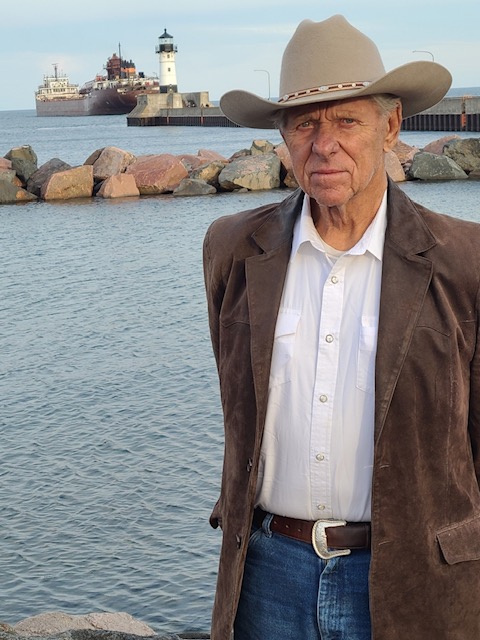
Nevada Bob is currently a cattle rancher from Winnemucca, Nevada, outside Reno, who is also a singer-songwriter and storyteller. It's his storytelling that brought us together. Born in Juneau, Alaska in 1939, Bob has seen a lot and has enough stories in him to fill half of Lake Superior. "It's all true," he will tell you, and when his memoir is published you'll see that there's a measure of truth to the Hopi proverb that those who tell stories rule the world.

Pillar of books, Duluth Public Library
He sings with that deep Johnny Cash resonance that makes tenors jealous. He stands lean and tall, with the erect stature of a Navy man, which he once had been. His weathered face can convey a Clint Eastwood gravitas one minute that is quickly displaced 
the moment he has an audience for his songs and stories. His eyes twinkle with warmth and everyone is engaged.

The working title for his book is 50 Years with the Wrong Woman. It's a memoir that he wrote this past year when he lost the love of his life to whom he had been married 58 years. Nobel Laureate Maya Angelou once said, "There is no greater agony than bearing an untold story inside you." After the loss of Carol, Bob resolved to put his stories down in print. 

The road tour that he and Gary Firstenberg have been on is something akin to the movie Green Book. Gary is both driver and tour guide... and documentarian.

On the Waterfront. In his youth he lived in Seattle. 

It's been an amazing trip, up the Eastern Seaboard to Maine, back down to Baltimore, across the Midwest and here to Duluth, taking in countless points of interest related to both music and baseball history. 

Nevada Bob and myself in front of birth home of Robert Zimmerman,
Central Hillside, Duluth

Here in Duluth we have the birthplace of Bob Dylan. Tomorrow they'll be visiting sites in Hibbing where young Bobby Z grew up and went to high school. If you see them, say hello. He'll sing you a song and maybe even share a few stories.

Minneapolis with Mary Tyler Moore.

In the studio with Daryl Bolicek of Wild Horse Recording in Stillwater
where Nevada Bob hopes to record the audiobook version of his memoir.

Meeting with Shane at JS Print to discuss publishing options for future books.

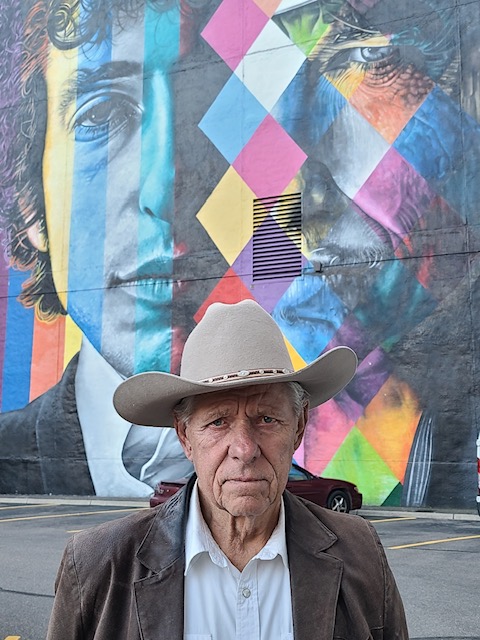
Inspirational Dylan mural in Minneapolis

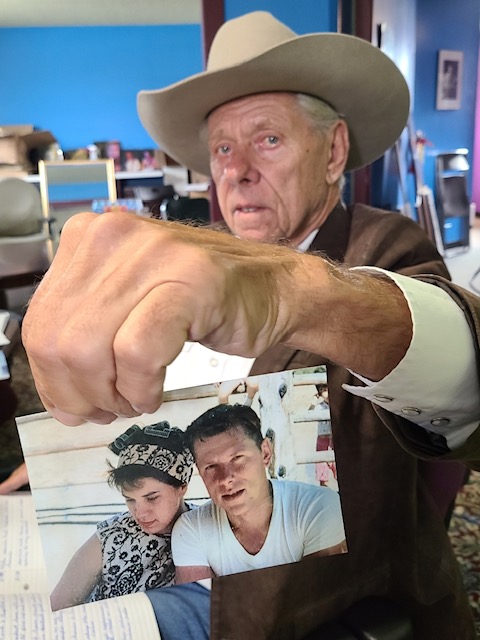
Photo of Nevada Bob holding photo of the woman who inspired him for a lifetime.
Carol and Bob had no idea the adventures that lay ahead.

Other people's stories re-ignite some of our own. I'm sure I'll be sharing more about this adventure as it unfolds. Stay tuned.

Related Links

Popular Posts