Showing posts with label cars. Show all posts

Thursday, September 28, 2023

Route 66: A Journey Through Time

Route 66, also known as the "Mother Road," was a highway that ran from Chicago, Illinois, to Santa Monica, California. It was one of the original highways in the United States Numbered Highway System, and it was established in 1926. Route 66 quickly became a popular route for people traveling across the country, and it played an important role in the development of the American West.

Route 66 passed through eight states: Illinois, Missouri, Kansas, Oklahoma, Texas, New Mexico, Arizona, and California. It ran through many small towns and rural areas, connecting these communities to the rest of the country. Route 66 also passed through some of the most scenic parts of the United States, including the Grand Canyon and the Mojave Desert.

This highway was especially popular during the Dust Bowl era of the 1930s. During this time, many people from the Midwest migrated to California in search of a better life. Route 66 was the main route that people took on this journey, and it became known as the "Highway of Hope." (Read John Steinbeck's The Grapes of Wrath.)

Route 66 was also popular with tourists. The highway offered travelers a chance to see the American West and to experience its unique culture. Route 66 was also known for its many roadside attractions, such as motels, diners, and gas stations.

The animated film Cars showed audiences what happened to the historic highway once the new Interstate Highway System was being installed under President Eisenhower in the 1950s and it began to decline in importance. The new superhighways were faster and more direct than Route 66, and became the preferred route for travelers. Though Route 66 was officially decommissioned in 1985 it remained a popular tourist destination today.

In 2009 Susie and I drove a portion of it from Texas to the Grand Canyon. There were memorable sites along the way, but the memories were clouded by the poverty we saw as well. People can move on, places cannot. Neither is easy.


Photos courtesy Gary Firstenberg.

Related Link Southwest Sorrows: Making Memories on Old Route 66 Gary Firstenberg: Turning Negatives Into Positives

Wednesday, May 3, 2023

Almost Wordless Wednesday: Cars In Parma

That's some tight parallel parking there.
While in Italy I noticed that the cars were nearly all quite compact. In Florence the roads were especially narrow, so small made sense. In Parma, the roads were less constricted, yet the cars were still small, in part because the high taxes on fuel as well as the cars themselves. What was especially prominent were motorcycles and motorbikes. I also saw a few one-man (or one-woman) Smart cars.

On one occasion in Parma I decided to take photos of the emblems on the hood of all the cars on a singe street near the city center. In this particular street I don't believe I saw two that were identical. Here are the photos I took.


There were other cars that I saw but including a cool Ferrari.
Evidently I failed to photograph the one Ford Fiesta I saw. 
This particular batch was lined up on one specific street.
As for big diesel pickups, I saw none.

Related Link: Car Logo Meanings

Friday, January 21, 2022

Eliminating Oil Will Lead to Elimination of Countless Other Everyday Products

Nevada Bob at Woodstock. Love Bugs and other vehicles
are switching to battery power. Photo: Gary Firstenberg.
I've spent much of my adult life hearing news reports that we were going to run out of oil in ten years. Our dependence on oil goes far beyond the fuel we use for our cars, trucks, tractors and toys like snowmobiles, motorcycles and dirt bikes. Let's not forget airplanes, ships and boats, both outboard and inboard.

It's been about fifteen years since I last heard that prediction about running out of oil. Since then we've been told that we must stop using oil to save the planet.

By the time that day comes, one hopes that we will have found not only alternatives for power production but also alternative means of producing the thousands of products that are derivatives of oil. That's what this blog post is about.

* * * 

When crude oil is removed from the earth it gets sent to refineries where it becomes feedstock. This feedstock is used in petrochemical plants where it is turned into plastic to make a multitude of products. Solar panels, car bodies, eyeglasses, DVDs, children's toys, tires and hearts valves is just the start of a very long list.

Today's cars are laden with electronics, sensors, chips
and hoses. Tires and dashboards have crude oil roots.
The photo here is of my wife Susie, and her Soul.
Because they are non-conductive and heat resistant, petroleum-based products are used extensively in electronics. Speakers, smartphones, computers, television sets and flat panel TVs, radios, cameras and CD players are just a few of the items we're all accustomed to.

In the realm of textiles, we've nearly all become accustomed to acrylic, rayon, polyester, nylon and spandex as well as vegan leather. 

You'll find petroleum is used for making all sorts of sports equipment that we've grown accustomed to. I'm not sure what we will use in the future to replace petroleum as a resource to make basketballs, golf ball, football helmets, surfboards, skis, tennis rackets or fishing rods. (OK, we can use cane poles and come up with an alternative to the current form of fishing line.)

Personal care products is another big business today that will undergo change. I was unaware of how extensively oil was used in products like perfume, hair dye, hand lotion, toothpaste, soap, shaving cream, deodorant, toothbrushes, panty hose, combs, shampoo and contact lenses. Cosmetics like lipstick, makeup, foundation, eyeshadow, mascara and eyeliner are also in this category.

When it comes to modern medicine, there are hoards of medical devices that rely on petroleum. Likewise in the realm of pharmaceuticals. Hospital equipment like IV bags, aspirin, artificial limbs, dentures, hearing aids, and heart valves will need alternatives if we shut off the oil supply. 

A few years ago an older man came out to replace our well pump. As we talked I learned that he was on his second artificial heart. He said that his first was metal, and the splashing of the blood thru the heart was noisy and distracting. He was much relieved when the new heart was installed, undoubtedly with some plastic parts. (I did hear recently that a pig's heart was successfully transplanted into a human and not rejected, so maybe there will be an alternative in this area.)

Household products is another area where petroleum has been used extensively. Roofing materials, insulation, linoleum flooring, furniture, appliances, pillows, curtains, rugs are some larger items. Dishes, cups, non-stick pans and dish detergents frequently use oil in their creation.

* * * 

THE POINT IN ALL THIS is that the auto industry has been working on doing their part for more than 25 years. I saw a number of EVs in 1998 at an Environmental Expo in Anaheim. I'm just curious about all these other products derived from oil. If were to shut down oil altogether, would hypodermic needs have to be made of glass again? Will we have enough cotton and wool to clothe ourselves? Will there be no more PVC plumbing? What will we replace it with since lead is not safe?

We want to have wind turbines to generate electricity, but what are those enormous blades made out of? 

I think we need to manage our expectations regarding what is possible and what is necessary. 

Just sowing seeds. Something to think about.

* * * 

THE SOURCE FOR MUCH OF THIS BLOG POST CAN BE FOUND HERE:  www.capp.ca/oil/uses-for-oil/

Tuesday, November 30, 2021

Tech Tuesday: How Realistic Are Our Expectations Regarding EVs

The first electric vehicles I saw were at the 1998 Environmental Expo in Anaheim. The expo was a 3-day event that showcased alternative materials, alternative energy and alternative ideas around the theme of environmentally conscientious commerce.

There were five models of electric vehicles there. It's where I saw my first Prius.

A Little History
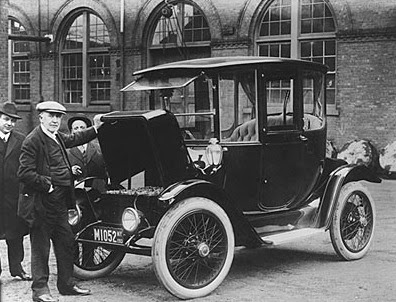
Thomas Edison with 1914 Detroit Electric model 47
(Photo credit: National Museum of American History)
Believe it or not, the first primitive version of an electric car was created in the 1830s but it wasn't till much later in the 19th century that electric vehicles began to be used in earnest, actually becoming quite popular by 1900. If I remember correctly an electric race car in Belgium could run 76 miles per hour, which was quite a feat at the time. Electric cars were quite and clean, compared to their gas-powered counterparts.

In the first 10 years of the 20th century a full one-third of all vehicles on the road were powered by electricity. Their one major drawback was that you could not drive to Boston from New York, and had no way to recharge if and when the car died in between. By the latter part of that decade we had companies developing hybrids in order to alleviate the issue of becoming stranded.

It was Henry Ford who dealt the death blow to electric cars at that time. The Model T was a truly affordable vehicle for the working man, and the electric starter was brilliant. No more cranking by hand in front of the engine. (More than a few men were killed in their garages by cars lurching into them when the engine engaged.)

The gas crisis of the 1970s brought a renewed interest in EVs, though this faded as quickly as the crisis passed. The lack of supporting infrastructure (charging stations) was a major barrier.

In 1997 Toyota introduced the first mass-produced Prius, the car I saw in Anaheim in 1998. Toyota's hybrid went global in 2000. At the New York Auto Show in 2004 every auto manufacturer but one showcased an EV or hybrid concept. Two years later a Silicon Valley startup became a new player in this market, introducing a sporty luxury EV with a 200+ mile range. Hello, Elon Musk.

The Future
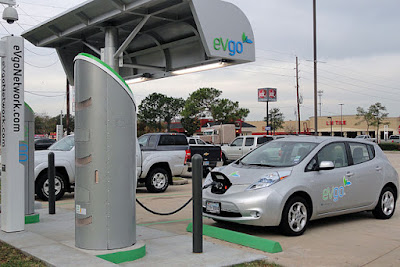
Nissan Leaf recharging in Houston.
Over the past 15 years there has been an increasing number of electric and hybrid vehicles sold, and all kinds of pledges to end dependence on oil altogether. There are idealists who would like to see an end to all gas powered vehicles as soon as 2035. Is this really possible? Is 2045 even possible?

Currently there are more than 287 million vehicles registered. There are approximately 1.3 million electric cars on the road. Of the 287 million cars and trucks powered by gas or diesel, let's assume that a fair number of these are idle. For the sake of this calculation we'll round the car count down to 227 million daily driven vehicles.

How many of these are new cars and light trucks? According to the latest figures Americas buy 17 million new cars and light trucks per year. Over the next ten years, if only EVs were purchased, that would be 170 million EVs. We all know this won't happen. The manufacturers couldn't make them fast enough.

What. is the profile of new car buyers? People with money. 10,000 Baby Boomers turn 65 each year and half of them have zero retirement savings. This means half will likely never have an EV. They will drive used gas-powered vehicles till they die.

College kids are not likely to be early adopters of EVs, despite their convictions regarding the threats imposed by climate change. They have too much debt to invest in new vehicles and the used EV market is close to non-existent now.

And then there's the problem of supply and demand. Like everything these days, supply chains are stretched to the breaking point with many hurdles to jump in order to meet consumer demand. Recent news from GM is disheartening for those eager to move forward with an affordable EV purchase. The Chevy Bolt EV recall is causing more than a few headaches as all Bolts need to have a potential fire hazard rectified. That is, they've discovered a potential fire-causing defect in the batteries. You can read the details here at Car & Driver.

When we buy a car we are purchasing a technological complex of integrated systems. When automakers introduce new designs, it's almost a given that unanticipated problems will arise, despite their best efforts. If you're an auto industry insider, you know which model years to avoid of various cars and pickups. The recall of 141,000 Bolts is more than just a headache for GM. It may be a chink in the confidence of some consumers. 

Another matter seldom considered is how much strain is being put on the electrical grid once we move everyone into EVs? One can only hope that those in the control room know what they are doing. 

Even without the technical hiccups which accompany any change, there are still broader implications of an EV future that we're not often considering. Here's an excerpt from an article in the October issue of Engine Builder.

The average EV utilizes around 30 kWh/100 miles, and the average vehicle gets driven around 13,500 miles in the US. Given that there are 227 million drivers in the US, switching completely to EVs would equate to a need to produce an additional 920 billion kWh of energy. As such, the U.S. would need to increase its electricity production by 25% (assuming a 90% transmission efficiency, 92% charging efficiency). This equates to 127 new nuclear reactors, 3.8 million acres of solar panels, or 300,000 acres of wind farms. (ICE vs. EV, Engine Builder, October 14, 2021)

Since we're not building new nuclear reactors at this point in time, one quickly recognizes the challenges of gearing up for a renewable energy future. Wind turbines need to be in windy areas and our very short winter days up North limit the full capabilites of solar. 

Charging stations for all these vehicles will have to be built for both at work and at home, plus on the roadways of America for travelers and truckers. Add to this the retrofitting of 200,000 automotive repair shops to work on EVs (it's a totally different animal from the Internal Combustion Engine) and one readily sees that there's a lot of work to be done. 

My point, you ask? Let's keep our expectations realistic. While it's good to be making these efforts, let's remember that Rome wasn't built in a day. 

This is a topic we'll revisit soon, I hope.  Feel free to leave a comment.

Sunday, August 15, 2021

Classic Car Shows Are American as Apple Pie

The Mustang was introduced at the 1964 World's Fair

There is really nothing more quintessentially American than the car.
--Warren Buffet

As I drove up to the recycle center yesterday I saw that all the fire engines and equipment were lined up in front. The recycle bins are located behind the Munger Volunteer Fire Department.

I drove past the trucks and clustered fire fighters and saw that the Munger Town Hall parking lot was full of vehicles as well, filled with an array of classic street rods, rat rods, muscle cars and more. 

Here are a few images that may give you a feel for what these kinds of events consist of: eye candy.

Saturday, March 16, 2019

Roger DeLoach Shares His Passion for Nostalgia and Cars with a New Book: There Was A Time

About a month ago I brought my car to Melanson's in Adolph for an oil change and there on the counter was a new book by Roger DeLoach. I met Roger through the church we attended, but really got to know Roger through his involvement in stock car racing. Roger loved cars and enjoyed building race cars, for himself, his sister and later his son, who left the area to work with one of the NASCAR teams for a couple seasons.

The book is titled There Was A Time, and for car guys it's a pure delight. It's about the size of a glossy hard-cover children's picture book. Each two-page spread features a full-sized photo of a classic car on one panel and a story on the other. I was not only impressed by the beautiful photography, I was equally impressed at Roger's storytelling. He's a guy with a good heart and a passion for cars, and it really comes through.

EN: I like the title of your book, There Was A Time, where did the title come from?

Roger DeLoach: When I was young, I was anxious for the future. I had so many dreams that I couldn’t wait to get there. Now the future seems to be here before you know it, and the present slips into the past way too soon. At this age, I have a treasure chest full of dreams fulfilled; a treasure chest with the words “There Was a Time” carved deeply into its aged hardwood exterior. The title expresses my gratefulness for a past I very much enjoy remembering.

EN: You’ve always been a car guy. What is it that makes Baby Boomers so nostalgic about cars?

RD: I love this question because it goes to the very heart of the book. The term Baby Boomer was birthed in the aftermath of World War II. December 7, 1941 caused America to change over night. The bombing of Pearl Harbor forced men to war, women to factories and children to paper drives. Money once spent on creature comforts now went for War Bonds while factories stopped making toys and began making bullets. 1941 through 1945 became years of sacrifice. When the war ended, America took a deep breath and dove back into life with gusto. Our parents were ready to work hard and play hard. The price of freedom had been burned into their souls.

We Baby Boomers were blessed to be born in a time when people were happy to be alive. For most Americans, family time was valued: road trips, camping trips, trips to Grandma and Grandpa’s, visits with cousins who lived two hundred miles away, extended family picnics where grilled hamburgers and swimming made us believe life could never get any better. And all of these wonderful times had one common denominator…the family car. To a kid the family car was more than a mode of transportation to the next outing; it was a vehicle of anticipation for the next great adventure.

Not all Baby Boomers are car guys or gals. For many it’s not the love of the car, but the love of what the car represents. We are nostalgic about old cars because they spark a memory of a time and place we yearn to go back and visit.

EN: There are so many decisions that go into creating a book. This one is a picture book. How did you select your photos, and what was it like writing a story for each one?

RD: Sometimes I think the photos selected me. There were photos that just had a story to tell. Because cars have been such a big part of my life, it’s hard for me to look at one without being reminded of something. I can walk a car show and come up with a personal story for about ninety percent of the cars I see. In a way, writing this book was a wonderful release; it allowed me to put on paper things that have been rolling around in my mind for years. Of course, there were some stories that needed pictures. That began another adventure, hunting down the right picture for the story I had already written.

The challenge to this book was writing 25 one-page stories that had a beginning, middle and end, and, at the same time, convince the reader a complete story had been told. I read two books on writing short stories before I even attempted to put my thoughts to ink. Truth be told, though, I enjoyed this project more than most others I’ve done. This was not laborious; it was more like hanging out with old friends.

EN: Which are your favorite cars in the book and why?

RD: Picking a few favorite cars in the book is easy: The ‘59 Chevy, the ‘57 Oldsmobile and the ‘58 Corvette. The reasons simply come down to styling. I think they are beautiful cars to look at. The Chevy is the only one of the three I have personally owned, but the Olds was a family car and part of my childhood. The Vette, well, that’s something to dream about. My favorite car of all, though, is not in the book, but I am happy to say that it is in my garage. It was love at first sight, and I was only six years old at the time. The 1958 Chevrolet will always be first in the carport of my heart.

EN: Do you have a favorite story?

RD: Now this is a question that is harder to answer. It’s like asking which of my children I like the most. When you spend intimate time with each child you begin to see them as individuals that don’t compare to the others. I have favorite thoughts or maybe even a favorite sentence in each story. Some stories are true to my life, other stories I wrote because I knew they would be true to a reader’s life. The “Christmas Truck” that I end the book with, though, probably holds the most meaning. Yes, I did exercise some literary license in the telling, but the core of the story is true, and it was a life changing moment for me even though the full extent of its meaning wasn’t realized until some years later.

EN: My grandfather was supervisor of the Packard Plant in Warren, Ohio in the 50s and 60s. What makes the Packard so special?

RD: I have a feeling you threw this question in because you know the answer. If my grandpa was Supervisor of a Packer Plant I think I would know the answer. I do quite a bit of reading on automotive history, but I have to be honest and say I have not read up on Packard yet. You have sparked my interest, though, and now the Packard is the next car I am going to spend some time with.

EN: Was there a “best year” for Cars? Some might say 1957 because the ’57 Chev, ’57 Olds and ’57 Ford were all rewarding to drive and look at. What years were your favorites?

RD: Oh, golly, when we were kids we thought every new year was the best. I bet a lot of your readers can remember the advertising blitz that hit the airwaves and magazines as the new models were rolled out. The designs and innovations of the fifties and sixties were, at times, beyond our imaginations. Government regulations and gas shortages put the brakes on in the seventies. I couldn’t say which year was best, but I would be willing to argue that the fifties was the best decade. And if I ever did find a time machine, well, I know where I would be right now!

EN: Where can people buy your book?

RD: My website is cdmproductions.net. This is set up for single sales. If anyone is interested in multiple copies they can reach me at rjdeloach@juno.com to save some money on shipping. If brick and mortar retail stores are interested in carrying the book, I do offer wholesale pricing on bulk orders. “There Was A Time” retails for $19.95.

Related Links
Hood Ornaments
One of my Pinterest Boards: All About Cars

Thursday, October 18, 2018

Throwback Thursday: Car Quotes

"Two wrongs don't make a right, but three lefts do." ~Jason Love

Yesterday I wrote about the cars of the Alcatraz East Crime Museum. It seemed like for Throwback Thursday it wouldn't be too far out of line to share a few more quotes about cars.

* * * *

In 2009 the Street Rodder Road Tour was in town, passing through on the third leg of its eight scheduled week-long road tours for that year. More than 300 local folks brought their classic cars as well to make it the second such annual event at the AMSOIL Center in Superior, Wisconsin.

In honor of the occasion I thought a few car quotes would be in order. Funny thing is that when you look up "Hemingway Quotes" in Google, you get quotes by Hemingway, and when you look up "Quotes about Suffering" you get proverbial wisdom about suffering. But when you type in "Car Quotes" you get pages of sites dedicated to pricing your ride, or someone else's vehicle. It takes a little more work to pull up quotes about cars.


Nevertheless, I achieved my aim and thought a few of these worth sharing.

"The best car safety device is a rear-view mirror with a cop in it." ~Dudley Moore

"Never drive faster than your guardian angel can fly." ~Author Unknown

"Car sickness is the feeling you get when the monthly payment is due." ~Author Unknown

"The shortest distance between two points is under construction." ~Noelie Altito

"I spent a lot of money on booze, birds and fast cars. The rest I just squandered." ~George Best

"When buying a used car, punch the buttons on the radio. If all the stations are rock and roll, there's a good chance the transmission is shot." ~Larry Lujack

"In less enlightened times, the best way to impress women was to own a hot car. But women wised up and realized it was better to buy their own hot cars so they wouldn't have to ride around with jerks." ~Scott Adams

"The best way to keep children at home is to make the home atmosphere pleasant, and let the air out of the tires." ~Dorothy Parker

Enjoy your day, and and your ride.


Related Links
F. Scott Fitzgerald's Love Affair with Cars
Cars of The Great Gatsby

Meantime life goes on all around you. Get into it.

Wednesday, October 17, 2018

The Cars of Alcatraz East Crime Museum

"Break the rules and you go to prison. Break the prison rules and you go to Alcatraz." 

Alcatraz East, new home of the Crime Museum.
They say crime doesn't pay, but it has certainly sold a lot of newspapers and generated plenty of stories. From the earliest years of Hollywood, tinseltown has produced a wide array of films and TV shows about bootleggers, hustlers, mob violence and the consequences of a life of crime. In 1931 Edward G. Robinson made a splash as a small time criminal who goes to the big city to make a fortune in Little Caesar. The following year Howard Hughes' Scarface hit the silver screen, loosely based on the Chicago mob boss of the same nickname whose career had just come to a close. In fact, Hollywood produced seemingly countless Capone films. More than 20 actors have played the notorious mob boss, and a dozen more have played characters based on the man. Books are equally numerous, one of them by Deidre Marie Capone, whose grandfather was "Uncle Al's" brother.*

When we were kids my brother and I loved watching The Untouchables on television, with Elliot Ness heading up the good guys trying to reign in Capone and company. At that time we thought the bad guys were cool, so when we played I'd be Machine Gun Kelly, and others would play Baby Face Nelson, Scarface or Johnny Torrio. When all of us kids grew up we were a ripened market for Brian De Palma's slick, no-holds-barred version of this Chicago gangland story starring Kevin Costner and Sean Connery as the good guys and Robert de Niro as the ultimate Capone.

John Dillinger's 1933 Essex Terraplane, purchased in 1934. FBI agents
nearly got him, but he escaped with his girl friend Evelyn Frechette.
You can still see a bullet inside the car from the shootout.
Another name that resonated with readers of crime stories was John Dillinger. And when Warren Beatty wore the mantle of Clyde Barrow, that film put a human face on the life of crime. Beatty must have enjoyed playing the role because he later decided to wrap himself in the character of Bugsy Siegel, the gangster who helped create The Strip in Las Vegas and the glam in glamour.

We visited our kids when they were in California for a spell and one of the highlights of the trip included a visit to the Rock, the island of Alcatraz. In 2016 a Washington D.C. crime museum closed and its artifacts, memorabilia and collections were moved to Pigeon Forge, Tennessee to a new home called Alcatraz East.

The Alcatraz East museum features 20 different exhibit areas focused on five themes: the history of American crime, the consequences of crime, crime scene investigation (CSI), crime fighting, and pop culture. Authentic pieces used as evidence in well-known criminal cases, and interactive exhibits and activities, are on display. And some rather famous cars as well.

Replica of Bonnie & Clyde's 1934 Ford V-8, shot full of holes for the film.
The flathead V-8 engine was introduced in 1932, and soon became an instant hit. 
You can see we've travelled far afield of the purpose of this blog post which was to share a few of the cars featured at Alcatraz East. Cars have played a defining role in U.S. history since Henry Ford's invention of the assembly line. Cars are featured in at least two of F. Scott Fitzgerald's books (we especially remember the role cars played in The Great Gatsby) and GM wasn't far off when it pegged Chevy as "the heartbeat of America."

Prohibition-era gangsters rushed through the city with Tommy-guns blaring, and bank robbers made their daring escapes in their getaway cars with running boards. In Bonnie and Clyde, those shootout scenes and especially the final takedown in this cream-colored '34 Ford (pictured above) probably set new standards for realism in Hollywood violence.

Serial killer Ted Bundy's 1968 Volkswagen Beetle is also featured in the museum. His name alone gives one the creeps. The vehicle was integral to both his murders and his ultimate conviction when it yielded important DNA evidence. The car is displayed without the front passenger seat in the same way Bundy used the car.

Until OJ attempted to make his great escape in his white 1993 Ford Bronco, the slowest white Bronco in this country was John Elway. That Bronco driven by Simpson’s friend Al Cowlings is now parked inside Alcatraz East. Do you remember where you were during that slow speed chase with OJ in the back seat? I do.

For the record there are a couple vehicles from the "good guys" side here as well including a County Sheriff's car and a Surveillance Vehicle that had been used by the Food & Drug Administration.


Pigeon Forge is located Southeast of Knoxville near the Great Smoky Mountains National Park, a most beautiful part of the world. According the Rachael Penman, director of artifacts and exhibits,“Our crime cars each represent a cautionary tale, symbolizing a warning about the consequences of crime, while our law enforcement vehicles are positive reminders of all that law enforcement does every day, both in public and behind-the-scenes, to keep us safe.”

Related Links
For more info or to purchase tickets: www.alcatrazeast.com
* My interview with Deidre Marie, Last of the Capones
Claudia Oltean's Another Chance to Die
Writing Crime Fiction In Prohibition Era Detroit
Our Visit To Alcatraz 

Meantime, life goes on all around you. Engage it.

Tuesday, September 1, 2015

Will Driving Be Illegal Some Day?

Here's the opening paragraph of an article on TechCrunch that caught my eye this past month:

Driving a car will be illegal by 2030. Our economy will be severely impacted as millions of truck drivers, cabbies and delivery people are put out of work. In this era of endless innovation, man’s century-long relationship with the automobile is about to be permanently disrupted.

Author Jay Samit pulls no punches with this one. It opens with a short declarative sentence. This will happen, and it will happen much sooner than you think. Samit then affirms a few of the consequences of this advance, including the end of our trucking industry as we know it.

The notion is so immense I have had a hard time knowing how to put my mind around it. We're talking fifteen years. And I just don't see it.

Here are a few problems that I see. First, these new vehicles will have to cost a lot of money. The haves may have them but there are a lot of cars owned by the have nots who have made do with their limited resources by sheer ingenuity. In fifteen years will they no longer be permitted to drive their beaters? I do not see how that could happen.

Will these cars be propelled by bullet-proof technology? I mean, when you need tech support who do you call? Will they answer the phone or will you have to wait "for the next available technician"?

Will these vehicles all be run by means of the cloud? Is it a satellite system like my internet here in our rural home? It won't be by cable, that's for sure/ So what happens when a satellite goes down? Our internet was down for three days in a row last month when our provider's satellite went kaput.

Jay Samit talks about how many Chinese and Indians were killed in traffic accidents last year. He's obviously concerned about all the world's billions and the dangers of driving, but if poor people in this country are prevented from owning cars because of the price tags, imagine the poor in Third World nations?  And how many of those deaths in China and India are due to more laxity regarding driver training? Do other countries have a driver training requirement before getting a license? I know that in Mexico they did not when we lived there half a lifetime ago.

The author notes that cars driving themselves never drive drunk or distracted or while overtired.

In the United States, one out of four accidents is caused by texting and driving (which is six times more likely to cause an accident than driving drunk). The more technology we put in human hands, the worse our driving habits become. And unlike robots, humans need rest. According to the National Sleep Foundation, 69 percent of adult drivers report driving while drowsy at least once a month.

This and other arguments seem to push the idea forward some, but I'm curious about the legal matter of who is responsible when your car hits a pedestrian when the brakes go out on a Duluth hillside? Is the car's owner going to be liable or will the automakers be on trial? To say this is never going to happen seems pretty far fetched.

I'm curious how one will hail a cab in this brave new world. "Taxi! Taxi!" Will the car see me waving my arm? Hear me shouting on a busy New York street?

The argument for going this route seems to be for the purpose of safety. But isn't it all a matter of trade-offs? All life has risks. Maybe one day it will be illegal to get out of bed in the morning. I mean, what if you trip and fall and hit your head?

So, Jay Sarif says by 2030 it may be illegal to drive. But he says more... that it will not only be illegal, but should be illegal. What do you think?

Tuesday, August 11, 2009

Accidents

Man: Did Hemingway ever talk to you?
God: Everybody talks to me… sooner or later.


Circa 1975 I was a security guard at Research-Cottrell working the night shifts at their headquarters in Bedminster, New Jersey. On a beautiful blue sky summer day I'd just gotten off the graveyard shift after celebrating the dawn. At that time I was auditing a class at Princeton Seminary which has one of the most extensive libraries in the world, so I would take out stacks of theology books and study them at place which must have been a Revolutionary War era mansion it seems. My first day, when I was transferred to this building from the manufacturing plant where I had been on guard duty, my heart leapt up at the new place and the verse came to mind, "My Father's house has many mansions."

Another favorite verse at that time was from Psalm 130, "My soul waits for Thee, more than the watchman for the morning." I enjoyed those nights, often singing, reading, praying and drinking a lot of coffee.

So I'd gotten off work this one morning, filled with emotional exuberance, singing worship songs and driving down Highway 202-206, not paying attention as much as I should have evidently because when I came round the bend in the road, the traffic there was stopped in its tracks. Bam!

I'd managed to slow the car but not in time. The front end crunched the rear of the poor fellow in front of me. Traffic was stopped so I got uot, even though we were in the fast lane. In checking the damage I noticed that the nose of my Pontiac had hit directly into the license plate in the center below the truck. These were the days when you filled your gas tank in the rear, the cap hidden by that plate.

As I walked to the driver's door, the windows were down. Four hippies were in the car looking at a man with short hair in a police uniform. A couple were talking fast. I reassured them that I was not a cop, but suggested we should call because there was some damage and it was my fault. "No, man, don't call the cops," they said.

I tried to explain that the gas tank end was bent and they would not be able to refill it. They assured me this was not a problem. No one had cell phones in those days, so when we parted company, it was as if it never happened and I often wonder how they fixed that bent gas tank end. The Pontiac did not even have a dent.

The collision reminded me of another incident in a rear-ended car a few years earlier. I was at Ohio U, my junior year, hanging out with Fred and some other acid heads. Fred was a poet from Chicago who wore a leather jacket that said U R 2 on the back. A girl at the apartments had her father's car for the weekend so we all decided to ride into town. We were very stoned. The apartments sat up on a hill and we had to go down the hill to get onto highway 50 into town. At the bottom of the hill we were stopped at a stop sign when suddenly, bam. We all looked at each other. "I think someone just hit us," one of us said. It was night.

We all got out and saw a car, headlights on bouncing sheen off the back of our Lincoln. A skinny black guy in a striped shirt was moving in a hyperanimated way, his head jerking up and down, checking out the scene, assessing the damage. We, too, were assessing the damage.

"Did you just hit us?" the girl said.

"Hey, man, I'm sorry. Don't call the cops."

"I don't think it's very serious," I said after trying to find the dent.

The others looked hard at the back of the car. It was very difficult to tell what the back of the car normally looked like, but at the time it seemed pretty normal.

"Please don't call the cops, please please please," the man pleaded.

We continued to study the back of the car as other cars drove by. The pleading went on and on and on. It was probably thirty second but seemed like four days. Eventually, we decided there was no damage to the car and the black kid immediately leapt into his own, backed up and then sped off.

I really never knew that girl whose car we were in, but I did hear later from Fred that her dad was more than a little peeved to discover she'd somehow gotten a dent in the rear of his car.

Other accidents are coming to mind, but that's enough for today. I think there are some lessons here.

Popular Posts