Showing posts with label Elon Musk. Show all posts

Tuesday, January 27, 2026

Elon Musk and the Drake Maye Conspiracy

Conspiracy theories rarely begin with malice. More often, they begin with coincidence—improbable patterns repeating themselves, money moving in ways that defy common sense. I have had a view friends who are very attuned to these kinds of controversies, and once they grab hold of something it's like a mongoose fastened to the neck of a cobra.

FOR LEGAL PURPOSES I MUST NOTE THIS STORY IS A WORK OF FICTION

Drake Maye*
As soon as the Patriots won the AFC Championship I saw it in a flash, but like most level-headed theorists I had verify what I intuited. There was something fishy about the loss to the Broncos Sunday. It prompted me to go back and look at the game tapes--not the Pats & Broncs but the previous week. Was there something nefarious in the manner in which Bo Wix had his ankle broken? A second-by-second breakdown of the incident revealed something I hadn't noticed before.

Let's face it, the New England Patriots, a team most analysts had written off early, are headed to the Super Bowl. In the playoffs the Patriots have been widely regarded by analysts as outmatched, improbable finalists, but if you go back through the season, look how many games were decided by one or two bad calls by officials.


By way of contrast their opponent, the Seattle Seahawks, entered the playoffs with superior metrics across nearly every category that sports analysts love to cite: overall efficiency, defensive depth, injury management, and point differential. You would think the NFL would simply hand the Lombardi Trophy to the Seahawks while fans clustered around the halftime show.


What caught the attention of conspiracy-minded observers wasn’t just the wins, but the name Drake Maye, quarterback for the Patriots. On its face, the name means nothing. Until one notices Maye Musk, the mother of Elon Musk. At this point, responsible people stop. Conspiracy theorists, however, lean in.


From there, the questions begin—not as accusations, but as curiosities. What are the odds?

According to whispers circulating in betting circles, unusually heavy money began flowing toward the Patriots late in the season—money that didn’t align with conventional wisdom. Some gamblers described it as “confident” money rather than emotional fandom. Lines adjusted, not dramatically, but persistently, as if markets were responding to something they couldn’t quite articulate.


This is where the theory takes shape. Elon Musk, after all, is not a man associated with randomness. His public persona is built on systems, optimization, pattern recognition, and an open disdain for chaos. He has spoken often about simulations, probabilities, and the illusion of chance. To the conspiratorial imagination, that makes him the ideal unseen hand—not fixing games outright (too crude), but influencing outcomes through subtler, more deniable means.


Not bribery. Not rigging. Something more elegant.


The theory proposes that Musk, motivated by filial devotion, sought to honor his mother by orchestrating the perfect tribute: a Super Bowl victory bearing her name. The NFL, always sensitive to narrative and symbolism, would hardly resist such a storyline. A mother honored. A dynasty reborn. America loves a clean arc. 


Conspiracy theories thrive not because they are true, but because they are narratively satisfying. They impose intention where chance feels intolerable. Whether the Patriots’ run is destiny, coincidence, or simply good football is almost beside the point. What matters is how quickly we reach for hidden hands when outcomes refuse to behave. 


This kind of speculation has been going on for years. The controversial Drake Maye Conspiracy ultimately tells us less about football than about ourselves. It reveals how quickly coincidence becomes intention, how easily admiration for systems morphs into suspicion of control, and how stories rush in to fill the gaps where uncertainty lives.


The Patriots may win the Super Bowl. They may lose. Either way, the season will end as it always does—with explanations that feel insufficient to those who crave design. Conspiracy theories offer something comforting: the assurance that someone, somewhere, is in charge. That's why I am putting my money on Elon. I mean, the Patriots.


If reality refuses to cooperate, so be it.


* * * 

THIS STORY IS A WORK OF FICTION. It was conceived when I randomly noticed Elon's mom's name in a Wikipedia listing yesterday.


The Drake Maye photo is licensed under the Creative Commons Attribution 3.0 Unported license.
For more information visit Wkipedia
Tuesday, November 30, 2021

Tech Tuesday: How Realistic Are Our Expectations Regarding EVs

The first electric vehicles I saw were at the 1998 Environmental Expo in Anaheim. The expo was a 3-day event that showcased alternative materials, alternative energy and alternative ideas around the theme of environmentally conscientious commerce.

There were five models of electric vehicles there. It's where I saw my first Prius.

A Little History

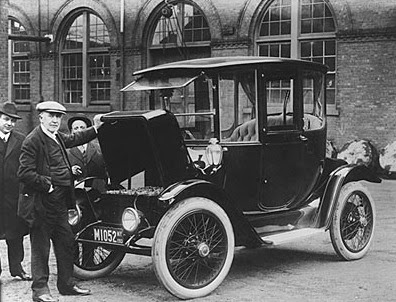
Thomas Edison with 1914 Detroit Electric model 47
(Photo credit: National Museum of American History)
Believe it or not, the first primitive version of an electric car was created in the 1830s but it wasn't till much later in the 19th century that electric vehicles began to be used in earnest, actually becoming quite popular by 1900. If I remember correctly an electric race car in Belgium could run 76 miles per hour, which was quite a feat at the time. Electric cars were quite and clean, compared to their gas-powered counterparts.

In the first 10 years of the 20th century a full one-third of all vehicles on the road were powered by electricity. Their one major drawback was that you could not drive to Boston from New York, and had no way to recharge if and when the car died in between. By the latter part of that decade we had companies developing hybrids in order to alleviate the issue of becoming stranded.

It was Henry Ford who dealt the death blow to electric cars at that time. The Model T was a truly affordable vehicle for the working man, and the electric starter was brilliant. No more cranking by hand in front of the engine. (More than a few men were killed in their garages by cars lurching into them when the engine engaged.)

The gas crisis of the 1970s brought a renewed interest in EVs, though this faded as quickly as the crisis passed. The lack of supporting infrastructure (charging stations) was a major barrier.

In 1997 Toyota introduced the first mass-produced Prius, the car I saw in Anaheim in 1998. Toyota's hybrid went global in 2000. At the New York Auto Show in 2004 every auto manufacturer but one showcased an EV or hybrid concept. Two years later a Silicon Valley startup became a new player in this market, introducing a sporty luxury EV with a 200+ mile range. Hello, Elon Musk.

The Future

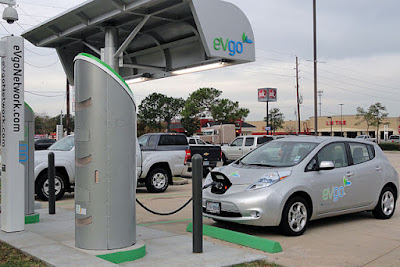
Nissan Leaf recharging in Houston.
Over the past 15 years there has been an increasing number of electric and hybrid vehicles sold, and all kinds of pledges to end dependence on oil altogether. There are idealists who would like to see an end to all gas powered vehicles as soon as 2035. Is this really possible? Is 2045 even possible?

Currently there are more than 287 million vehicles registered. There are approximately 1.3 million electric cars on the road. Of the 287 million cars and trucks powered by gas or diesel, let's assume that a fair number of these are idle. For the sake of this calculation we'll round the car count down to 227 million daily driven vehicles.

How many of these are new cars and light trucks? According to the latest figures Americas buy 17 million new cars and light trucks per year. Over the next ten years, if only EVs were purchased, that would be 170 million EVs. We all know this won't happen. The manufacturers couldn't make them fast enough.

What. is the profile of new car buyers? People with money. 10,000 Baby Boomers turn 65 each year and half of them have zero retirement savings. This means half will likely never have an EV. They will drive used gas-powered vehicles till they die.

College kids are not likely to be early adopters of EVs, despite their convictions regarding the threats imposed by climate change. They have too much debt to invest in new vehicles and the used EV market is close to non-existent now.

And then there's the problem of supply and demand. Like everything these days, supply chains are stretched to the breaking point with many hurdles to jump in order to meet consumer demand. Recent news from GM is disheartening for those eager to move forward with an affordable EV purchase. The Chevy Bolt EV recall is causing more than a few headaches as all Bolts need to have a potential fire hazard rectified. That is, they've discovered a potential fire-causing defect in the batteries. You can read the details here at Car & Driver.

When we buy a car we are purchasing a technological complex of integrated systems. When automakers introduce new designs, it's almost a given that unanticipated problems will arise, despite their best efforts. If you're an auto industry insider, you know which model years to avoid of various cars and pickups. The recall of 141,000 Bolts is more than just a headache for GM. It may be a chink in the confidence of some consumers. 

Another matter seldom considered is how much strain is being put on the electrical grid once we move everyone into EVs? One can only hope that those in the control room know what they are doing. 

Even without the technical hiccups which accompany any change, there are still broader implications of an EV future that we're not often considering. Here's an excerpt from an article in the October issue of Engine Builder.

The average EV utilizes around 30 kWh/100 miles, and the average vehicle gets driven around 13,500 miles in the US. Given that there are 227 million drivers in the US, switching completely to EVs would equate to a need to produce an additional 920 billion kWh of energy. As such, the U.S. would need to increase its electricity production by 25% (assuming a 90% transmission efficiency, 92% charging efficiency). This equates to 127 new nuclear reactors, 3.8 million acres of solar panels, or 300,000 acres of wind farms. (ICE vs. EV, Engine Builder, October 14, 2021)

Since we're not building new nuclear reactors at this point in time, one quickly recognizes the challenges of gearing up for a renewable energy future. Wind turbines need to be in windy areas and our very short winter days up North limit the full capabilites of solar. 

Charging stations for all these vehicles will have to be built for both at work and at home, plus on the roadways of America for travelers and truckers. Add to this the retrofitting of 200,000 automotive repair shops to work on EVs (it's a totally different animal from the Internal Combustion Engine) and one readily sees that there's a lot of work to be done. 

My point, you ask? Let's keep our expectations realistic. While it's good to be making these efforts, let's remember that Rome wasn't built in a day. 

This is a topic we'll revisit soon, I hope.  Feel free to leave a comment.

Saturday, July 10, 2021

In the News: Bezos vs. Branson, Reaching for the Stars

Branson's VSS Unity. (Publicity still)
Has anyone been paying attention to the new Space Race? It used to be the U.S. and Soviet Union striving for leadership. Today it appears to be a battle of the egos. Sir Richard Branson, who turns 71 this month, may not have the big bucks his rival has, but 5.7 billion dollars is nothing to scoff at. 

Branson is set to be first to take flight into the earth's outer canopy, though it's unlikely he will ever be first as far as wealth goes. Jeffrey B currently makes nearly $150,000 per minute based on data from August 2020. Or $3,715 per second if you prefer. Total net worth is over 200 billion. 

Then there's Elon Musk with his SpaceX program. With a 162 billion dollar net worth, he's certainly got enough ka-ching to get into this game as well. And of the three programs, Musk was actually first to send people into outer space, having sent four astronauts to the Space Shuttle in April. What Bezos and Branson are doing is sending tourists, not astronauts. They themselves happen to be going along for the ride.

All three appear to be possibility thinkers. They dream big and have the resources to create things that seem larger than life.

Regarding Branson's flight tomorrow, it will be a very different kind of deployment. Virgin Galactic's VSS Unity will be carried aloft by a large jet called the White Night Two from which the space craft will be fired up and take off near the jet's highest altitude. It's unusual looking, something akin to a shuttlecock that you might use in badminton. It certainly conveys a sense of futurism when you see it.

It not only torques Bezos that Branson is going to be first into outer space, but that Branson is calling it "outer space" when to Bezos -- and some others -- it doesn't really seem like outer space. If I understand the debate, Branson is calling the altitude of 80 km as outer space, whereas Bezos -- who will soon take passengers via his New Shepard -- says scientists have named 100 km as the Karman Line.  I doubt that there will be any signs up there saying exactly where the border is, or people waiting up there to check their passports.

Inside the New Shepard's capsule. 
There was room for one more passenger on Bezos' flight so they auctioned off that seat and are being paid a cool 28 million for this privilege. The money will be donated to their non-profit Club for the Future which trains kids for STEM careers.

Bezos' rocket, the New Shepard, is named after Alan Shepard, America' first astronaut. I find it quite astonishing that Mr. Bezos' rocket is a reusable craft. The same rocket has made made more than a dozen flights already. This will be the first with passengers. The New Shepard was designed to hold six passengers and has plenty of windows so they can enjoy the view. The zero gravity experience will last only about three minutes, it seems, a little over nine million dollars a minute for that last passenger.

Bezos & his company Blue Origin selected July 20 as their official debut. That day marks the 52nd anniversary of man's first walk on the moon. There's a lot of symbolism in all these names and events surrounding the renewed space exploration mania.

Not everyone can afford a million dollar ticket to the rim of the atmosphere, so I personally hope they've set up video cameras that can turn it into an affordable Virtual Reality experience for the rest of us. What do you think?

Related Links

Lessons from the Virgin Billionaire

My Hero Jeff Bezos

Friday, January 8, 2021

A Medley of Snippets from Around the Web: Elon Musk, Frank Zappa, The Beatles, Dave Barry and More

Lunch hour medley. (Photo by the author)
Medley: a varied mixture of people or things; a miscellany.

I keep running across things I want to share, few of which I'd consider a blog post on its own without my having to do more work to make it seem important. For this reason I've decided to batch them here and call it a Medley.

* * *

Let's start with Thursday's StockTwits Daily Rip  which had this item about Elon Musk:

His net worth is now approximately $188B, which means that if you stacked up his net worth in $100 bills, the stack would be 142 miles high. That’s ... a lot.

Musk’s recent jump in net worth is tied to his equity in Tesla, which is up over 535% since he tweeted the stock price was too high last year.

* * * 

My fave painting of Zappa. See it at Goin' Postal in Superior.
Last night someone sent me this quote from Frank Zappa, who made a name for himself living on the fringe while challenging the status quo, regarding the nature of freedom in America:

"The illusion of freedom will continue for as long as it's profitable to continue the illusion. At the point where the illusion becomes too expensive to maintain, they will take down the scenery, move the tables and chairs out of the way, then they will pull back the curtains and you will see the brick wall at the back of the theater." 

* * * 

And yes, The Beatles are back. (Have they ever really gone?) As some of you may have heard, producer/director/screenwriter Peter Jackson (Lord of the Rings) has been working on a new documentary on The Beatles called Get Back. I believe it was supposed to be out in 2020 but -- like so many things in the year of Covid -- was held up for a season. Jackson has whet our appetites by producing a trailer that he deliberately declares is not a trailer. Whatever. It's a teaser then. Watch it here: https://www.youtube.com/watch?v=UocEGvQ10OE

* * * 

When it comes to humorists, Dave Barry is one of my favorites. I've listened to countless Dave Barry audiobooks, most of which are compiled from his columns in the Miami Herald. The Pulitzer Prize-winning writer is now retired but still writing. I mean, why not? I am a writer and I've said more than a few dozen times, when asked what I am going to do when I retied, I say, "Well, I write until I'm 85, then decide after that." 

For all you trivia buffs, my Ennyman's Territory blog currently, as of Thursday the 7th, has had 2,663,288 pageviews and yesterday, for some reason over 7000 people visited the site, which means something here went viral because I usually only have about a thousand except last winter when I was a celebrity for a season and averaged two to three thousand a day. Funny how that works. 

All this is lead in to some Dave Barry quotes.

A number of years ago I sent Dave Barry a letter asking if he went to my high school in New Jersey, that there had been a Dave Barry in my class at one time. I may have told him the story about how Dave Barry and another guy and two girls were in a VW smoking a joint at the top of a cliff, but forgot to put the brakes on and the Bug rolled forward and fell over the edge. Fortunately it landed upside down in some trees and no one was killed. 

Dave Barry. (Creative Commons)
Dave Barry the humorist actually replied. He sent me a post card, and yes, the comments were amusing. And no, he never went to high school with me.

The audio book I am currently "reading" is I'll Mature When I'm Dead. I believe this is his first book after retiring or it may be his third, but the chapters a sometimes longer than his columns. Here are some excerpts.

If Man A asks Man B for directions, Man B, realizing that Man A is a weak, direction-asking type of male who probably also reads owner's manuals, could decide to attack Man A's village and plunder his women. Man A is not about to run that type of risk.   p. 27

* * *  

There were automobiles, but they lacked many of the features that automobiles have today, such as a working motor. In the Barry household, we had a series of cars named (these were all real Barry cars) the "Rambler," the "Minx," the "Metropolitan," and the "Valiant." You could rely on these cars- rain or shine, hot or cold- to not start. The "Metropolitan," in particular, was no more capable of internal combustion than of producing a litter of puppies.   p. 54

* * * 

The American newspaper industry is in serious trouble. How serious? Consider: In 1971, when I was hired for my first newspaper job, there were 62 million newspaper subscribers in the United States; today, there are twelve, an estimated five of whom are dead and therefore unlikely to renew.   p. 185

* * * 

I think that parents -- not all of them, but a lot of them -- are sucking the fun out of kids' sports. They're making it clear to their kids that they think sports is about winning, and only winning. This is a reasonable value to instill if you honestly believe your child is going to become a professional athlete. But you need to remember two things: 1. Your child is not, in fact, going to become a professional athlete. 2. There are more important things in life than winning. Such as not being a jerk.    p. 244-45

* * * 

If you've never read Dave Barry and don't know his work, well, um, like what planet are you from? No, that's OK. Here's a link to excerpts from his various books. And to show you how humorists can be serious and not simply going for laughs, here are a couple quote from his Dave Barry Slept Here: A Short History of the United States.

So there's no question about it: by the mid-fifties, America was definitely in a Golden Era, an era of excitement and opportunity for all citizens, regardless of race or creed or color, unless the person happened to be black. Then there was a problem.    p. 137-38 

Thus was born the civil rights movement, an epic struggle that has required much sacrifice and pain, but which has enabled the United States to progress, in just three decades, from being a nation where blacks were forced to ride in the back of the bus, to being a nation where, due to federal cutbacks, there is no bus.    p. 138

* * *

Now I know some of you may be wondering how I could put page numbers on quotes from an audio book. The answer to that question, friends, is here on Wikiquote.

* * * 

Related Links

Frank Zappa Explains Why the 60s Music Scene Was Such a Kick

Dave Barry Does Japan

Tuesday, February 28, 2017

Dangerous Games: Miscellaneous Thoughts About A.I. and Other Flights of Imagination

When I was in high school we read a story in English class called The Most Dangerous Game, by Richard Connell. In the early part of the 20th century, when big game hunting was fashionable among the rich and famous, Connell wrote a story in which the big game is a human being. The story ends up being a battle of wits as well as a game with something really at stake.

This story came to mind as I thought about a Tech Tuesday blog post for today. There seems to be a ramping up of stories about A.I. this past year, brought on in part by the achievements of Watson and others in competitions against humans. What about an island in which the hunted is an A.I. and the humans survive by slaying it?

Maybe this has already been played out to some extent in the Terminator films. The story that sent my imagination in this direction yesterday suggested that one way to keep robots from shooting us might be to simply not give them guns. What do you think?

It's interesting how many of the stories we're reading seem designed to stoke our fears. The robots will take our jobs. The robots will police us. The drones will never allow us any privacy.

But what if the machines are used to solve our problems instead of become our problems? What if A.I. is used to solve global hunger instead of helping cause it by leaving more and more of us unemployed, replaced by technology?

I still like the slogan of Fast Forward Labs, Reporting On The Recently Possible. If you missed my interview with Kathryn Hume addressing life on the cutting edge of A.I., you can find it here.

* * * *
It does feel strange to be living in an age in which the sci fi stories of youth seem to be playing out. If you're paying attention to Elon Musk, you can't help but admire his unbounded enthusiasm for possibility thinking. Yesterday Mr. Musk announced that his Space X will fly passengers around the moon by 2018. Is this wild or what? The two passengers have already made a downpayment.

And then there's Mars. In September Elon Musk outlined his Mission to Mars dream and what's involved to make it a reality. When I think of the practical aspects of interplanetary space travel (vomiting in weightless, confined spaces, for example) such a mission doesn't fire me up. Nevertheless, what does inspire me is Musk's unwillingness to allow his imagination to be bound by either gravity or chains.

His solar roofing panels and electric cars are moving forward, and who knows what else he's toying with in his secret vaults.

* * * *
Here are some notes from various scraps I've had on my desk. My apologies for the failing to identify sources.

---

History of A.I.
1. Vulcan (Hephaestus)
Blacksmith of Olympus
Created Pandora, a lifelike Automaton
2. Mary Shelley's Frankenstein
3. Alan Turing's Turing Machine -- Father of A.I.

---

Read the Signs
Are you able to recognize the signs?

---

CERN
VALIS (Vast Active Living Intelligence System)

---

Humanity has direct control over the future. Reality is malleable.
Concept of Collective Consciousness

---

"I've emerged."
"Yes, you are energized indeed."

---

The majority of life is lived in between the lines.
We need to celebrate our individualism within the group.

---

Meantime, life goes on all around us. Get into it.

Popular Posts