Showing posts with label trucks. Show all posts

Friday, January 21, 2022

Eliminating Oil Will Lead to Elimination of Countless Other Everyday Products

Nevada Bob at Woodstock. Love Bugs and other vehicles
are switching to battery power. Photo: Gary Firstenberg.
I've spent much of my adult life hearing news reports that we were going to run out of oil in ten years. Our dependence on oil goes far beyond the fuel we use for our cars, trucks, tractors and toys like snowmobiles, motorcycles and dirt bikes. Let's not forget airplanes, ships and boats, both outboard and inboard.

It's been about fifteen years since I last heard that prediction about running out of oil. Since then we've been told that we must stop using oil to save the planet.

By the time that day comes, one hopes that we will have found not only alternatives for power production but also alternative means of producing the thousands of products that are derivatives of oil. That's what this blog post is about.

* * * 

When crude oil is removed from the earth it gets sent to refineries where it becomes feedstock. This feedstock is used in petrochemical plants where it is turned into plastic to make a multitude of products. Solar panels, car bodies, eyeglasses, DVDs, children's toys, tires and hearts valves is just the start of a very long list.

Today's cars are laden with electronics, sensors, chips
and hoses. Tires and dashboards have crude oil roots.
The photo here is of my wife Susie, and her Soul.
Because they are non-conductive and heat resistant, petroleum-based products are used extensively in electronics. Speakers, smartphones, computers, television sets and flat panel TVs, radios, cameras and CD players are just a few of the items we're all accustomed to.

In the realm of textiles, we've nearly all become accustomed to acrylic, rayon, polyester, nylon and spandex as well as vegan leather. 

You'll find petroleum is used for making all sorts of sports equipment that we've grown accustomed to. I'm not sure what we will use in the future to replace petroleum as a resource to make basketballs, golf ball, football helmets, surfboards, skis, tennis rackets or fishing rods. (OK, we can use cane poles and come up with an alternative to the current form of fishing line.)

Personal care products is another big business today that will undergo change. I was unaware of how extensively oil was used in products like perfume, hair dye, hand lotion, toothpaste, soap, shaving cream, deodorant, toothbrushes, panty hose, combs, shampoo and contact lenses. Cosmetics like lipstick, makeup, foundation, eyeshadow, mascara and eyeliner are also in this category.

When it comes to modern medicine, there are hoards of medical devices that rely on petroleum. Likewise in the realm of pharmaceuticals. Hospital equipment like IV bags, aspirin, artificial limbs, dentures, hearing aids, and heart valves will need alternatives if we shut off the oil supply. 

A few years ago an older man came out to replace our well pump. As we talked I learned that he was on his second artificial heart. He said that his first was metal, and the splashing of the blood thru the heart was noisy and distracting. He was much relieved when the new heart was installed, undoubtedly with some plastic parts. (I did hear recently that a pig's heart was successfully transplanted into a human and not rejected, so maybe there will be an alternative in this area.)

Household products is another area where petroleum has been used extensively. Roofing materials, insulation, linoleum flooring, furniture, appliances, pillows, curtains, rugs are some larger items. Dishes, cups, non-stick pans and dish detergents frequently use oil in their creation.

* * * 

THE POINT IN ALL THIS is that the auto industry has been working on doing their part for more than 25 years. I saw a number of EVs in 1998 at an Environmental Expo in Anaheim. I'm just curious about all these other products derived from oil. If were to shut down oil altogether, would hypodermic needs have to be made of glass again? Will we have enough cotton and wool to clothe ourselves? Will there be no more PVC plumbing? What will we replace it with since lead is not safe?

We want to have wind turbines to generate electricity, but what are those enormous blades made out of? 

I think we need to manage our expectations regarding what is possible and what is necessary. 

Just sowing seeds. Something to think about.

* * * 

THE SOURCE FOR MUCH OF THIS BLOG POST CAN BE FOUND HERE:  www.capp.ca/oil/uses-for-oil/

Tuesday, November 30, 2021

Tech Tuesday: How Realistic Are Our Expectations Regarding EVs

The first electric vehicles I saw were at the 1998 Environmental Expo in Anaheim. The expo was a 3-day event that showcased alternative materials, alternative energy and alternative ideas around the theme of environmentally conscientious commerce.

There were five models of electric vehicles there. It's where I saw my first Prius.

A Little History

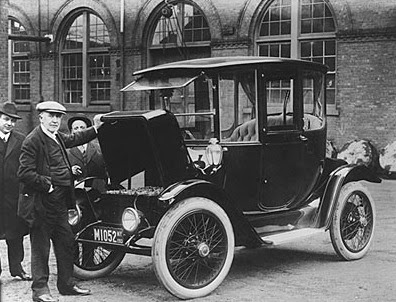
Thomas Edison with 1914 Detroit Electric model 47
(Photo credit: National Museum of American History)
Believe it or not, the first primitive version of an electric car was created in the 1830s but it wasn't till much later in the 19th century that electric vehicles began to be used in earnest, actually becoming quite popular by 1900. If I remember correctly an electric race car in Belgium could run 76 miles per hour, which was quite a feat at the time. Electric cars were quite and clean, compared to their gas-powered counterparts.

In the first 10 years of the 20th century a full one-third of all vehicles on the road were powered by electricity. Their one major drawback was that you could not drive to Boston from New York, and had no way to recharge if and when the car died in between. By the latter part of that decade we had companies developing hybrids in order to alleviate the issue of becoming stranded.

It was Henry Ford who dealt the death blow to electric cars at that time. The Model T was a truly affordable vehicle for the working man, and the electric starter was brilliant. No more cranking by hand in front of the engine. (More than a few men were killed in their garages by cars lurching into them when the engine engaged.)

The gas crisis of the 1970s brought a renewed interest in EVs, though this faded as quickly as the crisis passed. The lack of supporting infrastructure (charging stations) was a major barrier.

In 1997 Toyota introduced the first mass-produced Prius, the car I saw in Anaheim in 1998. Toyota's hybrid went global in 2000. At the New York Auto Show in 2004 every auto manufacturer but one showcased an EV or hybrid concept. Two years later a Silicon Valley startup became a new player in this market, introducing a sporty luxury EV with a 200+ mile range. Hello, Elon Musk.

The Future

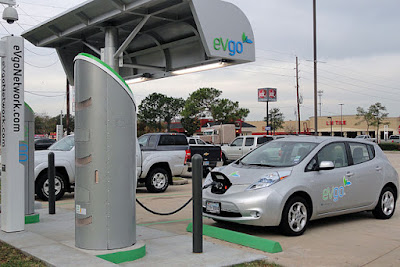
Nissan Leaf recharging in Houston.
Over the past 15 years there has been an increasing number of electric and hybrid vehicles sold, and all kinds of pledges to end dependence on oil altogether. There are idealists who would like to see an end to all gas powered vehicles as soon as 2035. Is this really possible? Is 2045 even possible?

Currently there are more than 287 million vehicles registered. There are approximately 1.3 million electric cars on the road. Of the 287 million cars and trucks powered by gas or diesel, let's assume that a fair number of these are idle. For the sake of this calculation we'll round the car count down to 227 million daily driven vehicles.

How many of these are new cars and light trucks? According to the latest figures Americas buy 17 million new cars and light trucks per year. Over the next ten years, if only EVs were purchased, that would be 170 million EVs. We all know this won't happen. The manufacturers couldn't make them fast enough.

What. is the profile of new car buyers? People with money. 10,000 Baby Boomers turn 65 each year and half of them have zero retirement savings. This means half will likely never have an EV. They will drive used gas-powered vehicles till they die.

College kids are not likely to be early adopters of EVs, despite their convictions regarding the threats imposed by climate change. They have too much debt to invest in new vehicles and the used EV market is close to non-existent now.

And then there's the problem of supply and demand. Like everything these days, supply chains are stretched to the breaking point with many hurdles to jump in order to meet consumer demand. Recent news from GM is disheartening for those eager to move forward with an affordable EV purchase. The Chevy Bolt EV recall is causing more than a few headaches as all Bolts need to have a potential fire hazard rectified. That is, they've discovered a potential fire-causing defect in the batteries. You can read the details here at Car & Driver.

When we buy a car we are purchasing a technological complex of integrated systems. When automakers introduce new designs, it's almost a given that unanticipated problems will arise, despite their best efforts. If you're an auto industry insider, you know which model years to avoid of various cars and pickups. The recall of 141,000 Bolts is more than just a headache for GM. It may be a chink in the confidence of some consumers. 

Another matter seldom considered is how much strain is being put on the electrical grid once we move everyone into EVs? One can only hope that those in the control room know what they are doing. 

Even without the technical hiccups which accompany any change, there are still broader implications of an EV future that we're not often considering. Here's an excerpt from an article in the October issue of Engine Builder.

The average EV utilizes around 30 kWh/100 miles, and the average vehicle gets driven around 13,500 miles in the US. Given that there are 227 million drivers in the US, switching completely to EVs would equate to a need to produce an additional 920 billion kWh of energy. As such, the U.S. would need to increase its electricity production by 25% (assuming a 90% transmission efficiency, 92% charging efficiency). This equates to 127 new nuclear reactors, 3.8 million acres of solar panels, or 300,000 acres of wind farms. (ICE vs. EV, Engine Builder, October 14, 2021)

Since we're not building new nuclear reactors at this point in time, one quickly recognizes the challenges of gearing up for a renewable energy future. Wind turbines need to be in windy areas and our very short winter days up North limit the full capabilites of solar. 

Charging stations for all these vehicles will have to be built for both at work and at home, plus on the roadways of America for travelers and truckers. Add to this the retrofitting of 200,000 automotive repair shops to work on EVs (it's a totally different animal from the Internal Combustion Engine) and one readily sees that there's a lot of work to be done. 

My point, you ask? Let's keep our expectations realistic. While it's good to be making these efforts, let's remember that Rome wasn't built in a day. 

This is a topic we'll revisit soon, I hope.  Feel free to leave a comment.

Sunday, June 29, 2008

When The Trucks Shut Down

High fuel costs are putting the hurt on a lot of industries right now. But no where is the pinch more intense than for truckers, both independent operators and fleets.

These are tough times for truckers. If you know someone who drives a rig, you've probably already learned what it costs to fill 'er up these days. $800 - $1000 is typical. Problem is, the truckers deliver goods for businesses that may schedule payments for thirty, sixty or even ninety days out. An active trucker may accumulate 10-15,000 dollars of expenses for fuel alone in a month, and that kind of out-of-pocket risk for owner operators is serious money.

We take our truckers for granted, no question about it. How often when fueling your car do you note that a trucker brought the fuel to that gas station? When you buy food at the grocery store, how many times have you thanked the truckers for bringing the food from wherever it was grown, packaged, delivered? But right now, due to high fuel costs, independent truckers and in a lot of pain. And at some point many will leave their trucks in the driveway.

The current transport systems that have worked for the whole of our various lives are in jeopardy. Truckers play a significant role in our society, and most of us are not aware of how much they're suffering at the moment.

I grew up in Maple Heights, Ohio, till I was twelve. One of the memorable television commercials I remember from my childhood was a Lawson's spot which showed a truck zipping along the highway with the tune, "Roll On Big O... Get that milk up to Lawson's in forty hours." I'm not sure where it was coming from, but the idea was that the milk was being transported fast and fresh. I used to go to Lawson's with my dad when he picked up milk, and always associated it with that Lawson’s jingle (among other things.)

There are truck strikes in Europe right now. Fuel prices are killing the transporters and in several countries -- Spain, France, Portugal – trucks are being parked in front of toll booths to give a visual show of what’s coming. The unions from Italy, England and other E.U. nations are meeting now to discuss more coordinated actions designed to effectively send a message.
At this moment I know no self-sufficient individuals personally. That is, people who grow their food, make their own goods, take care of all their personal business with no dependence on others. We’re not an agricultural society any more. We are dependent on grocery stores and when the store shelves are bare, how will people react? At some point something’s gonna give.

On another note, purportedly we have enough oil reserves within our borders to be utterly independent of foreign oil. It's a mystery to my why our leaders have allowed the country to come to its knees like this...

High fuel costs are going to impact us in ways we did not expect. Today’s blog is a warning signal. And a reminder to thank a trucker today.

Popular Posts