Showing posts with label hybrid. Show all posts

Tuesday, November 30, 2021

Tech Tuesday: How Realistic Are Our Expectations Regarding EVs

The first electric vehicles I saw were at the 1998 Environmental Expo in Anaheim. The expo was a 3-day event that showcased alternative materials, alternative energy and alternative ideas around the theme of environmentally conscientious commerce.

There were five models of electric vehicles there. It's where I saw my first Prius.

A Little History
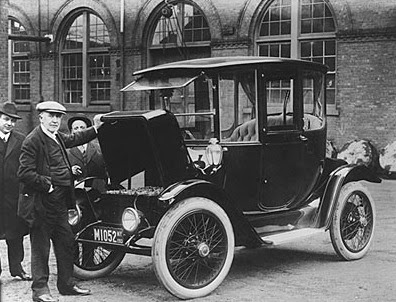
Thomas Edison with 1914 Detroit Electric model 47
(Photo credit: National Museum of American History)
Believe it or not, the first primitive version of an electric car was created in the 1830s but it wasn't till much later in the 19th century that electric vehicles began to be used in earnest, actually becoming quite popular by 1900. If I remember correctly an electric race car in Belgium could run 76 miles per hour, which was quite a feat at the time. Electric cars were quite and clean, compared to their gas-powered counterparts.

In the first 10 years of the 20th century a full one-third of all vehicles on the road were powered by electricity. Their one major drawback was that you could not drive to Boston from New York, and had no way to recharge if and when the car died in between. By the latter part of that decade we had companies developing hybrids in order to alleviate the issue of becoming stranded.

It was Henry Ford who dealt the death blow to electric cars at that time. The Model T was a truly affordable vehicle for the working man, and the electric starter was brilliant. No more cranking by hand in front of the engine. (More than a few men were killed in their garages by cars lurching into them when the engine engaged.)

The gas crisis of the 1970s brought a renewed interest in EVs, though this faded as quickly as the crisis passed. The lack of supporting infrastructure (charging stations) was a major barrier.

In 1997 Toyota introduced the first mass-produced Prius, the car I saw in Anaheim in 1998. Toyota's hybrid went global in 2000. At the New York Auto Show in 2004 every auto manufacturer but one showcased an EV or hybrid concept. Two years later a Silicon Valley startup became a new player in this market, introducing a sporty luxury EV with a 200+ mile range. Hello, Elon Musk.

The Future
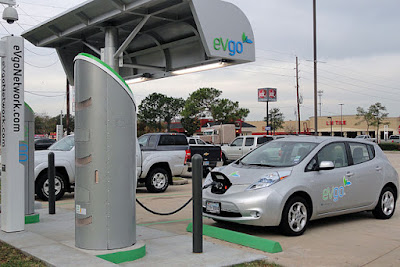
Nissan Leaf recharging in Houston.
Over the past 15 years there has been an increasing number of electric and hybrid vehicles sold, and all kinds of pledges to end dependence on oil altogether. There are idealists who would like to see an end to all gas powered vehicles as soon as 2035. Is this really possible? Is 2045 even possible?

Currently there are more than 287 million vehicles registered. There are approximately 1.3 million electric cars on the road. Of the 287 million cars and trucks powered by gas or diesel, let's assume that a fair number of these are idle. For the sake of this calculation we'll round the car count down to 227 million daily driven vehicles.

How many of these are new cars and light trucks? According to the latest figures Americas buy 17 million new cars and light trucks per year. Over the next ten years, if only EVs were purchased, that would be 170 million EVs. We all know this won't happen. The manufacturers couldn't make them fast enough.

What. is the profile of new car buyers? People with money. 10,000 Baby Boomers turn 65 each year and half of them have zero retirement savings. This means half will likely never have an EV. They will drive used gas-powered vehicles till they die.

College kids are not likely to be early adopters of EVs, despite their convictions regarding the threats imposed by climate change. They have too much debt to invest in new vehicles and the used EV market is close to non-existent now.

And then there's the problem of supply and demand. Like everything these days, supply chains are stretched to the breaking point with many hurdles to jump in order to meet consumer demand. Recent news from GM is disheartening for those eager to move forward with an affordable EV purchase. The Chevy Bolt EV recall is causing more than a few headaches as all Bolts need to have a potential fire hazard rectified. That is, they've discovered a potential fire-causing defect in the batteries. You can read the details here at Car & Driver.

When we buy a car we are purchasing a technological complex of integrated systems. When automakers introduce new designs, it's almost a given that unanticipated problems will arise, despite their best efforts. If you're an auto industry insider, you know which model years to avoid of various cars and pickups. The recall of 141,000 Bolts is more than just a headache for GM. It may be a chink in the confidence of some consumers. 

Another matter seldom considered is how much strain is being put on the electrical grid once we move everyone into EVs? One can only hope that those in the control room know what they are doing. 

Even without the technical hiccups which accompany any change, there are still broader implications of an EV future that we're not often considering. Here's an excerpt from an article in the October issue of Engine Builder.

The average EV utilizes around 30 kWh/100 miles, and the average vehicle gets driven around 13,500 miles in the US. Given that there are 227 million drivers in the US, switching completely to EVs would equate to a need to produce an additional 920 billion kWh of energy. As such, the U.S. would need to increase its electricity production by 25% (assuming a 90% transmission efficiency, 92% charging efficiency). This equates to 127 new nuclear reactors, 3.8 million acres of solar panels, or 300,000 acres of wind farms. (ICE vs. EV, Engine Builder, October 14, 2021)

Since we're not building new nuclear reactors at this point in time, one quickly recognizes the challenges of gearing up for a renewable energy future. Wind turbines need to be in windy areas and our very short winter days up North limit the full capabilites of solar. 

Charging stations for all these vehicles will have to be built for both at work and at home, plus on the roadways of America for travelers and truckers. Add to this the retrofitting of 200,000 automotive repair shops to work on EVs (it's a totally different animal from the Internal Combustion Engine) and one readily sees that there's a lot of work to be done. 

My point, you ask? Let's keep our expectations realistic. While it's good to be making these efforts, let's remember that Rome wasn't built in a day. 

This is a topic we'll revisit soon, I hope.  Feel free to leave a comment.

Thursday, April 30, 2009

It's Electric

I have a pet peeve and it's this. I find it annoying how some people, with a brassy personality and a measure of high-powered PR, can get a whole batch of publicity and dollars for ideas that are so full of holes they can't possibly float. No, that isn't quite the wording. It annoys me when people get publicity for very tentative things way off in the pipe dream realm while very real solutions, albeit incremental, are within our grasp.

Here's an example. Last fall the September 2008 issue of Wired magazine featured a cover story called The Future of the Electric Car, subtitled One man's audacious plan to change the way the world drives. The feature story was about an Israeli fellow named Shai Agassi whose idea is essentially an all-inclusive system of battery powered cars, re-charge systems and infrastructure that integrates computers, cars and GPS. It's a total system.

Here are a few clues to how things would work in a Better Place world.
1. Key fob tells how charged the battery is...
2. Driver unplugs and drives off...
3. During commute car locates three open parking spots to plug into during work day...
4. The car and energy control center connect and communicate...
5. While on the road, if re-charge needed, car OS locates best place for battery swap site...

Evidently it's this last item which is a central piece of Agassi's brainchild, I think. He envisions all these buildings around the country which operate like our car washes, where you drive in at one end and the equipment swaps the batteries so you can hit the road again quickly, efficiently, re-juiced.

But to be honest, I just can't picture it. First off, people hate waiting in lines. When I was growing up in New Jersey you had to go through annual vehicle inspections and if you weren't there a half hour before it opened, you could be in line for more than an hour, a line which sometimes stretched a block or more. Can you imagine having to wait in line to re-charge or swap out your battery every couple hundred miles?

The infrastructure issue alone for this system would be a nightmare. Converting enough parking meters and parking slots in cities like New York to accommodate a gazillion electric cars in need of re-charging would not be cheap or fast to implement. But this is not, as I see it, the biggest hurdle.

When I was at the New York Auto Show last year I saw a whole range of ideas for dealing with this issue, from hybrids to electric transmissions to hydrogen cells and the like. Before we see a technology become truly dominant, won't we have to see buy-in across the board to establish the infrastructure to implement it? Right now we have gas stations everywhere. There are so many gas stations that I almost never have to wait in line to fill 'er up. When we start a ramp up to one of these alternative technologies, how long will it take to put this infrastructure in place? Or more importantly, which infrastructure? Who is going to pay that kind of money to set up a system that may not become the dominant system of the future?

Video movies are a good example. VHS and Beta went head to head. Beta was better, I've been told, but VHS won out. In the automobile power game, a car wash costs about a million dollars. It takes time to recoup that investment. How much will these electric battery swapping stations cost to build or buy and own? Who is going to spend a million dollars on a technology that has a high possibility of not becoming the adopted system for tomorrow? The total rollout can be hundreds of billions... with no certainty of success either in implementation or adoption.

Well, Shai Agassi, on the force of his personal charisma alone, appears to have garnered $300 million seed money for the company he's called Better Place. But will Better Place become the better place he aims it to be? Some are already suggesting that the bloom is off the rose.

My prediction is that this guy Shai will be just another Mary Tolan.

In 2003, the mag Business 2.0 produced a laudatory article by Ralph King about a woman exec from Accenture named Mary Tolan who was pushing the notion that the U.S. could wean itself from big oil by 2015 by switching to hydrogen cell power. The article boldly stated, “Her ideas could help catalyze needed change.” (Mary Tolan’s Modest Proposal, Business 2.0, June 2003.)

Six years later, and where is Mary Tolan? Yes, she is still a connected exec with Accenture, but a zealous advocate for hydrogen cell batteries? Do your own research and you’ll see an impressive 2003 campaign that is just another blip in the history of the automobile.

This is not to suggest that I am opposed to electric cars or efforts to move toward green. If we're serious about being greener, there are certainly things we can be doing now if we wished. I just think there are too many unanswered questions with regard to going electric, straight up. How long will it take to get the power grid up to a level where it can juice all these cars? And when the power grid goes down, is it a paid vacation day or are we simply stuck?

Well, enough of that. Tomorrow's another day.

Wednesday, September 3, 2008

On Progress

“Progress might have been all right once, but it has gone on too long.” ~ Ogden Nash

The most recent Computerworld magazine featured an article called “Information Overload” by Mary Brandel. She begins by citing the remarks of Jeff Saper, a tech firm chief information officer who drives a hybrid car and has been highly sensitive to green issues. Saper’s concern today, however, is not air and water pollution. Rather, it’s digital pollution, information overload.

Change is a challenge for everyone, but we can usually find ways to make necessary adjustments when the changes come piecemeal. On the other hand, when a tidal wave of new technologies hits us all at once impacting every facet of our lives, it really can make us feel like we are drowning.

Even this morning this issue interfered with my life. I was wakened early by a periodic chirping noise. Assuming it was one of our three fire alarms with a low battery, I sat here and then there and then over by the stairs trying to determine which was the one, tracking down the source like a good Sherlock Holmes. Well, turns out to have been inside a pouch on the kitchen counter. My wife's cell phone battery was low, needing a charge.

How I long for the good old days of my youth when the most complicated decision you had to make was whether to throw to first or hope to get the lead runner sliding into third. The way we increased volume on our bicycles was to put baseball cards in the spokes, not electronic gadgets on the handlebars. Nearly any task on a car's engine could be figured out with a wrench, logic and common sense.

Nowadays, our cars are far more complex, as well as our bikes, our phones, our jobs and our lives. Computers are in most homes in America, but how many IT people live at your house? Not many homes come with an IT technician, so we have to learn how to fix modems, debug software, figure out anti-virus programs, and resolve Internet access issues just to do basic daily correspondence (via email, of course).

In short, we live in a world of mental clutter. In addition to complications caused by all these technical advances, our minds are filled with a trunk load of relationship issues, career issues, parenting issues, health issues, housing issues, problems with neighbors, addictions, mental “to do” lists and more. It’s simply a side effect of living a busy life in the modern world. Our heads are filled with a continuous “white noise” or mental chatter that serves as a perpetual distraction.

This is what “progress” in the civilized world has brought us to, it seems. No wonder we’re so distracted, neurotic and frenetic.

I remember sitting in the back seat of a car with a twelve year old boy in the 1980’s who was able to solve Rubik’s Cube in less than a minute. I couldn’t do the thing to save my life, yet here was this kid who simply astounded me with the rapidity of his hand movements directed by conscious decisions.

Later, upon reflection, I realized that he could devote 100% of his attention to the problem of solving the Cube. I was using only ten per cent of my brain, preoccupied as I was with career decisions, relationship issues, financial issues, etc. How wonderful to live in that age of innocence called youth.

Alas, youth is pretty short lived. Sooner or later, despite Peter Pan’s intentions to the contrary, most of us have to assume a measure of responsibility and participate in the modern world. At least, if you are a Westerner.

Popular Posts