Showing posts with label Elvis. Show all posts

Monday, September 18, 2023

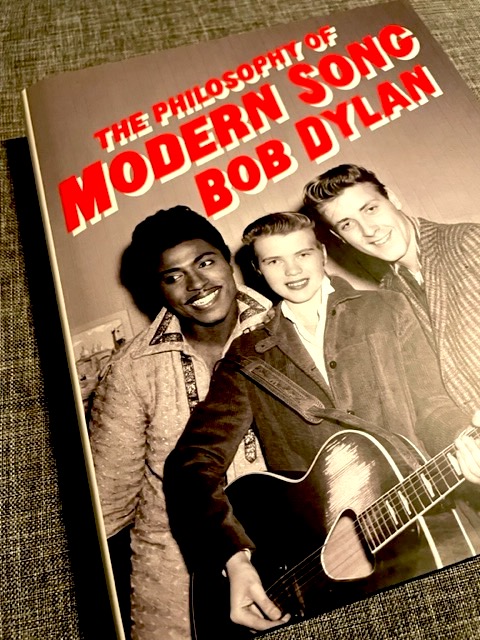
Weighing In on Bob Dylan's Philosophy of Modern Song

Despite waiting years for Dylan's sequel to Chronicles: Volume One, I did not order my copy of his Philosophy of Modern Song in advance last year, as I might normally have done. Rather, I requested it as a Christmas present and thus received it after weeks of reviews had already appeared. The "controversy" regarding his "autograph scandal" didn't phase me. Nor did the misogyny brickbats.

So here it is, sitting before me on the coffee table/wooden chest, beckoning me to express my initial first reactions.  

* * * 


The Philosophy of Modern Song is not anything like what most of us expected as the sequel to Chronicles Vol. 1. The writing, however, feels like a Dylan volume. Most Dylan fans who have listened to his Theme Time Radio show will very likely hear Dylan's voice reading it aloud as they read the text.

The book itself is a collection of essays on 66 songs by other artists, spanning from Stephen Foster to Elvis Costello. It has the look of a scrapbook in some ways. To some extent that makes sense in a pop culture sort of way. (When I was in Italy, I was talking about Dylan with a fellow who owned a craft brewery. He had a couple Dylan posters on the wall so I commented on my surprise at how much Dylan had been imported into Italy. He said, "America gave us two things: Bob Dylan and Pop Culture.")

According to the text on the inside cover flap Dylan began working on it in 2010. The sales-copy describes it as "a master class on the art and craft of songwriting," though quite a few critics demur on this proclamation. 

John Carvill at PopMatters.com, for example, wrote, "There’s very little of what we could sensibly consider ‘modern song’ in The Philosophy of Modern Song, and any ‘philosophy’ is strictly of the cracker barrel variety. That’s ok, though, because we’ve learned never to take Dylan at face value, and the title was just too pretentious to have been meant seriously." The subhead to that article calls it "an awful book, awash with misogyny and crusty old man rants."
I found that last barb to me a little harsh, but having become an older man myself I do understand why folk become "crusty" in their later years.

Sasha Frere-Jones called it "a fractured memoir and punch list of nightmares." And follows up with "what begins as a set of interpretations ends up as a sour little diary."
(4columns)

On the other hand, if you're seeking reviews with a little more enthusiasm for the subject matter (Bob's sequel to Chronicles: Volume One) then here's the place to be: 130+ Published Reviews of Dylan's Book.

I believe I did see at least one reviewer agree it that was "master class on the art and craft of songwriting." I saw it as something different. 

I enjoyed seeing the variety of songwriters selected. No surprise to find spotlights on Elvis, Little Richard, Johnny Cash and Hank Williams, as long-time fans know his respect for the music of these giants. Happy surprises include Stephen Foster, Nina Simone and many others. As for Dylan's impressions on pop hits from my own Boomer-era lifetime, there were many, such as "Ball of Confusion" by the Temptations, "Black Magic Woman" by Santana, "By the Time I Get to Phoenix" by Jimmy Webb, etc.  And then there are all the slices and slivers from other assorted musical genres that you probably would not have expected. 

The writing style is, as I noted, more of a rhythmic impressionism, a Dylan style you find in songs like "Subterranean Homesick Blues," punchy phrases falling all around like shrapnel from a hand grenade. 

Here's an excerpt from his chapter on Cher's "Gypsies, Tramps and Thieves" which is accompanied by old photos of a Peep Show carnival barker and a Side Show Zoo sign. 

You've evolved over thousands of years and you're still traveling through, setting up the tent and making ends meet. Hoaxes, tournaments and spectacles, that's your line of business. Drugstore cowboys, girl watchers, night owls--everybody and their uncle, you lighten them up and bleed them with ease. You give nightmares to people while they're fully awake. People whisper behind your back--lampoon you, satirize, mock and ridicule you, make bitchy comments but your place in the sun is secure.

Some of the book is almost as strange as his Tarantula.

A novel with a plot this is not. It's entertainment. Dean Martin's "Blue Moon" is accompanied by a cover photo of Robert Heinlein's The Moon is a Harsh Mistress. Carl Perkins' "Blue Suede Shoes" ends with a shoe ad.

Here's a digression from another chapter.

You're in an exclusive club, and you're advertising yourself. You're blabbing about your age group, of which you're a high-ranking member. You can't conceal your conceit, and you're snobbish and snooty about it. You're not trying to drop any big bombshell or cause a scandal, you're just waving a flag, and you don't want anyone to comprehend what you're saying or embrace it, or even try to take it all in. You're looking down your nose at society and you have no use for it. You're hoping to croak before senility sets in. You don't want to be ancient and decrepit, no thank you. I'll kick the bucket before that happens. You're looking at the world mortified by the hopelessness of it all.

In reality, you're an eighty-year-old man, being wheeled around in a home for the elderly, and the nurses are getting on your nerves. You say why don't you all just fade away. You're in your second childhood, can't get a word out without stumbling and dribbling. You haven't any aspirations to live in a fool's paradise, you're not looking forward to that, and you've got your finger....

In the first paragraph you are you, in a hopeless world. But suddenly, you are an eighty-year old man in a home for the elderly. Is that a pivot? Is Dylan saying what he means or is it the opposite? Is this his take on the sunset years? 

MY TAKE
Philosophy of Modern Song is fun, but is best enjoyed if you treat it like a book of poetry 
next to your easy chair which you can dip into and savor any time of day or night. Don't take it too seriously. Just enjoy it.

Related Links
Bob Dylan In Italy
What Does Charles Trenet's "La Mer" Have to Do with Dylan's Philosophy of Song?

Postscript
"an enthralling farrago of fabrications and tangents that occasionally, when it circles back to his early life on the Greenwich Village folk scene, offers rare bits of vivid personal disclosure, including meditations on artists and songs that helped shape him."
--Bob Dylan, Philosophy of Modern Song

Illustration Credit: Collaboration with Dream by Wumbo. 
Photo credits: the author, the latter at the train station in Florence, Italy.

Saturday, March 25, 2023

Bridge Over Troubled Water: Interpretations of a Classic

It's easy to see why people keep going back to the music of the Sixties. "Bridge Over Troubled Water" is another of the classics from that time, by Simon & Garfunkel. According to Wikipedia the song features lead vocals by Art Garfunkel and a piano accompaniment influenced by gospel music with a "Wall of Sound"-style production. 

The song received five Grammy Awards (I didn't know one song could win that many, but one of them was for being part of the Grammy-winning album of the year by the same name.)

The instrumentation was produced by L.A.'s famous session musicians known as the Wrecking Crew.  The vocals were recorded in New York.

Inspirations for the song came from some interesting places. The concept of the bridge over deep waters was taken from Claude Jeter's 1959 song "Mary Don't You Weep." Another portion of the melody was drawn from the classic hymn "O Sacred Head Now Wounded." It's no wonder that the song can find a home in both secular settings and religious ones.

In an interview with Rolling Stone, Paul Simon compared the instrumentation here with the Beatles' "Let It Be." I find it interesting that both albums took their name from these two songs, and also that for each group it was their last studio album before their breakups.

While listening to some Roy Orbison songs on YouTube last night I was quite moved by the song's power in this great vocalist's hands. Which led  me to check out some other artist's renditions. Wow! What a great song. Roy, Elvis and Whitney each knock it out of the park. (Forgive me the cliche metaphor, but Paul Simon likes to wear a baseball cap, so please excuse me.) Make time to enjoy these if you can.

Roy Orbison

Elvis gives it his all.


Whitney Houston and CeCe Winans... feel the power.


And Art, at the Concert in Central Park

For a big finish, here's one more.
Art and Paul at Madison Square Garden.

Sunday, August 28, 2022

James Dean's Bit Part in the Fifties Cast a Long Shadow, But What If....?

From the book James Dean: 50 Years Ago
Because Buddy Holly performed one of his last concerts here in Duluth, leaving lasting impression on the young Robert Zimmerman who was there that night, I've numerous times been asked, "Would Buddy Holly have stayed famous and influential had he lived?"

It's one of the age old questions people ask when famous people die young. "What if..." What if Marilyn Monroe had lived? What if JFK had lived? And today's theme: What if James Dean had lived?

* * * 

Earlier this year I picked out David Halberstam's The Fifties for my summer read because I was born in the early Fifties and believed it would help me understand myself. Though I've always believed it was the Sixties that shaped my life trajectory, one cannot escape recognizing how the outlines of our Sixties lives emerged from what came before. 

Interestingly, the ones who were most shaped by the Fifties were the kids born in the early Forties, like Bob Dylan. There's no question James Dean had been an influence on Dylan. Coming of age in Hibbing, Bobby Zimmerman's uncles owned the theaters there and much has been made of Bobby Z having spent hours at the Lybba and other theaters in town. We not only see references to films in his songs but also see his interest in the medium of film itself. (eg. Renaldo & Clara, Masked and Anonymous, Pat Garrett & Billy the Kid.)

As for James Dean himself, Bob Dylan once visited James Dean's hometown after a concert in Indianapolis, much like Dylan fans make a trek to Duluth and Hibbing to see the homes and points of interest where young Dylan grew up.

So we come to the question that is now on the table. What kind of career would James Dean have had had he lived? Here's some of what Halberstam wrote. In a chapter that focuses on three influential "bad boys" of the Fifties, he begins with Brando and Elvis.

Marlon Brando and Elvis Presley were only the first of the new rebels from the world of entertainment and art. Soon to come were many others. If there was a common thread, it was that they all projected the image of being misunderstood, more often than not by their parents' generation, if not their own parents themselves. There was little overt political content in their rebellion; their public personae and the characters they played were not fighting against the sinister injustices of the McCarthy era or racial injustice. Only Brando came close to politics when he confronted the mob in On the Waterfront.

According to Halberstam, the third bad boy James Dean was not the caliber of actor that Brando was. 

Dean's life and his art were inseparable. Unlike Brando, who had considerable professional training and considerable range, Dean basically played himself, but brilliantly. Sullen and sulky, he was still worthy of redemption if only the properly tender girlfriend could be found to mother him. Either he got a part right instinctively, (Elia) Kazan believed, or he didn't get it at all. At a certain point the only way to get him to improve his performance was to get him liquored up.

A little further Halberstam makes this observation about Dean's career.

His career was short. There were only three films before he met his death in a car accident. The end came at the height of his fame and in the very same year of his stunning debut in East of Eden. That early death ensured him a place in the pantheon of artists who lived fast and died young. His poster would grace the bedroom walls of future generations of young would-be rebels. Dick Schickel noted the advantages of dying young (Dean) and the disadvantages of not (Brando): "There is much to be said for dying young in circumstances melodramatically appropriate to your public image. There is very little to be said for living long and burying that image in silence. They're like fighters on their way up. It's a life or death struggle for them and they give their utmost to the role. This quality disappears later," he once said. "They become civilized and normal."

In another place Halberstam details the challenge Kazan had to deal with and the games the two men--Kazan and Dean--played before the latter would win his opportunity.

A friend told Kazan about Dean, whom he remembered from the Actors Studio as sullen and not very productive. At their first meeting Kazan, wanting to provoke Dean, deliberately kept him waiting; when he finally arrived, Kazan found Dean slouched down in his seat--rude, disrespectful, and shabbily dressed. The two of them were engaging in a certain kind of theatrical gamesmanship, Kazan decided. They did not talk much. Conversation was not James Dean's strong suit, particularly with someone so powerful in the theater and whose good opinion he so desperately wanted. Dean offered Kazan a ride on his motorbike, and off they went. "He was showing off," Kazan later wrote, "a country boy not impressed with big city traffic."

Fortunately for Dean, his act worked. To Kazan, who bore his own resentments against his father, Dean was Cal Trask. "There was no point in trying to cast it better or nicer. Jimmy was it. He had a grudge against all fathers. He was vengeful; he had a sense of alone-ness and of being persecuted. And he was uncommonly suspicious."

The impression one gets is that James Dean was not really a character actor, he was simply himself. If this were the case, the future he never had would require some maturing and more honing of his craft. He certainly made a splash, but how much of this was due to Kazan's skills handling the churlish Dean? 

Photo credits: All the images on this page were from this book which I picked up at a library sale early this summer. 

Friday, August 19, 2022

Flashback Friday: Charlie McCoy Talks About His Charmed Career In Nashville

Charlie McCoy
Originally published 21 June 2021

What do "Desolation Row", Blonde On Blonde, John Wesley Harding, Nashville Skyline and Dylan's Self Portrait have in common? Charlie McCoy helped each of these come to fruition as a session musician in the Sixties. 

What do Elvis Presley, Simon & Garfunkel, Perry Como, Roy Orbison, George Jones, Loretta Lynn, Dolly Parton, Johnny Cash, Ringo Starr, Tanya Tucker, Nancy Sinatra, Gordon Lightfoot, Manhattan Transfer , Jerry Lee Lewis, Waylon Jennings, Chet Atkins, Ray Stevens and many others have in common? Charlie McCoy played harmonica on one or more of their recordings.   

He's also played bass with Dylan, Leonard Cohen, Bobby Goldsboro, Charlie Rich and others.... and guitar work with many more, not to mention many other instruments with countless others. And most remarkably, he's still working in the music business, now more than 60 years.

In addition to all this session work with other artists, Charlie McCoy has recorded dozens of albums of his own -- 44 or 45 in all -- including his 1972 Grammy winner The Real McCoy. A member of the Country Music Hall of Fame, his resume includes an 18 year stint as Music Director for the syndicated TV show "Hee Haw".

* * *

I was introduced to Charlie McCoy by means of Nevada Bob Gordon who last year recorded his album Long Train to Nowhere in Nashville with Charlie as one of the session musicians. When I learned earlier this year that Nevada Bob was returning to Nashville to record a fifth album, I asked if he would again be working with Charlie McCoy. He said yes, so I asked for a favor. 

One of my favorite Bob Dylan books is Daryl Sanders' That Thin Wild Mercury Sound, which I read twice this past year. This book is rich with detail about nearly every aspect of the making of Blonde On Blonde. I would suggest that Sanders' book was the trigger that made me want to reach out to McCoy if he were accessible.

The interview, a mid-day phone conversation, took place on June 14 at 1:00 p.m. McCoy set the time and I privately created a loose agenda. After a brief greeting he set the tone with these opening lines: "I’ve been blessed. I’ve met great people. I still have my health, am still working until the man in the mirror says it’s time."

Nevada Bob @ the Burger Bar
Bristol, Tennessee
Charlie McCoy was born in Oak Hill, West Virginia. "The New River Gorge is there," he said, following up with, "Hank Williams died here." 

(EdNote: Photographer Gary Firstenberg and Nevada Bob have been taking a road trip through country and blues history these past few weeks. This photo of Bob Gordon was taken Thursday at the Burger Bar in Bristol, TN where Hank Williams's driver bought a burger. Hank Williams refused the food but continued popping pain pills in the back seat of his Cadillac. Williams died an hour later at Oak Hill up the road.)


I turned the conversation to Daryl Sanders' book.


“Daryl worked hard on that book,” McCoy said. "When it came to the making of Blonde On Blonde Bob didn’t know what to expect.” With John Wesley Harding Dylan “was more confident and ready. The session times were very efficient. The entire album was cut in nine and a half hours."

We turned our conversation to some of Charlie's career highlights and whom he considered some of the best people to work with. Elvis was mentioned first in conjunction with what he labeled the "Memphis Marathon." 


Charlie McCoy, 2021
"We recorded five albums in one week. Mostly movie soundtracks. Every song was his choice," McCoy said. "Normally he had a regular group that played with him. Unfortunately, the movie company changed the schedule and the regulars were booked on other projects," he explained. "Me, Kenny Buttrey and Pig Robbins got the call. We went in not knowing what to expect."

"What was Elvis like?" I asked.


"When Elvis entered a room, he commanded attention. He had a 'presence'... The first thing he did, he walked to each of the musicians and shook hands. 'Thank you for helping me,' he'd say."


McCoy said that Elvis considered the studio his safe place. Outside on the street he was too harried and harassed by fans.


The conversation shifted to McCoy's life in music. “I’m way overeducated musically for this music. I went to the best music school in Florida," he said. 


His life philosophy could be summed up with these words of wisdom: “Apply what you know to the problem at hand.”


We returned to the work he did with Dylan. I mentioned that I was surprised at how stripped down the John Wesley Harding album was. "Very stripped down," he said. "It took only 9 ½ hours to record that album. Dylan was a lot more laid back."  


McCoy in Normandie, France, 1990.
"Who were the most interesting people whom you worked with?" I asked.

After some thought Charlie replied…. "The Statler Brothers… more goofing off and more great work. Some, like Marie Osmond, never said a word.  Some really didn’t need a producer. Johnny Cash was totally in charge. Paul Simon was another who was totally in charge. When you look back at his career, he was right."


* * *

“A great musician got his break to Nashville.”-- Charlie McCoy on Dylan 


The story of "Desolation Row" begins with Bob Johnston. I’d always believed Bob Dylan came to Nashville because of  Charlie McCoy’s involvement in the making of "Desolation Row." But McCoy deflected any efforts to credit him for Dylan’s choosing to record in Nashville. "Bob Johnston made that happen," he said.


McCoy provided a little background saying Johnston’s career began as a writer, writing songs for Elvis movies. He pitched some songs to Columbia and he was asked “Did you produce these?” Johnston replied yes, having produced “Hush, Hush, Sweet Charlotte” which had been nominated for an Academy Award. Columbia asked him to come to New York. Shortly after his arrival someone said, “Come over to Studio B. I’d like you to meet someone.” It was Bob Dylan.


McCoy only briefly commented on the making of Desolation Row. “Eleven minutes of acoustic guitar. The whole time I kept thinking, 'What would Grady Martin do?'” 


(Martin, for those unfamiliar, was a veteran session guitarist on Nashville’s A-Team who played on hits such as Loretta Lynn’s “Coal Miner’s Daughter” and Marty Robbins’ “El Paso.”)


Charlie McCoy (L) with Nevada Bob
I asked McCoy what’s been happening today in Nashville. “There are so many fine studio musicians here now. I don’t care that I’m not working with mainstream artists now. Still having fun. We did a whole album with a fellow in Germany. Another with an artist from the Czech Republic."

He wasn’t afraid to make a few critical remarks about today’s music. “What troubles me is that the Internet allows anything of the poorest quality to get made. I want to hear people with a pulse and talent.”


In a wry curmudgeonly manner he took a poke at rap. “Rap music? I don’t use those two words in the same sentence.”


Another change in Nashville is this. “Construction is out of control. The side effect is traffic.” One reason for this growth, he said, was that there’s no state income tax.


McCoy moved to Nashville in 1960. 61 years later and he’s still at it. When we did this interview he was getting ready to fly to  Provence, France to do session work with the #2 recording artist in France, Eddy Mitchell. 


The catalyst for this blog post: Nevada Bob Gordon (Long Train to Nowhere) is flying to Nashville this weekend to record his sixth album with Charlie McCoy. You can learn more about Nevada Bob here.

Related Links

That Thin Wild Mercury Sound by Daryl Sanders Turns Readers into Blonde On Blonde Insiders

PHOTO CREDITS
Gary Firstenberg: Nevada Bob Gordon at the Burger Bar and Charlie McCoy with Nevada Bob
Roland Godefroy: Charlie McCoy in Normandie, France. Creative Commons.

Friday, July 8, 2022

Flashback Friday: Something's Burning

Fire is one of those things that can be endlessly fascinating, and equally frightening when out of control. We all know what it is, but might be hard-pressed to define it, so here are the first two definitions from dictionary.com:
1. a state, process, or instance of combustion in which fuel or other material is ignited and combined with oxygen, giving off light, heat, and flame.
2. a burning mass of material, as on a hearth or in a furnace.

When I woke this morning I was thinking about how frequently the word fire was used or came up as a metaphor in rock 'n roll. Here's a short list off the top of my head.

"Goodness gracious, great ball o' fire!" ~Jerry Lee Lewis

"I'm just a hunk, a hunk of burning love." ~Elvis

"She's cool like ice, like fire." ~Dylan

Earth, Wind and Fire

"Let me stand next to your fire." ~Hendrix

"Fire... I'll take you to burn." ~Arthur Brown

"Come on, baby, light my fire." ~The Doors

"Don't you play with me or you'll play with fire." ~Rolling Stones

"We didn't start the fire..." ~Billy Joel

"Something's burning, and I think it's love." ~Kenny Rogers

"I've seen fire and I've seen rain..." ~James Taylor

* * *
The Greek's left us a tale about how fire came to mankind, the story of Prometheus. In Greek mythology Prometheus is credited with creating man from clay. (My son used to make people from clay, too, when he was young.)  As he watched these people whom he created he observed that they suffered during the winter time while the gods all sat around being content in the warmth of their environment.

Prometheus asked Zeus to provide fire for the people but Zeus demurred stating that fire might make people strong and wise like the gods. In addition, fire is dangerous. Someday people might sings songs about it and work themselves into an uncontrolled frenzy.

Prometheus chose to act on behalf of the people and defied Zeus, an action that made him memorable to us but caused him great sorrow. One day he stole fire from Zeus' lightning and snuck it off to the humans that he cared about. Though there is much more to this tale the scene we remember most is the payback Prometheus received for defying Zeus. Prometheus was chained to a rock and each day an eagle (symbol of Zeus) would fly down and tear out his liver. This horrible thing never killed him, however, as the liver would regenerate and he would have to look forward to the same thing happening the next day once more, and the day after ad infinitum.

Fire did ultimately prove to be useful for the people of our world. But it's also done some damage. Homes have been destroyed. Lives have been taken. Fire has caused much destruction.

The story of Zeus and Prometheus seems like a generational thing. "Parents just don't understand." Sometimes parents are wise to be cautious. Fire can be a powerful force. On a cold mid-winter's night, though, I wouldn't want to be without it. When it's raging out of control, however, it can be a pretty scary thing.

Does fire frighten you or comfort you? Respect its power.

Tuesday, October 19, 2021

That Elvis Intangible: A Thoroughly Earnest "Nice Guy"

Graceland photos courtesy Dr. Ron Newman
How is it that Elvis became so famous? I mean, he's been dead 44 years and yet a half million people a year still visit Graceland, his mansion in Memphis. With the exception of the White House, it is the most visited home in the U.S.

This summer I interviewed Charlie McCoy, a session musician who was part of Nashville's A-Team for many years. He's been recorded with so many stars that the list of Nashville names he hasn't recorded with must be shorter than the list of those he has. Anyways, in the course of our conversation I asked "What was Elvis like?"

McCoy replied, "When Elvis entered a room, he commanded attention. He had a 'presence'... The first thing he did, he walked up to each of the musicians and shook hands. 'Thank you for helping me,' he'd say." 

* * * 

Elvis was a car guy, too. (Photo from Graceland)
When I heard that story it brought to mind another anecdote from an interview with the late George Barris a few years ago. Barris was the Hollywood car guy who designed the Munsters Coach, the Batmobile and other familiar TV cars. I asked, "You’ve been part of the scene for a long time. Who would you say are some of the nicest people in Hollywood?"

After giving it a moment's thought, Barris replied, "There was a young man that I was doing a car for, and he came in here and he’d walk to my paint man, Mr. Tubbs, who has been with me for 35 years and he said, “Mr. Tubbs, how you feeling today? I heard you were sick last week?” Then he’d go to my metal man, “Mr. Tony, your 14-year-old boy is really growing now isn’t he?” He went to every man that worked on his car, called him Mr., and extended his courtesy. And that young man was Elvis Presley. He was that kind of man, a young person that respected people and would meet and greet people."

* * *

Outfit on display at Graceland
At the end of August I was introduced to yet another man who knew Elvis personally, Tony Belmont, president and founder of the National Comedy Hall of Fame. Belmont's career as a rock and roll concert promoter go back to the days of Alan Freed, so he's known his share of household-name performers over the years.

When I asked Mr. Belmont about Elvis, he replied, "I was hired by Colonel Parker to help and co-produce the Elvis Aloha Concert from Honolulu. I was with Elvis for about three days. I've known just about all the great Rock stars. Elvis was the nicest guy you could want to spend time with."

* * * 

One of my favorite Dylan albums for a while was New Morning. One of my favorite songs on that album was "Went to See the Gypsy." I liked the prancing piano riff that kicks it off. What I most remember at the time were rumors that the song was about Elvis. I'd never been to Minnesota at that point in my life, so the setting seemed foreign and could have been Anytown USA, but having lived here four decades now it sparkles like home when Dylan sings, "in that little Minnesota town."

The entire song is fun, conveying a sense of playfulness. In describing the Elvis character (if that is the case) Dylan sings, "He smiled when he saw me comin' and he said, "Well, well, well." I can picture it.

Dylan was not shy about his admiration for Elvis. He was once quoted as saying: “The highlight of my career? That’s easy, Elvis recording one of my songs.” 


Related Links

A Rewarding Visit with Charlie McCoy, A Hero of Nashville's A-Team

Can You Guess Which Dylan Songs Elvis Presley Sang?

George Barris, the King of Kustomizers

The Impact of Elvis Presely's Death on Bob Dylan


Friday, July 2, 2021

Can Red Wortham Be Credited For Launching the Career of Elvis Presley?

Photo: Gary Firstenberg
For some reason "What if... ?" questions are endlessly fascinating. That's what makes the classic film "It's a Wonderful Life" starring Jimmy Stewart, Donna Reed and Lionel Barrymore so continuously entertaining. You know the story. Stewart, as George Bailey, is so down and out that he gives up on his hopeless situation and prepares to kill himself. Clarence, his guardian angel, saves his life but must also give him a reason to not give up on it all. 

When George Bailey says, "I wish I'd never been born," Clarence sees his opening. Using the special power only guardian angels in fiction stories have at their disposal, he shows Bailey exactly what would have happened, and what would not have happened.

I can think of a dozen places where my life could have been completely altered had things gone other directions. A pair of "chance" meetings resulted in my attending a school in Minnesota where I met my wife, for example. Had that not occurred, my kids and now grandkids would certainly have never existed.

These are the thoughts that flicked through my brain as I listened to Brian Oxley of the Storyteller's Museum* share the story of Red Wortham. Is it possible that we might never heard of Elvis Presley had it not been for this unusual man? 

It's useful to put stories in their context, and Oxley has produced a video that lays out his case. The 12-minute video, Seeing Red, now resides on YouTube. What follows are some of my notes, with an embed of the video afterwards.

SEEING RED

Record producer W.C. “Red” Wortham was born in Stewart County TN in 1920. His family lived on a mixed neighborhood street where blacks and whites got along. He evidently liked music because by the age of 13 Red and his friend Charlie were playing shows. As a teen he was getting paid to play on WLAC radio in Nashville.

At 20 Red formed his own big band orchestra that often performed at the Andrew Jackson Hotel, which became a go to spot for musicians. His location enabled him to start a music company where he could produce music and promote fellow musicians.

At a certain point he partnered with Jim Bullet of Bullet Records to expand his company’s reach. This positioned him to play a critical role in the music industry in the late 40s and early 50s.


The Prisonaires.
At age 42 he bought an old general store in Bon Aqua TN to create his distinctive recording studio, which remained active through the 60s and 70s. Throughout that time he recorded both white and black artists. African American musicians often sought him out knowing he was colorblind with regard to whom he worked with and promoted.

Red recorded hundreds of groups in a range of styles, but his recording of the Prisonaires proved to be his most significant decision.


When Frank Clement was elected governor in 1953 he appointed James Edwards to be warden at Tennessee State Prison. They brought a new attitude to the prison, focusing on the hopes of tomorrow rather than the mistakes of yesterday.


Joe Calloway, from local radio station WSIX in Nashville, was invited to broadcast from within the prison. Here he met a prisoner named Johnny Bragg who had been a singer since childhood. Bragg, who had already been behind bars 10 years, had assembled a group of guys that enjoyed singing. Joe Calloway thought they were pretty good and invited Red into the prison to record some demo tapes. 


The name of their group was already taken though, so Red gave them a new name: The Prisonaires. The group was comprised of two prison gospel singers, Ed Thurman and William Stewart (each doing 99 years for murder), and two new arrivals at the prison, John Drue Jr. (three years for larceny) and Marcell Sanders (on-to-five for involuntary manslaughter).


Elvis heard this song and felt a spark.
When Red brought his equipment into the prison they recorded "Just Walkin' in the Rain" and "Baby Please" in the doo wop style of the day. Red was impressed and sent the songs he pressed to Mercury Records and Decca. When Red didn't hear back, his friend Jim Bullet recommended that he go see Sam Phillips with his fledgling Sun Records.

Phillips indeed liked what he heard, but wanted a different B-side rather than "Just Walkin' in the Rain". Fortunately, Sam Phillips didn't get his way.


To record the official 45, Jim Bullett brought the Prisonaires to Sun Records on a day pass where they worked from morning till night recording it. When the song was released in 1953 it sold 50,000 copies.


Now that you've read this far, here's the point.

The significance of "Just Walkin' in the Rain" wasn't just that it put Sun Records on the map, but that it caught the attention of a young Elvis Presley. Presley began visiting Sun Records often that year. On one of these occasions he recorded a song for his mom called "My Happiness." This was the first time his voice had been recorded. 


As Phillips listened to the purity of the performance by the Prisonaires it reminded Phillips of Elvis’ voice and led Phillips to record "That’s All Right, Mama" and "Blue Moon of Kentucky." The rest is history.


EdNote: THE PRISONAIRES became so popular as a result of their hit single that they were given day passes to perform all over Tennessee. They even put on shows at the Governor's mansion.

It's probably impossible to say the Elvis phenomenon would have never happened without Red Wortham's having recorded the Prisonaires. It could be so, though. As with It's a Wonderful Life, few of us get to see what might have been. And most of us are probably unaware of how many others we ourselves have influenced, for better or worse, intentionally and unintentionally. 

Brian Oxley's stories get even more intriguing when we get to the Johnny Cash chapters. But I'm reserving that for another day.

* * * 


* The story Seeing Red is but one of many important stories that have been unearthed by Brian and Sally Oxley, founders of  The Storytellers Museum and Hideaway Farm in Bon Aqua, Tennessee. This is the place Johnny Cash once referred to as "the Center of My Universe." 

The Museum and Hideaway has been a project undertaken by Brian and Sally Oxley of whom I intend to share more in a future blog post. I was introduced to them by Gary Firstenberg, who has been giving Nevada Bob Gordon a tour of music history's points of interest in the Deep South. For more about this magical place visit https://www.storytellershideawayfarm.com/

Sunday, June 27, 2021

A Rewarding Visit with Charlie McCoy, A Hero of Nashville's A-Team

Charlie McCoy
What do "Desolation Row", Blonde On Blonde, John Wesley Harding, Nashville Skyline and Dylan's Self Portrait have in common? Charlie McCoy helped each of these come to fruition as a session musician in the Sixties. 

What do Elvis Presley, Simon & Garfunkel, Perry Como, Roy Orbison, George Jones, Loretta Lynn, Dolly Parton, Johnny Cash, Ringo Starr, Tanya Tucker, Nancy Sinatra, Gordon Lightfoot, Manhattan Transfer , Jerry Lee Lewis, Waylon Jennings, Chet Atkins, Ray Stevens and many others have in common? Charlie McCoy played harmonica on one or more of their recordings.   

He's also played bass with Dylan, Leonard Cohen, Bobby Goldsboro, Charlie Rich and others.... and guitar work with many more, not to mention many other instruments with countless others. And most remarkably, he's still working in the music business, now more than 60 years.

In addition to all this session work with other artists, Charlie McCoy has recorded dozens of albums of his own -- 44 or 45 in all -- including his 1972 Grammy winner The Real McCoy. A member of the Country Music Hall of Fame, his resume includes an 18 year stint as Music Director for the syndicated TV show "Hee Haw".

* * *

I was introduced to Charlie McCoy by means of Nevada Bob Gordon who last year recorded his album Long Train to Nowhere in Nashville with Charlie as one of the session musicians. When I learned earlier this year that Nevada Bob was returning to Nashville to record a fifth album, I asked if he would again be working with Charlie McCoy. He said yes, so I asked for a favor. 

One of my favorite Bob Dylan books is Daryl Sanders' That Thin Wild Mercury Sound, which I read twice this past year. This book is rich with detail about nearly every aspect of the making of Blonde On Blonde. I would suggest that Sanders' book was the trigger that made me want to reach out to McCoy if he were accessible.

The interview, a mid-day phone conversation, took place on June 14 at 1:00 p.m. McCoy set the time and I privately created a loose agenda. After a brief greeting he set the tone with these opening lines: "I’ve been blessed. I’ve met great people. I still have my health, am still working until the man in the mirror says it’s time."

Nevada Bob @ the Burger Bar
Bristol, Tennessee
Charlie McCoy was born in Oak Hill, West Virginia. "The New River Gorge is there," he said, following up with, "Hank Williams died here." 

(EdNote: Photographer Gary Firstenberg and Nevada Bob have been taking a road trip through country and blues history these past few weeks. This photo of Bob Gordon was taken Thursday at the Burger Bar in Bristol, TN where Hank Williams's driver bought a burger. Hank Williams refused the food but continued popping pain pills in the back seat of his Cadillac. Williams died an hour later at Oak Hill up the road.)


I turned the conversation to Daryl Sanders' book.


“Daryl worked hard on that book,” McCoy said. "When it came to the making of Blonde On Blonde Bob didn’t know what to expect.” With John Wesley Harding Dylan “was more confident and ready. The session times were very efficient. The entire album was cut in nine and a half hours."

We turned our conversation to some of Charlie's career highlights and whom he considered some of the best people to work with. Elvis was mentioned first in conjunction with what he labeled the "Memphis Marathon." 


Charlie McCoy, 2021
"We recorded five albums in one week. Mostly movie soundtracks. Every song was his choice," McCoy said. "Normally he had a regular group that played with him. Unfortunately, the movie company changed the schedule and the regulars were booked on other projects," he explained. "Me, Kenny Buttrey and Pig Robbins got the call. We went in not knowing what to expect."

"What was Elvis like?" I asked.


"When Elvis entered a room, he commanded attention. He had a 'presence'... The first thing he did, he walked to each of the musicians and shook hands. 'Thank you for helping me,' he'd say."


McCoy said that Elvis considered the studio his safe place. Outside on the street he was too harried and harassed by fans.


The conversation shifted to McCoy's life in music. “I’m way overeducated musically for this music. I went to the best music school in Florida," he said. 


His life philosophy could be summed up with these words of wisdom: “Apply what you know to the problem at hand.”


We returned to the work he did with Dylan. I mentioned that I was surprised at how stripped down the John Wesley Harding album was. "Very stripped down," he said. "It took only 9 ½ hours to record that album. Dylan was a lot more laid back."  


McCoy in Normandie, France, 1990.
"Who were the most interesting people whom you worked with?" I asked.

After some thought Charlie replied…. "The Statler Brothers… more goofing off and more great work. Some, like Marie Osmond, never said a word.  Some really didn’t need a producer. Johnny Cash was totally in charge. Paul Simon was another who was totally in charge. When you look back at his career, he was right."


* * *

“A great musician got his break to Nashville.”-- Charlie McCoy on Dylan 


The story of "Desolation Row" begins with Bob Johnston. I’d always believed Bob Dylan came to Nashville because of  Charlie McCoy’s involvement in the making of "Desolation Row." But McCoy deflected any efforts to credit him for Dylan’s choosing to record in Nashville. "Bob Johnston made that happen," he said.


McCoy provided a little background saying Johnston’s career began as a writer, writing songs for Elvis movies. He pitched some songs to Columbia and he was asked “Did you produce these?” Johnston replied yes, having produced “Hush, Hush, Sweet Charlotte” which had been nominated for an Academy Award. Columbia asked him to come to New York. Shortly after his arrival someone said, “Come over to Studio B. I’d like you to meet someone.” It was Bob Dylan.


McCoy only briefly commented on the making of Desolation Row. “Eleven minutes of acoustic guitar. The whole time I kept thinking, 'What would Grady Martin do?'” 


(Martin, for those unfamiliar, was a veteran session guitarist on Nashville’s A-Team who played on hits such as Loretta Lynn’s “Coal Miner’s Daughter” and Marty Robbins’ “El Paso.”)


Charlie McCoy (L) with Nevada Bob
I asked McCoy what’s been happening today in Nashville. “There are so many fine studio musicians here now. I don’t care that I’m not working with mainstream artists now. Still having fun. We did a whole album with a fellow in Germany. Another with an artist from the Czech Republic."

He wasn’t afraid to make a few critical remarks about today’s music. “What troubles me is that the Internet allows anything of the poorest quality to get made. I want to hear people with a pulse and talent.”


In a wry curmudgeonly manner he took a poke at rap. “Rap music? I don’t use those two words in the same sentence.”


Another change in Nashville is this. “Construction is out of control. The side effect is traffic.” One reason for this growth, he said, was that there’s no state income tax.


McCoy moved to Nashville in 1960. 61 years later and he’s still at it. When we did this interview he was getting ready to fly to  Provence, France to do session work with the #2 recording artist in France, Eddy Mitchell. 

Related Links

That Thin Wild Mercury Sound by Daryl Sanders Turns Readers into Blonde On Blonde Insiders


PHOTO CREDITS
Gary Firstenberg: Nevada Bob Gordon at the Burger Bar and Charlie McCoy with Nevada Bob
Roland Godefroy: Charlie McCoy in Normandie, France. Creative Commons.

Popular Posts