Showing posts with label influence. Show all posts

Wednesday, June 18, 2025

Edward R Murrow: Still Relevant as Ever

Murrow, at CBS. Public domain.
“The obscure we see eventually. The completely obvious, it seems, takes longer.”
—Edward R. Murrow


After watching Good Night and Good Luck again recently, I dug up some of Edward R. Murrow's pithy insights on media, politics and public responsibility. (EdNote: With help from Wikiquote and ChatGPT.) 


Murrow (1908-1965) was a major influence in the early years of broadcast journalism. He cut his teeth as a war correspondent and was highly respected amongst his peers. His influence grew with the influence of television in the 1950's, due chiefly to his courage and his integrity.


Like Mencken, Chesterton and many others, his observations remain wholly relevant and timeless.


* * * 


Is it not possible that an unruly head of hair, an infectious smile, eyes that seem remarkable for the depths of their sincerity, a cultivated air of authority, may attract huge television audiences regardless of the violence that may be done to truth or objectivity?

--Murrow, Saturday Evening Post, 1949

* * * 

When the politicians complain that TV turns the proceedings into a circus, it should be made clear that the circus was already there, and that TV has merely demonstrated that not all the performers are well trained. --1959

* * * 

“We must not confuse dissent with disloyalty.”

A reminder that questioning authority or mainstream opinion is often a sign of civic strength, not betrayal—a message that resonates in polarized times. This quote brings to mind Bertrand Russell's "Free Thought and Official Propaganda" speech from a century ago.


* * * 


“A nation of sheep will beget a government of wolves.”

This is a warning against complacency and blind obedience. It speaks directly to issues of media literacy, discernment and civic engagement.


* * * 

“This instrument can teach, it can illuminate; yes, and it can even inspire. But it can do so only to the extent that humans are determined to use it to those ends.”

From his famous 1958 RTNDA speech about television, it is equally applicable to the internet and social media today.


* * * 


“The speed of communication is wonderful to behold. It is also true that speed can multiply the distribution of information that we know to be untrue.”

A prescient observation about the dangers of viral misinformation, decades before the internet and social media.


* * * 


“To be persuasive, we must be believable; to be believable, we must be credible; to be credible, we must be truthful.”

A framework for journalism, leadership, and public discourse—especially vital in an era of “fake news” accusations. Sadly, the lack of credibility of mainstream media was on full display in its coverup of Joe Biden's mental decline. How many times were we told he was "sharp as a tack"? The phony "weapons of mass destruction" justification for overthrowing Iraq in 2003 ought to have taught us something. Are we required to believe Iran is on the verge of having nukes just because our government and media tell us so?


“Difficulty is the excuse history never accepts.”

This is a reminder that passivity or inertia in the face of hard challenges—like injustice or censorship—won’t be vindicated by future generations. I think here of the Proverb, "The complacency of fools destroys them."


“Anyone who isn't confused doesn't really understand the situation.”

Murrow's dry wit was a hallmark of his reporting. Here he challenges us about the complexity of global or national crises—encouraging humility, not apathy.


“Good night, and good luck.”

Murrow's trademark sign-off.  Simple, sincere—and a quiet call for integrity in uncertain times.


Related Links
Edward R Murrow's "Wires and Lights in a Box"

Edward R Murrow Wikipedia page

    Monday, July 22, 2024

    Biden Announcement Re-Affirms the Influence of X

    I believe it was an article in Politico that nudged me to take an interest in Twitter. This was early 2008 I believe. The article pointed out how journalists were using the social media platform to see what was happening and what's trending. It wasn't long before Twitter became my "go to" for following global events.

    The terrorist assaults in Mumbai during Thanksgiving weekend later that year demonstrated the power of this new medium. As the horror unfolded people were Tweeting their S.O.S. distress signals to the world,

    The power of Twitter and Facebook for disruption has been extensive as well. The two social media cites have been used to organize protests, spread information and to mobilize coups, overthrowing the leaders of Tunisia, Egypt and Libya.

    During covid, Bob Dylan released "Murder Most Foul," from his epic Rough and Rowdy Ways, Dylan's first album of original songs in eight years. The midnight tweet reverberated around the world. A week later he followed up with "I Contain Multitudes."

    And so it is that big news can break without leaning on traditional media. While yesterday's tweet by Joe Biden surprised many, utilizing the platform X to announce his stepping down from pursuing a second term, it was not without precedent.

    If you're a writer and are not part of the X, formerly Twitter, community... what are you waiting for?

    Friday, July 5, 2024

    Readng and the Power of an Educated Mind

    When I went to Italy last year, I learned how it came about that Florence became such a center of power and influence during the Renaissance period. They valued literacy; they valued books. They had one street there nicknamed Booksellers Row or something like that. The people there valued and collected ancient manuscripts on science, medicine, philosophy, history, architecture and religion. They were avid readers and book lovers. 

    Another fact I learned that really stood out was that the literacy rate in Florence was twice that of other towns in Italy. The fruit of this treasure trove of learning can be seen today in the architecture, the arts, and places like the Galileo museum

    * * * 

    Yesterday I saw a headline about the wisdom of our country's Founding Fathers and it brought brought to mind an anecdote about books and learning. A few years back, in a biography of James Madison the author noted how 
    London at that time had its own Bookseller's Row. The most influential book publisher in England during the later 1700s. The author noted that this major bookseller's most avid buyers were all from the American colonies. More than half of their customers were from the Colonies in North America.


    Bottom Line: Do you read? A love of reading is an integral feature of an educated mind. Do you want your children to amplify their influence in the future? Instill in them a love of reading.

    Saturday, April 27, 2024

    Who Was Demosthenes and What Can We Learn from Him?

    One of my favorite quotes comes from a story about the Greek orator Demosthenes.  David Ogilvy used it in the opening of his book Ogilvy on Advertising. "When Aeschines spoke, they said, 'How well he speaks.' But when Demosthenes spoke, they said, 'Let us march against Philip.'"

    I loved this quote because as an ad man I shared Ogilvy's view. It's not about getting praised for your creativity. Rather, it's about moving people to action.

    So who was Demosthenes? 

    Demosthenes lived in the fourth century BC. He was born in Athens in 384 BC. His father was a wealthy businessman, and his mother was the daughter of a politician. He was a bright kid, but he was also sickly and frail. While growing up he was bullied by his classmates and suffered from a speech impediment.

    Despite these challenges, Demosthenes was determined to become a great orator. He studied the speeches of previous public speakers and statesmen, and he practiced his own s
    peeches in front of a mirror. He also went so far as to walk along the beach giving speeches with a mouthful of
    pebbles in an effort to improve his enunciation.

    "Let us march against Philip!"

    The Philip in this quote was Philip of Macedon, a ruthless tyrant who had conquered much of Greece and was now threatening to invade Athens. In letters and speeches Demosthenes appealed to all Greeks to take the initiative and unite against Philip.

    In a letter to Epicurus he wrote, I am writing to you because I believe that you can help me to unite Greece against Philip. You are a respected philosopher, and your words carry great weight. I urge you to use your influence to persuade the Greek states to unite against Philip.

    The future of Greece hangs in the balance. If Philip is not stopped, he will conquer all of Greece, and our civilization will be destroyed. I urge you to help me to save Greece."

    The stakes were high, so it was imperative for Greece to rise to the occasion.

    The Takeaway
    1) Demosthenes did not let his handicap or shortcomings hold him back. He had enough self-awareness to know that his speech impediment would have to be conquered if he were going to be an influential orator. He took the initiative and committed to doing whatever it would take to overcome this. What's been holding you back? What are you doing about it?

    2) When Demosthenes spoke, his aim was to influence and move people to action. He was not speaking to garner praise for himself. Are you striving to make a difference or simply seeking attention (for your skills) and praise? 

    * * * 

    Saturday, March 23, 2024

    What Was Warhol's Influence on Dylan?

    e-Interpretation May 2012 from the "Screen Test"
    Dylan's intersection with Andy Warhol seems to have been inevitable. The emerging icon and established icon were both inhabitants of what was then the cultural center of the world.

    The Screen Test  
    Bob Dylan's encounter with Andy Warhol's camera, known as the "Screen Test," was a brief but iconic moment in both their careers and in the broader context of 1960s pop culture.

    Andy Warhol created hundreds of "Screen Tests" during the 1960s. These were short, silent, black-and-white film portraits of various individuals, usually lasting around three r four minutes each. Warhol used his 16mm Bolex camera to capture his subjects, often celebrities and friends, in a fixed frame with minimal direction.


    If you go to the Andy Warhol Museum in Pittsburgh you can see the setup and actually  participate in your "Screen Test."


    Warhol's Screen Tests were not scripted or directed in the traditional sense. Instead, they captured unguarded moments and subtle nuances of the subjects' personalities. 


    In the case of Bob Dylan, he visited Warhol's studio, known as The Factory, in 1965. The encounter resulted in a Screen Test session where Dylan was filmed by Warhol. During the session, Dylan exhibited his characteristic enigmatic persona, staring into the camera with his trademark inscrutable expression. The film captures Dylan's face in close-up, allowing viewers to study his features in detail. Some say Dylan was just being Dylan whereas others suggest that he was very uncomfortable.


    One of the features of Warhol's persona was the manner in which his personal life remained shrouded in mystery, unavailable to the public till the day he died. This air of mystery created an allure of sorts, not unlike the private spaces Dylan has maintained over the years.


    Warhol's observations about pop culture were pointed, not vapid. Dylan's work in the Sixties was equally pointed, right on target and so direct that it was sensationally influential. 


    Related Link

    The Warhol Museum

    Warhol -- A Poem


    Sunday, May 28, 2023

    Day 8 of Duluth Dylan Fest 2023, Plus Google Bard and ChatGPT Weigh In On Why Bob Dylan Was Labeled the "Voice of His Generation"

    Danny Fox stands and delivers.
    Today is the 9th and last day of Duluth Dylan Fest 2023.  In a week filled with numerous highlights, yesterday was an especially rich one. It began with 2-time singer/songwriter winner Danny Fox channeling Dylan the folk artist. Then it was followed by an information-packed talk by Matt Steichen as part of our John Bushey Memorial Lecture Series. Steichen's presentation detailed Dylan's significance as experienced by his fans. The title of his presentation: Bob Dylan and his Fans: Searching for Love and Inspiration. 

    Not only did he expand our understanding of why and how Dylan has been so influential, Matt demonstrated in no uncertain terms how much Minnesota has been in Dylan's DNA and the values that formed the foundation of his career--and has never forgotten his roots. 

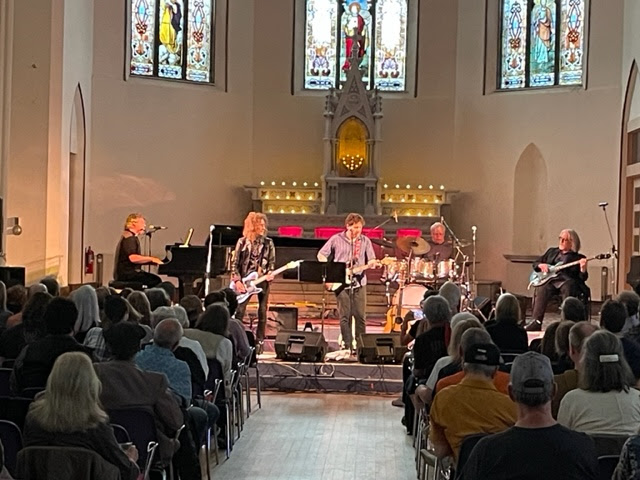
    Saturday evening a good crowd gathered once more at Sacred Heart to be swept away by The Infidels, a Minneapolis supergroup that put on one heckuva show. Here are some photos from Saturday's events followed by an interview with ChatGPT and Google Bard.

    Danny Fox

    Matt Steichen hits a grand slam.

    Dan Israel and the Infidels


    EN:
    Why did many people in the 1960's consider Bob Dylan the "voice of his generation"?


    The Infidels, Streaming Live
    OpenAI ChatGPT: Bob Dylan is often referred to as the "voice of his generation" because his music and lyrics resonated deeply with many people in the 1960s, particularly those who were part of the counterculture and protest movements of the time. Several factors contributed to Dylan's status as an influential figure and a representative of his generation:

    1. Protest and Social Consciousness: During the 1960s, there was significant social and political upheaval in the United States and around the world. Dylan's songs, such as "Blowin' in the Wind" and "The Times They Are a-Changin'," became anthems for the civil rights movement, anti-war movement, and other social justice causes. His lyrics addressed pressing issues like racial inequality, war, and the struggle for individual freedom, capturing the spirit of activism and resistance that defined the era.
    2. Authenticity and Emotional Depth: Dylan's music was characterized by its raw, honest, and deeply personal nature. His distinctive voice and passionate delivery conveyed a sense of authenticity and emotional depth that resonated with listeners. Many people felt that Dylan's songs reflected their own experiences, frustrations, and aspirations, making him a relatable figure and an embodiment of the struggles and dreams of the generation.
    3. Artistic Evolution and Cultural Influence: Dylan's music evolved throughout the 1960s, and he continually pushed the boundaries of folk music by incorporating elements of rock and other genres. His willingness to experiment and his ability to adapt his sound to reflect the changing times demonstrated his artistic growth and versatility. This evolution made him a cultural icon and influenced countless musicians who followed, shaping the direction of popular music.
    4. Intellectual and Poetic Lyrics: Dylan's lyrics were known for their poetic quality and intellectual depth. His ability to craft thought-provoking and introspective verses distinguished him from many other songwriters of the time. His lyrics often contained rich symbolism, vivid imagery, and social commentary, challenging listeners to engage with the messages and themes embedded in his songs.

    Overall, Bob Dylan's unique blend of social consciousness, emotional depth, authenticity, artistic evolution, and poetic lyrics made him a significant voice for the generation of the 1960s. His music spoke directly to the hopes, frustrations, and aspirations of his audience, earning him the title of the "voice of his generation."


    EN: Why did many people in the 1960's consider Bob Dylan the "voice of his generation"


    Malibu Bob (See footnote*)
    Google Bard: Bob Dylan was a singer-songwriter who emerged in the early 1960s. His music was a mix of folk, blues, and rock, and his lyrics were often poetic and political. Dylan was seen as a voice for the counterculture movement, and his music was often used to protest against the Vietnam War and other social injustices.

    Here are some of the reasons why many people in the 1960s considered Bob Dylan the "voice of his generation":

    • His music was relatable: Dylan's music spoke to the experiences and emotions of young people in the 1960s. His songs about love, loss, and social injustice resonated with a generation that was coming of age during a time of great social and political upheaval.
    • His lyrics were poetic and insightful: Dylan's lyrics were often poetic and insightful, and they offered a unique perspective on the world. His songs were not just about the here and now, but also about the past and the future.
    • He was a cultural icon: Dylan was not just a musician, but also a cultural icon. He was known for his rebellious attitude and his willingness to challenge the status quo. He was a role model for young people who were looking for a way to express themselves and to make a difference in the world.

    Dylan's music continues to be relevant today, and he is still considered one of the most important and influential musicians of all time. He is a true icon of the 1960s, and his music helped to shape the culture of that era.


    Balcony shot: The Infidels @ Sacred Heart 

    *There's always a bit of fun here that doesn't get captured. This is Karyn Wilder arrayed in Dylan attire. Karyn also helped close the week of events, performing at our goodbye brunch.


    To borrow a phrase from Miriam, who has been hosting Highway 61 Revisited on The North these past several years, "We'll catch you on the flip side."

    Wednesday, September 15, 2021

    My Grandmother Helped Build Telescopes, a Woman Ahead of Her Time

    Warren O. Tribune Chronicle, May 3, 1951
    I've often remarked on how my grandmother was one of the most influential people in my life. I owe her a debt gratitude for the encouragement she gave me and the example she set as an inquisitive, lifelong learner. 

    Last night I found a manila envelope in my garage with a newspaper story from 1951 featuring my grandmother polishing a mirror for a Newtonian telescope that she and the telescope society she belonged to were building. The title of the article is Astronomer Here Counts Herself Among Few Women To Make Telescope Mirror. 

    The journalist did not receive a byline, leaving the spotlight squarely on my grandmother, Elizabeth Sandy. What's immediately striking is that in those days they evidently did not identify women by their names but rather in association with the husband. Here are the first paragraphs:

    A lot of women make cookies, some make jam, and a few make quilts, but the number of women who have made mirrors for telescopes is very, very few.

    My grandmother Elizabeth Sandy
    One of the very few to ever make such a mirror is Mrs. Grant F. Sandy, 1426 Sunset NE, one of approximately 30 members of the Mahoning Valley Astronomical Society.

    Mrs. Sandy intends to use the mirror in a Newtonian reflecting telescope, the mounting of which she and her husband plan to construct in the near future. The mirror is the first one ever made by Mrs. Sandy altho she has had an interest in astronomy ever since she was a high school student in Cairo, W. Va near Parkersburg.

    "I’ve been fascinated by astronomy and history ever since I was a teenager," she said. "And the fact that I was also interested in mathematics helped considerably to foster my interest in astronomy."

    “Starting astronomy is like reading the history of the universe," she added. “Once you become interested you can’t quit your search for the truth about the marvels discovered by the telescope. We learn about our own earth by our observations of the other planets and universes.

    "Mirror making for telescopes is a fascinating hobby which takes dogged persistence and hard work. But the end product, the telescope, makes it all very much worthwhile when it takes a deep into the most romantic branch of modern science, astronomy and astrophysics."

    In the rest of the article the author shares a little about the Sandy family history, when they moved to Warren, how their children's interest in astronomy was fostered and where they went to college. Also mentioned is a planned trip out West which will include visits to the Mount Wilson Observatory near Los Angeles and possibly the Mount Palomar Observatory near San Diego, which is home to the largest telescope in the world.

    * * * 

    "Against the Wind" -- Elizabeth Sandy
    One of the reasons I chose Ohio University was that it was only an hour away from Parkersburg, where my grandparents returned to after Grandpa retired. One of the rooms in her house had bookshelves from floor to ceiling on all four walls. Grandma did the architectural design for the house which instead of wainscoting in the living room she had bookshelves on the lower portion of each wall. 

    She was a lifelong journal-keeper and greatly enjoyed reading and writing poetry, influenced directly by her great uncle John S. Hall, the blind poet of Ritchie County. She also did a little painting and was supportive of my own creative pursuits.

    Much more could be said, but maybe that will have to wait for another time. Here's a poem she wrote after a stroke in the early sixties. During a surgery she had an out of body experience in which she watched the doctors and nurses fighting to keep her alive. This experience led to our later discussions regarding the relationship of the soul, mind and body, and the nature of life.

    Aftermath Of A Stroke
    by Elizabeth Sandy

    Here I lie, tight packed as in my Mother's womb
    I laid with restlessness a full lifetime ago.
    But still entirely I, altho I have no room
    To move about and at my will to come and go.
    But now -- I wander, freely in my mind
    The long road thru the crowding mists of time,
    And pause in my journeying now and then
    To live the happy times again
    Made bright indeed by sunset's glow!

    * * * 

    Related Link: A Dedication 

    Friday, September 6, 2019

    Industry Veteran Cirina Catania Talks About Making Movies, Sundance and the Catalyst Film Festival

    (L to R) Riki McManus, North MN Film Office Director,
    Festival Director Philip Gilpin, Mayor Emily Larson
    and Cirina Catania.
    This coming October, Duluth will be hosting the Catalyst Content Festival, a gathering of independent media developers, producers, directors and visionaries. Sponsors include St. Louis County, Monaco Air, HBO, and the Abrams Artist Agency, among others. In my effort to learn more I have been interviewing various people and sharing their insights here.

    This past weekend I had an opportunity to speak with Cirina Catania, one of the co-founders of the influential Sundance Film Festival. Ms. Catania serves on the advisory board for Catalyst, offering a unique perspective on what Catalyst is striving to accomplish, and why Duluth is an ideal home for bringing the festival to a new level.

    The more we talked the more impressed I became in two regards. First, that she had been involved in Hollywood for more than three decades without becoming jaded, with a generous spirit and genuine warmth. Second, because she wore that mantle of cred that comes with experience.

    We had a good first "meeting" and this is a portion of what we talked about.

    EN: Who is Cirina Catania, besides being a Hollywood insider who has been involved in more than 100 films?

    URSA Mini Pro%2C Sony Still%2C Zeiss %26 Canon 
    Cirina Catania: I’m a creative person. I have both a left and a right side of the brain that work.

    I spent quite a few years in the studio system in Hollywood. MGMUA and then at the new UA (United Artists) where I was managing up to $200 million a year. I had final responsibility for all the budgets for marketing, PR, research. I have this other side of me that is creative and wants to do fun things with my brain. And doesn’t like to be put in a box.

    Before I got into elementary school I was playing with drawing, and got a Brownie Instamatic Camera and I loved photography, which became a way for me to express who I am.

    I loved how you could put five people together looking at the same thing and the creative rewards of what they are looking at are going to be completely different. Don’t you love that though? It’s sort of what makes the world go ‘round.

    I’m also a mom and a grandma and a family person. I was lucky that I had children when I entered the studio system. It kept me grounded. I had to go to the parties, and get into the limos with the actors and actresses, but it didn’t matter to me because at the end of the day I was going home to my kids. That was more important. I had the best of both worlds.

    EN: Among your many other activities you’re also affiliated with Catalyst. What attracted you to what is going on here?

    Philip Gilpin
    CC: I met Philip Gilpin a few years ago when I interviewed him for my radio show and I was very impressed with him. He and I then stayed in communication and when he was doing town hall meetings in Vermont and legislative lobbying there, he asked if I might be interested in speaking with the local community about what it takes to start a festival because of the Sundance connection.

    We met with the governor and did a couple town hall meetings. When the festival moved to Duluth I was really excited because I think the Duluth community is a much better fit. The people in Vermont were awesome and I met some beautiful people there, but they didn’t have the ability to expand to the extent the festival is going to expand.

    One of the goals of the festival is to put money in our pockets in this community. And I think it’s going to happen. I’m on the Advisory Board, offering advice and being a cheerleader to help make it happen.

    One of the things I’ve been trying to do at this stage in my career is mentor younger people and mentor film makers in the Heartland of America who are always asking, “Should I move to L.A.? Can I make a living here? Will I be happy staying here in my home town?”

    I always tell them, if you can make it work, and stay close to your family and friends in your home town, why not? This is a beautiful country.

    Cirina shoots a BMCC Zeiss 70-200-2PC B%26W
    EN: You recently came to Duluth to do a film making workshop.

    Catania & Gilpin flank Patty Mester, President and GM of WDSE/WPRT
    CC: We just did this 2-day master class in film making with WDSE-WRPT. It was a way for me to share what I’ve learned from working inside Hollywood.

    I used the example of a non-scripted reality show, like the films I have worked on with National Geographic, and what do you have to do at the end of the filming and in post-production to make sure you are delivering what the network needs in order to meet the contracts that have been signed.

    We also invited a group to come out from L.A. They really believe in the local film maker so we brought in people from the “We Make Movies Smart Phone Studio,” Aubrey Mozino and Sam Mestman, helping the creative people in that room to play. I wanted to take the equipment out of the equation. It was thrilling how the teams went from quiet in the beginning to fully engaged and excited by the end.

    I have learned so much over the years and so lucky with my career that as I mature although still working I’m thinking more about paying back, giving back to the creative community.

    EN: So, tell us about how Sundance got started. You were there right at the beginning.

    Cirina shooting Black Magic camera
    @Mosquito Creek
    CC: I was associate director of Utah State Film Commission working under Governor Scott Matheson (1977-1985). John Earle was director of the film commission. It was our mandate to try to bring more film making into the state of Utah.

    We did location scouting and produced a book of all the crews and resources for acquiring equipment. We were having dinner one night with Sterling Van Wagenen, John Earle and I, going over some business things, and we started talking about how the governor had contacted us and asked what else we could do. And the light went on and I said, “Let’s start a film festival.”

    But then everybody we subsequently talked to said, “No, there’s already one in Texas. We don’t need another film festival. What do you want to do a film festival for?” This was in 1978. We didn’t listen, and as I told you I don’t listen, and so we did it and it was probably the hardest I’ve worked in my life.

    Sterling directed it the first year. The festival went into debt. The board was thinking about disbanding it. They didn’t know if they could continue. Local merchants were owed a little bit of money—not a whole lot. We had no money in the bank, no offices, no furniture. And we wanted to do the festival another year. So Governor Matheson called me and said, “I really want to continue with the festival and if I give you a six month leave of absence, paid, will you take over the festival and direct it?

    I said, “Sure.”

    So I went around town—very similar to what Philip [Gilpin, Catalyst Director] is doing—and met with all the merchants, told them what we want to do. A lot of them believed in us. Some provided offices, some provided furniture.

    Whatever it takes to get the shot. (Photo by John Heino)
    I remember climbing down into the basement of Utah Bank and picking out used furniture. The president of the bank said, “You can have anything in this room.”

    In our second year, 1979, we actually made a very small profit. And it was pretty much clear sailing from then.

    It’s not easy to do a film festival. It is very time consuming and takes a lot of dedication. But let me tell you, I have seen that in Duluth. You go to an event, any event that’s creatively motivated like a theater like the Zeitgeist, and there are lines outside the door. People attend lectures to talk about photography, to talk about art, to talk about whatever it is, they are so involved and so enthusiastic.

    It's not this way everywhere. I think that Duluth is the perfect home for this festival.

    When we did this 2-day workshop I could see it. I could see the excitement in peoples’ eyes. The willingness to try something new. Their willingness to work together in teams. And to play. The joy of creating something. And I’m hoping the festival will be like that for people.

    Related Links

    MASTER CLASS: BUILDING YOUR SUCCESSFUL CAREER IN FILM
    https://www.wdse.org/masterclass

    SAMPLES from the Workshop
    https://m.youtube.com/playlist?list=PLnAsrW7oNh5SWoKLBvTmlURkTcuUfl1SP

    Catalyst Content Festival
    https://www.catalystcontent.org/schedule

    TIME Magazine – 2010 History of Sundance
    http://content.time.com/time/arts/article/0,8599,1956952,00.html

    Tuesday, November 28, 2017

    Sidetracked? Don't Worry, It Happens To All Of Us

    "The road to hell is paved with good intentions." --popular proverb

    Yesterday late afternoon I stopped by the library after work to drop off some DVDs and books, and to look for a couple other items on my reading list. One of these was a book called Brainwashed, which was on an upstairs shelf near some marketing books about persuasion and influence, one of the these being the famous work by Dr. Robert Cialdini.

    What caught my eye, though, was another book there titled Sidetracked, by Francesca Gina, which I began reading late in the evening instead of going to bed like a good boy. Subtitled "Why Our Decisions Get Derailed, and How We Can Stick to the Plan," I found myself immediately drawn in. For the record, it is a publication of the Harvard Business Review Press.

    Whether you are in a business with objectives, or an individual with a self-directed career plan, or just someone with personal dreams you wish to pursue, the book appears to have application to any and all of these kinds of reads.

    The introduction explains what the heavily researched book will cover. There are three forces at work in us whenever we set out to accomplish anything, Gino says. First, we have our internal distractions. As the saying goes, sometimes we are our own worst enemies. We frequently fail to see our own limitations, or have a mistaken sense of our own capabilities. Or, it may be we just don't know ourselves well enough to know what we want.

    Next, the author shows, are forces from our relationships that impinge upon us. These come in a variety of forms, from parental expectations to compromises we make on behalf of our spouses.

    Finally there are inevitably myriad external sources at work to distract us. Our intentions may be good, but because we are not resolute we allow other people or events to divert and thwart us.

    What I like about the title is the railroad metaphor. Trains are sometimes intentionally diverted to a side rail to keep the lines clear for other traffic. If our intention is to be in St. Louis by midnight, and we're parked on a side-rail, one must begin to wonder, "How did this happen?" and "What can I do to keep it from happening again?"

    When I was eight years old my grandparents took be out of school to travel from Cleveland to Reno on a train to go visit my aunt, uncle and cousins out west. The three-week adventure was a truly formative event in my life. The train went day and night for three days, with stops in Chicago, St. Louis and Salt Lake City. On the return east at some point during the night I was awake and looking out the window when I noticed a strange phenomenon. There were two glowing red lines on the ground next to our train. It was very strange because it just went on and on. I woke my grandmother to ask what it was. She didn't know, and we both studied it with wonder. Then the train slowed and stopped, the lights went on, and a voice announced that we were picking up passengers. We learned that a train on the adjacent railroad track had jumped the rails. We would have to all squeeze together till we reached the next stop.

    Wow. There was an explanation to those glowing lines. That was heat generated by friction. Ultimately the train, having derailed, was stuck in the middle of nowhere.

    Francesca Gino's book is has as its aim to help individuals and businesses avoid that kind of fate. It's a book for goal-setters and dreamers. And maybe a book for you.

    Popular Posts