Showing posts with label Picasso. Show all posts

Saturday, April 11, 2026

Hans Rookmaaker’s Modern Art and the Death of a Culture:

After philosophy, much of my college study (1970-74) was dedicated to the fine arts. I immersed myself in painting and drawing, as well as continuous rummaging of the art books housed in the school library, which was almost the nearest building to  my dorm. Though captivated by much of what I saw, and at times sought to emulate, there was plenty that I wasn't really attracted to. I did, however, have a great love for the process of laying paint on canvas. I found the process of creation magical.

During that time I had a friend who periodically told me, "The artist is the vanguard of the revolution." His meaning was clear. Art was to be subservient to political ends. My friend Walter Urban created powerful works of this nature, a life-sized soldier on a cross (protesting Viet Nam), a family in the future taking a walk in the park wearing gas masks.

I myself saw many ends that art could serve. After the death of a best friend in high school art served a therapeutic function for me. There were dark things in my heart that words seemed inadequate to express. Beyond the grief there were other emotions and art was a means of working it out.

As one stepped back and surveyed the previous 100 years, one could see that art also served as a mirror of the culture. This is the theme tackled by Dutch author, professor and Christian scholar Hans Rookmaaker.
 
Hans Rookmaaker’s
Modern Art and the Death of a Culture (1970) explores how the development of modern art reflects the spiritual and philosophical collapse of Western civilization. Writing as both an art historian and a Christian thinker, Rookmaaker argued that art is never created in a vacuum—it mirrors the worldview of its time. As Western society drifted from its biblical foundations, art, he says, became a visual record of man’s alienation, fragmentation, and loss of  meaning, themes taken up by mid-century existentialists like Camus and Sartre.

Rookmaaker traces the story from the harmony of classical and Renaissance art, where beauty and order reflected divine creation, through the Enlightenment’s turn toward human reason, and finally into the modern era, where faith in transcendence eroded. Artists like Van Gogh, Picasso, and Pollock emerge as prophets of a disintegrating world: their work cries out with spiritual yearning but lacks the hope once rooted in a Christian understanding of reality.


For Rookmaaker, the “death” of culture meant more than a shift in artistic style; it pointed to a deeper moral and spiritual drift. When God is no longer at the center, both art and life begin to lose their unity and meaning. Yet he did not fault the artists themselves. In their confusion and despair, he saw an honest reflection of the human condition. His response was not condemnation, but invitation—a call to recover beauty and, through it, a renewed sense of order and purpose.


[This seems to be a good place to insert a couple of comments by my eight-year-old grandson who visited New York's Museum of Modern Art this week. My daughter said, "He was so funny at the art museum with his sort of pithy, harsh reviews of the art: 'So, um ... How did this get so famous anyway?' and (no doubt responding to Pollock)  'Huh. It kinda looks like they just splattered paint on the paper.'"]


Ultimately, Modern Art and the Death of a Culture is not an argument against modernism but a plea for spiritual reawakening. The book invites readers to see that the renewal of art depends on the renewal of belief—that culture can be reborn only when it again recognizes its source in the Creator.

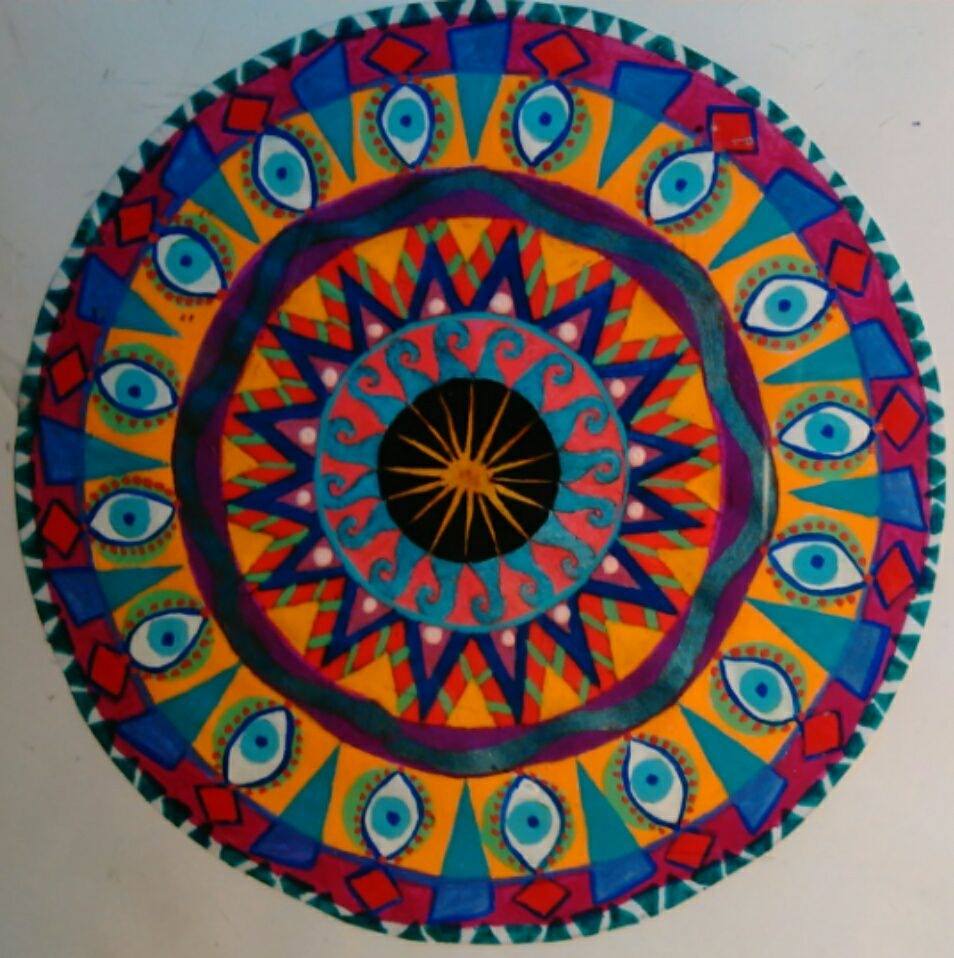
                                         "Red Star"  
Now that we are more than fifty years removed from Rookmaaker’s diagnosis, the story of art has not reversed itself so much as it has unfolded along the very trajectory he observed.

The boundaries are gone. The gatekeepers have loosened their grip. What once required training, patronage, or institutional approval is now open to anyone with a vision—and sometimes even to those without one. From installations and performance pieces to digital art and street murals, expression has multiplied in every direction. In this sense, there has indeed been a kind of liberation.


And yet, with that freedom has come a curious diffusion. Without a shared center—without a commonly held sense of the true, the good, and the beautiful—art often speaks in a thousand private languages. Some works are deeply personal, even therapeutic. Others are expressions of love. And then there is art that is simply functional, enriching us more than endless halls of empty walls.. And we still have the overtly political, echoing my friend’s conviction that the artist stands at the vanguard of revolution. Still others seem to revel in irony, fragmentation, or shock, as though meaning itself were suspect, though what shocks some seems to miss the mark because many of of oldsters have seen it all before and, yawn...


But beneath the variety, one thread persists: art continues to tell the truth about us. It reveals our longings, our confusions, our search for identity and transcendence. If the last century showed us the fracture, the past fifty years have shown us what it is to live within it.


Which leaves us, perhaps, where Rookmaaker left us—not with a neat conclusion, but an invitation.


If art is a mirror, then what we choose to create—and what we choose to behold—matters. The question is not only what art has become, but what it is for. And whether, in the midst of all this freedom, we might yet rediscover not only expression, but meaning… and perhaps even beauty in its myriad forms once again.


Related Links

The Painted Absurd

https://pioneerproductions.blogspot.com/2009/05/painted-absurd.html


A Century of Rebellion: Exploring 20th-Century Art Movements

https://pioneerproductions.blogspot.com/2025/03/a-century-of-rebellion-exploring-20th.html


Tuesday, April 4, 2023

A.I. Art in Advertising: Unethical or Much Ado about Nothing?

"Falcons On Fire" -- AI Generated image 
utilizing one of my abstract paintings as prompt.
Tech Tuesday

When we first read about elephants making art, there were more than a few debates about whether it was really art. I can’t recall, however, any kind of discussion about the ethics of elephants making art. Nor were there any concerns about elephant artists taking jobs away from other artists or ad agency illustrators. More recently, though, the emergence of computer-generated art has produced a whole new set of questions and concerns.  


The buzz around applied artificial intelligence (AI) has been white hot this year, chiefly due to the emergence of OpenAI’s ChatGPT. In this column I’d like to narrow the discussion to AI-generated art and the ethical issues it raises.


People have been watching developments in AI and “thinking machines” for longer than most of our lifetimes. As early as the 1940s Isaac Asimov’s stories and novels featured intelligent robots, some of which have become major Hollywood films like I, Robot (2004) and Bicentennial Man (1999). In 1997, the defeat of world chess champion Garry Kasparov by IBM’s “Deep Blue” in 1997 was considered a watershed moment for AI


What has captured our attention isn’t just the power of technology to amaze, but also the rapidity with which it can spread in our modern interconnected world. Consider this. The AI chatbot program ChatGPT was launched in November 2022. In January it had 100 million users.


In the art realm, numerous AI programs have emerged and it seems to be revolutionizing everything it touches. I’ve been trying out a number of these programs and it’s mind-blowing what they can produce. The speed with which they do it is especially amazing.


There are now more than a dozen AI art-making apps. New programs like Midjourney, DALL-E, Dream by Wombo, Nightcafe, Lensa AI and Jasper Art are cropping up all around us. Each has its own approach. 


Learning machines, however, don’t “learn” out of thin air. They get “trained” by pulling info and images from the cyber-universe, ever expanding their knowledge and capabilities. And this is where things begin to get ethically cloudy. For example:


1. Who owns the AI generated art if it is pulling from other artists’ unique styles? When artists and writers plagiarize, there are legal remedies (if you can afford them) or public shaming (on social media.) Who is responsible when the machines do it?


2. When AI systems replicate and amplify existing societal biases, is this a good thing? (For example, the sexualized notions of physical beauty.)


3.
How do AI systems make decisions? The lack of transparency is a problem.

4.
Should we be concerned about the job displacement that is coming? AI systems can produce massive quantities of original images in almost no time at all with virtually no cost. Where will that leave human artists a decade from now? 


Brian Barber, a respected local artist and illustrator who produces work for numerous local ad agencies and businesses, had this to say about the emergence of AI art-making technology. "Many AI models have been built using work without permission, compensation or even credit. To me, this is the biggest ethical issue, those images are now part of the AI. Short of dismantling it all and starting over with images they have the rights to use, there's no way to undo that damage. There are at least two lawsuits against AI companies for ‘scraping’ copyrighted material without permission or compensation. One is a class action suit, one is by Getty Images, a stock image company."


AI interpretation of my
Dreamtiger illustration.
Regarding AI apps replacing humans, are artists’ concerns an overreaction? Hollywood cinema didn’t put an end to theater, though it did pretty much end the silent picture era. Accounting technology hasn’t eliminated the need for accountants, though at the ground floor level those rooms full of tabulators are no longer around. 

When The Drum, a global publisher for the marketing and media industries, asked ChatGPT about the risks of using AI in advertising, the AI app pointed to bias, privacy issues, fraud, misleading or manipulative advertising, and loss of control. “As AI systems become more sophisticated and widely used in advertising, there is a risk that they could gain too much control over the ad ecosystem, leading to a lack of transparency and accountability,” the bot explained.


The way some of these programs work, it’s easy to see how plagiarism of an artist’s style can occur. While playing with Dream by Wombo, I would give prompts like “do a portrait of Bob Dylan in the style of Dali.” Or “Paul McCartney in the style of Picasso.” Seems harmless. The results are entertaining and it doesn’t feel like I am stealing from the Dali or Picasso estates. Nor do I profit in any way other than get a few likes when I share on social media. On the other hand, the New York Times recently carried a story about a living Eastern European sci-fi artist whose unique style is being reproduced by tens of thousands of people who have been giving the AI a prompt to do illustrations in his unique style. It’s very definitely cutting into his revenue stream. With replicas of his style appearing everywhere, the value of his work is being diminished. He is no longer perceived as producing unique work, and doesn’t receive a dime for any of it.

In the music industry, people who do covers of other songwriters’ songs pay a royalty. The Byrds, and Peter, Paul and Mary took Bob Dylan’s genius mainstream. He benefited from royalties as well as the public recognition of a young troubadour worth watching. In the art realm, with unbridled AI, there are no benefits to having the creator’s style dispensed abroad, especially with absolutely no acknowledgements of where his or her concepts originated.

Bottom line, I do not believe the concerns are much ado about nothing. 

This story originally appeared in my Business North column, Marketing Matter.

Tuesday, September 24, 2019

Dylan's "Times Are A-Changing" Vs. "Things Have Changed"--Picasso's Guernica Meets Dali's Hallucinogenic Toreador

One of the Dylan albums I have been listening to a lot lately is his Victoria's Secret Exclusive Lovesick. This 2004 release is a collection of nine great songs spanning the arc of his career. The playlist includes She Belongs to Me, Don't Think Twice,  To Ramona, Boots of Spanish Leather and It's All Over Now, Baby Blue from the first decade of his career. Then closes out with four late career songs from Time Out of Mind to Love & Theft.  "Things Have Changed" is the second to last track and I find myself repeating it each time I play this Lovesick CD.  As a result, the song, its lyrics and the way he delivers those lyrics has really gotten into my head.

As for the lyrics, this really is something of an unusual, even bizarre, song on one level. In a few minutes I will compare it to Salvador's Dali's Hallucinogenic Toreador. Like much of Dali's surrealistic painting, it's also infectious. And when contrasted with "The Times They Are A-Changin'" certain features especially stand out. In this case I will contrast Toreador with Picasso's explosive Guernica.

There are few long-time Dylan fans unfamiliar with this anthem of the Sixties and his third album wearing the same name.

Come gather ’round people
Wherever you roam
And admit that the waters
Around you have grown
And accept it that soon
You’ll be drenched to the bone
If your time to you is worth savin’
Then you better start swimmin’ or you’ll sink like a stone
For the times they are a-changin’

Each verse has a singular aim, the first verse setting the trajectory. "Listen up. You see what's happening. It's time to act."

The second verse is directed to writers and critics. "This is a unique time in history. Pay attention."

Verse three is directed to our political leaders. Each line in the stanza serves that end. "Don't stand in the doorway, don't block up the hall."

Verse four speaks to the mothers and fathers in our land and the widening generation gap.

Finally, we return to the overarching message. Things are changing, with the very last line echoing a passage from the Bible (Matthew 20:16), as if the truths here were a prophetic utterance from on high.

THINGS HAVE CHANGED
When dissecting "Things Have Changed," Dylan's Oscar-winning contribution to The Wonder Boys, we find a song both similar and dissimilar. The similarity comes in the structure. We get a batch of words, with lines that rhyme, followed by the recurring theme from which the title is extracted. "I used to care, but things have changed."

Whereas with "Times Are A-Changin'" each verse is crystal clear as regards its meaning, "Things Have Changed" is the very definition of ambiguity.

What's more, and this is what has struck me about the song, the lines are interchangeable, and actually have no relationship to one another except inasmuch as they are sung in conjunction with one another.  Watch this.

A worried man with a worried mind
No one in front of me and nothing behind
There’s a woman on my lap and she’s drinking champagne
Got white skin, got assassin’s eyes
I’m looking up into the sapphire-tinted skies
I’m well dressed, waiting on the last train

Standing on the gallows with my head in a noose
Any minute now I’m expecting all hell to break loose

Each of the images is specific, but very few lines are actually related to one another, other than the woman in line three and the suggestion that she's got white skin and assassin's eyes. But even that is only implied. What if he were referring to himself with white skin and assassin's eyes, since the next line is he himself looking into sapphire-tinted skies?

If this is a description of a scene, are they sitting outside. Where? At a train station?

The gallows is a pretty specific image, too, but can plainly be a metaphor. And the statement that any minute all hell could break loose is punchy, captures a sense we've all had at one time or another, but what is happening?

The elements are very specific, but the overall meaning is completely ambiguous. You could change multiple sentences anywhere along the way and not change anything. For example, in the second verse he sings:

Gonna take dancing lessons, do the jitterbug rag
Ain’t no shortcuts, gonna dress in drag
Only a fool in here would think he's got anything to prove

But you can insert anything for some of these lines and it would change nothing. The lines in maroon are my inventions. (Not saying these are good lines, just that I don't think they change the meaning of the song.)

Gonna walk through a storm, gonna fill my bag
I've never been afraid to kiss a hag
Only a fool in here would think he’s got anything to prove

Stick my fingers down my throat, make myself gag
Clean up the dishes with a greasy rag
Only a fool in here would think he’s got anything to prove

I mean it seems almost anything would work because the verses aren't focused on saying anything. But whoa, the way he sings it still floors you.

A lot of these lines could have been borrowed from films he was watching or books he's been reading. That is part of Scott Warmuth's schtick. This Rolling Stone article points to the line "Don't get up, gentlemen, I'm only passing through" as having originally come from the mouth of Vivien Leigh in Streetcar Named Desire.

This is not to suggest the song doesn't make connections with listeners. In point of fact, it continually makes connections, but in a more convoluted way than many of his other songs. The third verse has a set of truisms that connect with the listener, but aren't necessary to connected to each other, except they do make a picture, a Hallucinogenic Toreador.

I’ve been walking forty miles of bad road .    Possibly True
If the Bible is right, the world will explode .    Sort of True
I’ve been trying to get as far away from myself as I can .   Possibly True
Some things are too hot to touch .   True
The human mind can only stand so much .   True
You can’t win with a losing hand .    Possibly True

Then he says he feels like falling in love with the first woman he meets, and putting her in that wheelbarrow to roll her down the street. It's an image that's easy to picture, but where does it go? It affirms the refrain for sure. People are crazy and times are strange.

GUERNICA
Guernica. Click to enlarge.
If you've ever seen Picasso's Guernica in real life, it's power is difficult to dismiss. A massive painting written in response to the bombing of a Basque town of the same name during the Spanish Civil War. Like the cover of album The Times They Are A-Changin', Guernica is painted in black, white and greys. And like the song, every element contributes to show the horror of this incident which has become itself a metaphor for modern war in which civilians are the ones who suffer. (cf. The Cold War's Killing Fields)

It was also painted at a significant moment in time. Ultimately a reproduction of this was created for the United Nations. War is a horror, it says.

Dylan's song was likewise "painted" during a significant moment in time. It spoke of an upheaval taking place that would rock the nation. An despite it's reference to a moment in time, it continues to be relevant in its timeless way, the same as so many of Dylan's prophetic songs, and Picasso's Guernica.

THE HALLUCINOGENIC TOREADOR
"The Hallucinogenic Toreador"
Dali's striking Toreador stands 15 feet high and can be seen at the Dali Museum in St. Augustine. It's absolutely stunning in person, like most of his work. And like many of his paintings, the picture is comprised of optical illusions. In this case, it's a painting of a pair of Venus de Milo statues, which when viewed in an alternative manner become re-assembled as the image of a bullfighter.

Dali combines a number of other elements to produce the effect, including bees, dots of color, shadows. And in the upper left we see Gala, his wife and muse, who is a feature of many Dali paintings.

When all is said and done, you can lose yourself in the elements or come away with the bigger--and in real life it is a much bigger--picture. And like Dylan's Things Have Changed, it makes an impression.

It's noteworthy that neither Dali nor Dylan explained their work and let their works speak for themselves. As a result, critics have endlessly dissected and analyzed the symbols and images in both of their creative contributions.

* * * *
Here's another example of what I'm saying from the song's last verse. Dylan sings:

Mr. Jinx and Miss Lucy, they jumped in the lake
I’m not that eager to make a mistake

Notice that he doesn't link these two, yet they stand side by side. He could have written, "I'm not that eager to make that mistake" or "I'm not that eager to make their mistake." Instead, he just throws in a line that rhymes with lake, so he could have just as easily said, "I'm just diggin' through the fridge looking for something to bake." Or "I'm finished with this garden, gonna hang up my rake." Or "I'm a little too tired to be on the make."

Whatever line you throw down changes nothing because when you finish the refrain it still rings true.

People are crazy, times are strange
I’m locked in tight, I’m out of range
I used to care, but things have changed

What do you think?

* * * *

RELATED LINKS
Picasso's Guernica
Picasso's Guernica Revisited
Dali's The Hallucinogenic Toreador
Dylan and 50 Years of Change
Lyrics: Things Have Changed

Tuesday, March 13, 2018

Arlene Schneller Talks About Art, Promises, "Winchester" and Artist Paul Castagna

Last Friday I attended the opening reception for the Paul Castagna exhibition at the Kruk Gallery, UWS. Though I shared my impressions here on Saturday, there was more to tell and I asked curator Arlene Schneller if she'd mind sharing. She welcomed the opportunity.

EN: What years were you in school at Gogebic?

Arlene Schneller: I attended Gogebic Community College in 1976-79 but went back for personal enrichment art classes with Paul Castagna as my instructor in Painting I, II and III from 2007 to 2011 for 3 hour painting classes in the evening.

EN: When did you first take an interest in art? How did that come about?

Detail from "Winchester"
AS: I took art anytime I had the chance. I lived outside Tokyo, Japan for a year when I was 10, educated at the Tachikawa Air Force base. I had a very inspirational art teacher there, I remember my blue shaded vase that won an award. I came back to the US and painted a watermelon from a slice of wood the next year and my English teacher loved it so much she displayed it in a glass case in the hall. I loved taking art classes in high school. My art and English teachers have always inspired my creativity. I volunteered in the community for over 35 years with kids' free art programs. I currently volunteer as a teaching artist for children's art classes for a non-profit art center called Downtown Art Place (DAP) where Paul and I both rented DAP art studios.

EN: Did you start out as an art major in college or did you veer in that direction after taking painting classes with Paul?

AS: I did not major in art in college. I have an Associates Degree in general business. (I was a real estate broker for 35 years with my own office. Paul joked that when I retired that I'd become his art agent. I retired and now my business background helps because I guess I'm his art agent now.

I experimented with many art techniques, I have a home library full of art books and DVDs that I studied. My mother-in-law was also a great inspiration, as a watercolor artist.

EN: You say that he entrusted his work to you because no one else was interested? How many paintings and sketchbooks are there in total?

AS: Paul deeply loved his paintings, it was hard for him to let them go. He was afraid his work would be a large burden for anyone to take on, he worried that it would become a "geeze" for me, but he knew that if I was given the task that I'd do it well. His two sons at the time were in their early 20's and he felt they wouldn't care or know how to deal with the responsibility and his father was elderly.

Paul and I knew each other for 8 years. We had a great friendship, discussed art history, artists and artwork we loved. He critiqued my work and encouraged me to become more serious about my art and to create a series of work. As his student I had my first solo art show at Gogebic Community College at Art Space, a gallery he created.

I have over 140 acrylic and oil paintings, drawings, sketches, plus printmaking images, a few small sculptures, some music he made, images, processes of his work on multiple external hard drives, video, and at least 10 sketchbooks. I have a vast collection that will take time to process, I am still looking through some of his work. It's a huge responsibility and an honor to accept a lifetime of work. It's like making a puzzle and putting all the pieces back in the right place. His son and his father have additional gouaches and other important drawings and sketches. Paul's father is giving me his paintings to add to my collection. Paul was very creative, talented and committed to his work as an artist, philosophical too.

"Winchester"
EN: You made three promises to him. First, to have a show. What is the status of the other two?

"Winchester" -- detail from left panel.
AS: The three promises made to Paul were First, to show his work, Second, to donate a piece to a museum, and Third, promise to "do something good" with his work. The Kruk is his first show. There are more shows planned, his work will live on. I've been reaching out to a few people I know at museums to see where we can donate a piece, I'm confident that will happen. The "do something good" is the best promise because it will be ongoing and continuous and hopefully make a difference.

My next show for him starts on July 2nd in Ironwood Historic Theatre concourse, attached to the Downtown Art Place Gallery. I'm selecting the next body of work that needs to be framed. Some of the work from the Kruk Gallery show, including "Winchester," will be on display at the Ironwood Memorial Building in mid-July at the annual Range Art Association show.

Details from center panel, "Winchester"
Last year and this year, his art proceeds sponsored local artists to produce murals in the award winning Downtown Art Park as well as prize money for a photography show and an art show held at Downtown Art Place. This summer proceeds will also sponsor prize money to the Range Art Association for their annual art show held in July. Next year we'll sponsor matching grants for artists, artist initiatives, donate money to art related non-profits and the Carnegie Library for children's art classes, as well as sponsor children's art awards. We'll see how well sales go because I'd also like to donate art supplies for area art teachers, too.

I see his artwork sales creating a wonderful ripple effect in area arts. What a great way to create a lasting memory. It's been heartwarming to be given this challenge and I know I'm up for it.

Castagna's pieces are for sale at the Kruk. Two sold before the show. All art proceeds will be reinvested into children's art programs and artist initiatives within the Gogebic Range community.

EN: You now have a gallery in Ironwood. What kind of work do you show there? And do you still paint?

Schneller Art Gallery in Bessemer, Mich.
AS: Schneller Art Gallery is on US2 in Bessemer, Michigan. It's a small quaint place with a gallery in the front and an art classroom in the back. It is open seasonally in the summers only. When reopened, my gallery will feature my artwork and jewelry along with Paul's and a few other area artists' work.

I've got plenty of ideas for Paul's work in the future. I plan to incorporate some of his artwork into copper resin jewelry, too. Another collaboration of sorts.

After seeing the beautiful "Three Promises Show" I was so inspired. A special thanks goes out to Anne Dugan and her Gallery Practices students from UW-Superior for setting up and preparing the show.

Detail from lower portion of central panel, "Winchester"
I loved talking to various artists at the reception. Remembering Paul painting some of them and seeing his work on the walls was so emotional for me, what a rewarding promise to fulfill. I was a collage/abstract artist, and yes, I am totally inspired to finally pick up my paints again.

It's taken awhile to get over the loss of such a great friend. I quit painting for several years as a result. Instead I focused on making copper jewelry.

It was just the opposite for Paul's girlfriend Kate Greenough. She's a close friend of mine. She's a very talented artist and has been painting up a storm and is more inspired than ever. She learned a lot from Paul, too. Death affects us all in different ways. He was my instructor, mentor and dear friend -- in that order.

My charity work at the DAP studio I rent above the DAP Gallery keeps me busy during the winters. I teach children, young adults and friends how to make Copper Jewelry. Then we donate our items to area fundraisers and sponsor children's art programs.

Across from the DAP Gallery in Downtown Ironwood, there was a recent fire where 3 people died. We'll be active in helping raise funds for victims and survivors.

Currently I sell my copper jewelry and art at Downtown Art Place Gallery, DAP is a non-profit 11,000 square foot art center (Gallery/Studios/Classroom) which I helped get started 5 years ago, while running my own gallery. I wrote their 501(c)3 and volunteered a great deal of my time. I will be selling Paul's work at the DAP and at 906BOOM and at my gallery this summer.

A deeper dive into the left-hand panel.
EN: Tell us about the overall message in Winchester?

AS: Probably Picasso's most famous work, Guernica, is certainly his most powerful political statement. Castagna's political statement made in the mural-sized "Winchester" features similar frustrations from tragedies of war. I remember Paul being so frustrated with President George Bush's troop surge of 20,000 to Iraq, then angered when Obama sent 30,000 more troops to Afghanistan. Paul nearly cried, he couldn't believe they were sending more troops.

As a result, Obama takes on a sinister look with graying streaks of hair and long fingernails and Bush painted faintly near the bottom as if hiding behind a naked woman.

Castagna's "Winchester" was his anti-war symbol and a reminder of modern day tragedies of war. Castagna started with one center piece which grew into three large panels with references of small parts and pieces from Picasso's painting of Guernica, showing the madness of war repeating itself.

Castagna's symbols echo suffering, images of innocent people, greed, money, and newspaper headlines. I see fires burning, mechanical shapes stacked in piles of destruction, a power switch and one of his trademark angels angered in red. Picasso's influence is everywhere including Obama holding the broken sword, German swastikas and a dismembered foot. But of course, that's my interpretation.

It's an impressive piece that is difficult to translate for an ordinary viewer and reveals more than the eye can see with one look or one visit.

Interpretations of Guernica vary widely and contradict one another, just as Castagna's "Winchester" invokes similar thought. When Paul painted this masterpiece in class at one time the word "Winchester" was painted on it, when asked what it represented he gave no explanation. He preferred his work to be interpreted by the viewer for its detail and intensity.

* * * *

RELATED LINKS
Picasso's Guernica Revisited
Gallery Hours for the Kruk at UWS
More images from Castagna's exhibition at the Kruk

Friday, November 24, 2017

Flashback Friday: Picasso's Guernica Revisited

Steve Martin, in his autobiography Born Standing Up, describes the impression he received during his first visit to the Museum of Modern Art (affectionately referred to as the MoMA) as he came face to face with Picasso's Guernica. It stuns, and stops you in your tracks. When you see this painting reproduced in books it's difficult to comprehend its massive scale and the powerful effect it produces. Martin then rounds a corner and there finds himself awed by this miniature Dali, equally famous, The Persistence of Memory. It's an experience unforgettable.

Both of these share a prominent positions on many lists of the most significant paintings of the 20th century, Guernica topping the list and Dali's delicately rendered dreamscape third. (Duchamp's earth-shaking Nude Descending A Staircase, second but no second fiddlehangs in the Philadelphia Museum of Art.)

The MoMA has as many as 300 Picassos, but Guernica's the one that makes your hair stand on end. The painting was brought to mind by an article earlier this week in the ArtDaily about a newly released documents and research about the famous painting.


Those familiar with the story recall that Guernica was painted in response to the bombing of a Basque town on April 26, 1937 by German and Italian air forces under the orders of future Spanish dictator Francisco Franco. The horror was committed not against an army but against a village. Hundreds died, a foreshadowing of the bombings that would later occur in World War II by both the Allied and Axis powers.

That same year Picasso had been commissioned to produce a painting for the 1937 World's Fair in France. Before the bombing he was having the equivalent of writers block. The horror of the bombing ignited Picasso's imagination and this monumental work was the result.

The online exhibit Rethinking Guernica is an extensive exploration of the history of the painting, its influence, its role as a political symbol, its influence, the controversies it generated and Picasso's own perspective on the painting. If you don't have time to check it out today, take a minute to visit the page and bookmark it.


LOCAL ART SCENE 
Small Business Saturday


Mandala with Southwestern Influence, Terry Millikan
Artists and authors are small businesses. Before you spend all your Christmas shopping money on Black Friday, be sure to save a little for small bookstores like Zenith (Central Avenue) across the parking lot from Beaners. There are numerous local art venues clustered here and there, including SiVi's, Art Dock and Northern Waters within walking distance of one another in Canal Park.

In Downtown Duluth, we have Lake Superior Art Glass, Art in the Alley, Zeitgeist, the new Ryan Tischer Gallery and Lizzards within walking distance of one another. If you park nearby and do your walkabout Saturday afternoon, you can catch the Terry Millikan art opening titled Meditations at Lizzards from 1-4 p.m. at 11 Superior Street W.

BONUS TRACKS
All Creative Work Involves Decisions
Guernica in 3-D

Meantime, art goes on all around you. Get into it. 

Wednesday, July 6, 2016

Wordless Wedesday -- Local Art Seen: Inside the New Lakeside Gallery


"Art washes away from the soul the dust of everyday life." ~Pablo Picasso

For more information visit their website.
4431 East Superior Street 
Duluth, MN 55804 ​
art@lakesidegalleryduluth.com

Thursday, July 2, 2015

Balzac: A Passionate Life -- An Insight Into One Quality of Greatness

The current audio book I have been "reading" during my daily commute is The Big Miss: My Years Coaching Tiger Woods by Hank Haney. In the annals of golf history Tiger Woods is one of the great ones, if not the greatest. While reading this book, which I am about a third of the way through, Haney repeatedly underscores one of the key attributes of Tiger's greatness: his ability to focus. But he also stated that there was another quality that contributed to his success: his ability to keep a mental edge.

What he's saying is that lesser athletes get caught up in celebrating their victories and accomplishments so much that they eventually lose their edge, that need to win, to perform at the top of their game. Haney cited one golfer who won two majors one year, the first and second of his career, and he was done. He never won a major tournament again. He proved he could do it and that was enough.

But Tiger is something different.

And the reason this leaped out at me was that it's the same thing I've heard sportswriters and sportscaster say about Tom Brady. They marveled at his ability to perform year in and year out as if he had never won a championship before. He always played like those players who are hungry, with a longing to win the big one.

And so, as I watch this movie about Balzac, I see once again what separates the great ones from the herd. He had a vision for something major, and made sacrifices to nurture it, feed it, fan its flames... was even willing to be misunderstood for it, as revealed in this exchange...

Laure d'Abrantès: Whom do you love, besides yourself?
Balzac: I don't love myself. It's the work I carry within me that I love.

As I watch, I find it interesting how much my fictional interview with Balzac last summer seems so perfectly reflected in this portrayal by Gérard Depardieu.

Balzac: A Passionate Life is first and foremost a story about a writer. If you're a writer you will likely find a measure of inspiration in this telling of his story. It's been my experience, at least, that writers are drawn to other stories by writers about writers (eg. Martin Eden by Jack London, Cakes and Ale by Somerset Maugham), especially when it's a story well told.

The film was originally a min-series made for French television. Now it is a very long (200 minutes) film, best enjoyed episodically. Depardieu's portrayal of Balzac shows him as passionate, idealistic and eccentric, pursuing many women simultaneously and in constant battle with creditors. For sure the real Balzac's lifestyle was eccentric. He wrote all night and slept from six a.m. till just after noon each day. And, as the film shows, coffee was a staple of his life, no doubt for the caffein rush that provided his energy.

The version of the film that I've been watching is dubbed over in English, and it is probably the worst over-dubbing that I have ever seen, comparable to Woody Allen's What's Up, Tiger Lily? Nevertheless, I have been enjoying the story because of its reminders about what it takes to achieve truly great things: a passionate flame in the breast that will not die, a commitment to work hard, a willingness to take risks and be misunderstood.

His was not a particularly happy life, but his own sorrows were not the theme of his work. In one scene a woman asks why he doesn't write about his own pain. He replies, "That doesn't make for good literature. A writer deserving of his name paints the suffering of others, not those which he sees in his own mirror."

While working on my lecture "Picasso, Storytelling and The Unknown Masterpiece" I was impressed by the motivations and qualities that drove such men as Picasso and Balzac. I later wrote a blog post on this theme titled Five Qualities Shared by Balzac, Picasso and Dylan.

To all my friends who are writers: write on!

Sunday, February 8, 2015

The "Art Top 5" Project

This past week I learned a project called called the "Art Top 5" in which some people were looking for bloggers to create a blog post that shares their favorites art or artists in each of 5 categories: paintings, photography, film, song or song artist, and performing art. Making lists is something I like to do anyways, so here is my contribution.

painting:  Guernica by Picasso

In the 1970's the Guernica hung at the Museum of Modern Art in New York. Purportedly Picasso refused to allow its return to Spain until his homeland was a republic. All who had the opportunity to see the 11 foot tall by nearly 26 feet wide painting in person were rightfully moved. I certainly was.

The painting is a statement against fascism, showing the tragedies of war and the suffering it inflicts upon individuals, particularly innocent civilians. It was created in response to the bombing of Guernica, a Basque Country village in northern Spain, by German and Italian warplanes at the behest of the Spanish Nationalist forces on 26 April 1937 during the Spanish Civil War.(1)

It's quite impossible to really select a single painting out of the vast sea of historically significant works. Nevertheless, there are certain artists who have produced a remarkable impact on the times they lived in, and the artists who lived in those times. In the 20th century few have equalled the output and influence of Pablo Picasso.

photography: Matthew Brady 

I tip my hat to the photographers whose devotion to capturing the glory that is nature has resulted in the enrichment of all of us. Growing up on reading National Geographic, we didn't catch their names but the work produced created images we never forgot. Of peers I tip my hat to the work of John Heino, who has been capturing and sharing (via social media) images of astonishing beauty.

Matthew Brady once said, "My greatest aim has been to advance the art of photography and to make it what I think I have, a great and truthful medium of history." Any student of the Civil War will have become familiar with the black and white reproductions of his work, especially the battlefield shots. The camera never flinched. He captured generals, soldiers and presidents, and though the brutal honesty of the camera never made him rich, he served an important role in the history of photojournalism. By means of graphic imagery it was photojournalists who helped bring the war home to the American public.

movie:  Groundhog Day or Paths of Glory

I've had quite a few favorite movies over the years. There are simply a lot of great films. Twenty years ago my list of "Favorites" -- which included books, stories and music -- looked like this. At the top is a list of favorite films. There are quite a few additionals that would have been added since then, but here are two that have stood the test of time.

Paths of Glory is an early film by Stanley Kubrick that foreshadows all that made Kubrick's future films classic. Groundhog Day is an equally compelling film with an altogether different form, style and message. Each has continued to bring rewards upon subsequent viewings.

song or song artist: Bob Dylan, game changer

There are many who would declare Bob Dylan to be the most significant person in music of the past fifty years. By the 1990’s Dylan had been the most re-recorded songwriter in rock history. I don’t have the data on hand but his songs have appeared in conjunction with Hollywood films more than anyone I know of other than pro score composers like John Williams and Ennio Morricone. From Poor Little Rich Girl (1965) and Easy Rider (1968) to Henry Poole Is Here (2008) and The Help (2010), Dylan’s music has been used to bring home just the right mood and moment in so many varieties of film and television scenes. In light of the global reach of Hollywoo
d, in a culture that is increasingly splintered Dylan’s influence is a fluid thread that permeates all media forms.

To be asked to pick a single song or album would be a difficult -- if not impossible -- task for anyone, yet that smack of the drumstick that opens "Like A Rolling Stone" would have to be among the chosen few. For more than this, read my notes on Five Qualities Shared by Balzac, Picasso and Dylan.

performing arts: Cirque du Soleil
This was perhaps the most difficult. My thoughts slid from modern dance to symphony to theater with nothing really standing out, until I reflected on Cirque du Soleil. Circuses in America have a long history that goes all the way back to shortly after the Revolution, offering the masses a source of diversion and entertainment unlike anything else. In the days before radio and television there were as many as a hundred circuses weaving their way about the land. But circus was not just about spectacular entertainment. At the heart of the circus was an innovative showmanship and entrepreneurism.

The the advent of television, and moreso with Hollywood special effects, circuses would have to step up their game in order to compete. Cirque du Soleil has done exactly that, creating spectacle in altogether new ways leaving impressions not readily forgotten.

* * * *
You like looking at art and reading about what's happening in the visual/fine arts scene? Visit the artdaily.org

Meantime, art goes on all around you... in a whole variety of forms. Celebrate it.

(1) Wikipedia

Popular Posts