Showing posts with label SF. Show all posts

Tuesday, February 4, 2025

Where does the term Tenderloin District come from and what does it mean?

When our son got married, he and his bride moved to San Francisco, renting a small apartment in what was known as the Tenderloin District. He quickly found work within walking distance at a restaurant called Soluna where one of his sandwich creations became a menu item. 

When Susie and I visited (the following year?) the attraction of big city life was apparent. Everything you need is within walking distance. Big box retailers, eateries, City Lights Bookstore, night life--it was all around you. To the untrained eye it appeared to be thriving. 

This week I was doing research on a section of Duluth called Canal Park. To my surprise, there was also an area here called the Tenderloin District, and it made me curious.

The term originated in New York City. Purportedly, it was an area where police officers could afford to eat tenderloin steak using the bribes they collected from illegal activities there. Brothels, gambling dens and other forms of vice could all be found here. 

When similar characteristics begand to emerge in Frisco, the name was adopted, covering the area from Union Square to Van Ness and Market Sreet to Geary in the north. (While visiting stores on Market Street I watched some junkies across the street shooting up. They dispersed when one of the group noticed me observing.)

Duluth's vice trade was a well-known piece of Northland lore. Grandma's Saloon and Grill was formerly a brothel in this "red light" zone. Canal Park housed our own Tenderloin District. The term "tenderloin" refers to a choice cut of meat, a symbol of the wealth associated with illicit income from vice activities. Figuratively it signifies an area where one can indulge in forms of entertainment on the edge or beyond legal bounds.

One of the streets in Canal Park, called "Whiskey Row," purportedly had 22 saloons and brothels. The Twin Ports (Duluth and Superior) was one of the most active inland ports in the world, hence the preponderance of transient workers and sailors who these facilities catered to. 

For some eye-opening stories about vice and crooked cops, check out Nevada Bob Gordon's 50 Years with the Wrong Woman. 

Photo: Creative Commons 2.0 -- Flickr

Wednesday, August 3, 2022

National Night Out In Solway

Horst, the man who manages our recycle center, raises alpaca.
His wife knits products with their wool. They brought three
for the kids to see and enjoy.
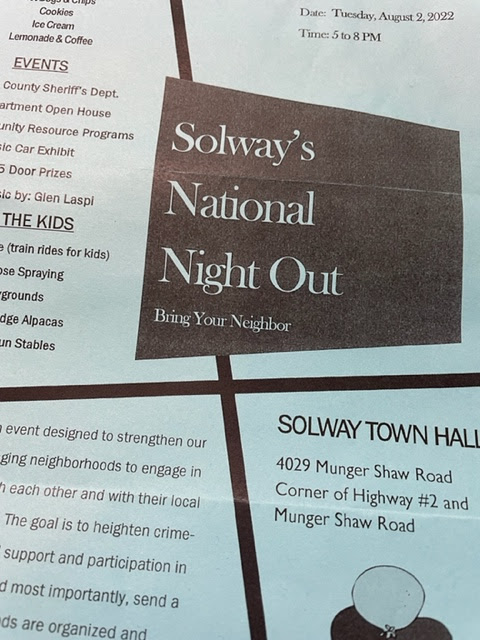
Did you participate in Tuesday's National Night Out? I decided to see what was shakin' here in our neighborhood. Community leaders organized a Solway Township event at the Munger Town Hall, which is located on the corner of Highway 2 and Munger Shaw Road across the street from the Munger Tavern.

There was live music, free food (hot dogs, chips, cookies, ice cream), a few classic cars, some animals and rides for kids. The volunteer fire department had its trucks and equipment on display. And even a representative from the county's sheriff department was on hand for a bit.

Here's an interesting comparison/contrast. The Solway Township is nearly a square six miles long by six miles wide, just under 36 sq. miles. As of 2018 it had a population of less than 2,000. By way of contrast, San Francisco has a land area just under seven by seven square miles. Its population is 874,000. 

This is the invitation we received.
For even more mind-bending numbers compare Solway to Manhattan. Manhattan is only 22 miles square but they house almost twice as many people as SF. When you compare these three communities it's mind boggling. Solway has zero crime. (Or it seems that way.) No homeless people die on our rural streets. There's never been a riot here. It's pretty quiet here. 

So National Night Out was a big event. Here are some photos. If you're weary of being afraid of vandalism or carjackings in your big city and want to move here, I believe we still have room for you. 

The kiddies had fun on this "train ride." 
Fire hall and recycle center in background.

Why are fire engines red?

First responder vehicle.
Young firefighters learn how to hold and aim a hose.


I should have taken photos of the crowd because it was a nice turnout. I got into a couple discussions about our biggest community issue right now: mail delivery has been spotty lately. 

Did you celebrate with your neighbors last night? Did you learn anything new? 

Let the sunshine in.


Friday, February 8, 2013

Street Art In the Bay Area and Big Apple

This building in SF caught my attention a few years back.
Last week when I shared examples of L.A. street art it brought to mind some of my San Francisco meanderings a couple years back and the street art I saw there. The building at the right here was striking because I'd never seen anything like it. Instead of graffiti or bright murals, it was a living sculpture with furniture falling out from all the windows.

What triggered my memories of SF was an article at ARTINFO.com on the 20 Best Spots to See Street Art in New York City. As the slide show demonstrates, the New York street arts community is quite talented, and busy. Personally I hate most articles that claim to designate ten or twenty things as the best of everything else, like the best actors of all time and top ten Dylan songs of all time. Usually it's just a person speaking authoritatively about his or her own opinion. Nevertheless, these kinds of articles do cause buzz or a bit of chatter amongst friends who get a chance to say, "Well, what about...?"

It used to be that graffiti artists worked on walls beneath underpasses and other out-of-the-way spaces because the work was unsanctioned. (i.e. illegal) Today's graffiti artist is now a street artist and their work is receiving a much higher level of recognition. Certainly building lathered with color are more interesting than abandoned structures that have been condemned but are yet to be dismantled.

I went to a Vegas auto show party once in which two dozen graffiti artists had been flown in from Detroit to create a wall of art during the course of the evening while suited executives sipped cocktails and talked about the industry. It seemed an odd juxtaposition.

For what it's worth, we have some really exceptional walls in Duluth and Superior, and I'm looking forward to seeing more in 2013.

The images below are from a wall in SF circa 2010. I wake earlier than everyone else so I walked the streets with my camera. How many times I've wished my eyeball were a camera, but there are a lot of fairy tale wishes in life that just ain't gonna happen.

Sunday, November 11, 2007

It's a Small, Small World

In 1889, Thomas Curtis Clarke opened his essay on "The Building of a Railway" with these words: "The world of today differs from that of Napolean more than his world differed from that of Julius Caesar; and this change has chiefly been made by railways." Little did he know how transfigured our world would become by the twenty-first century, first by the multiplying transportation routes, and later by communications.

Not too long ago I read a book by Stephen Ambrose about the building of the transcontinental railroad, the most ambitious engineering feat of the 19th century. Before the railroad there were three routes to California: overland, across the Panama Isthmus, and around South America's Cape Horn. The overland route was tedious, time consuming and dangerous. But travelling by sea proved no better. New York to California by boat, via Cape Horn, was a 196 day trip that included storms, seasickness, bad food and occasional shortages of water. The young, fit and ambitious who attempted to take the Panama shortcut had to risk life threatening fevers, and hope that a boat was waiting on the other side when they sloshed on through.

Financiers, engineers and an army of workers built the railroads. The nation reaped its benefits. The United States and her territories finally became acquainted. The size of our country began to shrink and become manageable. Relatives who went west no longer disappeared forever. They were eventually only days away.

In the last half of our century we've seen a further shrinking of our nation and the world. Airplane travel has become commonplace. California, once half a year's journey, was now less than half a day, once you include layovers. Indeed, the world keeps shrinking.

And frankly, I'm glad of it. Because last year my son got married and took his sweetheart to San Francisco. Thank goodness for email, cell phones and airplanes.

Popular Posts