Showing posts with label memoirs. Show all posts

Wednesday, September 14, 2022

Almost Wordless Wednesday: Nevada Bob Completes Another Road Trip

Nevada Bob and the Seattle Skyline.
After recording his sixth album in Nashville with Charlie McCoy and a select group of session musicians, Nevada Bob Gordon toured more of the country on a road trip that took him to a wide swath of the U.S. toward the Northwest. His escort, host and cohort on this adventure has been photographer Gary Firstenberg. I can't imagine a better tour guide. Gary knows where all the haunts where all the great music makers and performers of the past century were born, lived and died. If you ever want a music tour, Gary would be your primo first choice. Not only does he know the places and spaces where music history has been made, you will also end up with a top-notch photo album documenting your adventure.

Learn more about Frenchglen in Nevada Bob's memoir
Making music in Amarillo.
Paying tribute to Jimi Hendrix. 
Will Nevada Bob do a cover of Purple Haze on his next album?
Or Voodoo Child?
Nevada Bob used this Bowie knife to cut his 64 oz. steak.
Standing tall with a Tulsa Oilman.
The Woody Guthrie Center
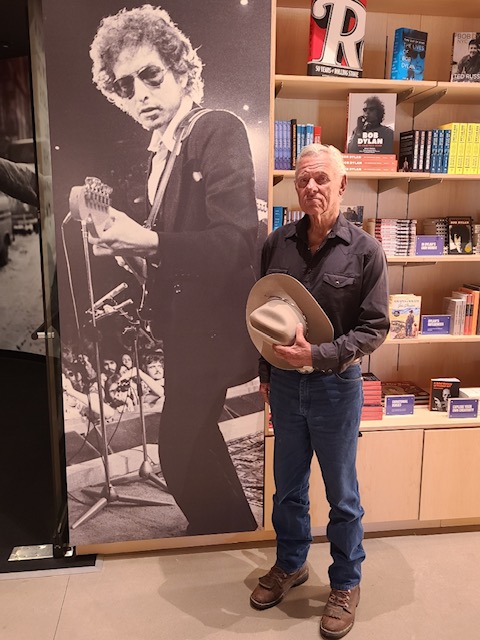
Standing with Bob at the Bob Dylan Center
You can never have too many banjos.

Learn more about the adventures of Nevada Bob at

Charlie McCoy on harmonica.

Read the reviews of 50 Years with the Wrong Woman on Amazon

With Gary Firstenberg. Comrades in arms.


Saturday, September 19, 2009

Four Books On U.S. Grant

From time to time I have been asked why I have this Matthew Brady photo of General Grant on the wall of my office. My ready reply goes something like this. "General Grant's life expresses a number of character qualities from which I get inspiration. He was a model of initiative, purposefulness, determination and creative problem solving. For these reasons, among others, I consider him a hero. I think everyone would benefit from having heroes to inspire and in some ways emulate."

There's one more thing about Grant that I also find inspiring. Before he came into his own, his life was floundering. He appeared to be a loser. For all intents and purposes, he was a loser, failing at everything and gaining for himself a reputation as a person more to be mocked than praised. But in his mid-thirties, when the Civil War split the nation, it afforded the young Grant an opportunity to do that for which he had become ideally suited.... to lead men.

For many years, I likewise floundered. After college I became a security guard for a couple years. Later I went to Mexico where I became a "failed missionary" by leaving at the end of a year instead of the three I'd committed to. For several more years I cast about, feeling a sense of "calling" as a writer but uncertain as to how that would really play out. Interestingly enough, I recently learned that my father privately confided to his sister that he was concerned at one point that he might have to support me the rest of my life. And I am certain that young Ulysses Grant's dad felt precisely the same concern for this loser son who was working in a hardware store for his brother.

For Grant, the skills were in place but the opportunity to utilize all his strengths had been absent. Gratefully, I too came into my own in my thirties and have experience more than two decades of success in advertising, marketing and PR.

The point here is that Grant's peers perceived him in a certain light based on circumstances, but there was much more to the man than met the eye. Furthermore, the trajectory of a life is not a fixed thing. Grant's trajectory changed significantly at a certain point in time, and it propelled him to the White House.

Here are four brief reviews on books about Ulysses Simpson Grant that I have enjoyed over the years.

Ulysses S. Grant, The Unlikely Hero by Michael Korda
Korda's bio of Grant is part of the Eminent Lives series of biographies of significant people For decades Korda had been editor-in-chief for Simon and Schuster, and is a well known essayist, novelist and literary figure. Hence, when I saw the book displayed at B&N, it was immediately placed in my "gotta have it" list.

Korda is an entertaining writer and the book unearths, in a creative manner, many observations and anecdotes about one of my favorite presidents. The book's aim is not to be comprehensive. Rather, Korda offers a thought provoking overview of the man and his achievements.

I've found it to be a thoroughly absorbing read, but do have questions about his repeated assertions regarding Grant's drinking, a theme that is pretty heavily underscored throughout the narrative. Is Korda's portrait accurate on this matter, or is the case built on rumor and innuendo? Stereotypes die hard. Grant was a man who accomplished much but who likewise made his mistakes. Korda's book comes highly recommended for its tight presentation of an interesting and significant man.

The Trial of U.S. Grant by Charles G. Ellington
This book was given to me as a gift by Charles Ellington himself in 1991 and it was a wonderful read. A grad from the Universities of Missouri, Harvard, and California Western, Ellington is (like myself) a USG fan. This book is an exploration of the events in Grant's life in the post-Mexican War period from 1852-1854. These two years in apparently aimless military service left Grant isolated, frustrated and homesick for his wife and two sons, one of whom he had never seen.

Ellington argues that this period of virtual exile was instrumental in developing the strength of character that resulted in Grant's later achievements. The author spent ten years researching the book and it is an excellent contribution to any Grant collection.

Personal Memoirs of U.S. Grant by Grant himself
For the 24 hours my wife Susie was in labor with my firstborn son, I was accompanied by this book, the Personal Memoirs of U.S. Grant. The origin of this fabulous memoir is a story itself. Grant had served two terms as 18th president of the United States. His finances were handled by a son who had gone into a partnership with another man who swindled them. Thus, the great general and former president was a penniless pauper. Mark Twain recognized that Grant's life would be a very marketable story. The result was a bestselling autobiography that helped Grant to be financially comfortable in his twilight years.

The preface opens thus: "Man proposes and God disposes." There are but few important events in the affairs of men brought about by their own choice.

This is a remarkable observation, and a great start point for a very enlightening read. I've read it twice and have retained many insights from its pages. If you have to choose but one book from this list of four, this is it.

Grant Wins the War, Decision At Vicksburg by James R. Arnold
Of the twenty most brilliant campaigns in military history, more than half were by Napoleon. Only two were conceived and executed by generals in the U.S. Civil War. The first was General Stonewall Jackson's Shenandoah Campaign. The second, Grant's victory at Vicksburg.

James Arnold begins this book by presenting the significance of the battle of Vicksburg. A key to success, whether in war or business, is not simply winning battles but in fighting the right battles. What propelled Grant to fame was not winning victories alone, but recognizing the importance of the objectives he pursued. Vicksburg, in Arnold's estimation, was even more significant than Gettysburg in bringing down the South.
This book focuses specifically on this singular battle, the challenges it presented and the unique strategies which Grant employed to achieve his aims. Arnold writes vividly and with great respect for all involved. Like the others, it is highly recommended, not only to Grant fans but to war buffs of all stripes.
Click on photos to enlarge. The map beneath the books shows the location of Grant's Pass in Oregon.

Monday, May 25, 2009

A Memorial Day Reflection

Do you remember when we used to celebrate Lincoln’s Birthday on February 12 and Washington’s on the 22nd? Memorial Day was May 30th in those days. All those midweek holidays were a bit disruptive and the two presidents are remembered on President’s Day, the 3rd Monday in February, and Memorial Day, today, is the last Monday in May.

The origin of Memorial Day goes back to the brutally bloody Civil War. Many communities set aside a day to mark the end of the war as a memorial to those who had died. Originally called Decoration Day (to decorate the graves of the fallen) the name was changed to Memorial Day in 1882. The holiday took on greater significance after World War II, another all-encompassing war that left few untouched or unmoved.

Setting aside a day for remembering has value because some things are too important to be forgotten.

My father-in-law, who served in World War II, eventually wrote a book about his experiences. Bud Wagner was on the first ship to Europe and served for the duration of the war, capturing details, images and keen personal observations that I doubt one can find anywhere.

Here's an excerpt from the introduction.


I began keeping a diary when I was quite young. I have many small books with short entries, and at the time I registered for the Draft in October 1940, when I was 22, I was closing the 5th year in a leather-bound 5-year diary.

I didn't even consider stopping with my diary because of my draft status, and I decided that in addition, I would keep a small camera with me at all times I possibly could during my Army service. My intention was to keep all my Army time on record to the best of my ability. On the front page of the 5-year diary I had written the Chinese proverb: "The faintest ink is better than the strongest memory."

There were many times during my Army career when I couldn't make my diary entries on the day they occurred. Days and nights would often run together when we were on the move, and dates were unimportant to me at the time.

Another reason I sometimes couldn't make daily entries is that for security reasons, I tried to keep my diary to myself. There were probably only three close friends who knew I was keeping it. I always carried it in my shirt pocket, and towards the end of the War it was getting to be quite a bulky burden. If I hadn't sent a part of it home before leaving Ireland, I wouldn't have been able to carry it all on my person.

Some of the problems I faced in writing it were (1) no light at night, (2) difficulty in getting ink, and (3) the fact that I didn't even have a real diary at times, but only small notebooks to write in.

There were times when I couldn't get away by myself that I would make believe I was writing a letter -- when actually I was trying to recollect and put in writing what had happened to me during the previous days or sometimes the previous week.

After I returned home in July 1945, the diaries were put into a drawer, moved with me several times, and were all but forgotten until about 1975 when our family was all together one Sunday afternoon. The talk turned to my Army life, and when I mentioned the diaries, everyone wanted to see them.

One of our sons-in-law, Ed Newman, a writer, thought there was potential in it for short stories, a journal, or a book. Our other son-in-law Harrold Andresen, a mechanic, was interested in all the mechanical work that had to be done to the vehicles. Our son, Lloyd, had heard some things about what I had written, and had been studying American and European history, including that of the World Wars, so he was very interested as well.


When Bud turned 79, he called me on the phone and said, “Eddie, I want you to take me to the store tonight to buy a computer. I’m ready to write my book.”

Whoever said you can’t teach an old dog new tricks was definitely mistaken. Bud had been assembling his research for a lifetime and was eager to prepare a manuscript. It was a major undertaking, but one could see the determination there. He also had help with preparing the polished version. His son Lloyd, my brother-in-law, did the “heavy lifting” as regards editing and organizing photos, etc. I did a measure of copy editing. And ultimately, an incredible book was produced called And There Shall Be Wars, a reference to Mark 13:7 in which Jesus said, “And when ye shall hear of wars and rumors of wars, be ye not troubled; for such things must needs be, but the end shall not be yet.”

To purchase your own copy of the book, Bud Wagner's diaries and memoirs of World War Two send an email to ennyman3@gmail.com or visit the Hermantown Historical Society.

This year Wilmer A. "Bud" Wagner turns ninety and he has been looking forward to that 90th birthday party coming up soon. We may have a few surprises for him. For sure I will be returning to this topic again over the next couple weeks.

In the meantime, let us remember all who sacrificed so much to preserve the freedoms we enjoy.

Saturday, January 5, 2008

Stigmata X

Stigmata X
by Terry Anderson
No man can ever start anew completely;
he's everything he's done
or said or failed to do.
Each bit is added on,
Altering the whole,
But covering, not replacing
what has gone before.
A piece of unfired clay,
he bears the marks
and scars of all his years.
Not just clay, though
sculptor, too;
he helps to mold himself:
Object, artist, audience.
Sometimes, though, larger hands --
destiny, fate, karma, God --
take firmly hold and,
wielding fierce events,
risk fracture to hack
and carve away some
awkward, ugly bits.
The final work cannot be seen
until it's fired, and all fires cold.

Paul knew: suffering and pain
are the truest ways,
the only ways for some of us,
to draw out that within
which answers to
the purpose of it all.

Terry Anderson was a journalist taken hostage in Beirut in the 1980's. After his release he wrote an insightful and powerful book called Den of Lions: A Startling Memoir of Survival and Triumph. It is an engrossing account of one's man's personal first hand experience in hell, with incredible self-disclosure. At various places in the account Anderson's poems have been interspersed. This one made an especially meaningful connection with me when I read it a few years back, and I share it with you hear.

Friday, November 23, 2007

A Smattering of Good Quotes

Someone once criticized me for using quotes from other people. He quoted Bill Gates to defend his position.

My interest in quoting comes by way of my mom who frequently made reference to Elbert Hubbard's Scrap Book. Hubbard was a collector of insights and pearls of wisdom from great minds and books that preceded him. A perpetual optimist, he created two magazines that proved influential at the dawn of the twentieth century. His Scrap Books were collections of insights and quotes. And for the whole of my life I have enjoyed the habit of "quote collecting."

I prefer utilizing quotes from my personal reading, lest it give the impression of putting on airs. But then again, there are so many pithy sayings and witticisms that others have collected, it seems a crime to leave them in the ditch when their illuminations are so apropos.

My favorite part of collecting quotes is that as you read and re-read them over the years, you internalize them. When a situation occurs, a pithy quote rolls off your tongue. (Or, frequently in my case, a line from a Dylan song.)

Here are some samples for today's meditation, and future utilization.

"Patience is bitter, but its fruit is sweet." ~ Rousseau

"Every man is a volume, if you know how to read him." ~ Channing

"When the state is most corrupt, then laws are most multiplied." ~ Tacitus

"I don't think much of a man who is not wiser today than he was yesterday." ~ Lincoln

"The greater the obstacle the more glory in overcoming it." ~ Moliere

"Every war is a national calamity, whether victorious or not." ~ Gen. Von Moltke

"Next to knowing when to seize an opportunity, the most important thing in life is knowing when to forego an advantage." ~ Disraeli

Sunday, August 19, 2007

And There Shall Be Wars

At age 79 my father-in-law Bud Wagner called me on the phone and said, "I'd like you to help me buy a computer." That night we went out and did just that. He taught himself how to use it and proceeded to finish a project that he'd carried in his heart for most of a lifetime.

At age 80, Wagner completed his first book, based on his diaries from World War Two. Wagner was the second Minnesotan drafted into the war. Cook, machine gunner and company agent, Wagner had the privilege of being on the first convoy to make its way across the Atlantic for the European theater. And the good fortune of having survived the duration of the war without becoming a casualty in North Africa and Italy, which included beachheads at Anzio and Salerno.

The book, And There Shall Be Wars, is a truly powerful account of this man's experience and worthy of being included in the annals of military history.

Wagner had several motivations for writing the book. "I wanted to put my diary in a concise journal form for the family," Wagner said. "I've kept a diary out of habit since I was a young kid. During the war nobody else did it and I wanted to have it as part of my life experience." Diary writing was rare not only because few soldiers did it, but also because the army had rules against it. When citing the value of diaries Wagner fondly quotes the Chinese proverb, "The faintest ink is stronger than the strongest memory."

A primary theme for this blog is journal writing. That is, I have been sifting thought my personal journals and bringing to light excerpts that might lead to some thought provoking discussion, or insights of value. Bud Wagner's book is similar in design. He kept a journal during the war, but his book is more. Having spent decades researching that siginifcant period of history, his journal notes include commentary amplifying the entries, with additional historical facts collated to make this book especially valuable.

For more information on this book, and to see what others have said.
To purchase a copy of And There Shall Be Wars, send an email to ennyman3@gmail.com

Monday, July 23, 2007

U.S. Grant & the Battle of Vicksburg

No one who saw U.S. Grant during his "lean years" could have imagined that THIS man would one day be catapulted to the presidency of the United States. His rise, when it came, was meteoric.


David Chandler, in his book The Campaigns of Napoleon, noted that of the 20 most brilliant battles of history, only two were from the U.S. Civil War. One of these was Grant's leadership and decision making in the Battle of Vicksburg. His decision at Vicksburg -- a strategic plan that emerged from a long hard brooding over the problem -- was one of two or three key decisions in the war.

As in our own lives, much of life is simply execution... plodding... Only in certain moments do we have the true power and opportunity to lay our mark on events. Grant was an original thinker who took initiative. The Battle of Vicksburg was his "mark" and it changed the course of the war, and history.
Journal Note: May 4, 1997


Along with several other books about our 18th president, I have twice read the Personal Memoirs of U.S. Grant, published by Mark Twain, and drawn great inspiration from his life. What I find especially exciting is that one never knows what tomorrow will bring. After the Mexican War, Grant fell into the boring tedium of non-combat soldiering followed by a retreat from the service altogether to be with his family. As a farmer he likewise failed and ended up a clerk in his brother's hardware store. Only when the war came did he have the opportunity to fulfill the role destiny had prepared him for. Grant rose to the occasion, and distinguished himself. His singular character qualities set him apart from other generals and earned him great respect from those who served under him.

May we ourselves do the same. If you wish to read a brief summary of the key character qualities that made him an inspirational leader, visit http://www.ennyman.com/grant.html

Popular Posts