Showing posts with label Vicksburg. Show all posts

Saturday, November 25, 2023

Putting Napoleon in Perspective: Insights, Notes & Quotes from "The Campaigns of Napoleon"

How significant was Napoleon? How large was his footprint on history? Is Napoleon worthy of a "big" Hollywood epic like Ridley Scott's latest production? 

In answer to the last question, Napoleon is indeed a worthy subject for a major motion picture. It waits to be seen if Hollywood can produce a film worthy of the man himself.

I myself became interested in Napoleon after reading the intro to James A. Arnold's Grant Wins the War: Decision at Vicksburg. In his prologue Arnold wrote that according to military historians there were only two military campaigns from the U.S. Civil War worthy of comparison to the genius and skill of Napoleon, Stonewall Jackson's Shenandoah Campaign and Grant's conquest of Vicksburg. Naturally this sparked in me a desire to learn more about Napoleon, so I did a little research and found the best book I could find, Chandler's 1200 page The Campaigns of Napoleon. His battlefield exploits were so astonishing that twelve of his battles are cited in the top twenty military campaigns of all time. For more than twenty years the battles of Napoleon consistently rose above the expected.

The quotes and observations below were primarily taken from the 120 page introduction to that volume.  

* * * 

"His powers were his own, but circumstances rendered them effective."
--Hudson  

"All that is to happen is written down. Our hour is marked and we cannot prolong it a minute longer than fate has predestined."
--Napoleon


His great skill: Translating (War) Theory into Activity.

· Napoleon was a Man of Action... not necessarily Original. He borrowed from history.

· He was "a developer and perfecter of the ideas of others." (p. 135)


He drew his major ideas from books.

· "I have fought sixty battles and I have learned nothing which I did not know at the beginning."

· "Read and meditate upon the wars of the great captains. This is the only means of learning the art of war."


Importance of Speed

· Seize the initiative & Keep it at all costs.

· The Objective: Swift destruction of the enemy's will to resist.


Importance of Planning

· Napoleon was "extremely thorough in his planning. Very little was left to chance.

· Yet, at the same time, he recognized Chance as a variable and believed

every plan should allow a period of time to remedy or exploit the unpredictable.


Importance of Time

· The loss of time (in war) is irreparable.

· Strategy is the art of making use of time & space. However, "space we can recover, time never."

· "I may lose a battle but I shall never lose a minute."


Importance of Moral Force

· The Moral is to the Physical as three is to one.

· Moral force, rather than numbers, decides victory.


Two Main Qualities of a Soldier

· "If courage is the first characteristic of a soldier, perseverance is the second."


Summing Up

I took an interest in battle strategies not because I wanted to be a soldier some day but, rather, because of a book by Al Ries & Jack Trout called Marketing Warfare, which AMSOIL founder Al Amatuzio loaned me more than 35 years ago. The twin topics--marketing and battle strategies--became a lifelong interest. 


Many people remember Napoleon only for Waterloo. Few Americans realize that Napolean was the most written about human being of the nineteenth century, with more than 100,000 books devoted to analysis of the man, his actions, his ideas and his life.


Bonus Tracks
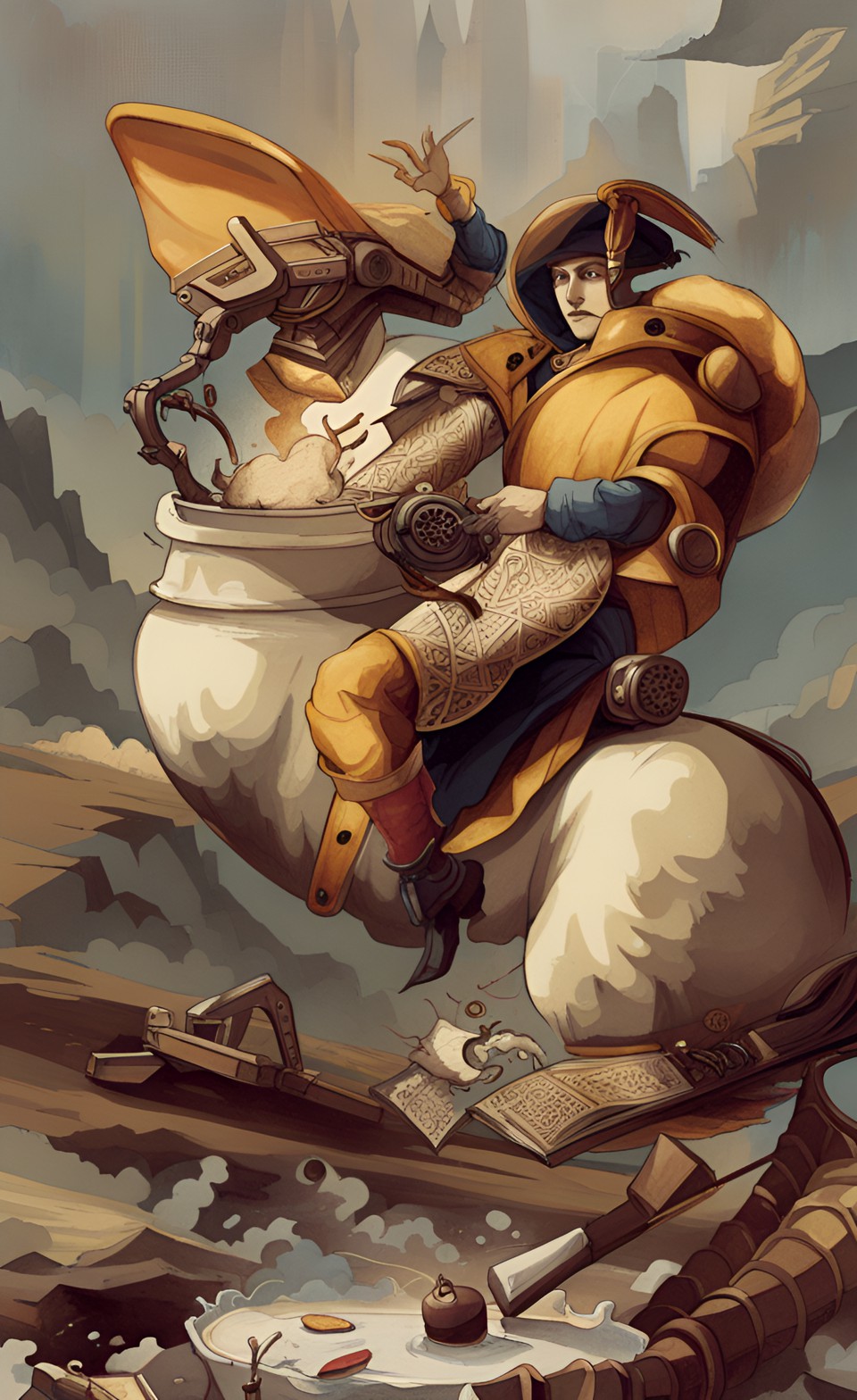
A.I.-generated images based on Jacques-Louis David's Napoleon Bonaparte


Saturday, April 27, 2019

This Week's Top Five Stories On Medium (by ennyman)

Here are the stories I've written which received the most pageviews this week on Medium.

Four Marketing Lessons from the Battle of Vicksburg
Here are four important marketing and leadership lessons that stand out from this battle. Each could be elaborated on with illustrations from businesses today. Published on Medium at The Startup.
Read More


Add Martin Guitar Factory to Your Bucket List
Every business has a story, a starting point and a history. Martin Guitars just happens to have a story that leaves none of us untouched. That is, anyone for whom music or pop culture has been a part of their lives, this company’s products have produced sounds that enhanced your life.
Read More


Life is the Artist’s Pallet
Artists, whether their medium is words or paint or cameras or music, discover at some point in time that they are themselves a medium, a vessel through which observation and experience is transmuted and shared.
Read More


Remembering Kurt Vonnegut
A Vonnegut tribute and re-cap of my interview with the author.
Read More


“Go Away Bomb:” — Dylan Writes A Song for Izzy Young
An original manuscript which Dylan wrote for and at the request of Israel “Izzy” Young, will be on display this coming month along with numerous other items from the Bill Pagel Archive. Young owned a music store called the Folklore Center in Greenwich Village. This original document from the Bill Pagel Archive will be on view through much of the summer here.
Read More

* * * *

Wednesday, April 17, 2019

Four Marketing Lessons from the Battle of Vicksburg

Gettysburg has been cited so frequently as the decisive turning point of the war that it seems to be common knowledge. The tagline for the 1993 film about this important battle was this: In 1863, the Northern and Southern forces fight at Gettysburg in the decisive battle of the American Civil War.

James Arnold, in his insightful book Grant Wins The War, begins by arguing that the Battle of Vicksburg was the the  decisive victory that broke the back of the South. When the Union Army captured Vicksburg, they effectively took control of the Mississippi River, cutting off all supplies from the West so that with the blockades it would only be a matter of time and the Armies of Northern Virginia would be depleted and defeated.

Arnold's intro notes that of the twenty most brilliant campaigns in military history, more than half were by Napoleon. Only two were conceived and executed by generals in the U.S. Civil War. The first was General Stonewall Jackson's Shenandoah Campaign. The second, Grant's victory here at Vicksburg.

Here are three important marketing and leadership lessons that stand out from this battle. Each could be elaborated on with illustrations from businesses today.

U.S. Grant. National Archives.
1. Fight the Right Battles
James Arnold begins this book by presenting the significance of the battle of Vicksburg. A key to success, whether in war or business, is not simply winning battles but in fighting the right battles. What propelled Grant to fame was not winning victories alone, but recognizing the importance of the objectives he pursued. Vicksburg, in Arnold's estimation, was even more significant than Gettysburg in bringing down the South.

2. When Your Plan Isn't Working, Change Your Strategy
In assessing the situation, General Grant observed that the firepower and high ground that Vicksburg controlled overlooking the Mississippi made it impregnable from an assault from the river side. After much consideration the first plan conceived was to re-route the river. The objective was important enough that time was less important than speed. In May 1863 digging commenced. After a while it became apparent this was an ill-conceived plan that wouldn't work. General Grant abandoned the idea and produced a superior strategic initiative.

3. Learn from Previous Experience 
Like many generals of the Civil War, U.S. Grant participated in the Mexican War a number of years earlier. There were two generals he served under and from each he learned something invaluable. From General Taylor he learned how to manage a big operation, how to maintain supply lines including food and munitions and how to coordinate movements. From General Winfield Scott he learned about taking initiative and the power of speed and the unexpected. With a small army and a sudden surprise appearance in Mexico City, his hundreds of men terrified tens of thousands of Mexican soldiers.

Here's how this played out in Vicksburg. Grant decided to bring his forces downstream for a similar surprise maneuver, abandoning his supply lines. In a series of skirmishes Grant's army remained mobile and could not be located by Confederate forces because they survived by foraging. He also sent a small raiding party southward as a decoy, generating rumors that kept the enemy confused and fearful. They seemed to be here, there and everywhere.

4. Know the Condition of Your Troops
General Grant not only made sure the men were fed, but also rested. In addition, he was very much in touch with the morale of his troops. For example, at the beginning of the war, he wanted his untested troops to come away from the first battle with confidence. He knew, from Mexican War days, that General Hood was a bit quick to run away from battle in order to preserve the numbers under his command. Grant used 1000 men to conquer a fort in which 500 of Hood's men were stationed. Hood fled as expected. Grant told his men that they just defeated an army of 2000 with minimal losses. His objective -- give the men experience in battle without undermining confidence -- was achieved.

Here is a story from Vicksburg that illustrates this point as well. The army had to cross a narrow wooden bridge at one point. He went first, parked his horse on the other side, facing his men as they came across. As they marched passed he greet each one, looking them in the eyes, assessing their morale, their readiness for what lay ahead. 

* * * *

Much more can be said about this significant victory for the North, but my aim here has been to draw attention to several features that make it a useful model for business lessons today, especially in marketing.

For more, here are Four Books on U.S. Grants
Related: Lessons from Desert Storm

Saturday, September 19, 2009

Four Books On U.S. Grant

From time to time I have been asked why I have this Matthew Brady photo of General Grant on the wall of my office. My ready reply goes something like this. "General Grant's life expresses a number of character qualities from which I get inspiration. He was a model of initiative, purposefulness, determination and creative problem solving. For these reasons, among others, I consider him a hero. I think everyone would benefit from having heroes to inspire and in some ways emulate."

There's one more thing about Grant that I also find inspiring. Before he came into his own, his life was floundering. He appeared to be a loser. For all intents and purposes, he was a loser, failing at everything and gaining for himself a reputation as a person more to be mocked than praised. But in his mid-thirties, when the Civil War split the nation, it afforded the young Grant an opportunity to do that for which he had become ideally suited.... to lead men.

For many years, I likewise floundered. After college I became a security guard for a couple years. Later I went to Mexico where I became a "failed missionary" by leaving at the end of a year instead of the three I'd committed to. For several more years I cast about, feeling a sense of "calling" as a writer but uncertain as to how that would really play out. Interestingly enough, I recently learned that my father privately confided to his sister that he was concerned at one point that he might have to support me the rest of my life. And I am certain that young Ulysses Grant's dad felt precisely the same concern for this loser son who was working in a hardware store for his brother.

For Grant, the skills were in place but the opportunity to utilize all his strengths had been absent. Gratefully, I too came into my own in my thirties and have experience more than two decades of success in advertising, marketing and PR.

The point here is that Grant's peers perceived him in a certain light based on circumstances, but there was much more to the man than met the eye. Furthermore, the trajectory of a life is not a fixed thing. Grant's trajectory changed significantly at a certain point in time, and it propelled him to the White House.

Here are four brief reviews on books about Ulysses Simpson Grant that I have enjoyed over the years.

Ulysses S. Grant, The Unlikely Hero by Michael Korda
Korda's bio of Grant is part of the Eminent Lives series of biographies of significant people For decades Korda had been editor-in-chief for Simon and Schuster, and is a well known essayist, novelist and literary figure. Hence, when I saw the book displayed at B&N, it was immediately placed in my "gotta have it" list.

Korda is an entertaining writer and the book unearths, in a creative manner, many observations and anecdotes about one of my favorite presidents. The book's aim is not to be comprehensive. Rather, Korda offers a thought provoking overview of the man and his achievements.

I've found it to be a thoroughly absorbing read, but do have questions about his repeated assertions regarding Grant's drinking, a theme that is pretty heavily underscored throughout the narrative. Is Korda's portrait accurate on this matter, or is the case built on rumor and innuendo? Stereotypes die hard. Grant was a man who accomplished much but who likewise made his mistakes. Korda's book comes highly recommended for its tight presentation of an interesting and significant man.

The Trial of U.S. Grant by Charles G. Ellington
This book was given to me as a gift by Charles Ellington himself in 1991 and it was a wonderful read. A grad from the Universities of Missouri, Harvard, and California Western, Ellington is (like myself) a USG fan. This book is an exploration of the events in Grant's life in the post-Mexican War period from 1852-1854. These two years in apparently aimless military service left Grant isolated, frustrated and homesick for his wife and two sons, one of whom he had never seen.

Ellington argues that this period of virtual exile was instrumental in developing the strength of character that resulted in Grant's later achievements. The author spent ten years researching the book and it is an excellent contribution to any Grant collection.

Personal Memoirs of U.S. Grant by Grant himself
For the 24 hours my wife Susie was in labor with my firstborn son, I was accompanied by this book, the Personal Memoirs of U.S. Grant. The origin of this fabulous memoir is a story itself. Grant had served two terms as 18th president of the United States. His finances were handled by a son who had gone into a partnership with another man who swindled them. Thus, the great general and former president was a penniless pauper. Mark Twain recognized that Grant's life would be a very marketable story. The result was a bestselling autobiography that helped Grant to be financially comfortable in his twilight years.

The preface opens thus: "Man proposes and God disposes." There are but few important events in the affairs of men brought about by their own choice.

This is a remarkable observation, and a great start point for a very enlightening read. I've read it twice and have retained many insights from its pages. If you have to choose but one book from this list of four, this is it.

Grant Wins the War, Decision At Vicksburg by James R. Arnold
Of the twenty most brilliant campaigns in military history, more than half were by Napoleon. Only two were conceived and executed by generals in the U.S. Civil War. The first was General Stonewall Jackson's Shenandoah Campaign. The second, Grant's victory at Vicksburg.

James Arnold begins this book by presenting the significance of the battle of Vicksburg. A key to success, whether in war or business, is not simply winning battles but in fighting the right battles. What propelled Grant to fame was not winning victories alone, but recognizing the importance of the objectives he pursued. Vicksburg, in Arnold's estimation, was even more significant than Gettysburg in bringing down the South.
This book focuses specifically on this singular battle, the challenges it presented and the unique strategies which Grant employed to achieve his aims. Arnold writes vividly and with great respect for all involved. Like the others, it is highly recommended, not only to Grant fans but to war buffs of all stripes.
Click on photos to enlarge. The map beneath the books shows the location of Grant's Pass in Oregon.

Monday, July 23, 2007

U.S. Grant & the Battle of Vicksburg

No one who saw U.S. Grant during his "lean years" could have imagined that THIS man would one day be catapulted to the presidency of the United States. His rise, when it came, was meteoric.


David Chandler, in his book The Campaigns of Napoleon, noted that of the 20 most brilliant battles of history, only two were from the U.S. Civil War. One of these was Grant's leadership and decision making in the Battle of Vicksburg. His decision at Vicksburg -- a strategic plan that emerged from a long hard brooding over the problem -- was one of two or three key decisions in the war.

As in our own lives, much of life is simply execution... plodding... Only in certain moments do we have the true power and opportunity to lay our mark on events. Grant was an original thinker who took initiative. The Battle of Vicksburg was his "mark" and it changed the course of the war, and history.
Journal Note: May 4, 1997


Along with several other books about our 18th president, I have twice read the Personal Memoirs of U.S. Grant, published by Mark Twain, and drawn great inspiration from his life. What I find especially exciting is that one never knows what tomorrow will bring. After the Mexican War, Grant fell into the boring tedium of non-combat soldiering followed by a retreat from the service altogether to be with his family. As a farmer he likewise failed and ended up a clerk in his brother's hardware store. Only when the war came did he have the opportunity to fulfill the role destiny had prepared him for. Grant rose to the occasion, and distinguished himself. His singular character qualities set him apart from other generals and earned him great respect from those who served under him.

May we ourselves do the same. If you wish to read a brief summary of the key character qualities that made him an inspirational leader, visit http://www.ennyman.com/grant.html

Popular Posts