Showing posts with label Gettysburg. Show all posts

Thursday, November 11, 2021

Gods and Generals: The Good, the Bad and the Boring

Today is Veterans Day. Originally this was Armistice Day, celebrating the end of World War I, which was terminated on the 11th hour of the 11th day of the 11th month of 1918. Armistice Day was renamed Veteran's Day in 1954.
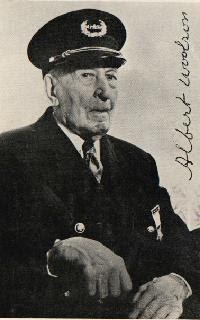
Interestingly enough, Albert Woolson, the oldest living veteran of the U.S. Civil War was still alive that year here in Duluth, Minnesota. Born in 1850, he served briefly as a teen in the last year of that war national conflict.

Woolson was not originally from the Northland but settled here later in life. His home on Duluth's Central Hillside was just a few houses from the first home of Bobby Zimmerman, who became known world wide as Bob Dylan. It's been said that on the Fourth of July the neighborhood boys would march up the alley behind Woolson's house and salute him as they went by. The young Dylan walked past that house every day during his first year of school, attending the Nettleton Elementary School two blocks away.

It is possible that Dylan's later interest in the Civil War was, in part, stimulated by these early memories. His song 'Cross the Green Mountain was written and recorded for the 2003 film Gods and Generals. It was included on the soundtrack for that movie and also included on his own album Tell Tale Signs in 2008, one of my favorite Dylan albums.

* * *
Gods and Generals was a Civil War drama written and directed by Ronald F. Maxwell based on a book by the same name by Jeffrey Shaara. Despite the praise heaped on this film and its sister project Gettysburg, I expected a story that would stir me. I could not have been more wrong. 

What follows are my impressions of the film. 

The Good.
The cinematography... Some beautiful camera work at times.
Dylan's elegant "Cross the Green Mountain. playing over the closing credits.
The film succeeded at depicting how clumsy it was to re-load a musket when you're in the heat of battle.

The Bad.
Hours of endless hokey music overlaying every speech and all the action.
Weak acting in the battle scenes.
Hokey speeches. Some being given in such a way that they were nothing more than soliloquies dribbling into the breeze.
Fake beards and mustaches. 
Maudliin sentimentality.
And then there were the inaccuracies.
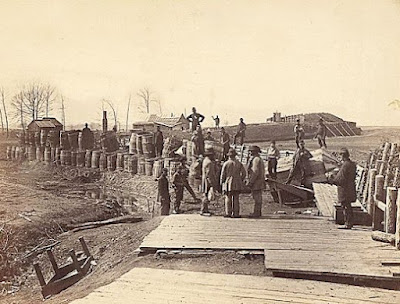
Manassas Fortifications (National Archives)
I will point to just one of the inaccuracies that stood out for me. There is a scene in which the army requests permission to use an estate as a hospital. They set up an operating table. There is an exchange of dialogue. But there are no moans, no groans, no screaming. Everything is peaceful and quiet.

By way of contrast, U.S. Grant in his autobiography (which I've devoured twice) describes an instance in which it was raining and cold and the wounded men were being worked on in the officers tent. He says the screaming and groaning was so loud that he went out and slept under a tree in the rain so he could get some needed rest.  

*

"Ours is not to reason why. Ours is but to do or die."
--Alfred Lord Tennyson, Charge of the Light Brigade

This film is purportedly about General Stonewall Jackson. Of the 20 greatest battles in world history as regards military strategy, 12 were conceived by Napoleon. Only two were conceived and executed by generals of the Civil War. One of these was the Battle of Vicksburg, carried out by General U.S. Grant. The other was General Stonewall Jackson's Shenandoah campaign.
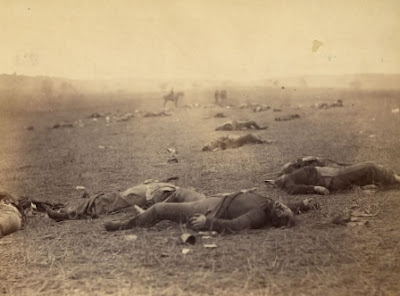
Dead on battlefield at Gettysburg. (National Archives)
Gettysburg was the first in this series of three films. (The third, I believe, was abandoned after the second was an epic fail.) Gods and Generals, the second in the series, which was actually a prequel, much like the superhero films Batman and Superman. With Stonewall Jackson as centerpiece and a cast of thousands (of extras performing their authentic re-enactment efforts) led by generals and officers whose idea of strategy seems to be having men march forward into withering gunfire, the film had potential as an idea. Rotten Tomatoes notes that only 8% of the critics reviewing it gave it a positive rating. 

I wanted to watch the film for two reasons. First, because Bob Dylan wrote a song for it, and second, because I wanted to see how they portrayed the Shenandoah campaign. To my surprise, there were no signs of Jackson's brilliance as a leader. And the director seems to have had no clue as to why the Shenandoah campaign had any importance at all.

The following statements, extracted from reviews I found at imdb.com, express some of my own impressions of the film.

A ridiculously long and staggering film that trips over itself in a drunken stupor so much that it becomes one of the biggest duds the cinema has ever seen.

and

Gods and Generals is targeted directly at the CWBs out there, a.k.a. the Civil War Buffs. It is so painstakingly boring and dull that only the fanatics could care about it. It is as if any interest in the film is tossed aside, just so the small amount of true CWBs out there can enjoy it, and nudge each other when their favorite historical figure comes on screen.

Someone else titled their review...

Great visuals, but where's the drama?

Another comment extract:

I found this dull, boring, and some of the worst war scenes ever in a movie. The battle scenes were not realistic and should have been saved for a TV movie.

* * * 

Sorry to belabor my point. Just trying to paint the picture.
If you like Civil War history, these links will interest you.

Related Links

Those Topps Civil War Cards Were Graphic But We Loved Them

Four Books About U.S. Grant

More Quotes Showing Why U.S. Grant Was Such an Inspirational Leader

Wednesday, April 17, 2019

Four Marketing Lessons from the Battle of Vicksburg

Gettysburg has been cited so frequently as the decisive turning point of the war that it seems to be common knowledge. The tagline for the 1993 film about this important battle was this: In 1863, the Northern and Southern forces fight at Gettysburg in the decisive battle of the American Civil War.

James Arnold, in his insightful book Grant Wins The War, begins by arguing that the Battle of Vicksburg was the the  decisive victory that broke the back of the South. When the Union Army captured Vicksburg, they effectively took control of the Mississippi River, cutting off all supplies from the West so that with the blockades it would only be a matter of time and the Armies of Northern Virginia would be depleted and defeated.

Arnold's intro notes that of the twenty most brilliant campaigns in military history, more than half were by Napoleon. Only two were conceived and executed by generals in the U.S. Civil War. The first was General Stonewall Jackson's Shenandoah Campaign. The second, Grant's victory here at Vicksburg.

Here are three important marketing and leadership lessons that stand out from this battle. Each could be elaborated on with illustrations from businesses today.

U.S. Grant. National Archives.
1. Fight the Right Battles
James Arnold begins this book by presenting the significance of the battle of Vicksburg. A key to success, whether in war or business, is not simply winning battles but in fighting the right battles. What propelled Grant to fame was not winning victories alone, but recognizing the importance of the objectives he pursued. Vicksburg, in Arnold's estimation, was even more significant than Gettysburg in bringing down the South.

2. When Your Plan Isn't Working, Change Your Strategy
In assessing the situation, General Grant observed that the firepower and high ground that Vicksburg controlled overlooking the Mississippi made it impregnable from an assault from the river side. After much consideration the first plan conceived was to re-route the river. The objective was important enough that time was less important than speed. In May 1863 digging commenced. After a while it became apparent this was an ill-conceived plan that wouldn't work. General Grant abandoned the idea and produced a superior strategic initiative.

3. Learn from Previous Experience 
Like many generals of the Civil War, U.S. Grant participated in the Mexican War a number of years earlier. There were two generals he served under and from each he learned something invaluable. From General Taylor he learned how to manage a big operation, how to maintain supply lines including food and munitions and how to coordinate movements. From General Winfield Scott he learned about taking initiative and the power of speed and the unexpected. With a small army and a sudden surprise appearance in Mexico City, his hundreds of men terrified tens of thousands of Mexican soldiers.

Here's how this played out in Vicksburg. Grant decided to bring his forces downstream for a similar surprise maneuver, abandoning his supply lines. In a series of skirmishes Grant's army remained mobile and could not be located by Confederate forces because they survived by foraging. He also sent a small raiding party southward as a decoy, generating rumors that kept the enemy confused and fearful. They seemed to be here, there and everywhere.

4. Know the Condition of Your Troops
General Grant not only made sure the men were fed, but also rested. In addition, he was very much in touch with the morale of his troops. For example, at the beginning of the war, he wanted his untested troops to come away from the first battle with confidence. He knew, from Mexican War days, that General Hood was a bit quick to run away from battle in order to preserve the numbers under his command. Grant used 1000 men to conquer a fort in which 500 of Hood's men were stationed. Hood fled as expected. Grant told his men that they just defeated an army of 2000 with minimal losses. His objective -- give the men experience in battle without undermining confidence -- was achieved.

Here is a story from Vicksburg that illustrates this point as well. The army had to cross a narrow wooden bridge at one point. He went first, parked his horse on the other side, facing his men as they came across. As they marched passed he greet each one, looking them in the eyes, assessing their morale, their readiness for what lay ahead. 

* * * *

Much more can be said about this significant victory for the North, but my aim here has been to draw attention to several features that make it a useful model for business lessons today, especially in marketing.

For more, here are Four Books on U.S. Grants
Related: Lessons from Desert Storm

Saturday, April 22, 2017

Meade Memorial in Washington DC Raises Curious Questions

One thing capitol cities are especially fond of is monument making, and Washington D.C. has them in spades. In addition to all the major monuments for our presidents and fallen heroes, there are an ample quantity of statues as well.

A couple weeks ago I was taking a leisurely stroll around the Capitol area when I came across a statue featuring General George M. Meade. Meade's fame rests on his having defeated Robert E. Lee's troops at Gettysburg, though my recollection is that he was late to the show and only arrived in the nick of time. After defeating Lee's army he then failed to follow up and as a result though dragging their tails between their legs Lee's troops were able to escape, recoup and prolong the war another two years. The actual location of this Meade Memorial is on the 300 block of Pennsylvania, just down the street from the White House.

Usually I do what most people do when I see these statues. I glance at the statue, note the bronze placard to see who it is, and pass on. This time, however, being in no hurry I loitered around its base, studying the actual craftsmanship and contents. To be honest, I thought it a strange collection of images, for it's not just the general on display. He is being attended to be a group of semi-clad young men and women whose aim appears to be to disrobe him.


The imagery was intriging enough to make me wish to understand it further, so I asked Google for assistance and found this:

The memorial is one of eighteen Civil War monuments in Washington, D.C., which were collectively listed on the National Register of Historic Places in 1978. The marble and granite sculpture, which includes depictions of Meade and seven allegorical figures, rests on a granite base and granite platform. It is surrounded by a public plaza and small park. The monument is owned and maintained by the National Park Service, a federal agency of the Interior Department.

General Meade was not a popular general after the war, having fumbled his opportunity to fame. Nevertheless, the people of his hometown Philadelphia desired to honor him, and this statue was eventually produced.

The curious composition is made of marble and granite, depicting Meade in his military uniform standing tall, peering out into the distance with great dignity, flanked by six figures representing "qualities the artist believed necessary in a great military leader... Chivalry, Energy, Fame, Loyalty, Military Courage, and Progress." One would be hard-pressed to make this conclusion by merely gazing at the nude women and semi-clad men. The cloak being removed is the "cloak of battle." On the rear side of the statue we find the winged God of War.

Here's some additional information regarding the figures:

The figure representing Loyalty holds a wreath and garlands behind Meade representing his accomplishments. The female figure representing Fame is behind Loyalty and is supported by the male figure of Energy. Behind Chivalry is the male figure of Progress and male figure of Military Courage. The latter is locking arms with War. A gold finial of the state seal of Pennsylvania is at the top of the memorial. 

Ultimately the Meade Memorial reminded me that artists often put more into their work than viewers take out, that meanings can sometimes be elusive even when the details are engaging.


The God of War. The hilt of his sword is its handle, consisting of guard, grip and pommel. 


* * * *


Next time you're in D.C. check out the statuary. Every picture tells a story. 

Sunday, June 1, 2008

Pickett’s Charge

I’m reading The Killer Angels again, Michael Shaara's deeply researched account of the Battle of Gettysburg, written with a storyteller's hand. It’s a book that probably could not have been written fifty years ago because it dares to be critical of General Lee, though this is not the book's focus. The battle made many images memorable, from Little Round Top and Devil’s Den to Cemetery Ridge. And it made many generals' names memorable as well, and none more so, in this battle, than General Pickett.

It could be argued that the mad futility of Pickett’s Charge broke the South. The unfolding events that orchestrated the charge should have never occurred but Fate had the upper hand and Reason found refuge in a foxhole. But was Pickett’s Charge the Worst Decision in Military History?

No. The whole of history is littered with dead bodies and tragedy.

Here is a familiar passage from Tennyson’s Charge of the Light Brigade.

Cannon to right of them,
Cannon to left of them,
Cannon behind them
Volley'd and thunder'd;
Storm'd at with shot and shell,
While horse & hero fell,
They that had fought so well
Came thro' the jaws of Death,
Back from the mouth of Hell,
All that was left of them,
Left of six hundred.

Similar sentiments can be found in Eric Bogle’s And the Band Played Waltzing Matilda drawn from recollections of the Battle of Gallipoli.

How well I remember that terrible day
How the blood stained the sand and the water
And how in that hell that they called Suvla Bay
We were butchered like lambs at the slaughter
Johnny Turk he was ready, he primed himself well
He chased us with bullets, he rained us with shells
And in five minutes flat he'd blown us to hell
Nearly blew us right back to Australia

If you have ever been to the Gettysburg battlefield and seen the stretch of ground across which Pickett and his men had to traverse, you can’t help but ask, “What were they thinking?” Maybe it had something to do with the madness of crowds. “All or nothing” has permanent consequences when you put lives on the line. “Ours is not to reason why; ours is but to do or die,” seems a common theme for the common soldier. And when a soldier falters in fully embracing this attitude, his own personal consequences are dire.

One of my own personal film favorites, this one set in the trenches of World War I, is Paths of Glory, an early Kubrick masterpiece that tells it like it was, is and probably ever shall be. War is hell.

Popular Posts