Showing posts with label movie review. Show all posts

Monday, November 24, 2025

A Lost Masterpiece: Fellini's 73 Ambushes and Captivates

Mastroianni as Francesco Conti
It appears that I'm on a Fellini kick, having been enthralled by his films when I was in college.  Watching them more than a half century naturally adds perspective that I could never have had in my youth. I never watched all of Fellini's films the way I did Kubrick and attempted with Hitchcock, but I saw quite a few. Despite being outside Hollywood, he is one of the majors as a director. This is a review of his film 73, a small, almost clandestine film that he never quite admitted was autobiographical.

Directed and co-written by Federico Fellini the 110-minute film again stars Marcello Mastroianni in the company of Anouk Aimée and Laura Antonelli.

Shot quickly between the baroque excesses of Roma and the haunted nostalgia of Amarcord, 73 is a whisper where most of his work shouts. It's also, without question, one of his most painful and beautiful.


Marcello Mastroianni (playing a character named Francesco Conti) is a fifty-year-old matinee idol whose face has begun to look like a tired carnival mask. After a near-fatal heart attack on the set of a ridiculous spy thriller, Francesco experiences what he can only describe as a visitation: a quiet, almost embarrassed encounter with Christ in a hospital corridor lit by failing fluorescents. He wakes up a believer. Not theatrically, not with trumpets, but with the sheepish certainty of a man who has discovered what people mean by the twin notions of peace and joy.


The film’s first half is vintage Fellini farce: Francesco tries to confess in three different Roman churches and is turned away each time (too famous, too late, too many photographers outside). One priest mistakes him for a paparazzo. Another asks to have his picture taken with him. A third simply locks the confessional when he hears the name “Conti.” Fellini films these scenes with the merciless glee of La Dolce Vita, except the laughter keeps catching in the throat.


Then the tone changes. Francesco finds a tiny evangelical parish in the outskirts, a converted barn where working-class Romans sing off-key hymns and drink real coffee after the service. He starts attending incognito (bad wig, sunglasses at night, the full ridiculous arsenal). He wants to belong, desperately. He learns the chords to “Amazing Grace” on a battered guitar. He brings expensive pastries and is politely asked not to, because they make the poorer members of the congregation uncomfortable. He tries to give testimony and is gently cut off after twenty minutes because “Brother Mateo has prepared something on the Book of Habakkuk.” Mastroianni’s face during that scene (half crushed, half illuminated) is worth more than most directors manage in a lifetime.


I found myself rooting for Francesco to make it, to be at home with his new family. It was hard to read how this would unfold.


Fellini refuses to mock the parishioners. That is the film’s great, almost shocking act of grace. These are not grotesques; they are ordinary people with crooked teeth and sincere handshakes. The cruelty comes from Francesco himself, from his inability to shrink to human size. When he finally explodes in frustration (“Don’t you know who I am?”), the room falls silent, and you feel the old Fellini thunder. But the thunder is followed by rain: a quiet elder takes Francesco outside, points to the night sky, and says, “Up there, nobody’s famous.”


The final sequence is pure cinematic sacrament. Francesco returns to the empty soundstage where he once filmed a sword-and-sandal epic. He walks among the ruins of cardboard temples and plastic lions, humming the hymn he never quite mastered. The camera cranes up slowly until he is just a speck beneath the rafters, still humming, still trying. The lights dim one by one, fade to black. Credits roll over silence.


73 was barely distributed. Fellini called it “a home movie I accidentally showed to strangers.” Critics at the time found it minor, even embarrassing. Today it feels like the key to everything else: a great showman confronting the one audience that will never applaud him. It's tender, funny, merciless, and finally heartbreaking. In a catalogue full of masterpieces, it may be the one that hurts the most, because it is the one in which Fellini finally asks to be forgiven, and isn’t sure the answer is yes.


Watch it alone. Watch it late. And when the last light goes out on that abandoned set, you will understand why Mastroianni, in his memoirs, simply wrote: “That was the best I ever was.”


Wednesday, June 28, 2023

Hitchcock's Rope: Morality, Guilt and the Tension of Secrets

Photo by Mockup Graphics on Unsplash
Monday evening the film Rope was on one of the cable networks, and even though I've seen this Jimmy Stewart classic several times I couldn't help but watch it yet again. What makes it a great film isn't just the acting and the dialogue, but also the psychological probing and collision of philosophical ideas that director Hitchcock explores.

Based on Patrick Hamilton's book by the same name, it later became a play before being adapted to film in 1948. It's a story of two young men, Brandon Shaw and Phillip Morgan, who strangle their friend David Kentley and then invite his friends and family over for dinner. The body is hidden in a chest in the middle of the room, and the two men pretend that David is still alive while offering various suggestions for his absence.

One of the guests is Rupert Cadell, a philosophy professor whom Shaw and Morgan admired when they were his students at University. Brandon is proud of what they have done, Phillip is rattled by the terror of being found out. It's one thing to imagine doing something audacious, quite another thing to actually do it. 

When David Kentley fails to show up for the party, Rupert begins to suspect something is amiss. Little by little the pressure is on, and Phillip begins to sweat. As the evening unfolds, Rupert's suspicions feel a little like thumbscrews being applied by a master tormentor. 

Brandon is so proud of his "achievement" that he's not concerned about Rupert's inquisitiveness. Phillip, however, begins drinking heavily to calm his nerves. Like a bloodhound, once Rupert is on the trail he's determined to follow it wherever it leads. When he finally discovers Kentley's body, the story is not yet over. Brandon points out how Professor Cadell's own words were what inspired him. 

And what were these words? Rupert had presented Nietzsche's concept of the Ubermensch, the "Superman." The Superman is not constrained by the conventional morality of the common man. Brandon justified their murdering someone as a philosophical decision, their way of demonstrating their superiority, that they belonged to the class of "exceptional people."

For Brandon, committing the perfect murder was something akin to an art project. The flawless execution of his idea was his way of proving his eminence. Living inside the bubble of his imagination, he assumed Rupert would actually appreciate his achievement.

Both perpetrators fell victim to the self-deception that they could detach themselves from the consequences of their actions. Guilt has a corrosive effect on one's conscience, and as the party proceeded it became increasingly difficult to hold normal conversations. As Neil Young once sang. "How slow and slow and slow it goes to mend the tear that always shows."

In past viewings, I focused on the masterful manner in which Hitchcock built suspense. Also, the way he creates situations in which everything occurs within a tight space. Lifeboat is an example of this, as is Rear Window. In the latter, as in Rope, there is a sense in which the audience is present in the room, watching voyeuristically.

The story explores power and manipulation as well. Paul Tournier's The Strong and the Weak examines how people react differently to external circumstances. Brandon's dominance is clear, and Phillip goes along with Brandon's smooth-talking persuasive arguments. How many people have "gone along" with things they felt uncomfortable with, that violated their foundational beliefs because they failed to be strong, failed to take a stand? Whether it be a gang or a simply a relationship, things get messy when values are at odds. In the end, both characters will suffer the same consequences and be held accountable for their crime. 

We can pity Phillip but in a court of law he was an accessory to murder and likely will not get a break in the courts.

* * *

Postscript
In 1979-80 I met a man who had been an accessory to murder. I was in Puerto Rico at the time. His uncle had planned to murder a man in Chicago and the nephew was used to lure the victim into an alley where the uncle took the man's life. Both the uncle and his nephew, whom I will call Antonio here, went to prison. Antonio's wife, a strong Christian, visited him every day no matter the weather. (She had to take a bus and walk miles to get there and home.) Her sacrificial love broke his heart and he gave his life to the Lord. When I met him he had a beautiful spirit and was dedicated to helping others to make a different choice from the one he made years earlier with his uncle. The hardships he'd endure, his wife's love and the mercy of God changed him on the inside. He approached life with humility because of what he had been through.

There's a Middle Eastern proverb that goes like this: The same sun that hardens clay melts wax. We all make mistakes and sometimes especially bad choices. How we respond determines the "what next" of our own lives.

It would be interesting to see how the story of Rupert, Brandon and Phillip plays out. One of these young men may become hardened bitterness whereas the other's eyes are opened and sees things in a new way. Perhaps Rupert will write a book that addresses these issues, that counters the creeping cynicism and amorality fostered by Nietzsche, Existentialism and (later) post-modernism.

What are your thoughts on this?

Friday, August 5, 2022

The Front Runner: Three Weeks Inside the Gary Hart Campaign Fiasco

This past week I watched The Front Runner. The movie stars Hugh Jackman as Gary Hart, the Colorado senator whose bid for the presidency unravelled as reality collided with his personal convictions about how things ought to be. Though but a news blip for many of us at the time, I was interested in how Hollywood would treat this implosion of the Gary Hart campaign. Over a period of three weeks the Democratic front runner became an also ran.

Nearly anyone who half followed presidential politics in the 80s remembers the story. Gary Hart was involved with a woman name Donna Rice and the press pressed him on this. He challenged the press and even invited them to follow him around. Well, some took him up on that, and he didn't like the fact that they actually dare to invade his privacy like that. 

If you're unfamiliar with the time frame, this was 1987. Though Gary Hart and Michael Dukakis were front runners, there were other candidates on the edge of throwing their hats in the ring and a few who did begin laying the groundwork for a serious run. This was Joe Biden's first attempt to be president. The catalyst for Biden's stumble was not infidelity but plagiarism, using a speech almost verbatim from a British Labor Party leader. 

Hart's stumble is what this film was about. 

A lot of people who were critical of the film focused on its effort to be an argument on Hart's behalf, suggesting he was a great man who was unfairly hounded by a press that ought to respect peoples' privacy. In the film Senator Hart, at one point, cites the manner in which the press concealed JFK's and LBJ's infidelities. "Why is it suddenly different now?"

Well, this is precisely what Jane Leavy's The Last Boy was all about. A sports journalist, Leavy wrote how at a certain point in time the rules changed with regard to journalism. The boy at the center of Leavy's book is Mickey Mantle. Up till Mantle, the innocence of our heroes was preserved because of the unwritten rule that journalists protect the privacy of person's of importance. Hence, the foibles of many sports heroes were concealed, much like the media concealed FDR's reliance on a wheelchair.

The major takeaway in Leavy's book is this. At a certain point in time a shift occurred. Up until then, if you revealed what you knew about a ball player, you were bad. You were slapped on the wrist and sent to your room without supper. Post-Mantle, in the new era of sports journalism, if you failed to reveal something you knew, you were punished. Writers were no longer permitted to conceal. It was now their job to reveal.  

This is why the Hart incident is so tragic. These "new rules" were no longer new. This new ethic had been in play for at least a dozen years. Hart should not have been surprised that journalists wanted to know what was happening, in his private life and on his private yacht, which he had named Monkey Business.

* * * 

Response to the film at imdb.com is less than enthusiastic. One reviewer felt it was an attempt to make Gary Hart historically more significant than he really was. Another simply didn't like the music score. I myself felt like there were some takeaways. The film does raise questions about how far the media should be permitted to strip away our privacy.  

Here's a review by someone called martimusross that I identified with:

The movie tried to establish that the public perception of morality towards its public figures changed sometime in the 80's and that accountability for their behavior in their private lives became news worthy. The movie implies this is a bad thing if this aspect of personal privacy deters decent candidates from applying for high office. I find this a totally morally ambiguous stance and leaves a nasty taste in the viewers mouth.

Here's another review of note by someone called ajkbiotech:

I was a high up guy in the Dukakis Campaign. Pretty obviously Hart's self-destruction was what turned the Duke into the front-runner. Having said that, Hugh Jackman's portrayal is spot-on. I've met Gary Hart, and there's no there there. He has a vacuous look, even though he's good looking with clear blue eyes. The person who impressed me in Colorado was Pat Scroeder, who was ten times smarter than Hart and far more charismatic. A good film.

I myself felt that it does bring certain issues to the foreground that are worth talking about. It's one thing for journalists and TV newspeople to hound public figures, but when protesters--some of them making threats--gather around the homes of of these same public figures, one wonders how safe this new level of privacy incursion is. Are we beginning to see a new "wild west" form of justice with kangaroo courts? Let's hope lynchings remain a thing of the past.

Thursday, November 11, 2021

Gods and Generals: The Good, the Bad and the Boring

Today is Veterans Day. Originally this was Armistice Day, celebrating the end of World War I, which was terminated on the 11th hour of the 11th day of the 11th month of 1918. Armistice Day was renamed Veteran's Day in 1954.

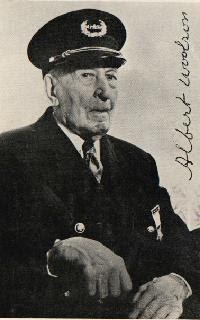
Interestingly enough, Albert Woolson, the oldest living veteran of the U.S. Civil War was still alive that year here in Duluth, Minnesota. Born in 1850, he served briefly as a teen in the last year of that war national conflict.

Woolson was not originally from the Northland but settled here later in life. His home on Duluth's Central Hillside was just a few houses from the first home of Bobby Zimmerman, who became known world wide as Bob Dylan. It's been said that on the Fourth of July the neighborhood boys would march up the alley behind Woolson's house and salute him as they went by. The young Dylan walked past that house every day during his first year of school, attending the Nettleton Elementary School two blocks away.

It is possible that Dylan's later interest in the Civil War was, in part, stimulated by these early memories. His song 'Cross the Green Mountain was written and recorded for the 2003 film Gods and Generals. It was included on the soundtrack for that movie and also included on his own album Tell Tale Signs in 2008, one of my favorite Dylan albums.

* * *
Gods and Generals was a Civil War drama written and directed by Ronald F. Maxwell based on a book by the same name by Jeffrey Shaara. Despite the praise heaped on this film and its sister project Gettysburg, I expected a story that would stir me. I could not have been more wrong. 

What follows are my impressions of the film. 

The Good.
The cinematography... Some beautiful camera work at times.
Dylan's elegant "Cross the Green Mountain. playing over the closing credits.
The film succeeded at depicting how clumsy it was to re-load a musket when you're in the heat of battle.

The Bad.
Hours of endless hokey music overlaying every speech and all the action.
Weak acting in the battle scenes.
Hokey speeches. Some being given in such a way that they were nothing more than soliloquies dribbling into the breeze.
Fake beards and mustaches. 
Maudliin sentimentality.
And then there were the inaccuracies.

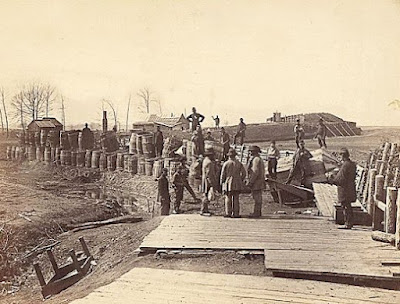
Manassas Fortifications (National Archives)
I will point to just one of the inaccuracies that stood out for me. There is a scene in which the army requests permission to use an estate as a hospital. They set up an operating table. There is an exchange of dialogue. But there are no moans, no groans, no screaming. Everything is peaceful and quiet.

By way of contrast, U.S. Grant in his autobiography (which I've devoured twice) describes an instance in which it was raining and cold and the wounded men were being worked on in the officers tent. He says the screaming and groaning was so loud that he went out and slept under a tree in the rain so he could get some needed rest.  

*

"Ours is not to reason why. Ours is but to do or die."
--Alfred Lord Tennyson, Charge of the Light Brigade

This film is purportedly about General Stonewall Jackson. Of the 20 greatest battles in world history as regards military strategy, 12 were conceived by Napoleon. Only two were conceived and executed by generals of the Civil War. One of these was the Battle of Vicksburg, carried out by General U.S. Grant. The other was General Stonewall Jackson's Shenandoah campaign.

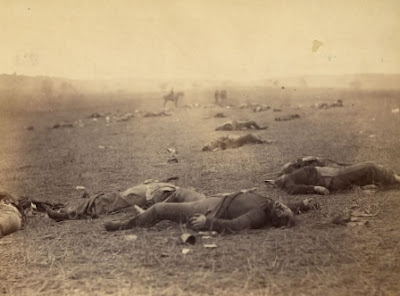
Dead on battlefield at Gettysburg. (National Archives)
Gettysburg was the first in this series of three films. (The third, I believe, was abandoned after the second was an epic fail.) Gods and Generals, the second in the series, which was actually a prequel, much like the superhero films Batman and Superman. With Stonewall Jackson as centerpiece and a cast of thousands (of extras performing their authentic re-enactment efforts) led by generals and officers whose idea of strategy seems to be having men march forward into withering gunfire, the film had potential as an idea. Rotten Tomatoes notes that only 8% of the critics reviewing it gave it a positive rating. 

I wanted to watch the film for two reasons. First, because Bob Dylan wrote a song for it, and second, because I wanted to see how they portrayed the Shenandoah campaign. To my surprise, there were no signs of Jackson's brilliance as a leader. And the director seems to have had no clue as to why the Shenandoah campaign had any importance at all.

The following statements, extracted from reviews I found at imdb.com, express some of my own impressions of the film.

A ridiculously long and staggering film that trips over itself in a drunken stupor so much that it becomes one of the biggest duds the cinema has ever seen.

and

Gods and Generals is targeted directly at the CWBs out there, a.k.a. the Civil War Buffs. It is so painstakingly boring and dull that only the fanatics could care about it. It is as if any interest in the film is tossed aside, just so the small amount of true CWBs out there can enjoy it, and nudge each other when their favorite historical figure comes on screen.

Someone else titled their review...

Great visuals, but where's the drama?

Another comment extract:

I found this dull, boring, and some of the worst war scenes ever in a movie. The battle scenes were not realistic and should have been saved for a TV movie.

* * * 

Sorry to belabor my point. Just trying to paint the picture.
If you like Civil War history, these links will interest you.

Related Links

Those Topps Civil War Cards Were Graphic But We Loved Them

Four Books About U.S. Grant

More Quotes Showing Why U.S. Grant Was Such an Inspirational Leader

Sunday, November 7, 2021

The Old Man and the Sea: Anthony Quinn Version of the Film Is Worthwhile

"He was an old man who fished alone in a skiff in the Gulf Stream and he had gone eighty-four days now without taking a fish."
--Ernest Hemingway

I first read The Old Man and the Sea in high school English class. I recall the teacher drawing attention to the symbolism, hoping to teach that there's more to a story than simply a good read.

The original novel by Ernest Hemingway was compact, a novella rather than an epic like War and Peace or Moby Dick. Since the description of the film already gives away everything, there is no "spoiler alert" on this brief review.

The Hemingway novel won accolades for its author, Ernest Hemingway. Written in 1951 and published in 1952, it's probably one of his most famous novels and certified his selection as Nobel Laureate in 1954 "for his mastery of the art of narrative." The book also garnered for Hemingway a Pulitzer Prize for fiction.

Seeking to capitalize on Hemingway's fame at the time, Hollywood released a film starring Spencer Tracy as Santiago in 1958. The old Cuban fisherman has been going through a slump lately. Believing his luck can change, he decides to launch out into deeper waters in search of larger game, and the hope of redemption. In typical Hemingway style, he only experiences more bad luck. Ah yes, he catches the biggest fish anyone has ever seen, but the sharks have their way with it and by the time he is home, all that's left are the bones.

In 1990, a made-for-TV version of the story was released, this time starring Anthony Quinn. Quinn is perfectly cast as Santiago, the old Cuban fisherman. 

There are actually six characters in this film. There is the old man, Santiago. And there is the youth who cares about him, brings him food, admires and looks up to him. Their touching friendship is noticed by a writer who is taking notes and finding the relationship between the boy and the old man to be curious, if not fascinating. The writer has a wife who has become bored with the mundane lives of Caribbean fisherman. The fifth character is the marlin. The sharks would be the sixth and final character in the story.

There are books and films with too many characters to give definition to. There are also films with characters introduced too quickly for the viewer to car about and embrace. This Anthony Quinn film gives us three characters you really care about: Santiago, Manolin (his devoted adolescent assistant), and the fish, which is more than a fish, much the same as Moby Dick was more than a whale.  

The writer and his wife were not in the book, nor were they in the Spencer Tracy version of the movie. Their dialogue is somewhat stilted and people who prefer the 1958 version point to their insertion into the story as a muddying of the storyline. 

The earlier version received a 7.0 rating from on Imdb.com viewers. This one has a 6.7 rating. Nevertheless, nearly everyone agrees that Anthony Quinn became a more authentic Santiago.

The old man's battle with the marlin brought back memories of deep sea fishing with my father off the coast of Miami. When Anthony Quinn first hooks the big fish, it reminded me of my father when he hooked the Grouper, which was the largest fish caught that day. (I think everyone put in $5.00 or some amount, and whoever caught the biggest fish took the prize.) My dad, who grew up in Ohio where we fished in ponds, lakes and streams, said that it felt like getting hooked on an underwater log.  Out on the ocean, our hooks were a long ways from the bottom, however.

A second scene from the film brought to mind my own battle with a Bonita. My line got all tangled so that I was unable to reel it in. We were trolling at the time. I began pulling in the fish with my hands, the line cutting my fingers. In the film, Santiago likewise has to pull in the fish with his hands, which also were bleeding. He wrapped rags around his hands like bandages, but what I remember most is the sting of the saltwater.

The cinematography is effective, especially when the Marlin breaks the surface for the first time. It really would be an awesome thing to see or, even better, to experience. 

I also have a third memory from our deep sea fishing excursion. When we disembarked on the dock, the boat alongside us had a 1,000-pound Hammerhead Shark cinched and hanging from a mast. That was one impressive fish as well.

The story ends with a thoroughly defeated hero. This blog post will end with a pair of quotes from the book.

--Every day above earth is a good day.

--Now is no time to think of what you do not have. Think of what you can do with what there is.

* * * 

Wednesday, October 13, 2021

Kudos to Daniel Craig: No Time To Die Lives Up to the Hype

Last night I went to The West here in Duluth to see my first movie in a theater since pre-pandemic. It was just what the doctor ordered, an escape. 

There is much to like about this latest Bond film. First, I still think Daniel Craig makes a great Bond, even if he doesn't toss around twinkle-in-the-eye wit with the flair of a Sean Connery. Daniel Craig is a different kind of Bond, a serious-minded Bond, so the screenwriters give many of those one line zingers to others.

The budget was purportedly a quarter of a billion dollars or more. That's quite a contrast to Dr. No, the first Bond send-up in 1962, which cost the studio barely a million. 

As usual, James Bond has been called on to the save the world. This time a villain named Lyutsifer has stolen a lethal DNA-modified bio-tech product that has been in development by "the good guys" for reasons M will explain later. Echoes of 12 Monkeys and our current pandemic seem to have morphed into a new storyline. 

In addition to Bond being back, so is his remarkable car which is impervious to the most lethal arsenal of automatic weapons ever arrayed against a car window. Why they didn't just blow out his tires is beyond me.

One of the things that makes fiction work is a mind game called "suspension of disbelief." If our critical self is constantly intruding by saying, "Oh that would never happen," then it diminishes our ability to get lost in the story dream. There are often a few of these moments in many films, but we override the critic and go with the flow. Afterwards, though, some of these scenes re-play and one has to laugh.

For example, in that early scene with the Bond supercar, you would think that maybe there might be people on balconies in the background holding up their cell phones so they could show all this drama on Twitter. The same could be said of any public scene with action, drama or violence these days. This is just a heads up to screenwriters. 

No Time To Die begins rather quietly. Bond is retired. As usual, we find ourselves in exotic locations. The quiet opening quickly turns dramatic, the first of many impossible escapes. He soon returns to the life of danger he once lived only at the request of his friend Felix from the CIA.  

Here are some other observations from my seat in the peanut gallery:

The new 007?
--All the usual characters are in this Bond film: M, Q and Moneypenny. Then there's a new 007 introduced, played by Lashana Lynch. Is this the future of the franchise? We shall see. 

--One of the themes in this film is secrets. Everybody has them, including M.  

--I wasn't sure if I'd want to watch a 2 hour and 45 minute film, for fear that it would drag, but it never did. At no point did I feel like I was going to be bored. The pacing carried me along like a good roller coaster ride that is over before you know it. 

--Daniel Craig's existential stance at the end brought to mind Jon Voigt in Runaway Train, or perhaps some legendary gods of Norse or Roman mythology. 

--This was Daniel Craig's fifth and last performance in the Bond role. According to one source his base salary plus bonuses will likely add up to $110 million dollars when all is said and done. Critics may call him the "Grumpy Bond" but he's helped sell a lot of tickets at the box office, so I'm sure he's smiling when he looks at his bank account.

--I personally liked the casting of Lea Seydoux as a more modest "Bond girl." I was happy to see the eye candy being downplayed in favor of the story. 

--The opening credits on a Bond film have always been awash in spectacle, and this one was no less so. How many millions were spent on the credits? I wouldn't mind seeing a whole film that did nothing more than have the opening credits and Bond song from first to last. Has anyone assembled this yet? I say go for it. 

* * *

Related Links

Daniel Craig, License To Kill

Devil May Care, a new Bond novel released on the 100th anniversary of Ian Fleming's birthday. (A review.)

Thursday, August 19, 2021

Throwback Thursday: A Film Noir Favorite, The Third Man

This week I again watched one of my fave film noir movies, The Third Man. Film noir was a style of Hollywood film, popular in the 40's and 50's that sought to expose and exploit the dark side of life. Themes were ambiguous, often not pretty, and occasionally considered scandalous. 
 
They were primarily black and white and gritty. Many have been resurrected less successfully than intended (eg. Cape Fear), though some have emulated the genre with superb flare (eg. L.A. Confidential). 

The Third Man 
The film -- starring Joseph Cotten, Orson Welles, Alida Valli and Trevor Howard -- is based on the novel by Graham Greene. The zither soundtrack is playful and somber simultaneously. If you've seen the film before the opening strumming will give you a lift as you know you're entering a story that has previously moved you. I have never tired of this interaction of these well defined characters with competing motives. 

 Unrelenting fascination is what I experience every time I watch this movie. It never seems old. It remains alive in my mind, haunting me, with its unearthly music, its dark, oblique photography and crisp, well-crafted storyline. 

Orson Welles excels, delivering some great lines and also one the best entrances in movie history to go along with a superb exit as well. It couldn't be better. I can't even express how I feel in words. If you've seen it it's worth re-visiting, and worth seeing if you haven't. 

The music track is Anton Karras on the zither. It greets you at the open and carries you through. When I hear the opening notes it awakens anticipation and memories simultaneously. 

Here's an informative review of the film from imdb.com 
Of all the movies during the studio era (pre-1960ish), there are three movies with cinematography that always stick out in my mind: Gregg Toland's work in Citizen Kane, Russel Mety's work in Touch of Evil, and Robert Krasker's work in The Third Man (all starring Orson Welles). 

I just recently saw a restored 35mm version of The Third Man. The vivid black and white visuals of a bombed out Vienna are breath-taking. Shadows are everywhere, a metaphor for the period detailed in this story. The unique way Krasker tilts the camera in some shots adds to the disorientation of the plot. And who can forget the first close-up of Welles with the light from an apartment room above splashing onto his face; one of the great entrances in movie history, made still more effective by the foreshadowing in the previous scene. Lime gives his old friend a smile that only Welles could give.

Here's my 2011 review of the film:  
Graham Greene The Third Man Continues to Satisfy
THIS REVIEW CONTAINS SPOILERS

Ten days ago I saw Graham Greene's 
The Third Man on someone's list of the fifty greatest films of all time and I felt compelled to rent it again. I've read the book at least twice, Greene being among my favorite novelists. I can't say how many times I've seen the film but invariably each time it's an enriching experience.

The story takes place in Vienna after World War II. The narrator is a hack writer of Westerns, Holly Martens (Joseph Cotton) from America who has come to Vienna to find his old college chum Harry Lime (Orson Welles). Upon arrival in the divided city (there is an American, French, Brit and Russian sector, as partitioned by the Allies) he learns that Lime has been killed in an accident outside the apartment house where Martens had been expecting to meet him. The witnesses, however, share conflicting details and Martens begins to suspect foul play.

It's not just the exotic settings that make a Graham Greene story such a thrill to read, but also the incredible way he allows the reader to see the story, even when the narrator doesn't get it. In this case Holly Martens, saturated with sentimentalism, believes only the best about his old friend, resisting all evidence to the contrary.

The third star in this film is the beautiful and somewhat unheralded Alida Valli as Anna Schmidt. Martens loves his friend because he doesn't know the truth about Harry; Anna is smitten by Harry in spite of the truth about him. Tumultuous tragic love smashes itself against the rocks with resigned futility.

I must also take a moment here to extol the cinematography. Shot in black and white mostly on location in Vienna, every frame is a work of beauty. So much of the film is at night, allowing wonderful contrasts and surrealistically stark scenes. This all works perfectly to set up the first appearance of Welles hiding in a dark doorway, his face suddenly illuminated when a light across the street flames to life.

At certain points in all our life stories light strikes from a new angle, revealing things we didn't previously understand. The clues were there all along, but until there is light nothing can be fully seen for what it is... whether we wish to see it or not.

* * * 
In case you can't tell, I really enjoyed this film. Each time I watch I catch subtle touches I'd missed previously. It's a film that has everything. Find it if you haven't seen it.

Monday, May 3, 2021

Two Films With Heart: One About Little League Baseball and the Other About Fencing

THE PERFECT GAME

OK, I'm not a huge fan of films featuring child actors (The Little Rascals being an exception) so I wasn't sure what to expect when I took out The Perfect Game from the library two weeks ago. But I loved baseball when I was a kid and right from the start I was so glad I went for it. It stirred up many memories, both from my Little League experiences and our year at an orphanage in Monterrey. In fact, I even got a little weepy toward the end. Yeah, the film won my heart.

The movie is based on a true story about a Little League team from Monterrey, Mexico that became the first non-U.S. team to win the Little League World Series.  There are some aspects of the story which are a stretch the way it is portrayed here, but if you go with it it's an enjoyable film. You can roll your eyes later. 

The film opens with a brief scene in which Cesar Faz (Clifton Collins, Jr.) is let go by the St. Louis Cardinals. Even though he never played with the Cardinals -- he washed their clothes and cleaned the locker room -- there was a mystique after he returned to Mexico about his having "been in the Majors." 

A few neighborhood kids in Monterrey persuade him to teach them what he knows about baseball, and he knows more than they do, even if he never played professionally. He had seen the game up close. One thing leads to another, and despite their seeming unreadiness and the coach's reluctance to lead them, the boys end up going North to see what competitive baseball is all about.

There's a love interest, and there's a religious aspect as their little Catholic church supports the team with prayers and cheers. (Cheech Marin, of Cheech and Chong fame, is Padre Esteban.) And then, there's baseball. 

There is a cute scene in which the boys are all kneeling before the padre who, instead of sprinkling them with oil, squirts oil into their open baseball mitts. As any serious ballplayer will tell you, rubbing oil into your mitt and taking care of the leather is an important part of the game.

The story takes place in 1957 where Jim Crow laws are still in effect. In various ways we see how the injustices of that period played out. Nevertheless, the team pressed on. 

As an aside, my mother's favorite baseball player back in the 1950s was from Mexico--Bobby Avila of the Cleveland Indians. When Susie and I were in Monterrey in 1981, we unexpectedly discovered Mexico's version of the Major League Baseball Hall of Fame, the Salon de la Fama. There we saw the uniform, and other Bobby Avila memorabilia.  

* * * 
THE FENCER

This is a similar story in which a "coach" trains a ragtag group of kids and transforms them into champions. The setting in this instance is Estonia after World War II, which was under Soviet rule during the Stalin era. And like The Perfect Game it is also based on a true story.

An understanding about the history of that period is useful though not necessarily essential to appreciating the story. Nevertheless, I will give a quick sketch of the backstory.

In 1940 the Soviet Union invaded Estonia and the Baltic States of Latvia and Lithuania. Stalin was fighting the winter war with Finland and they essentially abducted the young men of these countries for the Red Army or to work in the mines on behalf of the war effort that was coming. In 1942, the Germans liberated the Baltic States so that for two years these three countries were "free" from KGB night raids and abductions. 

In 1944, the Red Army began its million man march on Berlin. To give you an idea how much the Soviets under Stalin were feared, 10% of the Estonian population fled West in a single day. (My screenplay and unpublished novel Uprooted is about that period of Estonian history.)

The Fencer involves an Estonian named Endil Nelis who has lived his life on the run. Any Estonian who had anything to do with the German army was a marked man. They would be sent away to Siberia for betrayal. On the other hand, anyone who had been in Estonia from 1942-44 would have had no choice but to be drafted. Those who did not flee when the Red Army came West ran off into hiding. 

Endil Nelis, an award-winning fencer, survived after the war by living a life on the run. Early in the film his friend urges him not to come to Leningrad but to stay in a remote town outside the view of the authorities. He does so, and gains employment back in Estonia as a phys ed teacher. One thing leads to another and the children all want to learn fencing, which they essentially know nothing about.

He proceeds to teach, and he himself is a master, but he has no real ambition for the kids other than to give them an opportunity to learn. One of the children finds an advertisement for a tournament, which brings Nelis to a decision point. If he brings the children to Leningrad for the tournament he risks being identified and sent away.

Knowing Estonia's background is useful for understanding the complicated decision he must make. Many, if not most, of these children have no fathers. He has become a father figure for them. To avoid the tournament would be a massive disappointment. On the other hand, he has grown weary of living life in the shadows and ever fearful of discovery.

Little does he know that the Secret Police have already been making inquiries, so he is a trapped rabbit either way.

Märt Avandi, who plays Nellis, does a superb job of showing how complicated life is when you know what is going on but can't be transparent about it. He is burdened by the secrets he carries, but does not want to burden his students with this. 

The Fencer is a foreign language film with English subtitles that was nominated in 2016 for a Best Foreign Film Oscar. Some would criticize it's formulaic standard fare rags-to-riches, David & Goliath arc. For me, that was not a distraction, just a backdrop. The film says much about freedom and repression without saying it in a cliche manner. 

The story moved me and I recommend it.

Sunday, April 25, 2021

Chopin: Desire for Love and Thoughts from the Keen Mind of George Sand

George Sand was a woman who could not  and would not live within the confining boundaries society placed on women of her day. To be published as a novelist, she therefore wrote under a pseudonym. Her real name was Amandine-Aurore-Lucile Dupin, baronne Dudevant. 

This week I was watching a movie about Frederic Chopin and his relationship to George Sand titled Chopin: Desire for Love. It brought to mind the 1991 film Impromptu with Hugh Grant and Judy Davis in which Davis (as G. Sand) states that the beauty of Chopin's music is "proof that there is a God." It was a great line, and a statement that is hard to argue with. His piano compositions were exquisite.

Chopin: Desire for Love is a more recent production (2002) and less enjoyable. Like Impromptu it centers on the relationship between Chopin and Aurore Dupin, but in this latter version their conflicts become the story. His self-centeredness becomes painful to watch, no matter how much his compositions inspire or convey of the turbulence at the center of their passions. 

Dupin has two children who still need a mother. Chopin, who has never married or had children, sees her children as an impediment to the inspiration her love provides him. It's a form of machisimo that is common in certain parts of the world. When we worked at an orphanage in Mexico, some of the children there were kicked out of their homes by a second husband who would have nothing to do with the offspring of the first. 

Director Jerzy Antczak was nominated for an Academy Award for this 2002 production, which he filmed in Polish, then dubbed in English. The score is fabulous, simply because there is so much of Chopin there. Yo-Yo Ma is even one of the players in the soundtrack. 

The effect that Antczak attempted to achieve was to illuminate the conditions that created these sometimes emotionally charged pieces, much like that which was more successfully accomplished in Immortal Beloved about the music of Beethoven. Beethoven's stormy temperament is fairly well-known, so that film worked for me. This film diverged significantly from the image I have of a fragile, perfectionist composer who struggled with sickness and depression. 

One imdb.com reviewer stated that both Chopin films strayed far from the actual story of Chopin's career and affair with Aurore Dupin so that both were unacceptable. Of the two I preferred the former, even though I become impressed with the skill with which modern film makers are able to re-create the sets in these period pieces.

The actors were good and well cast for their roles--Piotr Adamczak as Chopin and Damuta Stenka as George Sand. Several of the reviewers gave the film high marks, so it may be something to consider, even if it does have a soap opera aspect. I will give it 5 stars out of 10, only because there is so much wonderful Chopin music in there. 

* * * 
George Sand by Auguste Carpentier
George Sand as a writer did not get as developed in this film. According to some, she was even more popular than Balzac and Victor Hugo in her day, and highly influential politically. 
I thought it would be worthwhile to share some quotes from this rule-breaking woman who had to make a go of it in a very restrictive time for women. She believed it was OK for a woman to wear pants (they were more comfortable than frilly dresses) and write novels. What I seem to recall was that she lived much of her life on less sleep because she did all her writing at night. Making sacrifices is what writers must do if they are to succeed. 

I'm always impressed by how much writers of that era accomplished without typewriters and word processors, or photocopy machines. George Sand lived in 1830, the typewriter was invented in 1872.

What follows are several quotes from her letters and writings.

* * * 
"I have an object, a task, let me say the word, a passion. The profession of writing is a violent and almost indestructible one."

* * * 
"Life resembles a novel more often than novels resemble life."

    * * * 
    "Life is a long ache which rarely sleeps and can never be cured."

      * * * 
      "Art is not a study of positive reality, it is the seeking for ideal truth."

      * * * 
      "Masterpieces are only lucky attempts."

      * * * 
      About Chopin
      "His creation was spontaneous, miraculous. He found it without searching for it, without foreseeing it. It came to his piano suddenly, complete, sublime, or it sang in his head during a walk, and he would hasten to hear it again by, tossing it off on his instrument. But then would begin the most heartbreaking labor I have ever witnessed." 

      * * * 

      Thursday, April 15, 2021

      Throwback Thursday: No Country for Old Men, Revisited

      ORIGINALLY PUBLISHED AUGUST 2014

      Elements of a Great Film
      Essentially, a movie is a series of scenes. And the great movies have incredibly memorable scenes.

      The Coen brothers' No Country For Old Men has many. One standout for me is the scene in which Anton Chiguhr (Javier Bardem) is in the gas station with the unsuspecting owner near the beginning of the film. Bardem says, “What’s the most you ever lost on a coin toss?” The unsuspecting fellow is confused.

      “Call it," the cold-blooded Bardem says.

      The man behind the counter is clueless that everything he has ever scrimped and saved for is on the line. “We need to know what we’re calling it for here,” he says.

      It’s an impeccable scene that foreshadows much that is to come regarding the nature of this character who is the embodiment of relentless evil. The manner in which Bardem is eating nuts, the manner in which the camera cuts to the squashed wrapper as it unfolds, again foreshadowing the unfolding of something frightening, produces compelling cinema, storytelling in film.

      A great film is also about great lines. “Baby, things happen. And you can’t take ‘em back.” Llewellyn Moss (Josh Brolin) tells his wife once he realizes the danger she's in.

      Great lines are what screenwriters live for. All the great films have great lines in them. You can hardly think of some of these films without immediately recalling a line... Films like Casablanca and The Wizard of Oz are rich with them. Quote the line and everybody knows exactly what you're talking about.

      "We'll make him an offer he can't refuse." Brando as The Godfather is impeccable.

      “Houston, we have a problem.” ~ Apollo 13

      “You can’t handle the truth.” ~ A Few Good Men

      “Show me the money.” ~ Jerry Maguire

      “Go ahead, make my day” ~ Sudden Impact

      “What we’ve got here is a failure to communicate.” ~ Cool Hand Luke

      Garbo
      Another feature of great films is casting. Not only are the main characters right for their jobs, the incidental characters are superbly selected. Casting is a strong feature of all the Coen brothers' films, and No Country is no exception.

      When I first reviewed this film in 2008 I was critical of the casting of Tommy Lee Jones as Sheriff Ed Tom Bell and I was critical of the limited amount of screen time Woody Harrelson carried. I take back both of these criticisms now, having watched the film several times since its first screening in Duluth. At this point I can't even imagine anyone else in the role Jones played. and had Harrelson been given any further screen time it may have detracted from the film simply because he is such a compelling presence. He had to make an early departure only because this story was about the cat and mouse survival game being played out between Brolin and Bardem.

      The ending may be a tad confusing for first time viewers, but the story needed to tie up a lot of loose ends quickly or it could have dragged out. The main conflicts in the film were resolved. And Sheriff Ed Tom was shaken to his core.

      Another great line, from the mouth of Tommy Lee Jones: "You can't make up stuff like that."

      And finally, among other things, there is the story itself. The essence of story is a moment in time in which the ordinary train of events in a character's life is shifted onto a new track. It may be something incidental, but like the railroad it will ultimately result an utterly different destination.

      For Llewelyn Moss, his destiny was altered when he accidentally came across the aftermath of a shootout while out hunting in a remote region in West Texas. The former Viet Nam vet makes a decision that alters everything.

      The skill with which the story is told makes all the difference in the world. The characters behave in ways that are believable. The sets, settings, pacing all conspire to keep the believability intact. A written story creates a dream in the reader's mind, and in film the dream is visually expressed, which involves risk. The Coen brothers have been pretty effective at it. Makes one wonder what will be next.

      * * *
      15 April 2021
      I decided to re-share this blog post because I just watched No Country again last night. There are a number of takeaways from the story and one of them is this. That there are some real bad people in this world. They are dangerous and we should have no illusions about this.

      My 2011 YA novel The Red Scorpion attempted to make this same point. There really is such a thing as evil.   

      Popular Posts