Showing posts with label baseball. Show all posts

Saturday, May 2, 2026

The "300 Wins" Club and Other Miscellaneous Baseball Notes

For some reason baseball has been on my mind this weekend. I suspect that something caused me to think about Nolan Ryan, the Astros hurler whose fastball was clocked at 108 miles per hour. That's little more than the blink of an eye when you're in the batter's box. 

One of the amazing things about Nolan Ryan was his longevity. He was still throwing overpowering fastballs in his forties, retiring at age 46. In addition to being a Hall of Famer with 5714 strikeouts, he was also a member of the "300-win club," a distinction reached by only 24 pitchers in Major League Baseball history. (Ryan retired with 324 wins.)

Reading that stat brought to mind memories of a couple other members of that elite club whom I actually saw pitch, Early Wynn and Tom Seaver. I saw Wynn in Cleveland in 1963 as he was chasing his 300th win. I was 10 going on 11. We had box seats a stone's throw from the Cleveland dugout. It was a sunny afternoon, the stadium packed in hopes of witnessing hisory and the grass was very green. I remember thinking he looked old and a bit stocky, not like the lean younger players I'd seen. The Indians lost that day but Wynn captured he's 300th in Kansas City within weeks and hung up his cleats. He'd achieved his milestone.

Tom Seaver of the New York Mets was another member of the 300-win club whom I saw. The Mets were one of the new expansion teams created in the Sixties, notoriously inept in their first years, but loved by their fans. I remember painting a banner for one of their many Banner Days. Their transformation from a comic opera to World Series Champions by the end of the decade was quite stunning. Tom Seaver was a major factor in the Mets' success with 25 wins and a 2.21 ERA, which is pretty much golden.

The game I saw him pitch was a double-header against the Pittsburgh Pirates. The Pirates were a favorite team of mine due to the fact that their rightfielder, Roberto Clemente, was my favorite player. The Puerto Rican Clemente was an exceptional man as well as an exceptional ballplayer, and the tickets we purchased for the game were intentionally down the right field line so Clemente could be in my direct line of sight. But since we're talking about pitchers, I seem to have digressed.

Tom Seaver pitched the first game, going head-to-head with Bob Veale of the Pirates, who was himself a formidable pitcher. Standing 6'6" Veale was one of the National League's strikeout leaders in the 60s, and top dog in strikeouts in 1964. Needless to say it was a boring game as far as action goes, and the home team won one to nothing. No problem with that. It was a double-header and the second game was full of action. Final score: 11-9.

Other pitching greats coming to mind now include Cy Young, Sam McDowell and Catfish Hunter. Cy Young's stats defy comprehension. Each year the Baseball Writers' Association of America select one pitcher from each league (American and National) to receive the Cy Young Award in honor of Young, who pitched from 1890 to 1911 and racked up an insurmountable pile of winning games during his 21 year career, 511 in all.

Today, starting pitchers seldom go beyond the 7th inning. Decisions are made by pitch counts. In baseball's early years hurlers would keep pitching till the game was over, which might take 15 or 20 innings. In 1920, Joe Oeschger of the Braves and Leon Cadre of Brooklyn pitched 26 innings before leaving a 1-1 tie on the scoreboard. They didn't have lights light today, so when it was too dark to see they had to call it. It was the longest game ever. 

The Cleveland Indians were a team with many pitching greats, among them Hall of Famers Bob Lemon and Bob Feller. When "Sudden Sam" McDowell joined the Indians in 1961 expectations ran high. He was a 6'5" fireballer who in high school pitched 9 no-hitters and once struck out all 27 batters he faced in a single game. He was precisely what the bumbling Indians needed to recover a measure of dignity and hope for fans. Unfortunately it was too weighty of a load for the young "potential" star. As we all know, when expectations run high, not everyone can handle the pressure, and in McDowell's case he succumbed to alcoholism. An unfortunate injury also contributed to his failure to live up to expectations. On one occasion he was pitching a fastball so hard that he cracked three ribs. (You have to know a little about the mechanics of pitching to understand how that could happen.) At the time of his retirement, his strikeout rate of 8.86 per nine innings was bested by only two pitchers: Nolan Ryan and Sandy Koufax.   

Jim "Catfish" Hunter will be the last pitcher in my spotlight today. A Hall of Famer, and Cy Young Award winner with a stellar career, he was the only pitcher since 1915 to win 200 games by age 31. He has the distinction of being baseball's first "big money" free agent. At 33 his career was shortened by arm troubles. In 1987, after being diagnosed with Lou Gehrig's Disease (ALS) he died within a year. Bob Dylan wrote a tribute song to Catfish that still lives on.

Related Link
It Happens Every Spring: Baseball and Duluth Dylan Fest 2026

Saturday, December 20, 2025

The Natural: A Nostalgic Fable about More than Baseball

"My life didn't turn out the way I expected."
~ Roy Hobbs

I used to watch movies every Sunday evening with a street person my wife and I befriended named Robert. One of his favorite films was The Natural, which we watched together in September 2000. Directed by Barry Levinson, The Natural stars Robert Redford as Roy Hobbs, a talented baseball prodigy derailed by tragedy. Years later, as a middle-aged rookie for the struggling New York Knights, he wields his homemade bat "Wonderboy" to chase redemption, glory, and pennant victory amid temptations and dark secrets.


There were any number of good lines. "I believe we all have two lives... the life we learn with and the life we live with after that." (It's an observation that for me brings to mind Vanilla Sky.)


But what about now? When does "the life we live with after that" begin?


Another interesting statement. "I didn't see it coming. I should have seen it coming." Some things that happen to us seem to have no foreshadowing even when in fact they do. Why were we so blind to it?

Interesting, too, that the movie ends with an upbeat heroic end that was altogether different from the book. I did read the book years ago and was surprised by the twist.(See The Player for an insight on how that happens.)

* * * 

Why do people want to be famous? Roy Hobbs wanted that... to be the best that ever was. Why? Iris (Glenn Close) challenges him: "Why does that matter so much to you? Isn't it good enough to know you were good?"


Too often we pursue treasures at the ends of the earth when there are acres of diamonds right here at our feet. If we would open eyes we'd see where true value lies.


Here's another great line by Redford that carries a lot of punch: "
Some mistakes I guess we never stop paying for." 


* * * 

Duvall as Max, the sportswriter
Redford doesn't carry the film alone. The supporting cast is strong as well: Glenn Close as the pure-hearted Iris, Kim Basinger as the seductive Memo, Wilford Brimley as gruff manager Pop and Robert Duvall as the bloodhound sportswriter who knows there's more to the story.


Critics knocked The Natural for its sentimentalism, but isn't that what baseball used to be all about? We loved our hometown teams and the heroes who populated them. My heroes included Rocky Colavito, Tito Francona, Roberto Clemente and (of course) the Mick (Mickey Mantle). Baseball was the perfect blend of poetry, nostalgia and statistics. The Natural also reflects the vibrant and varied vicissitudes of fate.


At the beginning of this post I mentioned our friend Robert, whose life revolved around movies. After he passed away I ended up with a few of his possessions including a notebook in which he wrote down every movie he watched every day. I counted at least 17 viewings of The Natural during this period in his life. He never tired of it. 

Monday, May 26, 2025

Robert Lookup's "Important Dates in Baseball History for May"

Photo by Daiji Umemoto on Unsplash
Last weekend I picked up from the library a copy of Rob Neyer's book Power Ball. It made me want to write about baseball today. The sun was shining and the grass green. You had to be outside at least a little, and baseball--perhaps like golf--is a sport enjoyed best under an open sky.

In the anthology of baseball literature, Power Ball is similar to Michael Lewis' Moneyball in the sense that it attempts to give readers an up-to-date snapshot of how much technology has changed the national pasttime. Moneyball is near a quarter century old though, so Neyer brought us up to date, except now it is already eight years behind the times. The fifteen second rule, and debates about the possibility of robot umpires had not yet been conceived. Even so, Power Ball makes a true contribution toward understand how the game has evolved and yes, we really have come a long ways.

The Last Boy.
For what it's worth, here's a partial list of baseball books I've read over the years.
Ball Four by Jim Bouton was an early introduction to baseball literature. Any and all books about Ty Cobb that I could find pre-1968 were read with earnest zeal. The Curse of Rocky Colavito by Cleveland sportswriter Terry Pluto. The Last Boy by Jane Leavy. Shoeless Joe, by W. P. Kinsella. (I heard Mr. Kinsella speak at a UMD writers event back in the late 1980s. Shoeless Joe was the basis for Field of Dreams, one of the great baseball movies Hollywood has produced.) Bernard Malamud's The Natural resulted in another great baseball flick. (The ending will surprise you.) Eight Men Out, about the Black Sox throwing the 1919 World Series. Men At Work: The Craft of Baseball by George Will is a classic.

Well, on to our list of important dates. This is a continuation of my February 25, 2020 blog post highlighting important dates in baseball history for April according to Robert Lookup. (I added one from this month, which you will note if reading this.)

 * * * *
IMPORTANT DATES -- MAY
* * * *

May 1, 1920
Joe Oeschger of the Braves and Leon Cadre of Brooklyn pitch 26 innings in a 1-1 tie. Longest game ever. (
EdNote: What a contrast to today's game where pitchers are on a pitch count leash and a time constraint.)

May 2, 1939
Lou Gehrig did not play against the Tigers at Briggs Stadium, ending his streak of 2,130 consecutive games played. (EdNote: This "Iron Man" record was surpassed 56 years later by Cal Ripken, Jr. who went on to set the current record by playing in 2,632 consecutive games.)

May 3, 1936
Joe DiMaggio plays his first game.

May 3, 1963
Pete Rose hits his first Home Run.

May 3, 1964
Tommy John pitches his first victory.

May 5, 1904
Cy Young (Red Sox) hurls a Perfect Game against the A's, besting Rube Waddell 3-0.

May 6, 1915 
Babe Ruth, pitching for the Boston Red Sox, hits his first major league home run at the Polo Grounds against the New York Yankees.

May 7, 1917
Babe Ruth (Red Sox) allows two hits in a 1-0 victory over Walter Johnson. Ruth knocks in the lone run with a sacrifice fly.

May 11, 1917
Pete Schneider of Vernon, CA (Pacific Coast League) hits five homers and a double, driving in 14 runs.

May 12, 1955
Sam Jones of the Cubs pitches no hitter after walking three Pirates in the ninth and striking out three to get the win.

May 13, 2025
Pete Rose is posthumously removed from Major League Baseball's permanently ineligible list, making him eligible for the Baseball Hall of Fame, after being banned in 1989 for betting on games. (Shoeless Joe Jackson and others are also reinstated.)

May 14, 1920
Walter Johnson wins his 300th game with a 9-8 win over the Tigers.

May 14, 1988
Jose Oquendo (Cards) becomes the first non-pitcher in 20 years to get a decision, a 7-5 loss to the Braves, when Ken Griffey knocked in two runs with two outs in the 19th inning.

May 17, 1979
Phillies beat the Cubs 23-22 in ten innings at Chicago when Mike Schmidt hits his second home run of the game.

May 30, 1904
Frank Chance, first baseman for the Cubs, is hit five times by Cincinnati pitchers in a double header, a record. The two teams split.


Bob Dylan'a Theme Time Radio Hour ~ Baseball


Related Links

Thursday, March 27, 2025

Throwback Thursday: It Happens Every Spring

It happens every spring. Baseball returns, a new season begins. Here's a blog post from April 2011 with a few memories about the game I loved while growing up.

This week I finished Ken Burns' epic documentary Baseball which is a masterful re-telling of the history of baseball from its roots to the present. But it is more than about baseball. Burns chose to use Baseball to tell America's story, a story filled with mythology and with many unpleasant realities we sometimes close our eyes to in order to enjoy the dream. One of those darker shadows in our history is race relations, and Burns handles this with such finesse while unflinchingly keeping it in our consciousness that we have a problem here.

Joseph Campbell once wrote, “Myths are public dreams, dreams are private myths.” Baseball has been a very public dream in America. We love these heroes, the gods who descended Olympus to be with us for a few seasons.

I grew up watching the Cleveland Indians in the fifties, glory years of the Yankees, our arch-adversary. Mickey Mantle was in his prime then, and when we moved to New Jersey in 1964 I had the privilege seeing the Mick play in Yankee Stadium as well. My biggest thrill was Bat Day in the mid-1960s, a game in which Mantle did not start but watched most of the game from the dugout. In the bottom of the eighth, with the Yankees down 2-1 and the bases loaded, Mickey Mantle was called in to pinch hit. The entire stadium was on its feet holding their bats skyward screaming for their hero to come through. The voltage was so high in that electrified crowd that would couldn't imagine it going higher. Suddenly the pitch and a swing and that most beautiful sound in the world (no doubt drowned out that afternoon by the noise, but I can imagine it because it is the most beautiful sound in the world, the meat of the bat striking a baseball). The ball shot out like a cannon burst in a line drive deep into left field, striking the grass and bounding on one hop over the wall, a ground rule double. The two runners who scored put the Yanks up by one, and an inning later that's how it ended. Every person there was satiated. They had feasted on the Mick, and the Mick did them good.

Mantle is the subject matter of Jane Leavy's The Last Boy, an audio book I started reading yesterday and which promises to be good. Mantle, like many American heroes, is a flawed man. His time in history was a period of innocence in which the sportswriters knew he was a man different from his iconic image. In those days the sportswriters could lose their jobs for writing some of the things they knew, Leavy notes. And today sportswriter might lose their jobs for not writing about what they knew. We live in a different time, a time of innocence lost.

When I was a kid you bought baseball cards both for the players you idolized and for the noise they made in the spokes of your bicycle. During the baseball card craze of the early nineties, kids bought cards looking for the ones with potential, sometimes throwing the rest straight into the garbage. Sometimes throwing them all straight into the can.

Ansel Adams said, “Myths and creeds are heroic struggles to comprehend the truth in the world.” Perhaps this is what Jane Leavy and Ken Burns are trying to do when they examine the mythological heroes and legends of our history, trying themselves to understand something about themselves because they are themselves one of us.

Food for thought as you await the next pitch.

Related Links

Wednesday, November 20, 2024

The Jackie Robinson Story: Challenge and Triumph

“Jackie’s character was much more important than his batting average.”
– Hank Aaron 

Jim Brown was possibly the greatest running back in NFL history. Brown was a superhero for many of us boys growing up in Cleveland in the 50s and early 60s. He is the only running back to have averaged more than a 100 yards per game for an entire career. (106)

Though his achievements were evident to all, cited weekly in the Cleveland Plain Dealer, there was another side that we didn't see from the stands or on TV: how he was treated as a black man. 

In his autobiography he describes how defensive players would grab handfuls of dirt and, when he was under a pile of tacklers, fling the dirt into his eyes. Keep in mind that many of his opponents came from a Jim Crowe South where blacks were supposed to use separate bathrooms and separate drinking fountains.

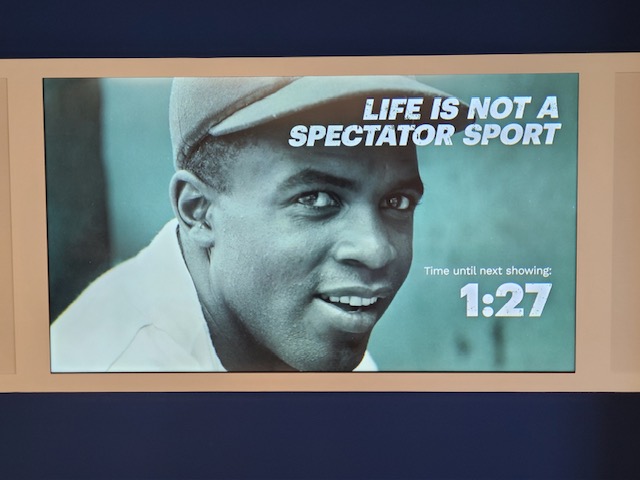
These stories sprang to mind when photographer Gary Firstenberg sent me a batch of photos he took at the Jackie Robinson Museum. Robinson was the first black man to cross the color barrier from the Negro League to the all-white Major League Baseball fraternity. He not only had to be an exceptional ballplayer, it was equally important to be a man of character. 


Actually, Robinson was a gifted athlete in many sports. While at UCLA he excelled in baseball, football, basketball, and track, showcasing his incredible range of skills. We only know him as the first black player in modern baseball history.


Robinson was a versatile ballplayer, excelling at third base, second and first. His bat and aggressive play made him a challenging foe for any pitcher. He was especially famous for his daring baserunning, stealing home 19 times in his career. 

When the time came, after hanging up his cleats, Robinson was inducted into the MLB Hall of Fame. Later, his legacy was affirmed permanently retiring his number, 42.

It was Hemingway who coined the phrase "Grace under pressure" to define courage. It was Robinson who exemplified it. Robinson endured relentless racism from fans, opponents, and even some teammates. He faced racial slurs, threats, and physical intimidation but adhered to an agreement with Dodgers' general manager Branch Rickey to not retaliate for the first two years. His ability to endure this abuse while excelling on the field demonstrated extraordinary mental toughness and inspired millions.

[EdNote: I remember what Hank Aaron went through years later. As he neared Babe Ruth's home run record of 714, Aaron became to receive death threats if he dared to hit more home runs than the Bambino. To hear these kinds of stories is heartbreaking.]

After his retirement from baseball Robinson became part of the Civil Rights Movement, showing that talent and character, not skin color, determine worth. He used his role as a leader to push for social and economic equality. 

Jackie Robinson’s greatness lay in his ability to excel as an athlete while bearing the burden of breaking barriers with dignity, courage, and grace. He was more than just a baseball player—he was a transformative figure who made an impact on both sports and society.

https://jackierobinson.org/
https://www.jackierobinsonmuseum.org/

Photos courtesy Gary Firstenberg

Thursday, October 6, 2022

Baseball Trivia of Various Degrees of Significance

Major League Baseball has has tucked another season under its belt and we're headed into the postseason. This weekend the Wildcard Playoffs will eliminate four of the 16 teams in contention for the World Championship. The division playoff will follow and eventually the World Series. 

As I like to say, I've been a baseball fan since my infancy. My parents adorned my crib with four teddy bears, each named after the starting rotation for the then Cleveland Indians who are now the Cleveland Guardians. Three of my four teddy bears became Hall Of Famers. Cleveland had some great teams back then. 

So, to mark the moment... a little baseball trivia is on the menu.

* * * * * 

In 2019 the Washington Nationals won the World Series. Today, only three years later, they have the worst record in baseball. What happened?

What a surprise (for me) to learn that Ty Cobb was only second in most career triples. First place in that category was his teammate Sam Crawford, the only player with over 300 triples (309 total), a record that will likely never be broken.

To give you an idea of how much fear Barry Bonds generated in opposing pitchers, check out these stats. In 2004 he was intentionally walked 120 times, which is 25 more walks than the American League leader in walks. 

* * *

That's nothing compared to this: In 2004 Bonds got on base more times than he had at-bats. Baseball is funny in that way. If you go to the plate and draw a walk, then it is not counted as an at-bat. 

In my first year of Babe Ruth League, for example, I struck out 50% of the time and walked 50% of the time. I hadn't hit my growth spurt yet, so even though I had been a Little League all star, I was not ready for the next level. And yet, based on my record that year my on-base percentage was .500 even though I never once hit the ball into play. My record: 15 walks, 15 strike outs. 

Barry Bonds did hit the ball in play, a lot. And he got on base a lot... in fact, he reached base more times (376) than he had at-bats (373). In addition to those 120 intentional walks he walked another 112 times (by not swinging at bad pitches), plus had 129 hits, was hit by a pitch 9 times and got on base via an error 6 times.

* * * 

In 1999 The Sporting News named Ty Cobb as #3 on their list of all-time greatest ballplayers. 

* * * 

Pitcher Mickey Lolich played for 16 years and never hit a home run in over 1,000 major league regular-season plate appearances, but in his first ever World Series at-bat in 1968 he homered off St. Louis Cardinals pitcher Nelson Briles. He stepped to the plate 452 times prior to his World Series homer, then another 565 after and failed to hit another.
(Source: Mike Lynch on Quora)

* * * 

April 23, 199: Fernando Tatis hit two grand slams in the same inning. I think the interesting thing is that the pitcher, Chan Ho Park, was still pitching when Tatis came to the plate again with the bases loaded. 

* * * 

In 1918, while Babe Ruth was with the Red Sox, he pinch hit in the tenth inning, a runner on base. Back in those days, the game would be over as soon as the winning run crossed the plate, so when Ruth hit a blast out of the park the game was over before he rounded the bases. His homer only counted as a hit, with a run batted in, and not a homer. 

I know that many people think of the Babe as a beefy, somewhat lumbering power hitter loping around the bases. Evidently he had more quickness and agility than we've imagined. Babe Ruth had 10 inside the park home runs in his career, four in 1923 alone!

This season, the big man Aaron Judge finally broke the American League single season home run record. Roger Maris did it '61 with 61. This past week Judge made it 62.

* * * 

In 1879, the Cincinnati Gazette wrote, "The baseball mania has run its course. It has no future as a professional endeavor." Maybe some day, but that day is not yet.


Thursday, September 1, 2022

30 Days Hath September: Baseball Quotes for the End of Summer

THROWBACK THURSDAY

It's a long season. Beginning in the spring, when the birds fly north, you hear the first crack of the bat and hearts going pitter-patter awaiting the season opener... followed by the long weary road as the season wears on. Every day is game day with only the All Star break to interfere. 
 
Now, it's September. Pennant hopes come alive, and we see which teams have enough pitchers left who can bring them home, because by now there are a lot of tired arms out there. 
 
Baseball is a game that has inspired many a poet, journalist, philosopher and story teller. It's a sport that, to some extent, defines the American spirit. Despite numerous strikes that broke many a fan's heart, we still get that feeling in September as the days crawl toward the playoffs... At least, I still get that feeling. 
 
I admit that I'm not the fan I used to be, but I still enjoy following the game. For several years I have played Fantasy Baseball as a way of connecting with my brother, and because I am somewhat competitive (some would call that an understatement) I study pitching stats and stay current with who's hot and who's not. The name of my team, the Munger Mudcats, comes from a pitcher named Mudcat Grant, who was an ace for the Cleveland Indians when I was a kid. Grant was the only Indian who made the 1963 All Star team which I saw live in old Cleveland Municipal Stadium. Munger is the community I live in now. 
 
It's hard to say whether life is more like baseball, or that baseball is like life. Here are some quotes from one of many sources on the internet that collect such pearls.
 
“If a woman has to choose between catching a fly ball and saving an infant’s life, she will choose to save the infant’s life without even considering if there is a man on base “ ~ Dave Barry

Oh, somewhere in this favoured land the sun is shining bright; 
The band is playing somewhere; and somewhere hearts are light;
And somewhere men are laughing; and little children shout;
But there is no joy in Mudville-- mighty Casey has struck out.
~ Ernest Lawrence Thayer, Casey at the Bat
 
"You look forward to it like a birthday party when you’re a kid. You think something wonderful is going to happen.”
~ Joe DiMaggio, on Opening Day

"Slump ? I ain’t in no slump. I just ain’t hittin’.” ~ Yogi Berra

"Baseball players are smarter than football players. How often do you see a baseball team penalized for too many players on the field?“
~ Jim Boulton 

"All I want out of life is that when I walk down the street folks will say, ‘There goes the greatest hitter that ever lived.’”
~ Ted Williams

"Since baseball time is measured only in outs, all you have to do is succeed utterly; keep hitting, keep the rally alive, and you have defeated time. You remain forever young.”
~ Roger Angell

"Cub fans, by consensus, are the best in baseball. Year after year, in good times and (mostly) bad, they turn out in vociferous numbers, sustaining themselves with a heavenly choir that combines loyalty, criticism, cheerfulness, durability, rage, beer and hope, in exquisite proportions.”
~ Roger Angell

"Trying to sneak a fastball past Hank Aaron is like trying to sneak the sunrise past a rooster.” ~ Joe Adcock

“They were starting to hit the dry side of the ball.”
~ Lew Burdette, on when he knew it was time to retire

“It’s designed to break your heart. The game begins in the spring, when everything is new again, and it blossoms in the summer, filling the afternoons and evenings, and then as soon as the chill rains come, it stops, and leaves you to face the fall alone.”
~ A. Bartlett Giamatti, Comissioner of Baseball, 1989
 
“People ask me what I do in winter when there’s no baseball. I’ll tell you what I do. I stare out the window and wait for spring.”
~ Rogers Hornsby, Hall of Famer

“Every day is a new opportunity. You can build on yesterday’s success or put its failures behind and start over again. That’s the way life is, with a new game every day, and that’s the way baseball is.” ~ Bob Feller
 
“I’d walk through hell in a gasoline suit to keep playing baseball.”
~ Pete Rose

“When you’re in a slump, It’s almost as if you look out at the field and it’s one big glove.” ~ Vance Law
 
“The game has a cleanness. If you do a good job, the numbers say so. You don’t have to ask anyone or play politics. You don’t have to wait for the reviews.”
~ Sandy Koufax
 
“Nothing flatters me more than to have it assumed that I could write prose--unless it be to have it assumed that I once pitched a baseball with distinction.”
~ Robert Frost

Initially published in September 2008

Thursday, August 18, 2022

Memory Lane: The Greatest Ballplayers of All Time Faced Off in the Dream World Series

OK, I'M BUMMED.

When I was in high school in the late 1960s, there was an incredible radio production called the Dream World Series. It was a virtual world series in which the greatest American League and National League all stars faced off in a best of seven competition, re-enacted as if it were really happening.

I listened to every game, which was broadcast complete with crowd noise, the crack of the bats and great announcers calling the game. I kept scorecards, cheered for the American League throughout--I was a Ty Cobb fan, plus there were so many other greats--and never missed an inning.

WHAT I'M BUMMED ABOUT is that I can't find this epic event online. I have done periodic searches, and always come up empty.

I can't recall who won the series, but I do remember it went to seven games. I also remember that Ty Cobb may have been ejected from one of the games for his aggressive manner of playing.

Does anyone out there remember this historic event? If it is online anywhere, can you send me the link? ennyman3 AT gmail.com.   I would love to re-live that memory.


The baseball cards here are from my Hall of Fame collection. For some reason they don't have the value old Topps cards have. If you are a collector I have a number of very interesting items, like the programs from two All Star Games in Cleveland (1954 and 1963). 

Now that we live in the amazing digital age, someone will assemble a Dream World Series that is video. It would be an epic undertaking, but... wow. You can imagine it... "Here's Mariano Rivera coming in to relieve Cy Young as 8-time batting champion Honus Wagner steps up to the plate, runners on first and third. Wagner flexes, digs in and gets set. The windup... and the pitch.... strike one."


Tuesday, July 12, 2022

Trouble with the Curve: More than a Baseball Flick

"Baseball, it is said, is only a game. True. And the Grand Canyon is only a hole in Arizona. Not all holes, or games, are created equal."--George Will

Last week my friend Phil and I were talking about baseball movies. We listed favorites and commented on also-rans. We also each learned about a few films we'd not yet seen. One of these, for me, was the 2012 release Trouble with the Curve, starring Amy Adams, John Goodman, Justin Timberlake and a crotchety Clint Eastwood. 

Eastwood (Gus) is an aging baseball scout for the Atlanta Braves whose eyesight is beginning to deteriorate. Adams is Eastwood's estranged daughter, a hard-working attorney on the verge of becoming a partner at a law firm. Gus named her Mickey after his favorite baseball player, Mickey Mantle. 

The setting is ten years or so into the "moneyball" era. If you remember Moneyball, the film based on the Michael Lewis book by the same name, you'll recall that it took place in that transition period when computer algorithms began displacing the traditional system of sending out scouts to find new talent. It became an almost total reliance on data. Gus is a throwback whose perceived value is questionable to the younger scouts who live by the data. 

The backstory here is that Gus lost the wife he loved when Mickey was six. For reasons that come out later in the film, Gus and his daughter have an unresolved issue to deal with. 

Pete Klein, a longtime friend, is concerned enough about Gus that he intercedes and asks Mickey to help her father in an important scouting assignment. She reluctantly agrees because she's in the middle of a major project which may have a bearing on her becoming the first female partner at the legal firm she works for.

Well, Mickey knows baseball because baseball was her father's life and in choosing to join her father on a North Carolina scouting trip she...

As it turns out, the film is a father-daughter story with a baseball setting. It's also a feel-good with a measure of predictability. Nevertheless, it's a worthy baseball movie that you ought to see, in the event you missed it when it was released.

I like seeing John Goodman in a "normal" role, as opposed to those over-the-top characters he played in Flight and Inside Llewyn Davis. Goodman shows the value of longtime friends who notice and care about what we're going through.

As an aside, I couldn't help but think of Bill Belichick as I watched Mickey step up and show how much she knew about baseball by growing up with her father. Bill Belichick's dad was a football coach, and by age eight little Billy was learning how to assess defenses by watching game films. He was a student of the game from a very early age.

I suppose we should mention Justin Timberlake (Johnny). He's a scout for the Red Sox. Boston has the first pick in the MLB draft and Johnny is evaluating the same stud power hitter that the Braves are. One of the subplots is Mickey's personal love life. There's a lawyer with the firm who has a serious interest in her, but she's remaining non-committal, for reasons that come out later. You can tell that there's more electricity developing between her and Johnny as the story moves along. Will it end the way her other relationships have floundered?

Not that we care all that much. It's not high drama, just a comfortable ride with some characters we have grown to like and enjoy being with as they work out their problems.

Watching Trouble with the Curve did bring back a few baseball memories. When I played ball in the Babe Ruth League our team had a pitcher that some scouts from the Pittsburg Pirates were paying attention to. And another time, when I was playing varsity ball in high school, I faced a pitcher from Piscataway who was being scouted for MLB potential. When Ron Fulop, our first baseman, hit a triple off one of his fastballs, this "superstar" pitcher got rattled. I was up next and he whizzed four adrenaline-injected, supersonic pitches shoulder height and higher. I drew a walk. 

I never did find out if either of those guys made it to the majors. 

For a great read about how a kid from Panama became the greatest relief pitcher in baseball history, read The Closer. Here's my review of this inspiring baseball story.

Thursday, April 28, 2022

Robert Lookup's Unusual List of Important Dates In Major League Baseball

The other day I mentioned a meeting I had with Eric Ringsred, a local doctor with whom I have shared a mutual friendship. The mutual friend was Robert Lookup, a unique man, sensitive soul, savant and street person who was part of mine and Susie's life for ten years.

Today is Throwback Thursday, so I am sharing all the events in Robert Lookup's "Important Dates In Baseball History." As they say, "It happens every spring." The birds fly north, the snow melts and a new baseball season begins. (Oh, and yes, people fall in love.)

As is occasionally the case, the 2022 season had some hiccups in preseason, and we weren't quite sure when this year's opening day would commence. Fortunately, it wasn't too dastardly. As usual, there have been some interesting April stories. I just happened to be listening to Clayton Kershaw's "almost" perfect game. He was actually pulled after seven innings... despite the very real possibility of his joining an elite group of pitchers, 23 all-time to have achieved that. Then again, he will be in the Hall of Fame and... well. 

Anyways, here, all in one place, are Robert Lookup's list of important events that I shared a couple years ago. 

April
https://pioneerproductions.blogspot.com/2020/02/important-dates-in-major-league.html

May
https://pioneerproductions.blogspot.com/2020/03/important-dates-in-major-league.html

June

https://pioneerproductions.blogspot.com/2020/04/important-dates-in-major-league.html

July

https://pioneerproductions.blogspot.com/2020/05/important-dates-in-baseball-history.html

August

https://pioneerproductions.blogspot.com/2020/07/important-dates-in-mlb-baseball-history.html

September and October
https://pioneerproductions.blogspot.com/2020/09/important-dates-in-major-league.html

 
Here is a link to one of Robert's favorite films, The Burmese Harp, which he encouraged me to watch. This is a review (with anecdotes).

Robert: Thanks for the memories, precious all.

Tuesday, September 28, 2021

This Day In History: Ted Williams Tales

THIS DAY IN HISTORY
Ted Williams hits his final homer #521 (off Jack Fisher)

Early Ted Williams baseball card
(oldest in my possession)
No question about it, Ted Williams was one of the great hitters of all time in Major League Baseball. On this day in 1941 the Boston Red Sox star ended the season with a .406 batting average, the last player to bat over .400 for a complete season. His On Base Percentage (a measure of a player's ability to get on base) was the highest of all time in pro baseball.

To illustrate OBP, consider my first year of baseball after Little League. Little League was for kids 8-12. Babe Ruth League is what you played when you were 13-18. Even though I was a Little League All Star, when I turned 13 and played in Babe Ruth League I was a runt. I never got a hit the whole season. Yet, even though I struck out 13 times, I also walked 13 times, so my On Base Percentage was .500.  That is, half the time I went to the plate I got on base.

Ted Williams got on base by base hits, but also by discipline. He made pitchers throw the ball over the plate. He did not swing wildly at pitches outside the strike zone. He wasn't ashamed to take a walk. He knew that every runner who gets on base, by any means, is a potential run.

For more read:
I consider it an honor that this blog post was re-posted on the John Updike Society website.
 
Other Events of Significance on This Day
In 1066 William the Conqueror invaded England
The Jesse James Gang's surprise attack of a train in 1864 results in 150 killed. 
In 1908 Henry Ford's first Model T rolls out of the Piquette Plant in Detroit.
In 1954, the Tonight Show premiered with host Steve Allen.
In 1963, Lee Harvey Oswald visited the Cuban Consulate in Mexico City.
In 2021, Ed Newman published his 5,195th post on his Ennyman's Territory blog.

Have a great, and grateful, day.

OH NO! EVERYTHING HERE IS WRONG. THIS ALL HAPPENED ON SEPT. 27.
NOT INTENDED TO BE FAKE NEWS... LET'S CALL IT MISTAKE NEWS.

My apologies to those who count on me for accurate reporting. This is a reminder to verify before you share. 

Monday, May 3, 2021

Two Films With Heart: One About Little League Baseball and the Other About Fencing

THE PERFECT GAME

OK, I'm not a huge fan of films featuring child actors (The Little Rascals being an exception) so I wasn't sure what to expect when I took out The Perfect Game from the library two weeks ago. But I loved baseball when I was a kid and right from the start I was so glad I went for it. It stirred up many memories, both from my Little League experiences and our year at an orphanage in Monterrey. In fact, I even got a little weepy toward the end. Yeah, the film won my heart.

The movie is based on a true story about a Little League team from Monterrey, Mexico that became the first non-U.S. team to win the Little League World Series.  There are some aspects of the story which are a stretch the way it is portrayed here, but if you go with it it's an enjoyable film. You can roll your eyes later. 

The film opens with a brief scene in which Cesar Faz (Clifton Collins, Jr.) is let go by the St. Louis Cardinals. Even though he never played with the Cardinals -- he washed their clothes and cleaned the locker room -- there was a mystique after he returned to Mexico about his having "been in the Majors." 

A few neighborhood kids in Monterrey persuade him to teach them what he knows about baseball, and he knows more than they do, even if he never played professionally. He had seen the game up close. One thing leads to another, and despite their seeming unreadiness and the coach's reluctance to lead them, the boys end up going North to see what competitive baseball is all about.

There's a love interest, and there's a religious aspect as their little Catholic church supports the team with prayers and cheers. (Cheech Marin, of Cheech and Chong fame, is Padre Esteban.) And then, there's baseball. 

There is a cute scene in which the boys are all kneeling before the padre who, instead of sprinkling them with oil, squirts oil into their open baseball mitts. As any serious ballplayer will tell you, rubbing oil into your mitt and taking care of the leather is an important part of the game.

The story takes place in 1957 where Jim Crow laws are still in effect. In various ways we see how the injustices of that period played out. Nevertheless, the team pressed on. 

As an aside, my mother's favorite baseball player back in the 1950s was from Mexico--Bobby Avila of the Cleveland Indians. When Susie and I were in Monterrey in 1981, we unexpectedly discovered Mexico's version of the Major League Baseball Hall of Fame, the Salon de la Fama. There we saw the uniform, and other Bobby Avila memorabilia.  

* * * 
THE FENCER

This is a similar story in which a "coach" trains a ragtag group of kids and transforms them into champions. The setting in this instance is Estonia after World War II, which was under Soviet rule during the Stalin era. And like The Perfect Game it is also based on a true story.

An understanding about the history of that period is useful though not necessarily essential to appreciating the story. Nevertheless, I will give a quick sketch of the backstory.

In 1940 the Soviet Union invaded Estonia and the Baltic States of Latvia and Lithuania. Stalin was fighting the winter war with Finland and they essentially abducted the young men of these countries for the Red Army or to work in the mines on behalf of the war effort that was coming. In 1942, the Germans liberated the Baltic States so that for two years these three countries were "free" from KGB night raids and abductions. 

In 1944, the Red Army began its million man march on Berlin. To give you an idea how much the Soviets under Stalin were feared, 10% of the Estonian population fled West in a single day. (My screenplay and unpublished novel Uprooted is about that period of Estonian history.)

The Fencer involves an Estonian named Endil Nelis who has lived his life on the run. Any Estonian who had anything to do with the German army was a marked man. They would be sent away to Siberia for betrayal. On the other hand, anyone who had been in Estonia from 1942-44 would have had no choice but to be drafted. Those who did not flee when the Red Army came West ran off into hiding. 

Endil Nelis, an award-winning fencer, survived after the war by living a life on the run. Early in the film his friend urges him not to come to Leningrad but to stay in a remote town outside the view of the authorities. He does so, and gains employment back in Estonia as a phys ed teacher. One thing leads to another and the children all want to learn fencing, which they essentially know nothing about.

He proceeds to teach, and he himself is a master, but he has no real ambition for the kids other than to give them an opportunity to learn. One of the children finds an advertisement for a tournament, which brings Nelis to a decision point. If he brings the children to Leningrad for the tournament he risks being identified and sent away.

Knowing Estonia's background is useful for understanding the complicated decision he must make. Many, if not most, of these children have no fathers. He has become a father figure for them. To avoid the tournament would be a massive disappointment. On the other hand, he has grown weary of living life in the shadows and ever fearful of discovery.

Little does he know that the Secret Police have already been making inquiries, so he is a trapped rabbit either way.

Märt Avandi, who plays Nellis, does a superb job of showing how complicated life is when you know what is going on but can't be transparent about it. He is burdened by the secrets he carries, but does not want to burden his students with this. 

The Fencer is a foreign language film with English subtitles that was nominated in 2016 for a Best Foreign Film Oscar. Some would criticize it's formulaic standard fare rags-to-riches, David & Goliath arc. For me, that was not a distraction, just a backdrop. The film says much about freedom and repression without saying it in a cliche manner. 

The story moved me and I recommend it.

Popular Posts