Showing posts with label racism. Show all posts

Monday, February 2, 2026

One Mighty and Irresistible Tide: The Epic Struggle Over American Immigration

"We have all been here before; we have all been here before."
--David Crosby, Déjà Vu

With immigration policy at the center of our national conversation, I went to the library last week to find a specific book that was referenced in an online debate. What I found (among other things) was another intriguing title: One Mighty and Irresistible Tide: The Epic Struggle Over Immigration.

Before tackling our current immigration issues I wanted to set the stage by outlining the various stages of our own immigration historyThe Seven Eras of U.S. Immigration History.

Jia Lynn Yang's book, One Mighty and Irresistible Tide, is a well documented deep dive into the decades-long battle over U.S. immigration policy from the passage of the restrictive Immigration Act of 1924 through the enactment of the transformative Immigration and Nationality Act of 1965. In other words, it covers Era Five of the seven periods. 


The 1920's was a strange time in our history. Many people have images of flapper girls and wild parties, inspired by F. Scott Fitzgerald's The Great Gatsby. It was also an era of gangsters and turf wars generated by the Volstead Act (Prohibition). Simultaneously, we have images of a "lost generation," the young veterans of WWI having returned to a society they didn't understand, that didn't really understand them either. (See "Soldier's Home" by Hemingway in his first small volume of short stories, In Our Time.)


The early 1900s was also a time when the Eugenics movement gained significant traction,  legalizing sterilization in 33 states lest "inferiors" reproduce. Eugenics was seen as a means for addressing overpopulaton and "over-multiplication of the unfit and unintelligent," among other societal problems. Promoted by intellectual elites, the eugenics movement reached its apex in the early 1930s. More han 66,000 Americans were sterilized against their will.


We should also note here that the Ku Klux Klan had had a rebirth at the beginning of the last century as well and were well represented in politics. According to the Congressional Record the Klan elected about 16 U.S. Senators as well as 11 governors, along with an undetermined large number of congressmen. "Undetermined" means that not all federal officeholders were openly affiliated with the Klan, but owed their electoral success, in part, to Klan support. (This surge in Klan power also contributed to mass migration of blacks from the Deep South to industrial centers in the North. But that's another story.)


The combination of these factors contributed to passage of the 1924 Immigration Act, which imposed ethnically based national quotas on immgration, sharply curtailing immigration from Southern and Eastern Europe and nearly banning immigrants from Asia, reflecting widespread nativism and racial prejudice of the era.


Yang's book follows the political struggle to dismantle these discriminatory quotas over the next forty years, focusing on the efforts of key lawmakers, activists, and presidents—from Emanuel Celler, Herbert Lehman, and civil rights advocates to presidents like John F. Kennedy and Lyndon B. Johnson—who worked to build coalitions for reform.


This long campaign culminated in the 1965 Immigration and Nationality Act, which abolished the national-origins quota system and created a new immigration framework emphasizing family reunification and skills. That legislation dramatically reshaped America’s demographic landscape and opened U.S. immigration to people from Asia, Africa, and Latin America in unprecedented numbers.


Yang frames much of this history through personal context—drawing on her own family’s immigrant experience—while illustrating how the yesterday's debates over immigration policy resonate with ongoing controversies today.

Friday, January 2, 2026

The Chinese Exclusion Act of 1882

One of the fascinating things about trying to write a historical novel is how much you learn that you never thought about before. One of our character is a Chinese immigrant who became an explosives expert while on the Transcontinental Railroad. While researching the background for this character I learned about the Chinese Exclusion Act and its implications today.

Chinese gold miners working alongside white miners
The Chinese Exclusion Act of 1882 marked a significant moment in American history, serving as the first major piece of federal legislation to restrict immigration based on ethnicity. The path to this discriminatory law was paved throughout the 1870s with increasing persecution and hostility towards Chinese immigrants. It was a period in our history marked by economic anxiety, racial prejudice, and political opportunism that culminated in one of the darkest chapters of American immigration policy.

I'd never realized that Chinese began arriving on or shores in significant numbers during the California Gold Rush of the late 1840s and early 1850s. (My how word travels!) They were drawn, like many others from around the world, by the promise of wealth and opportunity. Initially, these immigrants were welcomed for their labor, which was crucial in the burgeoning mining industry and later in the construction of the Transcontinental Railroad. However, as the number of Chinese immigrants grew, so did resentment among white Americans.


For example, in 1852, Governor John Bigler asked the California Assembly to pass laws to stop Chinese immigration. Two years later, a California legal case set a bad precedent as regards legitimizing violence towards the Chinese. The situation was exacerbated by the case of People v. Hall (1854). In 1853, a white miner named George Hall robbed one Chinese miner and killed another. Based on the testimony of several Chinese witnesses, Hall was arrested and sentenced to hang. However, the California Supreme Court declared that the testimony of Chinese people could not be used against white defendants, and Hall was released. This effectively meant that there were now almost no legal protections for the Chinese, and assaults on the Chinese community continued unabated throughout the 1850s. 


By the 1870s, the United States was experiencing economic difficulties, including the Long Depression that began in 1873. Jobs became scarcer, and competition for employment intensified. Chinese laborers, who were willing to work for lower wages, were seen as a direct threat to other workers. This economic anxiety was a critical factor driving anti-Chinese sentiment. Labor unions, particularly those in California, were vocal in their opposition to Chinese immigration. Leaders like Denis Kearney of the Workingmen's Party of California used inflammatory rhetoric, blaming the Chinese for unemployment and depressed wages among white laborers.


Economic factors weren't the only sources of tension. Racial prejudice played a significant role in the persecution of Chinese immigrants. Chinese people were viewed as racially inferior and culturally unassimilable by many white Americans. They were often depicted in the media and political cartoons in a derogatory manner, reinforcing negative stereotypes. (Much can be written about this practice.) The cultural practices and communal living arrangements of the Chinese, which were different from those of the majority population, further fueled suspicion and xenophobia.


The growing hostility towards Chinese immigrants translated into both social and legal discrimination. In many cities and towns, Chinese individuals were barred from certain occupations and faced restrictions on property ownership. Violent attacks against Chinese communities were not uncommon. One of the most notorious incidents was the Chinese Massacre of 1871 in Los Angeles, where a mob killed around 20 Chinese men and boys while looting their homes and businesses.


As one might expect, politicians capitalized on the widespread anti-Chinese sentiment to gain support. Anti-Chinese rhetoric became a staple in political campaigns, especially in California. The state's politicians pushed for local and state laws to restrict the rights of Chinese residents. The Page Act of 1875, which prohibited the immigration of Chinese women under the pretext of preventing prostitution, was an early example of federal legislation influenced by anti-Chinese sentiment.


By the end of the 1870s, the stage was set for more comprehensive federal action. The combination of economic fears, racial prejudice, and political manipulation had created a climate ripe for restrictive legislation. In 1882, the Chinese Exclusion Act was passed by Congress and signed into law by President Chester A. Arthur. This act suspended Chinese immigration for ten years and declared Chinese immigrants ineligible for naturalization. It was a culmination of the decade-long persecution and represented a significant shift in American immigration policy, establishing an unfortunate precedent for future restrictive laws.


Related Links

The Problem of Hate

Opposition to Chinese Exclusion (1850-1902)

Covering Islam: How the Media and the Experts Determine How We See the Rest of the World 

He Who Controls the Narrative Controls the People

Wednesday, November 20, 2024

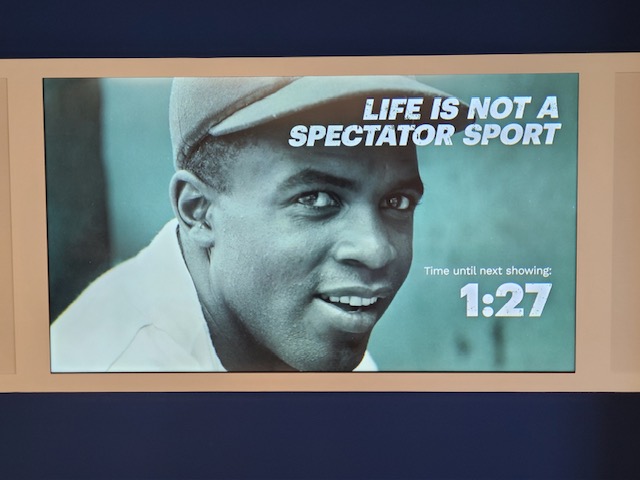
The Jackie Robinson Story: Challenge and Triumph

“Jackie’s character was much more important than his batting average.”
– Hank Aaron 

Jim Brown was possibly the greatest running back in NFL history. Brown was a superhero for many of us boys growing up in Cleveland in the 50s and early 60s. He is the only running back to have averaged more than a 100 yards per game for an entire career. (106)

Though his achievements were evident to all, cited weekly in the Cleveland Plain Dealer, there was another side that we didn't see from the stands or on TV: how he was treated as a black man. 

In his autobiography he describes how defensive players would grab handfuls of dirt and, when he was under a pile of tacklers, fling the dirt into his eyes. Keep in mind that many of his opponents came from a Jim Crowe South where blacks were supposed to use separate bathrooms and separate drinking fountains.

These stories sprang to mind when photographer Gary Firstenberg sent me a batch of photos he took at the Jackie Robinson Museum. Robinson was the first black man to cross the color barrier from the Negro League to the all-white Major League Baseball fraternity. He not only had to be an exceptional ballplayer, it was equally important to be a man of character. 


Actually, Robinson was a gifted athlete in many sports. While at UCLA he excelled in baseball, football, basketball, and track, showcasing his incredible range of skills. We only know him as the first black player in modern baseball history.


Robinson was a versatile ballplayer, excelling at third base, second and first. His bat and aggressive play made him a challenging foe for any pitcher. He was especially famous for his daring baserunning, stealing home 19 times in his career. 

When the time came, after hanging up his cleats, Robinson was inducted into the MLB Hall of Fame. Later, his legacy was affirmed permanently retiring his number, 42.

It was Hemingway who coined the phrase "Grace under pressure" to define courage. It was Robinson who exemplified it. Robinson endured relentless racism from fans, opponents, and even some teammates. He faced racial slurs, threats, and physical intimidation but adhered to an agreement with Dodgers' general manager Branch Rickey to not retaliate for the first two years. His ability to endure this abuse while excelling on the field demonstrated extraordinary mental toughness and inspired millions.

[EdNote: I remember what Hank Aaron went through years later. As he neared Babe Ruth's home run record of 714, Aaron became to receive death threats if he dared to hit more home runs than the Bambino. To hear these kinds of stories is heartbreaking.]

After his retirement from baseball Robinson became part of the Civil Rights Movement, showing that talent and character, not skin color, determine worth. He used his role as a leader to push for social and economic equality. 

Jackie Robinson’s greatness lay in his ability to excel as an athlete while bearing the burden of breaking barriers with dignity, courage, and grace. He was more than just a baseball player—he was a transformative figure who made an impact on both sports and society.

https://jackierobinson.org/
https://www.jackierobinsonmuseum.org/

Photos courtesy Gary Firstenberg

Monday, October 5, 2020

John Steinbeck and the New Orleans School Desegregation Crisis

I recently finished reading Travels with Charley, the 1960 bestseller by Nobel Prize winning author John Steinbeck. Steinbeck took to the highways in order to see how much the U.S. had changed in the 25 years since he last travelled about the country. He felt he was a little out of touch with who and what America was. I myself read the book because it had been more than 25 years since I first read his account of this journey. 

To be frank, the only thing I remembered about the book was his eagerness to home after seeing the unconcealed racism in the Deep South. When I read this portion of the book I was as appalled as he was when he encountered it, and upon reading it again, the same emotions were stirred.

In the book he did not call it the New Orleans School Desegregation Crisis. Instead, the designation he gave this chapter was more ironic: The Cheerleaders. 

* * * * 

Steinbeck's journey took six weeks. He started at his home on Long Island, traveled north through New England, headed West through Buffalo, across all our Northern tier states, to the Northwest corner whereupon he turned South then back East through various places till he reached Texas, New Orleans and the Deep South.

His companion on the journey is Charley, a large poodle who adds a measure of interest to the story in various ways. 

The observations Steinbeck makes along the way are interesting, but mostly forgettable. Even so, it is interesting how surprised he is by how much of a role cheese plays in Wisconsin, and that he gets lost in Minneapolis. 

The year is 1960, six years after Brown v. Board of Education of Topeka. The extent to which this desegregation ruling continued to rankle the powers that be startled Steinbeck. Maybe sickened is a better word. (Last night I started watching The Best of Enemies, a film about this very same issue in Durham, North Carolina in 1971.)

When Steinbeck arrived in New Orleans, he'd read and heard enough about the goings-on that he needed to see first hand what the fuss was about. More than one person he met along the way, recognizing him to be from New York (by his license plate) commented, "Are you going to see the Cheerleaders?"

The first time I saw the word--the title of the chapter, actually--I thought it was going to be about football cheerleaders. This, naturally, came to mind because he'd just been in Texas where football is almost a religion.

Essentially, the cheerleaders were a small mob of white middle class racists who went to the two elementary schools each day to scream racial slurs and intimidate the four little girls who were being escorted into the desegregated schools by federal marshals. Three girls were enrolled in one school and six year old Ruby Bridges was enrolled in the other. There was later a riot at the school board meeting, but Steinbeck's chapter focuses on the ugliness of the scene where the Cheerleaders gathered each day. 

Steinbeck was so disturbed by what he saw that he couldn't wait to leave the South and get back home. 

As these ugly protests continued reporters began to write about what they saw. Eventually, the people of New Orleans began to realize how undesirable the image of their city was becoming to outsiders. This was the primary motivation for ending the Cheerleaders' reign.

You can read the full account here on Wikipedia. https://en.wikipedia.org/wiki/New_Orleans_school_desegregation_crisis

It's eye-opening and it's sad. Or would "tragic" be a better word?

Photo: Public domain. Federal U.S. Marshalls escorted Ruby Bridges into the school each morning and home each evening. 

Saturday, June 20, 2020

Things My Mother Used to Say

Self-Portrait. Mexico, 1981
This week I've been thinking a lot about how to end racism, probably like a lot of people these past few weeks. I don't think any reasonable person is desirous to see the recent tensions remaining as something we "just have to live with." (Perhaps this is, in part, what so moved me about the film about Mr. Rogers that I'd watched yesterday.)

While reflecting on these things, something my mother used to say came to mind.

"A man convinced against his will
is of the same opinion still."

The saying was made famous by Dale Carnegie, though its apparent origin is from the pen of Mary Wollstonecraft, early British feminist and mother of Mary Shelley the famous author of Frankenstein.

Racism has to end. It's bad for all races. But the how of it is going to be the thornier problem. This saying gives a glimpse of the kinds of tactics that won't work.

* * * *

Thinking about this led me to recall a couple other things Mom said when I was growing up. Here's a second.

"Oh what a tangled web we weave
when first we practice to deceive."

If you always tell the truth, it's less likely to get you tripped up under cross-examination.

* * * *

A third saying that came to mind was this one: "Boys will be boys." My mom had four of them and she would know. (We had no sisters.) But when I talked with her this morning, she gave it a quite different spin.

"People would say, 'Girls are different from boys,' and I would say, 'Boys are different from boys.' All four of you were different." 

This was an interesting observation, and very true. Each us were very different in many respects, though I've oft observed that I share common traits with each of my brothers.

* * * *

A trait that I share with my mother is an appreciation of poetry. I'd always assumed I gained my fondness for reading and writing poetry through my grandmother, who likewise wrote poems and had been influenced by an uncle who wrote poetry, John Hall, the blind poet of Ritchie County. But as I thought on the sayings above with their poetic qualities, I realized that my attraction to verse was closer to home.

This morning she told me that when she was in high school she got extra credit for memorizing poetry. "So I memorized a lot of poetry," she says. "I bought 101 Famous Poems and liked to read Robert Burns."

One of the poems she remembered from her high school days was a pre-Civil War poem about how terrible it was see Negroes chained up and being sold. It evidently made such an impression on her that she remembers it 75 years later.

* * * *

Mom said she liked to quote Ogden Nash sometimes.  I recall a big fat book of Ogden Nash poems on my grandmother's bookshelf in her living room. (Instead of wainscoating, Grandma had bookshelves along some of the walls.) Nash wrote pithy short verses like these.

The Camel
The camel has a single hump;
The dromedary, two;
Or else the other way around.
I’m never sure. Are you?


A Word to Husbands
To keep your marriage brimming
With love in the loving cup,
Whenever you’re wrong, admit it;
Whenever you’re right, shut up.

I wish I'd memorized this last when I when I was younger.

* * * *

Wednesday, June 10, 2020

What White Privilege Looks Like (A First Hand Experience)

For years I never quite grasped the meaning of "white privilege." My father grew up in extreme poverty and worked his way out. This is America and others from all races, many who never even spoke a word of English, went from rags to a decent life in one generation.

Then I reflected on an incident from my life which I'd never viewed through the lens of privilege, a story which I share with you here.

* * * *
We moved to our rural home while our children were still young, 4 & 6. We had a little land, added a couple small shed-sized barns, and acquired some animals, geese, a duck, pygmy goats, rabbits. The kids learned responsibility and we all enjoyed the hobby farm experience.

We had a problem, however. One of the neighbors had a dog that was accustomed to running free, and he took an interest in visiting our critters. He was aggressive and they were intimidated, frightened. After several such incidents I began to wonder where the law stood with regard to shooting the dog if things continued this way.

Mind you, I do not own guns and would not have done such a thing, but it did make me curious as regards where the law stands on the matter.

It just so happened that as I was driving home from work the next day I was thinking about this question as I drove past a police car with two officers in it. (Proctor police have had a reputation of no mercy for people going faster than the 30 mph speed limit through town.) As I drove by I looked into the face of one of the officers and considered stopping to ask my question.

In the next instant, the red lights were flashing and it became quickly apparent that it was I whom they wanted to stop, so I pulled over. What happened next surprised me though.

Both cops got out of their car and pulled their guns. They made their way slowly along both sides of my car. I watched each in the two side mirrors, curious about what was going on. I was almost laughing because it seemed such an over-reaction. I had not been speeding. I could not imagine what was happening.

I rolled down my window and asked what was going on. He replied that they thought I was someone else.

I then said, "Oh, while you're here, I have been having a problem with the neighbor's dog," and I explained the situation.

He said, "You can shoot the dog."

* * * *

How does White Privilege relate to this story?

My REACTION to being approached by two cops with pistols drawn illustrates White Privilege. I thought it amusing, even funny as it was happening. It was such an obvious over-reaction that I couldn't take it seriously.

I'd be willing to bet money that there are not a lot of African Americans in most parts of the country who would have reacted that way. Two cops approaching with guns drawn? I'm guessing the heart would be racing a little faster, maybe even some praying. Possibly even a temptation to take off and try to get away. Just as a dog can sense our fear, the police might sense this man's fear, and emotions would escalate.

It's more than unfortunate that this situation exists in so many parts of the country, if not most. I do not know how to change it, but it's useful to have a clearer understanding of what people are trying to change. I didn't always "get it."

* * * *
ADDENDUM
We didn't have any more problems with the dog, only because the neighbors dealt with it themselves. And no, even if we did I would not have tried to shoot him. That's not who I am.

Sunday, May 31, 2020

Duluth Protesters March from the Clayton-Jackson-McGhie Memorial to City Hall

Will it be different this time? I think this is the question many people have been asking this past week in response to the death of George Floyd who had been in the custody of the police at the time, in broad daylight and on social media. The Memorial Day incident proved to be a spark that ignited a firestorm that went internationally viral.

The unspoken question many have is this: when all the clamor subsides, will everything go back to normal, as if it were just another news story? I'd like to believe it will be different this time, and there seems to be evidence this is so.

Scott Shackford's article Even Police Unions Trash the Actions of the Cop Who Killed George Floyd begins by asking "Are we seeing a tipping point where police begin to grasp why the public is so outraged?" Police departments rallying around the misconduct of their own is so commonplace that it had become cliche to read it in novels and see it in Hollywood movies. The article in Reason begins with an example of the NYPD defending its own in a similar incident 6 years ago.

This time it really is different. Instead of rallying around their own, police departments from across the country are criticizing and condemning what happened in the George Floyd case.


THE RALLY IN DULUTH
The start point, which seemed relevant, for Saturday afternoon's killing of George Floyd protest was the Clayton-Jackson-McGhie Memorial at the corner of 2nd Avenue East and First Street. For those unfamiliar, this is the location where three black circus workers were lynched 100 years ago this summer.

An elderly woman working her way past me with her walker asked m how many people were there. "100?" she asked. I replied, "Between 500 and a thousand. Probably closer to a thousand." Sunday's Duluth News Tribune estimated the same... about a thousand, a strong show of support for the injustice that occurred at the beginning of last week in Minneapolis.

The Ojibwe drummers and singers near the memorial set the tone as people began arriving to assemble for the march. The crowd continued to fill the intersection, and though not exactly social distancing, they were all masked and conscientious. (There were a couple people handing out face masks for the very few who arrived not wearing one. Stacks of pizzas from Pizza Luce were piled on the sidewalk nearby.

Eventually a woman with a bullhorn drew attention to a pickup truck parked on the avenue just above First Street where Brayleigh Keliin and Joe Carter were standing, accompanied by a large quantity of bottled water for those who might be thirsty on the warm afternoon. A mixed crowd of black, white and Native peoples filled the intersection, in solidarity with the aims of the organizers, to essentially change the systems of injustice that have condoned racism.

Joe Carter, a young black man, welcomed the crowd and introduced Brayleigh. "Duluth, you have come together"" After a round of cheers she said, "I'm scared for my son and all blacks," citing "what living in America is like as a minority." This is why we must demand justice for George Floyd, she said.

Two key words: Justice and Change. "We will have a new tomorrow. We are tired, angry and united," he said. "Racism is a war on the people."

Joe Carter and Brayleigh Keliin were both articulate and passionate, and seemed to project a good-heartedness of spirit.

The bullhorn was passed to Kym Young from Superior, who identified herself as an elder. She spoke about the history of racism in America going back to the founding, and made her appeal to "tear down injustice" and systems of oppression. "We are traumatized and not OK."

A Native woman then spoke briefly about the Ojibwe concept of "Megwiich" which then yielded to the beginning of the march to the St. Louis County Courhouse and City Hall eight blocks away.

What's interesting about this for me personally is that when we moved to Duluth in 1986 and I learned about the lynchings here in 1920, I never understood why the actual event took place here, eight blocks away from the jain? The answer came years later when I learned that City Hall used to be one block below this corner as was the city jail. At that time a mob formed also, perhaps the biggest in our city's history, to carry out a terrible crime... taking the law in their own hands.

It was fitting to see a peaceful march yesterday, to the Courthouse and City Hall where an appeal for justice was made. As part of the gathering there the crowd was asked to kneel for nine minutes, the length of time the officer in Minneapolis knelt on the neck of George Floyd. Try kneeling for nine minutes like that and think about what goes through your head while a voice chokes out "I can't breathe."

* * * *


Statements on the Clayton-Jackson-McGhie Memorial
IN ANOTHER PART OF THE CITY there was evidently another gathering of protesters. I only heard about it later on social media and was concerned when still later there were people marching up to Central Entrance and heading toward the Mall. It would not have been a good action, as the point has been made, and I believe Chief Tusken has been remarkably responsive to the minority factions in our community. Things really are different in Duluth.

Rumors were circulating that cars and/or buses were coming from the Twin Cities with more protesters, outsiders that were a concern to city officials. For this reasons a curfew was announced for 10:00 p.m. and earlier for tonight.

The continued looting and burning across the country is heartbreaking. Marvin Gaye's "What's Goin' On?" comes to mind. 

Related Link
Carla Hamilton's Gezielt (Targeted) Creatively Makes Us Think and Gives Us Something To Talk About
A Few Thoughts on the Clayton-Jackson-McGhie Memorial

Saturday, February 1, 2020

Day One of Black History Month: How Much Do You Know About Sojourner Truth?

“I am not going to die; I'm going home like a shooting star.” —Sojourner Truth

Today is the kickoff for Black History Month and I thought it appropriate to share a bit about Sojourner Truth, one of the earlier stories from our nation's history. In 1797, when she was born in New York (no precise date has actually been recorded) both her parents had been born in Africa (father in Ghana, mother Guinea) so that she was a first generation African American.

The family who owned her parents lived about 95 miles North of New York City, which really isn't that far from Woodstock.

When she was nine, Sojourner Truth was sold at an auction, along with a flock of sheep, for $100.

New York had passed a Gradual Emancipation Act that would have permitted her to gain her freedom in 1827 at age 30. She learned, however, that her owners were not going to let her go free, so she ran away with her infant daughter. Tragically she had to leave her five-year-old son behind. The slave owner in turn sold the boy to a plantation in Alabama, a thousand miles away. (Do you think he was being vindictive?)

When her freedom was declared official, she brought a lawsuit against this former owner for selling her son illegally, one of the first lawsuits in our history by a black woman against a white man. Amazingly, she won her case in court and got her son back. Oh happy day!

In 1843 she changed her name to Sojourner Truth and began traveling around the country speaking out against slavery and for women's rights.

Over the years I'd been familiar with her in name only and upon becoming acquainted with her story found her achievements quite astonishing, not only because of where her story began and all she'd been through, but because she was later so influential. This was a woman who never learned how to read and write, but her public speaking rattled the walls and challenged people's attitudes.

Sojourner Truth died in 1883 and was buried
in Battle Creek, Michigan.
Her most famous speech was titled, "Ain't I a Woman?"  This was ten years before the Civil War, nearly 170 years ago. How many of us who write today will be remembered in 170 years? 

I'm most impressed by her courage. (Impressed is an understatement.) Against seemingly impossible odds she fought for what what was right, speaking out against injustice.

Here are some quotes from this mighty woman. Her slant on some familiar Scriptures is amusing and pointed.

“Truth is powerful, and it prevails.” —Sojourner Truth

“If the first woman God ever made was strong enough to turn the world upside down all alone, these women together ought to be able to turn it back, and get it right side up again!” —Sojourner Truth

“I have borne 13 children, and seen most all sold off to slavery, and when I cried out with my mother's grief, none but Jesus heard me!” —Sojourner Truth

“How came Jesus into the world? Through God who created him and woman who bore him. Man, where is your part?” —Sojourner Truth

“It is hard for the old slaveholding spirit to die, but die it must.” —Sojourner Truth

“I went to the Lord and asked Him to give me a new name. And the Lord gave me Sojourner, because I was to travel up and down the land, showing the people their sins, and being a sign unto them.”
—Sojourner Truth

You can learn more about her story here:
https://www.biography.com/activist/sojourner-truth

Friday, February 22, 2019

Ota Benga Story Challenges Our Illusions About How Enlightened We Are

A few weeks ago I was looking at some notes from the philosophy club that used to meet at our house a number of year ago. I was struck by a couple of significant dates. Neither was a precise date, but rather a general one, the first being the dawn of the Renaissance.

Professor Robinson stated that the although the Renaissance is loosely pegged as beginning in the 13th century, it wasn't until centuries later that it was actually "named" the Renaissance. The Enlightenment, or Age of Reason, followed in its wake, an intellectual and philosophical movement that was more of an 18th century phenomenon that flowed out of those streams.

At the time, European intellectuals took great pride in being part of this "enlightened" species of humanity. But when we look back, one wonders how they could have been so obtuse. Yes, they invented things and produced remarkable architecture and art, but by another measure--how people were treated--it's almost as if they were still in the dark ages. Consider the atrocities of Belgium's King Leopold in the Congo.

In the 19th century the American slave trade was still alive and well. In 1850, our enlightened Supreme Court declared that the Negro was not a person. The atrocities committed against Native Americans were zealously carried out by "enlightened" white folk who immigrated here from Europe. When a judge ruled that the indigenous peoples were indeed human beings with rights, the powers that be took it to a higher court to have that ruling overturned so they could take still more of their land.

Why do I bring these things up? Because the further in the past that it occurred the more we can distance ourselves from it.

This week I began reading Spectacle: The Astonishing Life of Ota Benga by Pamela Newkirk. The Ota Benga story doesn't take place in our American pre-history. It is a 20th century story that took place in New York City.

Ota Benga was a pygmy from the African bush country who had been brought to North America as a sideshow. He was brought first to St. Louis to be displayed in the 1904 World's Fair there, and then to the Bronx Zoo in 1906. Ota Benga was an immediate sensation. His home was in the monkey house.

You read that correctly. He was treated like the other monkeys, in a cage where people gawked at him, where he had no privacy. And when there were complaints about his being in the monkey house, the response was, "Yes, but it is one of the nicer cages here."

Ms. Newkirk does more than just tell the Ota Benga story though. It is a story about rich, powerful men, about exploitation and an exploration of the attitudes that enabled these kinds of things to happen.

Here's a quote from an Amazon review that sums up some of the feelings roused by this story:
"I found it mind-boggling to read about a human being that was taken from his native land and put on display at a zoo for all of the world to see like some caged animal. Even though the book is not solely about Benga, I learned so many more facts about other things from reading this book. This was a great history lesson."

Another Amazon reviewer wrote:
"Excellent historical documentation supporting story of Ota Benga. Underscores how politics, greed, fake science, failure of religious institutions, and ignorance and indifference can spawn oppression and cruelty toward any targeted group of people."

A 2015 NYTimes book review cites this passage from the preface by Pamela Newkirk:
“While on the surface this appears to be the saga of one man’s degradation — of a shocking and shameful spectacle — on closer inspection it is also the story of an era, of science, of elite men and institutions, and of racial ideologies that endure today.”

In order to give him a more fierce aspect, Benga's teeth had been filed so they were pointed. Eventually, he did find freedom from the zookeepers and went to work in a tobacco plant in Lynchburg, Virginia where he received new teeth. His desire to return home to Africa was strong and he looked forward to the day when this would happen. Unfortunately, after his plans were made, World War I had broken out and passenger ships were forbidden to go out on the open seas. The result is an unhappy ending.

* * * *
Related Links
A Fresh Lens on the Notorious Episode of Ota Benga
Bury My Heart At Wounded Knee Puts Manifest Destiny Into Perspective

Friday, July 20, 2018

Thurgood Marshall Story Is Powerful Reminder of Many Important Truths

This week I saw the film Marshall for the first time. The film, based on a true story, retells an early case legal case by Thurgood Marshall, the young attorney who would later become the first black man to serve on the Supreme Court. It's an impressive film, made all the more so by the acting of Chadwick Boseman, the star of Black Panther and an actor I definitely want to see again.

This summary by a reviewer on imdb.com expresses my take on the film as well.:
This enjoyable and inspiring movie is a worthy contribution to the courtroom movie genre. It memorializes the great Thurgood Marshall (who later won Brown v. Bd. of Education and sat on the Supreme Court). The film brings to life a forgotten rape case in Connecticut that Marshall tried early in his career when he was the solo staff lawyer at the NAACP. The story focuses on the plight of a black man accused of raping a white woman and it highlights issues of racism in the courtroom and on the streets. The movie recalls the classic films "To Kill a Mockingbird" (which also involved a black on white rape case) and "Anatomy of a Murder" (which also involved sexual issues and in which--like many real trials--we're never sure just what actually happened and who is telling the truth). The writing is sharp and witty and the acting and direction are great. Particularly strong is the emerging partnership and friendship of Marshall and the local lawyer, Sam Friedman, who had never tried a criminal case and thought he would just sit next to Marshall during the trial and do nothing. But the judge forces Friedman to conduct the trial with Marshall serving as his adviser--and he rises to the occasion.

Here's an excerpt from another imd.com review:
The actors in this intelligent film are all first rate and believable in their roles. Film is strong in mystery and suspense. The film is part of history but very entertaining from start to finish. It's an uplifting and positive film for everyone to enjoy. There are great believable interpersonal relationships. The film is high quality production including the music score. There is no detail that was spared. Plenty of great symbolism in the film for example the images in wall frame pictures in court room. I do expect actor and/or actress and other film awards in the future. Marshall 2017 is a must see film.

I only later realized that I had seen Boseman before on the screen. He played the role of Jackie Robinson in the film 42. I predict him to be the next Denzel Washington, a serious actor who will leave a legacy. He's well on his way.

One feature of the film, which takes place around 1940, is the reminder that blacks were not the only people discriminated against. Jews were not permitted into certain establishments, country clubs, etc. You may recall Jack Nicholson in the film Chinatown asking if the nursing home accepted Jews.

Near the end of the film, the prosecuting attorney tries to work a plea bargain with Sam, the attorney forced by circumstances to defend this black man charged with rape and attempted murder of a white woman. Friedman's response is one of many great lines in the film.

Loren Willis: "I thought Jews were supposed to be smart. You sound just like the Negro."
Sam Friedman: "That's the greatest compliment you could have given me."

In the closing arguments, as Sam trickled drops of ink into a glass of water, I thought of Perry Mason's manner of making vivid a point he wished to get across to the jury. And though we never saw the discussion that took place when the jury deliberated, I imagined the Henry Fonda film 12 Angry Men, and how what appears an open and shut case can become altogether other when honest dialogue occurs.

The DVD is available on Netflix. It comes with my highest recommendation.

Related Links
Marshall @ imdb.com
Emmett Till

Tuesday, March 7, 2017

The Death of Emmett Till -- Dylan Places Spotlight on American Shame

Tomorrow evening there will be a community forum gathered to discuss Carla Hamilton’s current art exhibit at the Duluth Art Institute. The show is titled Gezielt (Targeted). It addresses issues of race and community policing. The discussion will be led by the DAI Artist Services Director, Amber White. Panelists will include Hamilton; the City of Duluth Human Rights Officer Carl Crawford; Chief of Police Mike Tusken; and the president of the National Association for the Advancement of Colored People (NAACP)-Duluth, Stephan Witherspoon.

The rewards of any artistic engagement, from poetry to music to the visual arts, are directly related to the personal investment of time and reflection we put into it. Carla Hamilton's Gezielt, therefore, becomes an opportunity to reflect once more on race relations in America. Hamilton's exhibit serves to help us simultaneously think about how far we've come and how much progress is still needed.

Initially, when she told me about her experience last year it struck me like a poke in the eye. But then, her response was not only creative, but also revealing. We really have made progress.

In January, I reflected again on Dylan's early protest songs about race relations in the Deep South. Songs like The Lonesome Death of Hattie Carrol and Only A Pawn In Their Game have always remained riveting reminders of systemic injustice. Another very early song Dylan recorded, but never released was a grimly disturbing The Death of Emmett Till.

This past week I discovered an audio version of a book written fifty years after this 1955 incident titled The Blood of Emmett Till, by Timothy B. Tyson. A unique feature of Tyson's book is this: Carolyn Bryant, the white woman in whose name Emmett was lynched for having somehow having violated, gave her first interview in her life and told a different story than the one she initially told.

Anyone familiar with Duluth's lynching of three Negros in 1919 can't help but hear echoes of our own experience. "They're selling postcards of the hanging..." Audacity.

Emmett Till grew up in Chicago, but had come down to Mississippi for the summer with two other boys. One day the kids got into a car and drove into town to go to the store. Carolyn Bryant worked at this little drifter store and after some of the boys had been inside they told Emmett she was pretty and he should also fetch a look. Emmett and another went inside. His friend went outside again and for about a minute he was alone in the store with her. What she claimed happened next resulted in his death.

In The Blood of Emmett Till Timothy Tyson spends five chapters laying the groundwork for "the incident." Bryant's response may have seemed as insignificant as a spitball thrown over the edge of a cliff, but once events are set in motion there's not much one can do to stop it. The power of an avalanche can be devastating.

In the Jim Crow South there were two kinds of laws, the spoken and the unspoken. Perhaps this is true in most cultures, but in the South violating an unspoken law was a matter of life a death. In Emmett Till's case, the latter.

Some people would say that growing up in Chicago he didn't know any better. They speculated that it's is possible, for example, that when he paid her (if that occurred) he touched her palm when he put the money in her hand, not realizing he should have put it on the counter.

But even Chicago had its unwritten rules and the blacks knew their place there, too. Years ago I purchased and read Pulitzer Prize-winning writer Carl Sandburg's book about the Chicago race riots of 1919 which was triggered by an incident involving a black boy crossing an imaginary line from a black swimming area into a white swimming area in Lake Michigan. Whites essentially stoned him to death, setting in motion a riot that resulted in 38 deaths and more than a hundred injuries. In other words, each race was to know its place.

Tyson uses the first five chapters of the book to set up the context before telling the incident in chapter 6. What happened next is what led to the young Bob Dylan producing a song about it.

Dylan wrote The Death of Emmett Till in 1962, performing it but once, on July 2. He was barely 20 years and forty days old. A recording of this performance was released on the 1972 album Broadside Ballads, Vol. 6: Broadside Reunion, under the artist name Blind Boy Grunt. Dylan did a studio recording the song as well, which was finally released in 2010 on The Bootleg Series, Volume 9: The Witmark Demos.

The song is not a feel-good. Nor is the book, which ends on the note that although lynchings are no longer the threat that they once were racism in America is still alive and well.

The Death of Emmett Till

’Twas down in Mississippi not so long ago
When a young boy from Chicago town stepped through a Southern door
This boy’s dreadful tragedy I can still remember well
The color of his skin was black and his name was Emmett Till

Some men they dragged him to a barn and there they beat him up
They said they had a reason, but I can’t remember what
They tortured him and did some things too evil to repeat
There were screaming sounds inside the barn, there was laughing sounds
out on the street

Then they rolled his body down a gulf amidst a bloody red rain
And they threw him in the waters wide to cease his screaming pain
The reason that they killed him there, and I’m sure it ain’t no lie
Was just for the fun of killin’ him and to watch him slowly die

And then to stop the United States of yelling for a trial
Two brothers they confessed that they had killed poor Emmett Till
But on the jury there were men who helped the brothers commit this
awful crime
And so this trial was a mockery, but nobody seemed to mind

I saw the morning papers but I could not bear to see
The smiling brothers walkin’ down the courthouse stairs
For the jury found them innocent and the brothers they went free
While Emmett’s body floats the foam of a Jim Crow southern sea

If you can’t speak out against this kind of thing, a crime that’s so unjust
Your eyes are filled with dead men’s dirt, your mind is filled with dust
Your arms and legs they must be in shackles and chains, and your blood
it must refuse to flow
For you let this human race fall down so God-awful low!

This song is just a reminder to remind your fellow man
That this kind of thing still lives today in that ghost-robed Ku Klux Klan
But if all of us folks that thinks alike, if we gave all we could give
We could make this great land of ours a greater place to live
Copyright © 1963, 1968 by Warner Bros. Inc.; renewed 1991, 1996 by Special Rider Music

* * * *
Both the song and the story can make us uncomfortable. Nevertheless, becoming uncomfortable is a first stage of personal growth, laying the foundation for community growth. Tomorrow evening's Community Forum at the Underground may have some uncomfortable moments. Addressing issues of race and injustice can seldom be characterized as "fun" but it can give us an opportunity to learn more about who we are, what we believe and what we want our future to look like.

Meantime, life goes on all around you...

Popular Posts